 XHLUX
XHLUX

Table of contents
- Why Hotel Corridors Feel Either “Too Dark” or “Too Harsh”
- Why Hotel Corridor Lighting Is Critical for Guest Experience
- Safety Requirements in Hotel Corridor Lighting
- Visual Comfort: The Key to a Pleasant Hotel Corridor
- Choosing the Right Color Temperature for Hotel Corridors
- Best Lighting Fixtures for Hotel Corridor Lighting
- Recommended Lighting Layout Strategies for Hotel Corridors
- Track Lights vs Downlights: Which Works Better for Hotel Hallways?
- Common Hotel Corridor Lighting Mistakes to Avoid
- How to Balance Safety, Comfort, and Efficiency in Hotel Corridor Lighting
- Comparison Table: Downlights vs Linear vs Track (For Hotel Corridor Use)
- FAQ About hotel corridor lighting strategies
- Conclusion: Great Hotel Corridor Lighting Is a Triple Win
- Business inquiries are welcome
Why Hotel Corridors Feel Either “Too Dark” or “Too Harsh”
Hotel corridors are one of the most sensitive lighting areas in hospitality. They are not a showroom, not a lobby, and not a guestroom—yet they connect all of them. Guests use corridors multiple times a day, and at night they become even more critical: people are tired, eyes are adapted to darkness, and tolerance for discomfort is low.
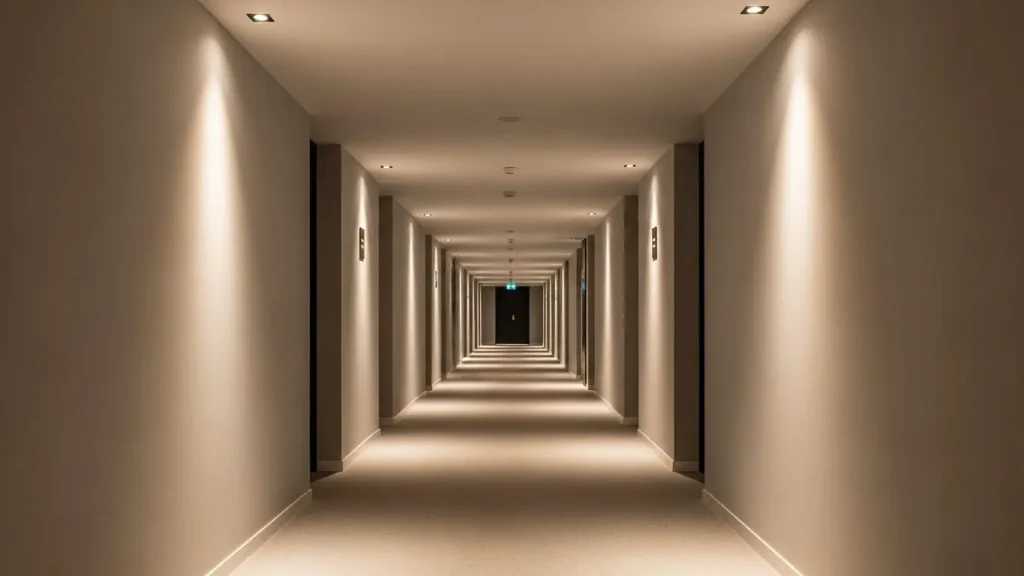
That’s why hotel corridor lighting is often judged more harshly than lighting in other zones. Many hotels install modern LED fixtures, but still end up with one of two outcomes:
- Too dim: guests feel unsafe, signage is unclear, trip hazards increase.
- Too bright and glaring: the corridor feels like an airport runway, guests complain, and the “premium” atmosphere disappears.
The real challenge is not choosing a fixture with higher lumens. The challenge is balancing three priorities that usually conflict:
- Safety baseline (visibility, uniformity, emergency readiness)
- Visual comfort (low glare, soft distribution, calm nighttime experience)
- Operational efficiency (24/7 reliability, stable drivers, low maintenance)
This guide breaks down practical, professional strategies to achieve all three—so hotel corridors stay safe, comfortable, and easy to operate long-term.
Why Hotel Corridor Lighting Is Critical for Guest Experience
Hotel corridors are “transition spaces,” but they strongly influence how guests feel about the property. Corridors affect:
- First impressions: from elevator to room, guests subconsciously evaluate quality.
- Orientation and confidence: clear door numbers, consistent brightness, and intuitive wayfinding.
- Nighttime comfort: harsh glare feels intrusive when guests are half-awake.
- Perceived cleanliness: uneven lighting creates shadow patches that can make finishes look worn or dirty.
In hospitality, visibility is not equal to brightness. A corridor can be bright and still uncomfortable if glare is uncontrolled or if distribution is uneven.
Why is hotel corridor lighting important?
Because it directly impacts guest safety, orientation, and visual comfort—especially at night.
Safety Requirements in Hotel Corridor Lighting
Safety is the non-negotiable baseline. But safety in corridors is not achieved by “maximum brightness.” It is achieved by adequate, uniform, well-directed illumination.
Adequate and Uniform Illumination
Hotels often over-focus on peak brightness (lux at the brightest point). In corridors, what matters more is uniformity—how consistent the lighting is along the path.
Poor uniformity causes:
- dark patches that feel unsafe
- visual “pulsing” while walking (fatiguing)
- increased risk of missteps near carpet transitions, thresholds, or housekeeping carts
Rule of thumb: In corridors, avoid dramatic contrast between adjacent pools of light. Soft overlap is more comfortable and more professional.
Clear Visibility of Doors and Signage
Corridors must support:
- readable room numbers
- recognizable door hardware
- clear exit signage and direction indicators
- camera coverage without harsh hotspots
If door faces are underlit or unevenly lit, guests hesitate, slow down, and feel uncertain—especially at night.
Integration with Emergency Lighting
Emergency lighting is not a separate “add-on.” It should be integrated into the corridor lighting plan so that when emergency mode activates, guests do not experience a sudden harsh contrast change.
Practical integration considerations:
- consistent distribution between normal and emergency lighting
- controlled glare during emergency mode (panic should not be amplified by harsh light)
- clear visibility of exit routes and signage
- reliable driver performance and testing strategy
For control and emergency coordination, many projects rely on standardized protocols such as DALI (DALI Alliance)
to support dimming scenes, nighttime modes, and central monitoring.
How does lighting improve safety in hotel corridors?
Proper lighting improves visibility, reduces trip hazards, and helps guests navigate corridors safely at all times.
Visual Comfort: The Key to a Pleasant Hotel Corridor
In hotel corridors, the best lighting is the lighting guests don’t notice. They should feel calm, guided, and comfortable—particularly at night.
Glare Control for Nighttime Comfort
Glare is often the reason a corridor feels “cheap” or “aggressive” even when the interior design is premium. At night, glare becomes more severe because the human eye is more sensitive to bright sources in a darker environment.
Glare control strategies that actually work:
- deep recessed optics that reduce direct view of the LED source
- low-glare lens systems with controlled cut-off
- avoiding fixtures that expose the LED chip directly to the line of sight
- aiming accent lighting away from guest eye-level directions
Professional comfort discussions frequently reference standards like EN 12464-1
as a framework for indoor lighting quality and comfort thinking (even if the corridor project uses local codes, the comfort logic is universal).
Why is glare control important in hotel corridors?
Because it prevents discomfort and visual fatigue, especially for guests walking through corridors at night.
Soft Light Distribution: Avoid “Hotspots” and Hard Edges
A corridor should not look like a series of bright circles separated by darkness. That pattern creates the “runway” effect and makes people feel like they are walking through a tunnel of spotlights.
Soft distribution means:
- smooth transitions between bright and dim areas
- minimal harsh beam edges
- consistent vertical illumination on doors and walls
- controlled reflections on glossy surfaces (art frames, signage, door plates)
Optical design matters here. Two downlights with the same beam angle can look completely different depending on lens quality and beam spread behavior. For a neutral reference on beam angle definition: beam angle definition
Choosing the Right Color Temperature for Hotel Corridors
Color temperature sets the emotional tone. In corridors—especially at night—cool white lighting tends to feel clinical and reduces the sense of relaxation.
Recommended CCT Ranges for Hotel Hallway Lighting
| Corridor Style / Use Case | Recommended CCT | Why It Works |
|---|---|---|
| Luxury / boutique hotels | 2700K–3000K | Warm, calm, premium feel; night-friendly |
| Mainstream business hotels | 3000K–3500K | Balanced comfort + clarity; widely accepted |
| Extended-stay / residential feel | 2700K–3000K | Home-like, relaxed experience |
| Avoid in most corridors | 4000K+ | Often feels cold, “hospital/airport” at night |
Practical note: If the property wants a slightly “cleaner” look, use 3500K rather than jumping to 4000K. The difference in nighttime comfort can be significant.
CRI and Color Consistency Matter More Than Many Hotels Expect
Corridors include skin tones, fabrics, wall finishes, artwork, and signage. Low color quality lighting makes even premium materials look dull.
For hospitality-grade outcomes, many designers specify:
- CRI >90 (Ra97 for premium corridors)
- SDCM <3 to keep color consistent from fixture to fixture
- stable CCT over lifetime (important for long corridors where small differences become obvious)
Best Lighting Fixtures for Hotel Corridor Lighting
Most hotel corridors rely on recessed or surface-mounted LED fixtures that deliver uniform, low-glare lighting. The fixture choice should support 24/7 operation and easy maintenance.
Primary Choice: LED Recessed Downlights (Low Glare, Stable, Clean Ceiling)
For many corridor designs, recessed LED downlights are the workhorse solution because they can hide the light source and control glare.
Key corridor-friendly fixture features:
- deep anti-glare structure (better shielding angle)
- controlled optics for smooth distribution
- stable drivers suitable for long operating hours
- easy installation and service access
A professional corridor approach often uses glare-controlled LED spot downlights as the main layer—especially when you want clean ceilings with low visual clutter.
Engineering checklist (commercial-grade):
- Efficiency target: 100–130 lm/W (varies by optics/output class)
- Lifetime: L70/B50 50,000 hours for reduced maintenance cycles
- Thermal management: die-cast aluminum heatsink for stability
- Optics: quality PMMA lens options for smooth distribution
- LED package: reliable COB chip options where beam quality matters
- Driver stability: flicker control and consistent dimming behavior
Optional Enhancements (Used in Better Corridor Designs)
- Wall washing or vertical lighting
Vertical illumination improves orientation and reduces the tunnel effect. It also helps signage and artwork look intentional. - Low-level night lighting
A subtle night mode improves comfort for late-night guests. This is often achieved via dimming scenes or separate low-level luminaires. - Linear ambient layer
A soft linear layer can reduce harsh contrast and create a calm rhythm—especially in premium hospitality corridors. Consider LED linear lighting as an indirect or diffused layer where the design calls for it. - Decorative corridor elements (select hotels)
In boutique corridors, decorative fixtures can add identity while still meeting comfort requirements. Options like LED pendant lighting may work in wider corridors or lobby-connected hallway zones—but glare control must remain the priority.
Recommended Lighting Layout Strategies for Hotel Corridors
The corridor layout determines whether the space feels calm or chaotic. Good layout creates visual rhythm without making the corridor feel like a runway.
Strategy 1: Maintain Rhythm, Not “Uniform Circles”
Even spacing is important—but the visual effect matters more than the raw number.
A professional corridor layout aims for:
- consistent overlap between beams
- no visible dark gaps near doors
- predictable brightness along the walking line
- softer lighting near guest sightlines
Strategy 2: Prioritize Vertical Surfaces for Orientation
Guests identify rooms and directions by looking at walls and doors—not by looking at the floor. If the floor is bright but doors are dim, the corridor feels wrong.
To improve orientation:
- ensure door faces receive adequate light
- avoid placing all luminaires directly above the corridor centerline
- consider slight offsets or wall-oriented optics where appropriate
Strategy 3: Avoid the “Airport Runway” Look
Runway effect happens when:
- beams are too tight
- spacing is too wide
- illumination is concentrated in small hotspots
- the ceiling becomes a dotted line of bright points
A softer beam or better overlap often fixes this without increasing wattage.
Corridor Layout Reference Table (Practical Starting Point)
These are starting references. Final layout should be validated on-site or via calculation, considering ceiling height, corridor width, and finish reflectance.
| Ceiling Height | Corridor Width | Typical Beam Choice | Suggested Spacing Approach |
|---|---|---|---|
| 2.6–2.8 m | 1.6–2.0 m | 36°–60° soft distribution | tighter spacing, smooth overlap |
| 2.8–3.2 m | 1.8–2.4 m | 36°–60° | balanced rhythm, avoid hotspots |
| 3.2–3.8 m | 2.0–2.6 m | 24°–36° + ambient layer | prevent patchiness, consider linear fill |
Quick Comfort Check: Uniformity vs “Peak Brightness”
| If You See… | Likely Cause | What to Adjust |
|---|---|---|
| bright circles + dark gaps | tight beam + wide spacing | soften beam / reduce spacing |
| bright floor, dim doors | centerline-only layout | shift optics toward vertical surfaces |
| glare when exiting rooms | visible source in sightline | deeper anti-glare optics / reposition |
| harsh reflections on signage | high-angle spill light | better cut-off + aiming changes |
How should lights be arranged in hotel corridors?
Evenly spaced with a calm rhythm, with enough overlap to avoid dark zones—without creating a runway effect.
Track Lights vs Downlights: Which Works Better for Hotel Hallways?
This question comes up often in renovation projects.
LED Downlights (Most Common for Corridors)
Strengths
- easier to achieve consistent comfort
- recessed designs naturally reduce glare
- clean ceiling aesthetic
- stable distribution along long corridors
Risks
- poor downlight optics can still cause glare
- “dot pattern” if spacing and beam are wrong
- difficult to adjust after ceiling is closed
For most corridors, glare-controlled downlights remain the best foundation. Use professional downlight options with proven optics and stable drivers.
LED Track Lighting (Useful in Select Corridor Scenarios)
Track lighting is not typical for narrow corridors, but can be useful when:
- corridor doubles as a gallery (artwork highlighting)
- displays or branding elements change frequently
- ceilings are open-style in modern hospitality design
In those cases, choose systems with strong glare control and smooth beam behavior. If the corridor includes feature walls or art niches, you might use a limited number of Faretti a LED for accent layers—while keeping downlights/linear as the comfort base.
Common Hotel Corridor Lighting Mistakes to Avoid
Hotels often repeat the same mistakes because the corridor is seen as “secondary space.” In reality, it’s one of the most complaint-sensitive areas.
Mistake 1: Excessive Brightness to “Feel Safe”
Too much brightness at night causes discomfort and makes guests feel exposed rather than safe. Safety comes from uniform visibility, not glare.
Mistake 2: Poor Glare Control (Visible Light Source)
If guests can see the LED source directly when exiting their rooms, complaints are likely. Corridors are full of sightlines at shallow angles.
Mistake 3: Color Temperature Too Cool
Cool white lighting can destroy nighttime comfort and downgrade the perceived quality of finishes.
Mistake 4: Only Considering Initial Cost
Corridor lighting often runs long hours. Cheap drivers, poor thermal design, and short lifetime will cause:
- increased maintenance
- inconsistent light output over time
- higher operational disruption
What are common mistakes in hotel corridor lighting?
Excessive brightness, poor glare control, unsuitable color temperature, and uneven layout—plus ignoring long-term operating reality.
How to Balance Safety, Comfort, and Efficiency in Hotel Corridor Lighting
This is the “decision module” for owners, designers, and buyers—especially those trying to avoid rework and complaints.
Hotel Corridor Lighting Checklist (Practical and Spec-Ready)
Safety & Navigation
- Uniform illumination with no dark zones
- Door numbers and signage clearly visible
- Exit route clarity and emergency coordination
- No harsh contrast changes between normal and emergency modes
Visual Comfort
- Low glare design (deep shielding, controlled cut-off)
- Soft distribution with smooth transitions
- Avoid direct source visibility from common sightlines
- Comfort-focused targets where relevant (for reference, office projects often use UGR<19; corridors should still prioritize low perceived glare even when UGR is not formally specified)
Color & Quality
- Warm/neutral CCT: 2700K–3500K
- CRI >90 / Ra97 where premium finish rendering matters
- SDCM <3 for long-corridor consistency
- flicker-controlled driver performance
Operational Efficiency
- High efficiency: 100–130 lm/W (project-dependent)
- Lifetime: L70/B50 50,000 hours
- robust thermal path: die-cast aluminum heatsink
- durable optics: PMMA lens options where needed
- service-friendly installation (maintenance access matters)
System Flexibility
- scene control for night mode (dimming strategy)
- compatibility with building control where required (e.g., DALI)
- option to adjust optics/beam where corridor geometry changes
Why Corridors Trigger Complaints (and How Smart Specs Prevent Them)
In hotel projects, corridor complaints often happen after the opening—when the space is fully used at night. Typical pattern:
- daytime walkthrough looks acceptable
- nighttime guest movement exposes glare and harsh contrast
- staff reports “too bright” or “guests squint”
- hotel attempts to dim—then signage clarity suffers
- maintenance increases because lights run long hours and drivers fail early
The projects that avoid this pattern usually do two things early:
- prioritize low-glare optics + soft distribution (instead of chasing peak brightness)
- specify commercial-grade reliability for 24/7 operation
That’s why corridor lighting should be treated as a professional system decision—not a commodity fixture purchase.
If you’re planning a hotel corridor project and want to reduce complaint risk, fixture selection and layout planning can be validated through a structured hospitality lighting solution approach and supported by real applications and references.
Comparison Table: Downlights vs Linear vs Track (For Hotel Corridor Use)
| System Type | Best Role in Corridors | Comfort Risk | Where It Works Best |
|---|---|---|---|
| Recessed LED downlights | primary base lighting | Low–Medium (depends on optics) | most standard corridors |
| Linear lighting | soft ambient layer | Low | premium corridors, indirect designs |
| Track lighting | limited accent use | Medium–High | gallery-style corridors, feature walls |
For spec and procurement alignment, many teams prefer reviewing all corridor-relevant options in a single reference document like the catalogo prodotti.
FAQ About hotel corridor lighting strategies
1) What is the best lighting for hotel corridors?
A low-glare LED system (often recessed downlights) with uniform illumination, warm-to-neutral CCT (2700K–3500K), high CRI, and reliable long-life drivers is typically best.
2) How bright should hotel corridor lighting be?
There is no single lux number that fits every hotel. Focus on uniformity, door/sign visibility, and comfortable nighttime perception rather than peak brightness.
3) What color temperature is best for hotel hallways?
Warm to neutral lighting (2700K–3500K) is ideal. Cooler white often feels harsh at night and reduces the premium hospitality atmosphere.
4) How do hotels reduce glare in corridors?
Use glare-controlled optics (deep shielding, controlled cut-off), soft distribution, correct spacing overlap, and avoid placing visible sources in guest sightlines.
5) Is LED lighting suitable for hotel corridors?
Yes—LED is excellent for corridors due to high efficiency and long lifetime. The key is choosing commercial-grade optics and drivers for comfort and 24/7 reliability.
Conclusion: Great Hotel Corridor Lighting Is a Triple Win
Hotel corridor lighting succeeds when it delivers:
- Safety: clear navigation and no dark zones
- Comfort: low glare and calm nighttime experience
- Efficiency: stable 24/7 operation and reduced maintenance
The difference between corridors that feel “high-end” and corridors that feel “harsh” is rarely just brightness. It’s optics, distribution, color quality, layout rhythm, and long-term reliability—working together.
Business inquiries are welcome
If you are currently:
- renovating hotel corridors and want to avoid glare complaints,
- balancing night comfort with safety visibility, or
- selecting fixtures designed for long operating hours and low maintenance,
it can be helpful to validate layout rhythm + optical choice + driver reliability before installation.
You may want to explore:
- Comfort-focused corridor fixtures such as LED downlights / spot downlights
- Softer ambient layers for premium corridors like LED linear lighting
- Reference outcomes from real hospitality applications in project cases
If you want project-based guidance (CCT selection, glare control strategy, layout spacing logic, and fixture recommendations), you can reach out here: Contact/Quote.
For buyers who prefer a full technical overview first, you can also review the catalogo prodotti or learn more about the team on Chi siamo.