 XHLUX
XHLUX

Walk into any world-class museum or gallery, and you’ll notice the art before you notice the light. This is by design. The light is a silent, crucial partner to the art, tasked with the dual responsibilities of breathtaking presentation and meticulous preservation. At the heart of this delicate balance is a highly specialized fixture: the museum downlight.
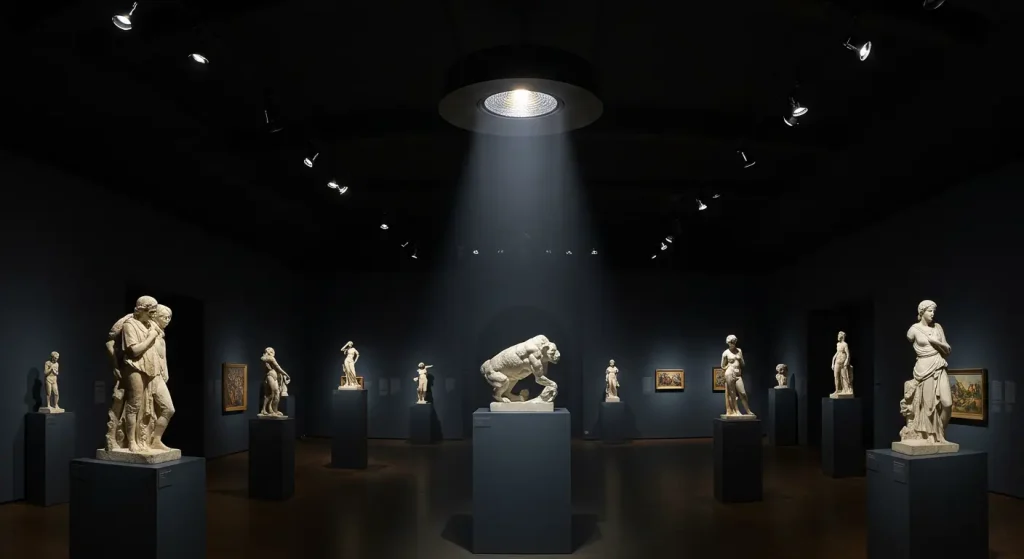
But what truly separates a museum downlight from a standard architectural fixture? The term itself evokes precision, quality, and a commitment to artistic integrity. Whether you are a curator, an architect specifying a gallery space, or a passionate collector aiming to give your art the respect it deserves at home, you understand that not just any light will do.
This guide is your definitive 2025 resource for understanding the science and artistry behind museum-grade downlighting. We will move beyond generic advice to explore the critical specifications, advanced technologies, and nuanced application techniques that professionals use. We will demystify the jargon and empower you to select and implement lighting that makes art come alive while protecting it for generations to come.
What Defines a Museum Downlight? The Four Pillars of Quality
A true museum downlight isn’t defined by a single feature, but by its performance across four uncompromising pillars. For anyone specifying lighting for fine art, these are the non-negotiable metrics that matter most.
Pillar 1: Uncompromising Color Fidelity
This is, without question, the most critical attribute. The entire purpose of viewing art is to see it as the artist intended, and that begins with rendering color accurately.
- Color Rendering Index (CRI): For decades, CRI has been the industry standard. It measures how accurately a light source renders colors compared to a natural light source. For general commercial use, a CRI of 80+ is considered good. For museum applications, a CRI of 95 or higher is the absolute minimum acceptable standard. A CRI of 97-99 is the professional benchmark.
- IES TM-30-20: While CRI is useful, it primarily measures color fidelity based on only eight pastel color samples. The art world is far more complex. TM-30 is a more comprehensive system that evaluates light across 99 color samples and provides two key metrics:
- Fidelity Index ($R_f$): Similar to CRI, this measures color accuracy. Again, aim for $R_f$ > 95.
- Gamut Index ($R_g$): This measures color saturation. An $R_g$ value between 98 and 102 indicates that colors are not being oversaturated or desaturated, which would distort the artist’s intent.
- Spectral Power Distribution (SPD): This is the DNA of a light source. The SPD graph illustrates the intensity of light at each wavelength across the visible spectrum. A high-quality museum LED will have a full, continuous spectrum with no significant spikes or valleys, which is what allows it to render the subtle nuances in a painting or artifact so faithfully.
Expert Insight: “We look beyond a single CRI number. We demand the full SPD chart from the manufacturer. You can have two 97 CRI lights, but the one with the smoother, more complete spectral curve will invariably perform better in revealing the subtle texture of impasto or the delicate tonal shifts in a watercolor.” – A seasoned museum lighting designer
Pillar 2: The Absence of Harm (UV and IR Radiation)
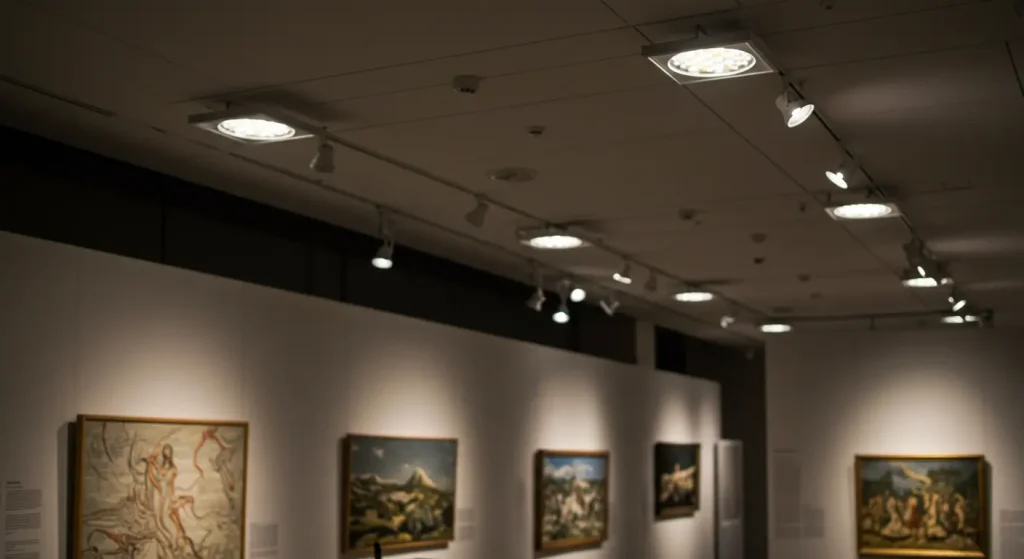
Light, by its nature, causes damage over time. The primary culprits are invisible Ultraviolet (UV) and Infrared (IR) radiation. UV light causes irreversible fading and yellowing in pigments and textiles, while IR radiation generates heat, which can desiccate organic materials, causing them to become brittle and crack.
| Radiation Type | Wavelength | Impact on Art | Museum Standard |
|---|---|---|---|
| Ultraviolet (UV) | 100-400 nm | Causes photochemical damage: fading, yellowing, disintegration. | Near-zero emission. Typically <10 µW/lm. |
| Visible Light | 400-700 nm | Necessary for viewing, but still causes cumulative damage. | Controlled via lux levels and exposure time. |
| Infrared (IR) | >700 nm | Radiates heat, causing desiccation and thermal stress. | Minimized through “cold beam” LED technology. |
Modern, museum-grade LED downlights are engineered to produce virtually no UV and minimal IR, a revolutionary advantage over the halogen and incandescent bulbs of the past, which required expensive and often ineffective external filters. Always verify that the fixture’s specifications explicitly state its UV and IR output levels.
Pillar 3: Absolute Control over the Beam
Illuminating art is like surgery; precision is paramount. You need the ability to shape, focus, and dim the light with absolute control.
- Adjustable Beam Spreads: A fixed beam angle is useless in a dynamic gallery setting. Museum downlights feature advanced optics that allow the beam to be adjusted, often from a very narrow spot (e.g., 8-10 degrees) to a wide flood (e.g., 50-60 degrees). This adjustment can be achieved through interchangeable lenses/reflectors or, in the most advanced models, through internal mechanics that are adjusted externally.
- Beam Shaping Accessories: The highest tier of fixtures accepts a range of accessories to precisely shape the light. These can include:
- Snoots: To create a tight, circular spot of light.
- Framing Projectors: Use shutters to shape the beam into a perfect square or rectangle, ideal for illuminating a canvas right to its edge with zero light spill.
- Spread Lenses: To elongate the beam, perfect for lighting sculptures or long display cases.
- Deep Dimming & Flicker-Free Performance: The ability to dim smoothly to very low levels (e.g., 0.1%) without any flicker is essential. This allows curators to set precise light levels (lux) appropriate for the object’s sensitivity. Flicker, even if imperceptible to the eye, can be a major issue for video recording and digital archiving.
Pillar 4: Consistency and Longevity
In a large gallery, consistency is key. Every downlight illuminating a series of works must produce the exact same color temperature and quality of light.
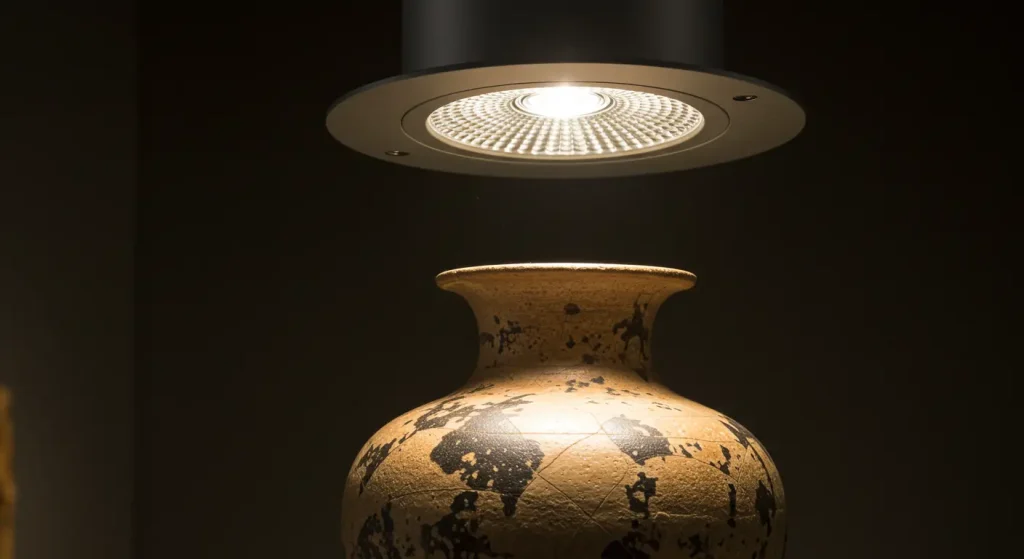
- Color Consistency (SDCM): Measured in MacAdam ellipses, or Standard Deviation of Color Matching (SDCM). This metric indicates how much color variation exists between fixtures from the same batch. A 1-step or 2-step MacAdam ellipse (1-2 SDCM) is the professional standard, ensuring that the human eye cannot detect any difference in the white light from one fixture to the next.
- Lumen Maintenance (L-Value): An L90/B10 rating at 50,000 hours means that after 50,000 hours of use, 90% of the fixtures will still be producing at least 90% of their initial lumen output. This ensures long-term stability and reduces maintenance cycles, a critical concern for institutions.
Types of Museum Downlights and When to Use Them
The term “downlight” can encompass a range of fixtures. In a museum context, the choice depends on the ceiling structure, the flexibility required, and the specific exhibit.
1. The Adjustable “Gimbal” Downlight (Recessed)
This is a recessed fixture where the central lamp head can be tilted and rotated within its housing, typically up to 35-40 degrees of tilt and 360-degree rotation.
- Best For: Permanent or semi-permanent installations with fixed ceiling heights. Common in newly constructed galleries, high-end residential projects, and retail spaces aiming for a museum feel.
- Pros: Clean, minimalist ceiling appearance. High degree of adjustability from a fixed point.
- Cons: Less flexible than track lighting if exhibit layouts change dramatically.
2. The Monopoint Spotlight
A monopoint is a single, surface-mounted or pendant-mounted spotlight. It offers the same high-quality head as a track light fixture but is mounted to a single canopy.
- Best For: Spaces with very high or architecturally complex ceilings (e.g., historic buildings, churches) where recessed lighting is impractical. Highlighting a single, major focal point like a large sculpture in a lobby.
- Pros: Extreme flexibility in aiming. Can be a design element in itself.
- Cons: Visually more prominent than a recessed downlight.
3. The Track-Mounted Downlight/Spotlight
This is the workhorse of the modern, flexible gallery space. A series of spotlight heads can be attached anywhere along a ceiling-mounted track, providing unparalleled flexibility.
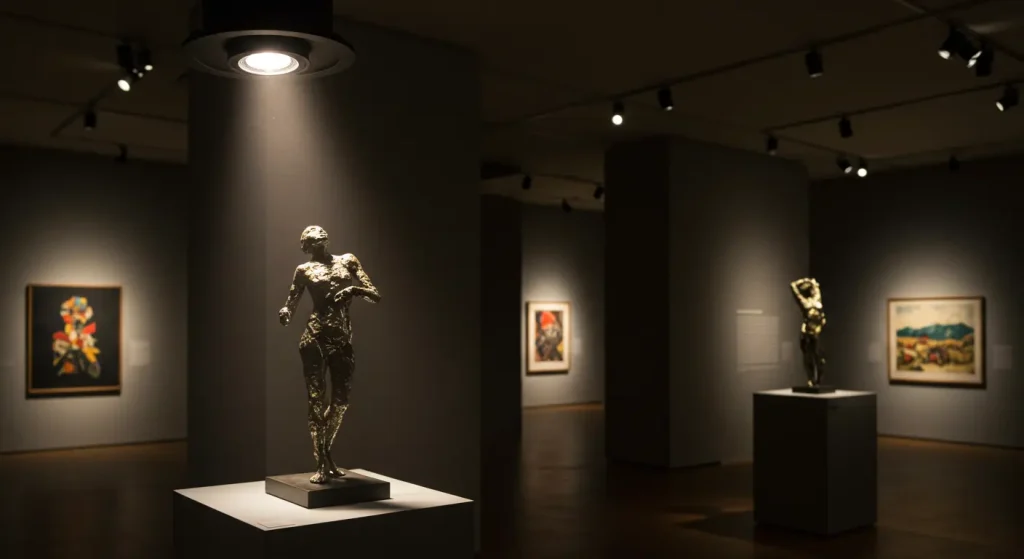
- Best For: Dynamic exhibition spaces where layouts are frequently reconfigured. Multi-purpose galleries, temporary exhibits, and art fairs.
- Pros: The ultimate in flexibility for positioning and aiming. Easy to add or remove fixtures as needed.
- Cons: The track itself is a visible architectural element that may not suit all aesthetics.
Advanced Control Systems: The Brains Behind the Beauty
The fixtures are only half of the equation. As of 2025, advanced control systems are the standard for any serious museum or gallery project. They provide the granular control needed for both presentation and conservation.
| Control System | How it Works | Best Use Case |
|---|---|---|
| Phase Dimming (Triac/ELV) | Reduces power to the fixture via the main voltage line. Simple on/off/dim from a wall dimmer. | Small-scale residential art lighting, single-room galleries where individual control isn’t needed. |
| 0-10V Dimming | Uses a separate pair of low-voltage wires to send a signal from 0V (off) to 10V (100% brightness). | A robust and reliable commercial standard. Good for zones of lights but lacks individual fixture control. |
| DALI (Digital Addressable Lighting Interface) | A two-way digital communication protocol. Each fixture has a unique address. | The gold standard for museums. Allows for individual control of every single fixture, scene-setting, and status monitoring from a central computer or tablet. |
| Wireless (e.g., Casambi, Bluetooth Mesh) | Fixtures are controlled wirelessly via a Bluetooth mesh network from a smart device. | Excellent for retrofitting historic buildings where running new control wires is impossible or cost-prohibitive. Gaining massive traction in the industry. |
The Rise of Tunable White: Beyond dimming, tunable white technology is a game-changer. It allows the curator to adjust the color temperature of the white light, typically from a warm 2200K (like candlelight) to a cool 5000K (like daylight). This allows for tuning the light to best complement the specific artwork. A 17th-century Old Master painting might look best under a warmer 2700K, while a modern, minimalist sculpture may pop under a neutral 4000K.
Bringing the Museum Home: Applying Professional Principles
You don’t need to own a gallery to light your art like a pro. The same principles apply.
- Invest in One Great Light: For a single important painting, invest in one high-CRI (95+), adjustable downlight or monopoint. The difference it makes compared to a standard light is astounding.
- The Rule of 30 Degrees: To avoid casting your own shadow and to prevent veiling reflections (glare) on the canvas, the ideal angle to light a painting is approximately 30 degrees from the vertical. Position your downlight so the center of its beam hits the center of the painting at this angle.
- Use Layers and Dimmers: Don’t rely on one downlight to illuminate the entire room. Use it specifically for the art, and use other, softer light sources for ambient light. Always put the art lighting on a separate dimmer switch.
- Consider a Framing Projector: For the ultimate in-home statement piece, a recessed framing projector will shape the light to the exact dimensions of your art, creating a stunning “lit-from-within” effect that will be the centerpiece of any room.
By understanding the technology, embracing a “quality over quantity” mindset, and focusing on the core principles of color fidelity and control, you can harness the power of light to transform a piece of art from a mere object on a wall into a breathtaking experience.