 XHLUX
XHLUX

Table of contents
- 1. Why Food Appearance Decides Whether Shoppers Stop
- 2. What Is a High CRI97 COB LED Downlight?
- 3. Why CRI90 Is Often “Not Enough” in Fresh Food Displays
- 4. What CRI97 Actually Improves in Fresh Food Displays
- 5. Why COB Light Engines Are Especially Suitable for Fresh Food Downlights
- 6. Performance Differences by Food Zone
- 7. High CRI97 COB Downlights vs Standard Food Lighting
- 8. How to Choose High CRI97 COB LED Downlights
- 8.1 Verify the Claim: “CRI97” Must Be Real
- 8.2 Red Rendering Matters (Don’t Ignore It)
- 8.3 Spectrum Must Be Food-Appropriate, Not “Generic High CRI”
- 8.4 Heat Management: Low Thermal Risk, Long Runtime Ready
- 8.5 Glare Control: “Premium Food” Demands Visual Comfort
- 8.6 Consistency: Color and Output Must Match Across Batches
- 8.7 Efficiency Still Matters (But in the Right Range)
- 8.8 Control Options (When You Want Real Optimization)
- 9. Data Tables You Can Use in Real Food Lighting Planning
- 10. Common Mistakes in High-CRI Fresh Food Lighting
- 11. FAQ About High CRI97 COB Downlight Food
- 12. Why High CRI97 COB LED Downlights Are a Rational Fresh Food Display Upgrade
- Business collaborations are welcome
1. Why Food Appearance Decides Whether Shoppers Stop
In fresh food retail, customers don’t get a “test drive.” They usually can’t taste the strawberries, cut open the avocado, or compare two steaks under neutral daylight. What they can do—instantly—is judge with their eyes.
That is why lighting becomes a hidden part of merchandising:
- If produce looks gray or muddy, shoppers assume it’s tired.
- If red meat looks dark or brownish, shoppers assume it’s old.
- If prepared foods lack gloss and texture, shoppers assume it’s dry.
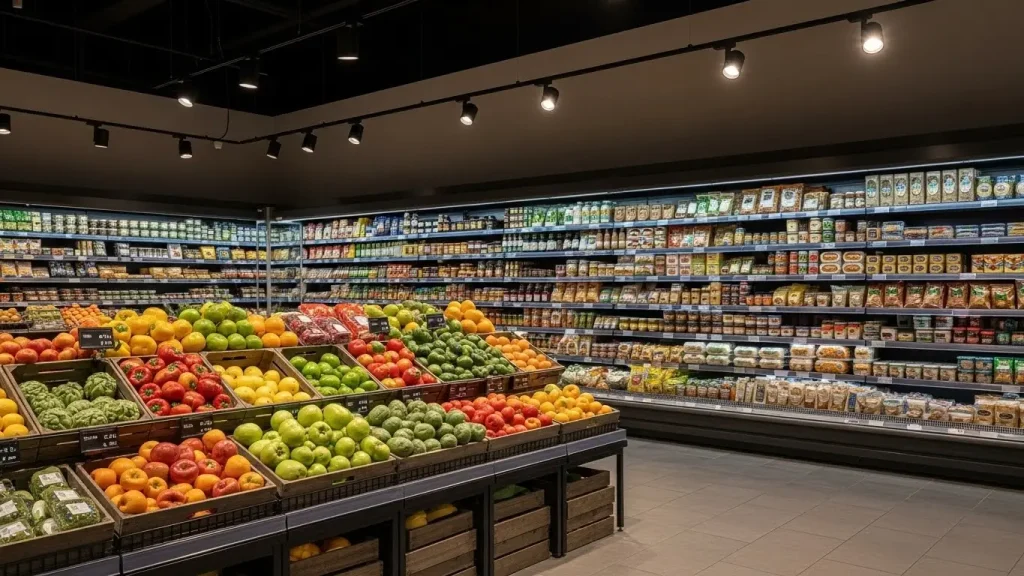
This is exactly why global searches like high CRI97 COB downlight food are growing: professionals aren’t asking about “brightness.” They’re asking:
How can we use better light quality to make food look real, fresh, and worth buying—without making it look fake?
That’s where High CRI97 COB LED downlights become a practical upgrade: they provide higher color fidelity (more truthful color), cleaner beam control, and better “food texture visibility”—especially when you choose the right optics and the right spectrum strategy.
2. What Is a High CRI97 COB LED Downlight?
Let’s define the two keywords the way a food retail project team actually uses them.
CRI97: “Color Fidelity Is the Product”
CRI (Color Rendering Index) measures how faithfully a light source reveals object colors compared with a reference light. It’s a quantitative measure of color rendering performance.
- CRI90 is a common commercial baseline.
- CRI97 is a premium level often used when color nuance is central to sales—exactly the case in fresh food.
And an important note: CRI is not the same as “how warm or cool the light looks.” That is CCT (correlated color temperature). CRI is determined by spectrum.
COB: “Clean Beam, Clean Texture”
COB (Chip-on-Board) LED construction integrates many LED dies into a single module (often on a thermally conductive substrate). This supports a more uniform luminous surface and is commonly used to improve LED lighting efficiency and beam control. (维基百科)
In food displays, COB downlights are valued because:
- the emitting area behaves more like a single light source (better optics control)
- beams look cleaner and more “premium”
- it’s easier to build focused accents without messy multi-shadow artifacts
One-sentence definition:A High CRI97 COB LED downlight is a focused retail luminaire designed to render food colors with near-daylight fidelity while delivering a clean, controlled beam for merchandising.
If your fresh food strategy already includes accenting key displays, this typically pairs well with dedicated retail accent families such as LED Spot Downlights.
3. Why CRI90 Is Often “Not Enough” in Fresh Food Displays
CRI90 is good. In many commercial spaces it’s absolutely acceptable. But fresh food is unusually sensitive to small color errors because shoppers are trained—by instinct and habit—to interpret subtle cues:
- Is that tomato “ripe red” or slightly dull?
- Does beef look vibrant or slightly oxidized?
- Do greens look crisp or faded?
- Does roasted chicken look golden or flat beige?
CRI has known limitations (especially for modern LED spectra), and even high Ra values do not always correlate perfectly with what observers prefer or perceive. (cie.co.at)
That’s why serious food lighting projects often look beyond a single “CRI number” and care about red rendering and spectrum shape.
Why Reds Matter So Much (R9 Thinking)
Fresh food—especially meat and many prepared foods—leans heavily on red/yellow cues. Many teams therefore pay attention to red rendering performance (often discussed as “R9” in CRI context). While CRI is a general metric, the practical takeaway for fresh food projects is simple:
If reds are weak, food looks less alive.
4. What CRI97 Actually Improves in Fresh Food Displays
CRI97 is not “more bright.” It is “more correct.” Here’s how that translates into sellable visual differences.
4.1 More Accurate Key Food Colors
High fidelity helps maintain natural differentiation in:
- reds (meat, berries, tomatoes)
- greens (leafy vegetables, herbs)
- yellows/oranges (citrus, cheese tones, baked goods crust)
When fidelity improves, shoppers find it easier to trust what they see.
4.2 Clearer Layers and Texture
Food isn’t flat color. Freshness is often communicated by micro-contrast:
- moisture sheen
- fat/meat separation
- skin texture on produce
- crust texture on bakery items
High-quality spectrum + clean optical control increases the perception of texture and “realness.”
4.3 Reduced Misjudgment Caused by Lighting
Promotional displays fail when lighting makes good food look questionable. In mixed lighting environments (ambient + accents), CRI97 downlights make the display lighting less likely to “fight” the real product color.
One-sentence summary:
CRI97 improves food merchandising by improving color truth and texture readability—not by over-saturating the scene.
5. Why COB Light Engines Are Especially Suitable for Fresh Food Downlights
COB is not automatically better for every use, but it aligns well with food accent downlights.
5.1 Beam Quality and Optic Control
A COB light engine allows lenses and reflectors to form:
- tighter, cleaner beams (for hero displays)
- stable cut-off and glare control (for shopper comfort)
This matters because fresh food is often displayed at eye level, and glare can ruin the experience fast.
5.2 Cleaner Shadows, Less Visual “Noise”
With some multi-point sources, you can get overlapping shadows that make food look less clean. COB helps reduce this risk and presents food with a more premium “single-source” look (depending on optic design).
5.3 Better Integration with Retail Anti-Glare Accessories
Food counters and produce islands often have glossy surfaces, stainless steel, glass, and wet textures—glare magnets. COB + proper optic stack supports:
- deeper recess design
- honeycomb louver options
- controlled cut-off angles
6. Performance Differences by Food Zone
A fresh food store is not one zone. Each category has different visual priorities.
6.1 Meat Zone
Key goals:
- rich but natural red
- clean fat separation
- avoid “brown” or “gray” perception shifts
Lighting research and retail practice widely note that different light sources can significantly change perceived meat color. (Promolux LED Lighting)
6.2 Produce Zone
Key goals:
- natural greens (not yellow-green or gray-green)
- fruit saturation without artificial “neon”
- texture clarity (skin, freshness cues)
6.3 Prepared Food / Deli
Key goals:
- appetizing warmth
- gloss/texture visibility
- avoid harsh high-output glare on glazed foods
6.4 Seafood
Key goals:
- prevent “washed-out white” look
- maintain natural contrast and freshness cues
- reduce glare reflections from wet displays
Practical principle:
Use CRI97 where shoppers make “quality judgments,” not necessarily everywhere.
7. High CRI97 COB Downlights vs Standard Food Lighting
This is where supermarkets and specialty grocers make the real call.
Standard Lighting Approach
- cheaper and universal
- often optimized for general efficiency
- rarely optimized for category nuance
CRI97 COB Approach (Targeted)
- used in high-value zones
- designed to improve color truth and presentation
- treated as merchandising infrastructure
Retail truth:
Fresh food lighting isn’t just a cost line—it’s a hidden display investment.
If your store uses layered lighting (ambient + accents), CRI97 COB downlights often complement system categories like LED Linear Lighting for aisles and Faretto a LED su binario for flexible feature tables.
8. How to Choose High CRI97 COB LED Downlights
This is the section project teams actually use.
8.1 Verify the Claim: “CRI97” Must Be Real
Ask for:
- lab reports / test documentation
- batch consistency policy
- sample confirmation under your store materials
Also consider that CRI has limitations; many high-level projects increasingly reference TM-30 metrics (Rf/Rg) for a fuller picture of fidelity and saturation behavior.
8.2 Red Rendering Matters (Don’t Ignore It)
For food applications, especially meat and deli, ensure the spectrum supports strong red rendering. Don’t treat this as optional.
8.3 Spectrum Must Be Food-Appropriate, Not “Generic High CRI”
Some “high CRI” sources are tuned for residential comfort, not food merchandising. Food zones often require a carefully balanced spectrum—true-looking, but not dull.
8.4 Heat Management: Low Thermal Risk, Long Runtime Ready
Fresh food zones run long hours. Your downlight must be built like a commercial luminaire:
- Die-cast aluminum heatsink for thermal stability
- stable driver selection
- designed for L70/B50 lifetime 50,000 hours (typical commercial expectation)
8.5 Glare Control: “Premium Food” Demands Visual Comfort
Even perfect color is wasted if shoppers see the LED source. For serious projects, specify:
- deep recess
- optional honeycomb louver
- proper cut-off design
8.6 Consistency: Color and Output Must Match Across Batches
Fresh food chains care about replication. Require:
- SDCM < 3 for tight color consistency across fixtures
- consistent lumen maintenance and driver behavior
8.7 Efficiency Still Matters (But in the Right Range)
For commercial-grade downlights, it’s common to target 100–130 lm/W depending on optics and CRI target (higher CRI can trade some efficiency for spectrum quality). Use this as a practical planning band—not as a single absolute value.
8.8 Control Options (When You Want Real Optimization)
Even in food zones, dimming can help reduce glare at night, match ambient adaptation, or align with energy strategies:
- DALI / DALI-2 for system control
- 0–10V / phase cut where the project requires it
For DALI background, refer to:
9. Data Tables You Can Use in Real Food Lighting Planning
Table A — Where CRI97 COB Downlights Deliver the Most ROI
| Zone | Why CRI97 Helps | Typical Use Strategy |
|---|---|---|
| Meat counter / packaged meat | Red fidelity + fat separation | Accent + controlled beams |
| Produce islands | Greens + skin texture clarity | Medium beams, glare control |
| Deli / prepared foods | Warm realism + gloss perception | Warmer CCT + dimming optional |
| Bakery | crust warmth + texture detail | moderate beams, avoid harsh glare |
| Seafood | reduce washout + improve contrast | careful spectrum + anti-glare |
Table B — “Spec-First” Food Downlight Baseline (Commercial Grade)
Use this as a procurement baseline when you brief a supplier:
| Item | Suggested Baseline |
|---|---|
| Color quality | CRI ≥ 97 (Ra97) + strong red rendering request |
| Color consistency | SDCM < 3 |
| Efficiency target band | 100–130 lm/W (depending on optic + CRI) |
| Lifetime target | L70/B50 50,000 hours |
| Thermal design | Die-cast aluminum heatsink |
| Optical material | PMMA lens (common for retail optics) |
| Light engine | COB chip |
| Glare strategy | Deep recess / optional honeycomb |
| Controls | DALI / 0–10V / phase-cut as required |
| Installation | Easy installation + maintenance access |
| Personalizzazione | ODM finishes / beams / accessories |
(Note: UGR is typically referenced more in offices; for food retail you should still demand “low glare” optics. If your project includes adjacent office zones, UGR < 19 is a standard comfort target there.)
10. Common Mistakes in High-CRI Fresh Food Lighting
Mistake 1: Only Looking at “CRI97” and Ignoring Spectrum Shape
CRI is helpful, but it doesn’t guarantee the light will make food look right. When quality matters, ask about TM-30 data (Rf/Rg) or at least confirm food zone performance with real samples. (Illuminating Engineering Society)
Mistake 2: Using CRI97 Everywhere
CRI97 is a premium tool. Use it where it influences buying decisions: food displays, counters, hero islands—not necessarily every back-of-house aisle.
Mistake 3: Skipping Anti-Glare in Wet/Glossy Zones
Seafood, deli, and polished tile reflect light aggressively. Without glare control, you lose comfort and perceived quality fast.
Mistake 4: Ignoring Long-Run Stability
Fresh food retail means long operating hours. If the thermal design is weak, output and color can drift over time.
Mistake 5: Treating Food Lighting as “One-Time Setup”
Stores change: seasonal displays, planograms, product mix. Your lighting platform should support repeatable success and easy adjustments.
11. FAQ About High CRI97 COB Downlight Food
Q1: Will CRI97 make food look “fake” or over-saturated?
Not if the spectrum is designed correctly. CRI measures fidelity to a reference; the goal is realistic, not exaggerated color. (维基百科)
Q2: Do I need CRI97 for the whole store?
No. Use CRI97 in the zones where shoppers judge freshness and quality. Use standard commercial lighting elsewhere for efficiency.
Q3: Does high CRI mean higher energy consumption?
High CRI spectra can reduce peak efficacy compared to lower-CRI sources, but the business question in fresh food is often ROI on presentation and sales, not just lm/W.
Q4: Does COB cause glare?
Any high-luminance source can cause glare without proper optics. COB becomes excellent in retail when paired with deep recess, controlled cut-off, and optional louvers.
Q5: What matters more—CRI97 or CCT (2700K/3000K/4000K)?
Both matter, but they solve different problems. CCT influences the “warm/cool mood.” CRI influences how true the food colors look.
Q6: Should we look at TM-30 in addition to CRI?
For high-stakes color applications, TM-30 provides more information about fidelity and saturation behavior than CRI alone. (Illuminating Engineering Society)
Q7: What documents should a supplier provide for a food lighting project?
Photometric files (IES), cut sheets, spectrum/CRI reports, driver/control options, installation guidance, and warranty terms.
12. Why High CRI97 COB LED Downlights Are a Rational Fresh Food Display Upgrade
Fresh food merchandising is visual. Lighting doesn’t change product quality—but it changes how customers interpret quality.
When stores rely on generic lighting, food can look:
- dull
- gray
- less fresh than it truly is
High CRI97 COB LED downlights solve a practical retail problem:
- more truthful food color
- improved texture and clarity
- higher shopper confidence
- better presentation consistency in premium zones
For supermarkets, grocers, and specialty retailers, this is rarely a “nice-to-have.” It’s often a high-leverage upgrade—especially when applied strategically to meat, produce, deli, bakery, and other decision-heavy zones.
Final takeaway:High CRI97 COB LED downlights are built for realistic, vivid fresh food presentation—where color truth directly supports sales.
Business collaborations are welcome
If you want CRI97 downlights that actually perform in fresh food zones, the fastest way to de-risk your decision is to align on a few inputs:
- your store zone map (meat / produce / deli / bakery / seafood)
- ceiling height + target display distance
- preferred beam angles (narrow/medium/wide)
- glare control level (standard vs premium counters)
- control requirement (DALI / 0–10V / phase-cut)
- consistency targets (SDCM, batch policy)
If you’d like us to match the right downlight optics and spectrum approach to your layout, you can:
- Start here: Contattaci
- Or request a solution-level plan: Lighting Solutions
- For reference while building your shortlist: Catalogo prodotti
- If you want to review real implementations: Project Cases
And if your store strategy mixes fresh food accents with aisle/base lighting, these ranges typically work together in one schedule:
- LED Spot Downlights (food displays, counters, hero islands)
- LED Linear Lighting (aisles, circulation, continuous runs)
- Faretto a LED su binario (flexible seasonal displays)