 XHLUX
XHLUX

Table of contents
- Why “Upgrading to LED” Still Fails in Retail Projects
- Mistake #1 – Treating Retail Lighting Like Office or Home Lighting
- Mistake #2 – Using Only Downlights and Ignoring Accent Lighting
- Mistake #3 – Choosing the Wrong Beam Angle
- Mistake #4 – Ignoring CRI and Color Accuracy
- Mistake #5 – Selecting the Wrong Color Temperature (CCT)
- Mistake #6 – Poor Glare Control and Visual Comfort
- Mistake #7 – No Lighting Plan or Layered Lighting Design
- Mistake #8 – Choosing LED Lights Based Only on Price
- How to Avoid These Retail LED Lighting Design Mistakes
- FAQ About Retail led Lighting Design Mistakes
- Welcome to discuss business cooperation
Why “Upgrading to LED” Still Fails in Retail Projects
Many retail stores invest in LED lighting upgrades—new fixtures, higher brightness, even “modern-looking” ceilings—yet they still struggle with poor product visibility, uncomfortable brightness, or an unattractive store atmosphere. Shoppers don’t feel guided. Displays look flat. Premium products don’t look premium.
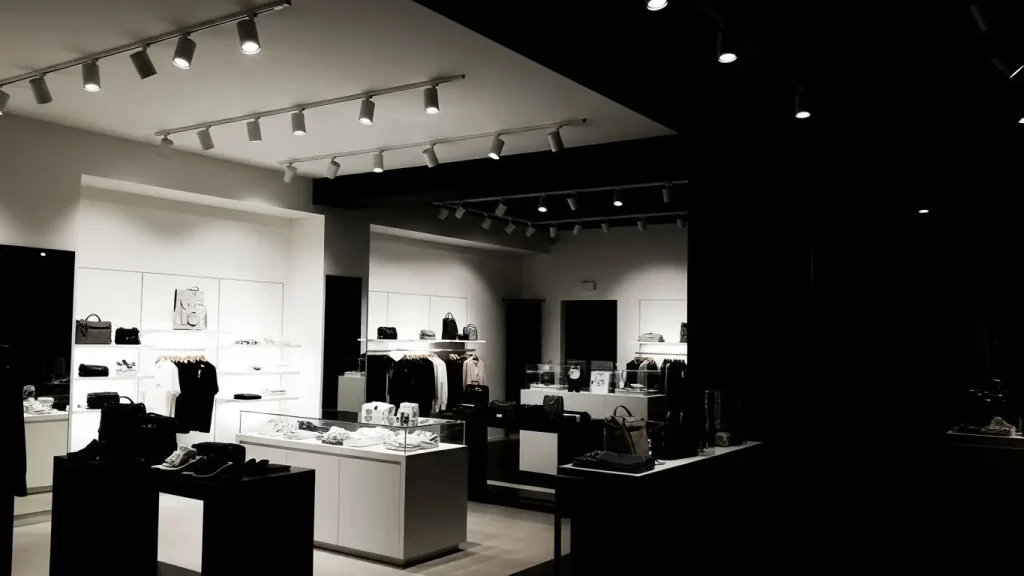
In most cases, the problem is not the LED fixtures themselves—but common retail LED lighting design mistakes. These errors quietly reduce customer comfort, weaken visual merchandising, and can even trigger expensive rework during installation or after the store opens.
This guide reveals the most common mistakes in retail LED lighting design, explains why each one hurts customer experience and sales, and shows how to avoid them with proven design principles—so you can build a reliable commercial LED lighting plan with fewer regrets and faster decision-making.
Quick sourcing shortcut (for project buyers):
- Accent layer: LED Track Lighting
- Ambient base: LED Spot Downlights
- Flexible beam needs: Zoomable Track Lights
- Full lineup: Catalogo prodotti
Mistake #1 – Treating Retail Lighting Like Office or Home Lighting
Why is retail lighting different from office lighting?
Retail lighting focuses on highlighting products and guiding customer attention, while office lighting prioritizes uniform brightness and visual comfort for work tasks.
Why this mistake hurts retail performance
Many lighting plans are designed using office logic—uniform brightness and wide beam angles everywhere. In retail, that produces a space where “everything is visible,” but nothing stands out. Retail lighting must create contrast and hierarchy so shoppers intuitively know where to look.
Retail is also strongly tied to emotion and brand perception. If lighting makes the store feel flat or uncomfortable, shoppers browse less, interact less, and buy less—even if the lux level is “high enough.”
How to avoid it (the professional approach)
Use lighting as a sales tool by designing layered lighting:
- Ambient lighting for comfort and navigation
- Accent lighting for spotlighting products and visual merchandising
- Task lighting for checkout and staff zones
In practice, this usually means downlights for base + track lighting for flexible accents, not one fixture type everywhere.
📊 Core Chart #1: Retail vs Office Lighting Design (Comparison)
| Item | Office Lighting | Retail Lighting Design |
|---|---|---|
| Core goal | Visual comfort for work tasks | Guide attention & boost sales |
| Brightness approach | Uniform illumination | Controlled contrast & hierarchy |
| Key success metric | UGR / uniformity / compliance | Visual merchandising impact |
| Typical fixture strategy | Panels + downlights | Downlights (ambient) + Track (accent) |
| Beam angle usage | Mostly wide, uniform | Narrow + wide mixed for layers |
| CRI requirement | Often CRI 80 is acceptable | CRI ≥ 90 (premium: Ra97) |
Next step:For retail accent and merchandising focus, explore LED Track Lighting.
Mistake #2 – Using Only Downlights and Ignoring Accent Lighting
Are downlights enough for retail LED lighting?
No. Downlights provide general illumination, but without accent lighting such as track lights, products lack visual focus and depth.
Why this mistake happens
Downlights look clean, minimal, and “safe.” Many store owners assume that if the space is bright and uniform, products will naturally look better. But retail is not a warehouse—products need focal emphasis to feel valuable and intentional.
What goes wrong in real stores
A downlights-only lighting plan often creates:
- Flat displays with weak hero zones
- Poor product contrast (everything blends together)
- Wasted lighting on floors instead of merchandise
- No flexibility when displays change
How to avoid it
Use LED track lighting as the merchandising layer:
- Spotlights for new arrivals, mannequins, feature walls
- Adjustable heads to adapt to seasonal resets
- Layered contrast that makes products “pop” without over-lighting the entire store
📊 Core Chart #2: Role Division (Downlights vs Track Lighting)
| Lighting Type | Best for | What it cannot do well | Typical retail zones |
|---|---|---|---|
| Faretti a LED da incasso | Ambient lighting, ceiling cleanliness, lighting uniformity | Strong product focus, flexible re-aiming | aisles, general areas, circulation |
| LED Track Lighting | Accent lighting, spotlighting products, flexible displays | Uniform base lighting (alone looks patchy) | feature wall, mannequins, endcaps, promo tables |
Next step:
- Accent layer: LED Track Lighting
- Ambient base: LED Spot Downlights
Mistake #3 – Choosing the Wrong Beam Angle
How does beam angle affect retail lighting?
Beam angle controls how light spreads on products. Wrong beam angles can cause flat displays or harsh hotspots, reducing visual appeal.
Two common beam angle errors
Error A: All wide beams (flat store effect)
The store becomes evenly lit, but products feel average. There’s no visual hierarchy and no merchandising pull.
Error B: All narrow beams (hotspots and glare)
You get harsh bright spots, strong shadows, discomfort, and reflections—especially on glossy packaging, screens, or jewelry showcases.
How to avoid it: Mix beam angles for layered lighting
A strong retail plan typically combines:
- Narrow beams for spotlighting products
- Wider beams for browsing comfort and shelf visibility
- Intentional overlap to avoid dark gaps
📊 Core Chart #3: Beam Angle Quick Guide for Retail
| angolo del fascio | Lighting effect | Best use cases | Common mistakes |
|---|---|---|---|
| 10°–15° | Ultra-spot, very high contrast | jewelry counters, hero products | too harsh, glare risk if mis-aimed |
| 15°–24° | Spotlight | mannequins, premium displays, window | too narrow for shelves/aisles |
| 24°–36° | Accent + coverage balance | feature walls, mid-size displays | used alone can look “average” |
| 36°–60° | Flood / broad coverage | shelves, aisles, circulation | used everywhere makes store flat |
Next step:Need flexible beam options for changing displays? See Zoomable Track Lights.
Mistake #4 – Ignoring CRI and Color Accuracy
Why is high CRI important in retail LED lighting?
High CRI lighting ensures products appear in their true colors, helping customers make confident purchasing decisions.
Why CRI impacts sales more than most people think
Retail decisions are visual. If lighting distorts product color, it creates hesitation and mistrust—especially in categories where color is “the product”:
- Fashion and textiles
- Cosmetics
- Food and fresh produce
- Jewelry and luxury materials
Low CRI lighting can make premium items look cheaper and increase returns because the product looks different at home.
How to avoid it: Use retail-grade color quality
A practical baseline for professional retail projects:
- CRI ≥ 90 (minimum for serious retail)
- Premium zones often prefer Ra97
- Tight color consistency: SDCM < 3
Mistake #5 – Selecting the Wrong Color Temperature (CCT)
Why this mistake is so common
Many stores choose CCT based on preference (“warm feels cozy” or “cool looks modern”), rather than matching the product category and brand positioning.
What goes wrong
Wrong CCT can:
- Make products look dull or unnatural
- Reduce perceived freshness or luxury
- Clash with interior finishes and branding
How to avoid it: Match CCT to store type
A practical guideline:
- 3000K: luxury, boutique, premium warmth
- 4000K: mainstream retail balance
- 5000K: electronics, tech-forward crispness
Mistake #6 – Poor Glare Control and Visual Comfort
Why glare is a silent sales killer
Glare doesn’t always show up in photos, but it shows up in customer behavior:
- Shorter dwell time
- Avoidance of certain aisles
- Discomfort at checkout and fitting rooms
- Reflections on glossy packaging and screens
How to avoid it
- Use optics designed for shielding (deep reflectors, lens control, honeycomb)
- Aim track heads away from direct sightlines
- Avoid intense narrow beams at eye level
- In sensitive zones, many designers target comfort levels similar to UGR < 19, guided by references such as EN 12464-1.
Mistake #7 – No Lighting Plan or Layered Lighting Design
What is layered lighting in retail design?
Layered lighting combines ambient, accent, and task lighting to create depth, focus, and a comfortable shopping environment.
Why missing a plan causes rework
Without a lighting layout, teams often install fixtures first and “fix the look later.” That leads to:
- Patchy brightness and dead zones
- Weak displays even with high wattage
- Random aiming and glare issues
- On-site changes that cost time and money
How to avoid it: A simple retail lighting layout workflow
- Zone the store: entry, aisles, feature walls, endcaps, checkout
- Build ambient lighting first (downlights / linear)
- Add accent lighting (track heads for displays)
- Add task lighting for checkout and staff areas
- Fine-tune with beam angle + CRI + CCT + glare control
Next step:
- Project support: Lighting Solutions & Services
- Real references: Project Cases
Mistake #8 – Choosing LED Lights Based Only on Price
Why “cheap” becomes expensive in retail projects
Retail projects often fail due to hidden costs:
- Early driver failures and flicker issues
- Color inconsistency between batches
- Higher maintenance frequency
- Customer complaints after opening
- Worst case: replacement + rework
How to avoid it: Buy based on total cost of ownership (TCO)
Professional commercial evaluation includes:
- L70/B50 50,000 hours lifetime planning
- Stable thermal design (e.g., die-cast aluminum heatsink)
- Reliable optics (e.g., PMMA lens, anti-glare structure)
- High color quality (CRI > 90 / Ra97, SDCM < 3)
- Target efficiency often 100–130 lm/W
- Verified dimming compatibility (TRIAC or DALI Alliance references)
📊 Core Chart #4: Price vs Total Cost of Ownership (TCO)
| Factor | Cheap option risk | Professional commercial option benefit |
|---|---|---|
| Driver stability | flicker, early failure, complaints | stable performance, fewer call-backs |
| Color consistency | mixed batches, SDCM too high | SDCM < 3, consistent look |
| Maintenance | frequent replacements | L70/B50 50,000 hrs planning |
| Customer experience | glare, flat displays | glare control + hierarchy |
| Hidden cost | rework + returns + downtime | smoother installation & operation |
Next step:Compare models quickly via the Catalogo prodotti.
How to Avoid These Retail LED Lighting Design Mistakes
Use this checklist to reduce rework and speed up sourcing decisions:
- ✅ Treat lighting as a sales tool (retail ≠ office)
- ✅ Combine LED downlights + LED track lighting for layered lighting
- ✅ Mix beam angle types (spot + flood)
- ✅ Specify CRI ≥ 90 (premium: Ra97)
- ✅ Keep color consistency tight (SDCM < 3)
- ✅ Choose correct color temperature (CCT) by store type
- ✅ Prioritize glare control (comfort targets like UGR < 19 in sensitive zones)
- ✅ Evaluate TCO, not only fixture price
- ✅ Verify track standards and dimming compatibility
FAQ About Retail led Lighting Design Mistakes
What are the biggest retail lighting mistakes?
Treating retail like office lighting, using only downlights, wrong beam angles, ignoring CRI, wrong CCT, poor glare control, skipping layered design, and buying only by price.
Can bad lighting reduce retail sales?
Yes. Bad lighting lowers product appeal, weakens visual merchandising, reduces dwell time, and decreases perceived product quality.
Is LED lighting always good for retail stores?
LED is efficient, but results depend on design and specification. Wrong beam angle, low CRI, and glare issues can still cause failure.
How do I improve lighting in my retail shop?
Start with zoning and layered lighting: downlights for ambient base + track accents for displays. Then refine with beam angle, CRI, CCT, and glare control.
What type of LED lighting is best for retail?
Most professional retail projects use: Faretti a LED da incasso for ambient + LED track lighting for accent and spotlighting products.
Welcome to discuss business cooperation
Retail LED lighting succeeds when it’s designed as a system:
- Ambient lighting for comfort and navigation
- Accent lighting for spotlighting products and visual merchandising
- Task lighting for checkout and staff clarity
To avoid the most costly mistakes, specify your project with:
- CRI > 90 / Ra97, SDCM < 3
- Comfort-focused glare control (UGR < 19 in sensitive zones)
- Mixed beam angles for hierarchy
- Efficiency targets often 100–130 lm/W
- Lifetime planning L70/B50 50,000 hours
- Track + downlight combination as the foundation
Direct next steps:
- Explore accent products: LED Track Lighting
- Build the ambient base: LED Spot Downlights
- Need flexible beam angles: Zoomable Track Lights
- Compare models fast: Catalogo prodotti
- Get a quick recommendation: Contact & Quote