XHLUX
XHLUX
Three proposals land on the desk for the same suspended linear run—all labeled hanging LED light bar. One lists a slim extrusion and integrated driver; another shows a heavier housing and remote boxes; drop ranges, mounting lines and beam notes do not even share the same column headers.
That mismatch is common on suspended linear lighting projects. It does not always mean someone trimmed the spec—it often means each vendor priced a different bundle of fixture body, hang kit, driver strategy and optics.
This page explains why hanging LED light bar specs differ between quotes—not which quote is cheaper, covered in Comment les prix des luminaires LED linéaires varient-ils en fonction de la longueur et de la puissance ?, and not open-plan layout configuration in Linear Hanging Lights in Open-Plan Ceilings: Drop, Cables and Layout.
For the wider suspend / surface / recess map, start with Comment choisir un éclairage LED linéaire : suspendu, en saillie ou encastré ?—then return here to align bar quote lines before you release a PO.
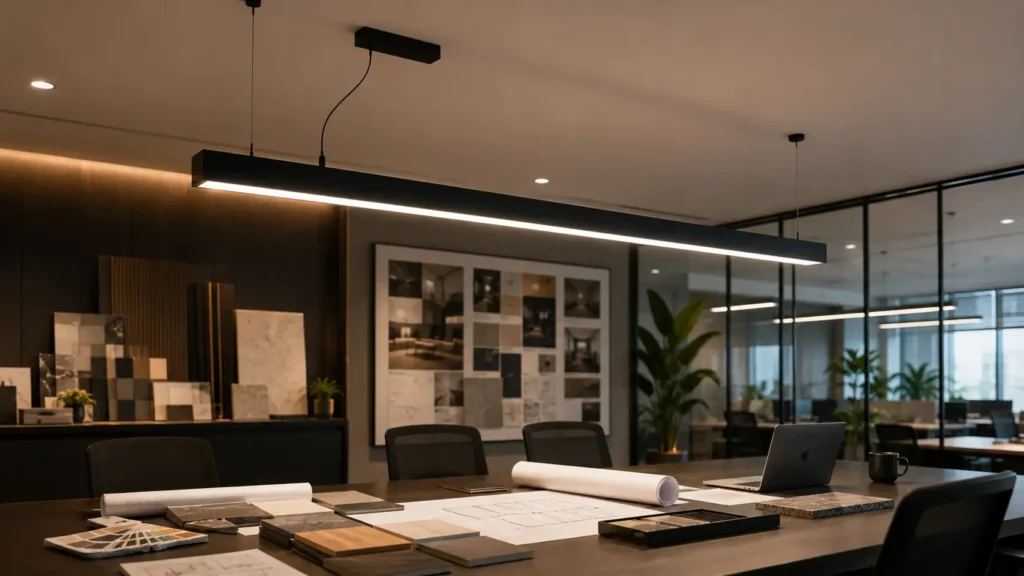
TL;DR : Bar fixture, drop height, mounting scope and beam distribution often disagree because driver topology, optics, certification tier and what is inside the quote bundle differ—not because the same SKU got three random price tags. Send one quotation comparison schedule (BOM/BOQ) to every vendor, then compare rows—not headline labels alone.
Table des matières
- 📦 1. Compare the bar fixture itself, not just the label
- 📏 2. Check why drop height ranges differ
- 🛠️ 3. See what mounting options actually includes
- 💡 4. Understand why beam distribution numbers move
- ✅ Four spec rows at a glance
- Que faire ensuite ?
- 🏁 Conclusion
- FAQ
📦 1. Compare the bar fixture itself, not just the label
Suspended LED bar fixture rows look alike when every line says “linear bar”—until you open the cut sheet.
The same label can hide different:
- Housing depth and weight — slim extrusion versus a deeper chamber for drivers or emergency gear
- LED pitch and lumen package — narrow wash versus higher output on the same length
- Driver location — integrated inside the bar versus remote drivers that never appear on the bar line item
- Listing and IP — dry-location bars versus damp or listed assemblies for kitchens, canopies or washrooms
- Control features — dimming protocol, sensors or emergency circuits that change the housing family
Procurement guides commonly warn that like-for-like comparison needs the same scope on a comparison schedule, not the same marketing name. Treat “suspended LED bar” as a category until housing part number, driver topology and listing match.
Ask each vendor which catalogue row their bar line maps to—and what is excluded from that row.
🎯 Does a lighter bar line always mean a stripped-down fixture?
Not always—it may be a slimmer series profile. Compare part numbers, driver location and listing—not shipping weight alone.
📏 2. Check why drop height ranges differ
Linear light bar drop height on a quote is rarely one fixed millimetre—it is a range tied to cable kit, structure and what the vendor assumed about the hang.
Drop ranges diverge when:
- Cable kit tier differs — fixed drop versus adjustable grippers versus custom length leads
- Canopy and gripper stack — some quotes include the full hang assembly; others list bar only
- Ceiling interface assumed — open structure hangers versus grid-rated clips change the allowable range on the same bar
- Power-feed and canopy configuration — where the feed enters, how the canopy is sized and whether remote gear sits in the plenum change the hang kit quoted—not the cable’s adjustable range by itself
Remote drivers above the ceiling can constrain plenum layout and canopy choice, but they do not directly set the suspension cable’s min/max drop. Pull drop limits from the hang-kit and canopy rows on each quote.
This page does not publish universal drop millimetres. Pull min/max drop from the hang-kit sheet for the exact bar and canopy SKU on each quote—not from a generic “standard drop” note.
If one proposal shows a wide range and another shows a single number, check whether the narrow line assumes site measure later—that is a scope gap, not proof the wide range is padded.
🎯 Can two correct quotes show different drop ranges for the same bar?
Yes—when cable kits, canopy stacks or assumed ceiling types differ. Align hang accessories on the comparison schedule before you judge the range column.
🛠️ 3. See what mounting options actually includes
LED light bar mounting options is the row most often misaligned—because “mounting” can mean bar brackets only, or the full path from structure to luminous face.
Mounting lines disagree when:
- Bar-only versus kit — one quote lists the extrusion; another includes grippers, canopies, cable, safety wire and structure adapters
- Grid versus open deck — T-bar clips, threaded rod and beam clamps are different SKUs and different install hours
- Safety and code extras — seismic kits, secondary support or listed hang assemblies may sit on a separate line
- Join and end hardware — continuous runs may need join brackets that a single-bar quote omits
Industry practice on bid tabs is to normalize accessory scope before comparing mounting columns. If Vendor A includes hang hardware and Vendor B does not, the mounting option field will never match—even for the same bar housing.
Mark on your quote template: structure interface, primary hang, secondary support, join hardware and who supplies each.
🎯 Is an empty mounting column always an incomplete quote?
Often it means bar-only pricing—ask whether hang hardware is excluded, optional or by others. Empty is a scope question, not a green light to compare bar price alone.
💡 4. Understand why beam distribution numbers move
Hanging light bar beam distribution changes when optics change—even at the same wattage and length.
Beam rows diverge because of:
- Optic type — bare diffuse, linear lens, asymmetric wall-wash or graze optics shift angle and spill
- LED spacing and diffuser geometry — same watt label, different board pitch or diffuser profile can change perceived uniformity on the file
- Direct versus direct/indirect output — uplight or return-light fractions change the published distribution curve even when forward wattage matches
- Accessory louvers or baffles — not always visible on a one-line beam note
Do not compare a single “120°” note across quotes without the photometric file or cut sheet for that optic package. For wall-wash or graze layouts, ask for IES or LDT for the exact housing + optic + drive combo—not a generic family curve.
Wattage alone does not set beam shape; neither does the word “linear.”
🎯 Do matching watt labels mean matching beam distribution?
No. Optic kit, drive mode and housing aperture change distribution independently of wattage on the label.
✅ Four spec rows at a glance
| Paramètre | Common reasons quotes disagree | What to align on the comparison schedule |
|---|---|---|
| Suspended LED bar fixture | Driver integrated vs remote; listing/IP; emergency or sensor options; different series depth | Housing PN, driver topology, listing, lumen package |
| Linear light bar drop height | Cable kit tier; canopy stack; bar-only vs full hang; ceiling type assumed | Min/max drop for listed hang SKU |
| LED light bar mounting options | Bar-only vs full hang kit; grid vs open hardware; seismic/secondary support | Structure interface + primary/secondary hang PNs |
| Hanging light bar beam distribution | Optic/lens kit; drive mode; louvers; different photometric files | IES/LDT for exact optic + drive, not label wattage |
No quote prices or “percent savings” appear in this table—only spec alignment fields.
Que faire ensuite ?
- Build one quote template with the four rows above plus length, finish, control and listing columns (same structure as your quotation comparison schedule).
- Send the same comparison schedule to every vendor and ask them to fill missing cells—not to “match the cheapest line.”
- Reject comparisons where bar-only lines sit next to bar-plus-hang bundles without normalization.
- Request photometric files for feature zones before you set beam notes on the submittal.
Triage:
- If the question is why dollar amounts move for the same length and watt band, read the price-variation guide linked in the boundary—not this page.
- If you still need open-plan drop, cable and layout for a full floor—not bar quote lines alone—use the open-plan hanging guide linked in the boundary.
- If quotes are aligned and you are ready to release suspension hardware, use the suspension pre-order checklist in related posts below.
Comparing suspended linear lighting quotes from multiple suppliers? Send XHLUX your fixture schedule or quotation comparison sheet. We can help check whether the housing, suspension, driver, controls, optics and accessories are being compared on the same scope before you finalize the PO.
🏁 Conclusion: Why do hanging LED light bar specs vary so much between quotes?
Back at those three mismatched proposals, the honest answer is usually scope and optics—not a single bar getting three random identities. Once bar body, drop kit, mounting bundle and beam files share one comparison-schedule language, you know what to ask—not whether two headline numbers were ever comparable.
Explorez nos articles de blog connexes :
- Linear LED Suspension: What to Check Before You Order
- Modern Linear Suspension Lighting for Offices and Lobbies
- Do Linear Lights Need Different Ceiling Recess Depths by Mount Type?
Notes et sources
- TPI, Wholesale LED Lighting Suppliers: A Project Buyer’s Guide (reviewed Aug 2026): advises comparing quotations on the complete luminaire—driver, mounting parts, accessories and project-specific photometric evidence—not wattage or fixture count alone; requests itemized offers by named fixture reference on the schedule when bulk quotes diverge in driver, optic, housing and controls (plain-text citation; no outbound link in this draft).
- Hyperlite, Commercial Lighting Installation Quote Package (2026): describes a normalization sheet with the same columns for every bidder (base scope, quantities, accessories, exclusions, alternates) and warns against ranking totals until scope differences are visible (plain-text citation; no outbound link in this draft).
- Price movement by length, wattage band and supply scope stays on the linear price-variation guide linked in the boundary—not duplicated here.
- Open-plan hanging layout, cable routing and grid-agnostic placement stay on the open-plan hanging guide linked in the boundary.
- Drop millimetres, beam angles and lumen values are not invented as universal constants. Use vendor datasheets, IES/LDT files and site mock-ups for final specs.
- Structural, electrical, listing and accessibility rules still apply. Check local codes and the installation sheet before install.
![Ai-je besoin de caches pour mes spots encastrés ? Le guide complet [2025]](https://www.xhlux.com/wp-content/uploads/2025/07/Do-i-Need-Downlight-Covers-560x560.webp "Ai-je besoin de caches pour mes spots encastrés ? Le guide complet [2025]")