XHLUX
XHLUX
The phrase track light on wall sounds like a mounting question, but permission to mount the system is only the first test. Before evaluating the optics, confirm that the manufacturer permits the exact track, feed, adapter and luminaire to operate in that orientation.
This guide goes one step further: even approved wall-mounted track lighting may be optically unsuitable. The head still has to reach the target without forcing an extreme angle, exposing the source to normal sightlines or sending most of the beam somewhere else.
For the wider choice between line-voltage, multi-circuit, magnetic and proprietary rail families, start here:
→ Guide des systèmes d'éclairage sur rail : types, composants et comment choisir
For a target-first commercial layout process, use this companion guide:
→ Conseils d'aménagement pour l'éclairage sur rail LED dans les présentoirs de magasins
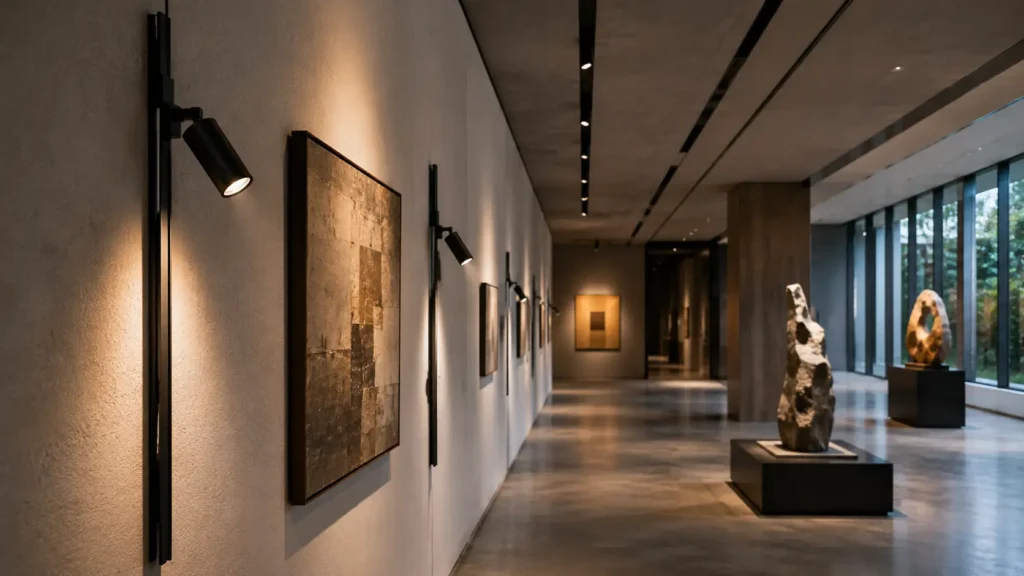
TL;DR : Confirm wall-mount permission first. Then draw the target and normal sightlines, place the rail where the head’s real rotation and tilt range can reach, test beam spread and glare, verify mechanical retention and the feed route, and approve only the exact rail-and-head combination shown in the project documents.
1. Wall mounting changes the aiming geometry
A ceiling track begins above the target. A wall track begins beside it. That change affects the direction of travel, the visible face of the luminaire and the angle through which the head must rotate.
A vertical track light installation can also change how positions along the rail relate to target height. Sliding a head upward may increase reach but expose the source to more viewers. Sliding it downward may reduce glare from a distance yet bring the body into a collision zone.
Do not treat adjustable as a complete answer. The useful range is the part of the adjustment envelope that remains available after the adapter is locked into the wall-mounted rail.
Record these three geometries separately:
- Rail orientation and mounting plane
- Head rotation and tilt after attachment
- Target and observer positions in section, not only plan
🎯 Does wall mounting preserve the same aiming range as ceiling mounting?
Not necessarily. The adapter orientation, body clearance and mechanical stops can remove directions that were available when the same head faced downward.
2. Start with the target, not the empty wall
Good track lighting placement begins with what must be illuminated. Mark the centre and edges of the artwork, shelf, work surface, sign or architectural feature before drawing the rail.
Then add the credible viewing positions. A gallery visitor, retail customer and seated worker do not see the luminaire from the same height or direction.
Utilisez cette séquence :
- Draw the target plane and its usable boundaries.
- Mark normal standing, seated and circulation sightlines.
- Test several possible rail heights and orientations.
- Apply the real adjustment limits of the shortlisted head.
- Choose the position that reaches the target without exposing the aperture.
This is more reliable than centring the rail on the available wall. A neat centreline may force every head to work near its mechanical limit.
The project drawing should label wall track light placement relative to permanent architecture, not movable decoration alone. Include the rail datum, target datum and the direction from which the head is expected to aim.
🎯 Should the rail be centred on the available wall?
Only if that position also serves the target and sightlines; an empty-wall centreline is not an optical design rule.
3. Check the head’s real rotation and tilt limits
A catalogue may call a wall-mounted track fixture adjustable without showing whether the stated range applies in every adapter orientation. Ask for a dimensioned drawing or a physical sample.
Check for interference between the rail, adapter, driver housing, heat sink, snoot and accessories. A head may rotate freely until a visor or louvre is fitted. A long cylinder may strike the wall before reaching the required tilt.
Pour vertical track lighting, also verify whether the adapter can be inserted at every intended position and whether the head can be turned to both sides of the rail. Do not assume a symmetrical-looking body has a symmetrical adjustment envelope.
An approval mock-up should test:
- The shallowest and steepest required aiming angles
- Both ends of the rail and positions beside connectors
- The exact optic and accessory combination
- Adjustment by the person who will maintain the installation
- Whether the head holds its aim after repeated movement
🎯 Is a published tilt angle enough to approve the layout?
No. The project needs the usable angle after the exact adapter, rail orientation, housing and optical accessories are assembled.
4. Make sure the adapter can hold the head in that orientation
A wall mount track lighting system is safe only when the manufacturer permits the rail and luminaire to be used on that plane. Similar profiles or a head that clicks into place do not prove approval.
IEC 60570:2003+A1:2017+A2:2019 covers electrical supply track systems designed for ordinary interior use on, flush with or suspended from walls and ceilings. It does not turn every individual product into a universal wall-mount system, and it does not establish operational compatibility between different track families.
Product instructions must close that gap. For example, Signify’s Lightolier LyteSpan BoldFlood LWW instructions explicitly identify compatibility with ceiling- and wall-mounted track while restricting the head to named Lightolier systems. That is evidence for that product family, not permission to generalize across suppliers.
Confirm these items for the exact assembly:
- Permitted wall, ceiling or suspended orientations
- Adapter locking method and contact alignment
- Luminaire weight and any system-specific limits
- Rail fixing intervals and approved substrate
- Connector, feed and end-cap orientation
- Whether accessories change retention or balance
🎯 Does IEC 60570 prove that any track head may be mounted on any wall rail?
No. The standard provides a safety framework, while the exact manufacturer instructions define the permitted product combination and orientation.
5. Test whether the beam can reach the target without creating glare
The right wall position lets the beam reach its target without requiring an extreme angle or placing the bright aperture in a normal line of sight.
Use photometric data for the exact head and optic. A nominal beam angle gives an initial spread, but an IES or LDT file shows the actual intensity distribution and supports a project calculation.
Check four outcomes together:
- Useful light reaches the intended target plane.
- Spill does not dominate the floor, ceiling or adjacent display.
- The aperture remains screened from normal sightlines.
- Beam shape remains acceptable at the oblique incidence angle.
Wall mounting can make a circular beam appear elongated on a target because the light arrives obliquely. It can also reveal a bright LED source from across the room even when the target receives enough illuminance.
CIE 117:1995 makes observer position and direction of view part of discomfort-glare evaluation. CIE 232:2019 further explains why average-luminance methods can underestimate discomfort from highly non-uniform LED sources. For a wall-mounted head, glare therefore cannot be approved from wattage, beam angle or a catalogue UGR number alone.
The diagram compares geometry only. It is not a universal mounting-height rule or a substitute for photometric calculation and an on-site mock-up.
🎯 Can a beam reach the target and still produce unacceptable glare?
Yes. Adequate target illuminance does not prove that the aperture is screened from people approaching or viewing the installation.
6. Confirm the wall, feed position and cable route
Mechanical and electrical details can rule out an otherwise workable optical position. Identify the wall construction, fixing substrate and concealed services before approving the rail datum.
Compare the available track lighting mounting options with the exact build-up. Surface rail, recessed profiles and stand-off brackets require different tolerances and support details.
A plug-in wall track light may suit a product specifically designed and listed for cord-and-plug use. It is not a generic way to convert a hardwired commercial rail. Confirm the supplied cord, strain relief, switching, socket position and local electrical rules as one system.
The drawing should show:
- Structural fixing points rather than finish-layer assumptions
- Feed location and conductor route
- Driver or power-supply access where applicable
- Clearances from doors, shelving and movable equipment
- A maintenance path for removing and re-aiming heads
🎯 Can a convenient socket make any wall track a plug-in system?
No. Cord-and-plug operation must be part of the approved product arrangement, not an improvised substitute for the specified feed.
7. Know when a wall-mounted track is the wrong choice
The most important track lighting limitations appear when the system is assessed as a complete installation rather than as a rail alone.
Choose another method when:
- The manufacturer does not permit the required orientation.
- The head reaches the target only at its mechanical stop.
- The source remains visible from normal circulation or seated positions.
- Doors, stock handling or occupants can strike the rail or heads.
- The beam becomes too distorted or creates excessive spill.
- The substrate or feed route requires an unreasonable workaround.
- Future targets will move outside the usable aiming envelope.
Ceiling track may restore a more useful aiming path. A dedicated wall spotlight may offer better shielding and a mounting system designed for that plane. A fixed linear luminaire may be clearer when the target is continuous rather than adjustable.
A track may be mechanically mountable on a wall without being optically useful in that position. The right wall position is the one that lets the fixture reach the target without forcing an extreme aiming angle or exposing the light source to normal sightlines.
🎯 When should a wall track be rejected even if it can be installed safely?
Reject it when the approved assembly still cannot reach the target, control glare and remain clear of normal use without operating at an impractical limit.
Que faire ensuite ?
- Obtain the exact track, feed, adapter and head installation documents.
- Draw target planes and normal sightlines in section.
- Apply the real rotation, tilt and accessory clearances.
- Run the exact photometric file and review spill and glare.
- Test one complete assembly on the intended wall build-up.
- Record the approved aim, circuit and maintenance method before ordering.
If the rail family is not yet fixed, return to the Track Lighting Systems Guide linked in the introduction. If the project includes changing displays, use the retail layout guide linked there to develop a repeatable aiming schedule.
FAQ
Notes et sources
- CEI 60570:2003+A1:2017+A2:2019, Systèmes de rails d'alimentation électrique pour luminaires.
- Signify Lightolier, LyteSpan BoldFlood LWW Series Track Head Installation and Operating Instructions.
- CIE 117:1995, Éblouissement inconfortable dans l'éclairage intérieur.
- CIE 232:2019, Inconfort causé par l'éblouissement des luminaires à luminance non uniforme.