XHLUX
XHLUX
Un rgbw downlight combines red, green and blue emitters with a separate white-light channel. That extra W does not automatically make it RGBWW or tunable white.
The names describe different channel structures and functions. Confusing them can leave a project with the wrong white range, insufficient driver channels or a controller that cannot address the specified light engine.
For the general category before comparing channel types, start here:
→ Que sont les spots encastrés à changement de couleur ? Guide complet de l’éclairage
For the dedicated white-light concept, use:
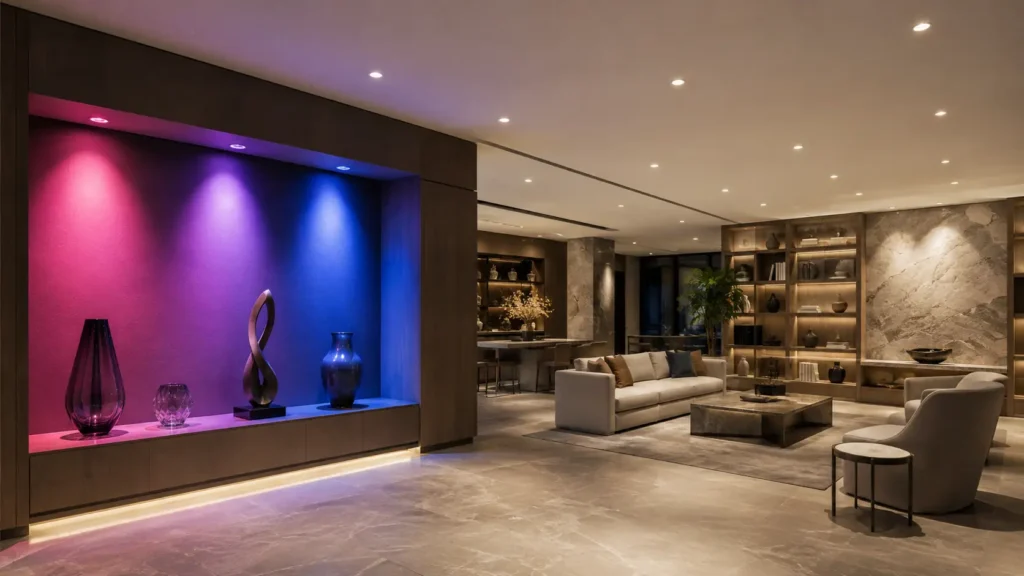
TL;DR : RGB uses coloured channels to create hues and an approximate white. RGBW adds one dedicated white channel, usually at one specified CCT. RGBWW commonly adds two white channels, often warm and cool, but the label is not universal. Tunable white changes white-light CCT without necessarily producing saturated colours. Approve the channel schedule, driver and controls, not the acronym alone.
1. Start with the channels, not the product name
Each additional letter can change the LED package, driver outputs, control addresses and commissioning work.
The usual interpretation is:
| Label | Typical independently controlled channels | Main capability |
|---|---|---|
| RGB | Red, green, blue | Saturated colours and mixed colour effects |
| RGBW | Red, green, blue, one white | Saturated colours plus one dedicated white source |
| RGBWW | Red, green, blue, two white channels | Saturated colours plus a wider white-light range |
| Tunable white | Warm white and cool white, sometimes more white primaries | Adjustable CCT within a white-light range |
This is common usage, not a universal naming standard. Request a channel schedule naming every LED primary and its nominal CCT.
🎯 Does RGBWW always mean five channels?
No. It often means RGB plus warm and cool white, but suppliers use the label differently, so the exact channel schedule must decide.
2. RGB can make white, but it is still three-colour mixing
An RGB luminaire can raise its red, green and blue outputs together to create light that appears white. That does not make the spectrum identical to a phosphor-converted white LED.
The U.S. Department of Energy’s LED Color Characteristics guidance notes that similar-looking white light can come from different spectral power distributions and render objects differently.
RGB-mixed white may suit effects and short decorative scenes. It is a weaker default for everyday light over food, faces, merchandise or work surfaces.
The phrase rgbw vs rgb led should therefore lead to two separate questions:
- Does the project need saturated colour?
- Does it also need a documented white-light mode?
If everyday white is required, compare CCT, lumen output, colour rendering, consistency and dimming. An RGB colour wheel cannot prove them.
🎯 Is RGB white the same as a dedicated white LED?
No. They can share a similar chromaticity while having different spectra, colour-rendering performance, output and efficiency.
3. RGBW adds one white channel, not a tunable-white range
Un rgbw color mixing downlight normally adds one phosphor-converted white channel to the red, green and blue channels. The white LED may be 2700K, 3000K, 4000K or another fixed value chosen by the manufacturer.
That channel can improve white scenes and pastel mixing without running all three coloured channels to obtain white-looking light.
One white channel does not create an independent warm-to-cool range. Blending RGB around it remains full-colour mixing, not a dedicated tunable-white engine.
Check white-only and mixed-scene data. Driver or thermal limits may prevent every channel from running at its published maximum simultaneously.
An RGBW specification should record:
- Nominal CCT of the white channel
- White-only lumen output and wattage
- Colour-rendering data in white mode
- RGB and white channel current limits
- Dimming range and low-level behaviour
- Colour consistency between luminaires
- Allowed combined-channel operating modes
🎯 Can RGBW provide both effects and normal lighting?
Yes, when its dedicated white channel meets the project’s everyday output and colour requirements rather than serving only as a mixing aid.
4. RGBWW may add warm and cool white, but verify the label
RGBWW often combines RGB with warm-white and cool-white channels, allowing a white CCT range alongside saturated colours.
This also increases driver and commissioning complexity. Yet RGBWW is not self-defining: listings may mean RGB plus warm white or a five-channel warm-and-cool system.
Do not approve “RGBWW” unless the submittal states:
- Number of independent channels
- Warm-white and cool-white endpoints
- Output across the white tuning range
- Colour-rendering data at relevant settings
- Whether RGB can operate with both white channels
- Driver and decoder channel capacity
- Control profile and address requirements
XHLUX currently has no separate RGBWW article to link here. A future spoke could cover five-channel specification in depth; this comparison only defines the boundary.
🎯 Is RGBWW automatically better than RGBW?
No. It offers more potential flexibility, but only when the project needs variable white and can support the added controls and commissioning.
5. Tunable white is a function, not another name for RGBW
The Illuminating Engineering Society defines tunable white as spectral tuning used to vary the correlated colour temperature of a white-light source.
Many systems mix warm-white and cool-white channels across an adjustable range. More advanced engines may use additional primaries.
A tunable-white luminaire may have no RGB channels, so it cannot necessarily produce saturated brand colours. Its priority is controllable white light.
The table keyword tunable color downlight can hide this distinction. “Colour tunable” may refer to full-colour RGB-type systems, while “tunable white” normally refers to changing CCT within white light. The specification must use the intended function, not a vague marketing label.
The U.S. Department of Energy separates full-colour products such as RGBW from white-tunable products and notes that white tuning must coordinate colour and intensity.
🎯 Can tunable white produce saturated red or blue light?
Not unless the luminaire includes additional coloured channels; a standard warm-white and cool-white engine stays within white-light tuning.
6. Compare the architectures before choosing
The diagram shows common architectures, not mandatory definitions. The correct route depends on whether the project needs saturated colour, one dependable white setting, a variable white range or all three capabilities.
| Project requirement | Strong first route | Main limitation to check |
|---|---|---|
| Saturated effects only | RGB | Quality of mixed white if used |
| Effects plus one everyday white | RGBW | Fixed white-channel CCT |
| Effects plus warm-to-cool white | RGBWW or another RGB plus tunable-white engine | Vendor terminology and channel count |
| Adjustable white without saturated colour | Tunable white | CCT path, output and control interface |
| Complex architectural scenes | Multi-channel system selected by exact capabilities | Commissioning, protocol and maintenance |
7. Driver and control checks change with channel count
Every controlled LED primary needs a corresponding driver or decoder output. A three-channel RGB engine cannot gain a white channel through an RGBW decoder.
A five-channel product needs controls that address all five outputs. An RGBW interface may leave one function unavailable or require proprietary mapping.
Le rgbw downlight control option should be documented through the complete path:
- User interface or show controller
- Gateway, processor or network where required
- Protocol and addressing method
- Driver or decoder channel outputs
- Cable cores and connector pinout
- Luminaire LED channel order
- Scene storage and fallback behaviour
Possible controls include DMX, DALI-based solutions, 0–10V arrangements or proprietary systems. A protocol name alone does not guarantee sufficient channels or the correct profile.
For apps, voice assistants and smart-home control boundaries, use the Smart Downlight guide linked below rather than expanding this comparison into a platform tutorial:
→ Qu'est-ce qu'un spot encastré intelligent et comment est-il contrôlé ?
🎯 Can any RGBW controller operate any RGBW downlight?
No. Channel order, voltage, current, protocol, addressing and supported control profile must match the exact driver and luminaire.
An eight-point specification check
Before approving RGBW, RGBWW or tunable white, request:
- A named list of every LED channel
- CCT of each white channel
- Output and wattage by operating mode
- Colour-rendering data for normal white scenes
- Driver channel count and electrical ratings
- Control protocol, profile and address requirements
- Cable, connector and channel-order drawings
- A commissioned sample showing required scenes and fallback operation
Test real finishes at intended dimming levels. A colour wheel proves hue change, not acceptable white light, batch consistency or system recovery.
Que faire ensuite ?
- Write the required white-light range and saturated colours separately.
- Decide whether one fixed white CCT is enough.
- Treat RGBWW as an unverified label until every channel is named.
- Match the driver and controller to the real channel count.
- Commission the required scenes on a representative sample.
- Keep a standalone RGBWW specification guide as a future content option only; do not create an internal link until it is published.
- Ask XHLUX or another project supplier for channel schedules, photometry, colour data, driver diagrams and control compatibility before production.
Notes et sources
- The U.S. Department of Energy’s Understanding LED Color-Tunable Products separates dim-to-warm, white-tunable and full-colour-tunable product categories.
- The U.S. Department of Energy’s LED Color Characteristics fact sheet explains that similar-looking white light can come from different spectral power distributions.
- The Illuminating Engineering Society definition of tunable white limits the term to varying the CCT of a white-light source.
- Manufacturer use of RGBWW varies. The exact LED primaries, CCT endpoints and channel count must be verified from product documentation.
- External authorities are identified as plain text only. No external website receives a clickable link.