XHLUX
XHLUX
Aperçu
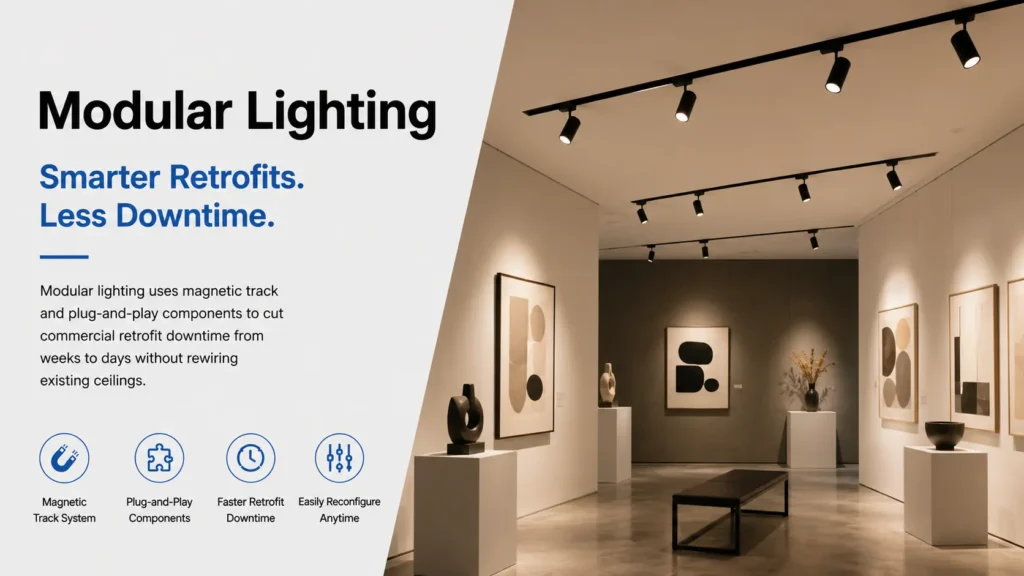
- A modular lighting system uses standardised, interchangeable components — track rails, connector fittings, and snap-on fixture heads — that can be added, removed, or repositioned without rewiring. This cuts commercial retrofit downtime compared to replacing individual hardwired fixtures.
- The three modular formats gaining commercial traction are 48V magnetic track, modular linear trunking, and interchangeable downlight modules — each suited to different ceiling types, operating hours, and reconfiguration frequencies.
- Modular lighting is most cost-effective in spaces where the lighting layout changes at least once per year: retail stores with seasonal floor plan changes, exhibition galleries, co-working spaces, and hospitality venues that refresh interiors periodically.
What Makes a Lighting System “Modular”?
A modular lighting system is built from standardised, field-replaceable parts rather than a single sealed fixture. The defining characteristic is that the mechanical connection and the electrical connection are separated — the track or trunking body carries power, and the fixture heads attach mechanically (magnetically or via clip) while drawing power from the rail. This means fixture-level changes happen without touching building wiring.
This architecture is fundamentally different from conventional hardwired downlights or track lights. In a conventional retrofit, replacing 50 ceiling fixtures means 50 junction boxes to open, 50 sets of wires to disconnect and reconnect, and 50 holes to patch or re-cut. Each fixture change is an electrical event. In a modular system, the track or trunking is installed once and commissioned by an electrician — after that, fixture heads can be added, removed, or swapped by facilities staff without an electrician present.
The key components of a modular system:
- Power-carrying rail or trunking: the electrified backbone, available in surface-mount, recessed, or suspended formats. Carries low-voltage (48V DC) or line-voltage (120–277V AC) power.
- Mechanical/electrical adaptors: the interface between the rail and the fixture. Magnetic (48V systems), clip-lock (traditional track), or plug-and-socket (linear trunking).
- Interchangeable fixture heads: spotlights, flood heads, linear modules, pendant adaptors, and sensor modules — all compatible with the same rail.
- Connector fittings: L, T, X, and flexible connectors that join rail sections without hardwiring each junction.
- Power supply/driver: for 48V systems, a remote power supply unit feeds the rail. For line-voltage systems, each fixture may carry its own driver or share a track-mounted driver module.
Why Modular Lighting Matters for Retrofits
In a commercial retrofit, the dominant cost is not the fixture — it is the downtime. A retail store losing revenue during a ceiling rewire, an office floor rendered unusable for two weeks, a hotel with rooms out of service — the fixture cost is a fraction of the business interruption cost.
Modular lighting attacks the downtime problem at its root: it separates the one-time electrical installation from the ongoing fixture-level changes.
| Facteur | Conventional Hardwired | Modular System |
|---|---|---|
| Install 50 fixtures | 50 electrical connections | 1 track run + 50 snap-on heads |
| Add 10 fixtures later | 10 new junction boxes + wiring | 10 snap-on heads, no electrician |
| Reconfigure layout | Rewire or replace | Slide fixtures along rail |
| Typical retrofit downtime | 2–4 weeks (full floor) | 3–7 days (full floor) |
| Fixture-level change | Electrician required | Facilities staff or contractor |
The economic case is strongest in spaces where the lighting layout changes at least once per year — retail stores with seasonal floor plan changes, exhibition galleries, co-working spaces with reconfigurable desk layouts, and hospitality venues that refresh their interiors periodically. For fixed-layout offices and corridors, modular lighting still offers future-proofing but the immediate payback is less compelling.
The Three Modular Formats Gaining Commercial Traction
Voie magnétique 48V
Magnetic track systems use neodymium magnets embedded in the fixture base to attach the light head to a low-voltage (48V DC) rail. Electrical contact is made through continuous copper strips on the rail surface — no pins, no locking tabs, no tools.
Idéal pour : retail display lighting, gallery exhibitions, high-end office spaces where the ceiling is visible, and any space where fixtures are repositioned more than twice per year.
Caractéristiques principales :
– SELV (Safety Extra-Low Voltage) classification — touch-safe, fixture changes may not require an electrician depending on local electrical codes (verify with local regulations before installation)
– Rail profiles as narrow as 20mm — significantly slimmer than traditional track
– Compatible with DALI, Casambi BLE, Zigbee, and 0–10V dimming depending on driver configuration
– Per-fixture cost is higher than traditional track, but reconfiguration labour is near zero
– Maximum run length limited by voltage drop — typically 8–15 metres per power feed
Modular Linear Trunking
Modular linear trunking systems use a continuous aluminium extrusion that carries both power and mechanical support. Individual linear LED modules plug into the trunking at any position using tool-free connectors. This format is common in office ceiling grids and supermarket aisle lighting.
Idéal pour : open-plan offices, supermarket shelving aisles, educational facilities, and any suspended ceiling grid installation.
Caractéristiques principales :
– Line-voltage (120–277V) operation
– Continuous runs up to 50 metres from a single power feed
– Integrated emergency lighting modules can be plugged into the same trunking
– Lumens-per-watt typically 120–160 lm/W across the product category
– Compatible with suspended, surface-mount, and recessed ceiling integration
Interchangeable Downlight Modules
Interchangeable downlight modules separate the housing (the part fixed in the ceiling) from the LED engine and optics (the replaceable module). When an LED module reaches end of life or a different beam angle or CCT is needed, the module is swapped without touching the ceiling or the housing.
Idéal pour : hotel corridors, healthcare facilities, and commercial spaces where ceiling access is restricted, or where fixture-level maintenance must be completed during operational hours without disruption.
Caractéristiques principales :
– Housing installed once, modules replaceable from below the ceiling
– Beam angles from 15° to 60° available within the same housing family
– CCT options from 2700K to 5000K
– Typical module lifespan 50,000 hours to L70
– Module replacement time: under 60 seconds per fixture
How to Evaluate a Modular System for Your Project
When comparing modular lighting systems, assess these five factors before pricing:
1. Track/trunking compatibility. A modular system is only as flexible as its fixture ecosystem. Confirm how many fixture types — spotlights, linear modules, pendants, sensors — are available for the specific rail format before committing to a track standard.
2. Power supply architecture. 48V magnetic systems require a remote DC power supply. The power supply rating (typically 100–300W) determines the maximum number of fixtures per circuit. Line-voltage trunking systems do not need a separate power supply but may require per-fixture drivers.
3. Connector availability. L, T, X, and flexible connectors should be available in the same product family. A track system with only straight connectors limits layout geometry — you cannot turn corners or create grid patterns.
4. Dimming and control compatibility. Confirm that the fixture heads, drivers, and control protocol (DALI, 0–10V, TRIAC, Casambi, Zigbee) are all compatible. A modular system with DALI-2 addressable drivers allows per-fixture dimming and scene control without additional control wiring.
5. Future fixture roadmap. Ask the manufacturer whether new fixture types are planned for the same track format. A track system installed today should be compatible with fixture heads released in 3–5 years. A proprietary track format with only 3–4 fixture types available today may limit upgrade options later.
Installation: What Modular Means for the Contractor
From a contractor’s perspective, a modular lighting installation changes the project timeline:
- Day 1–2: electrician installs the track or trunking, connects power feeds, tests continuity. This is the only phase requiring a licensed electrical contractor.
- Day 2–3: fixture heads are snapped onto the rail by the installation team — no wiring, no junction boxes. A team of two can install 50–80 fixture heads in a day.
- Post-installation: fixture repositioning, addition, or removal is handled by facilities staff. No further electrical work needed.
The installation advantage is most visible in multi-tenant buildings and retail chains, where tenant fit-outs happen frequently and each fit-out previously required a full lighting rewire. With modular track already installed, a tenant change means repositioning or swapping fixture heads — not rewiring.
Foire aux questions
Que faire ensuite ?
A modular lighting system is worth evaluating if your project meets two or more of these criteria: ceiling area above 500 sqm, expected layout changes within 3 years, multiple tenant fit-outs planned, or requirement for future fixture-level control upgrades (per-fixture dimming, presence sensing, daylight harvesting).
Product lines supporting modular installations from XHLUX:
- XHLUX Low-Voltage Track Lights (48V DC) — magnetic and traditional low-voltage modular options
- XHLUX LED Linear Track Lights — continuous linear trunking for retail and office ceiling grids
- XHLUX LED Track Lights — Full Range — spotlights, flood heads, and adjustable fixtures for modular track
- XHLUX Zoomable LED Track Lights — adjustable beam angle 15–60° for modular repositioning
For project-specific track layouts, power supply sizing, or connector compatibility matrices, consult XHLUX’s technical documentation for the specific product family being specified.
Data notes: Technical specifications cited in this article (track run lengths, power supply ratings, lumens-per-watt ranges, installation timelines) are industry reference values based on commercially available modular lighting products. Specific figures vary by manufacturer, model, and project conditions. Verify with product specification sheets before procurement. All electrical work must comply with local codes and regulations.