 XHLUX
XHLUX
A distributor asks a factory for “a custom version” of a track light.
The request might mean picking a 24° beam and a black finish from the existing option list. It might mean a different LED, a DALI driver and the distributor’s own brand on the same housing. Or it might mean a slimmer body, a new reflector and a new mould.
All three get called “customisation”. They are very different jobs.
OEM and ODM are used differently across industries and suppliers. In this article, we use product-change depth as a practical way to scope a lighting project—not as a universal definition of OEM and ODM.
When you buy wholesale from an LED lighting manufacturer, the real question is not “Do you do OEM?” but how far the request changes the product platform.
TL;DR : In this framework, a standard-range request chooses options that already exist on a proven platform. An OEM-level request redefines a version on that platform, such as LED, driver, colour quality, control or brand, without new structure. A project moves toward ODM-level development when the structure, optics, thermal design or tooling change. One wholesale product line can contain all three at the same time.
Table des matières
- Three ways to work with a manufacturer
- Standard range
- OEM
- ODM
- Side-by-side comparison
- Where the OEM/ODM line sits
- One range, three models
- How XHLUX supports each model
- FAQ
- Conclusion
🧭 What Cooperation Models Are There When You Buy Wholesale From an LED Manufacturer?
Buying from an LED manufacturer is not a choice between “stock” and “custom”. It usually falls into three levels of product change.
In this framework:
- Standard range — you buy from a proven platform and choose from existing options.
- OEM-level request on an existing platform — you define your own version of that platform.
- ODM-level development — the product itself is developed or redeveloped.
The labels matter less than the depth. Each level changes a different layer of the product, and each layer brings its own development work, testing and risk.
🎯 How can you scope a custom lighting request?
In this framework, by the deepest layer it changes: options, configuration, optics, structure or tooling.
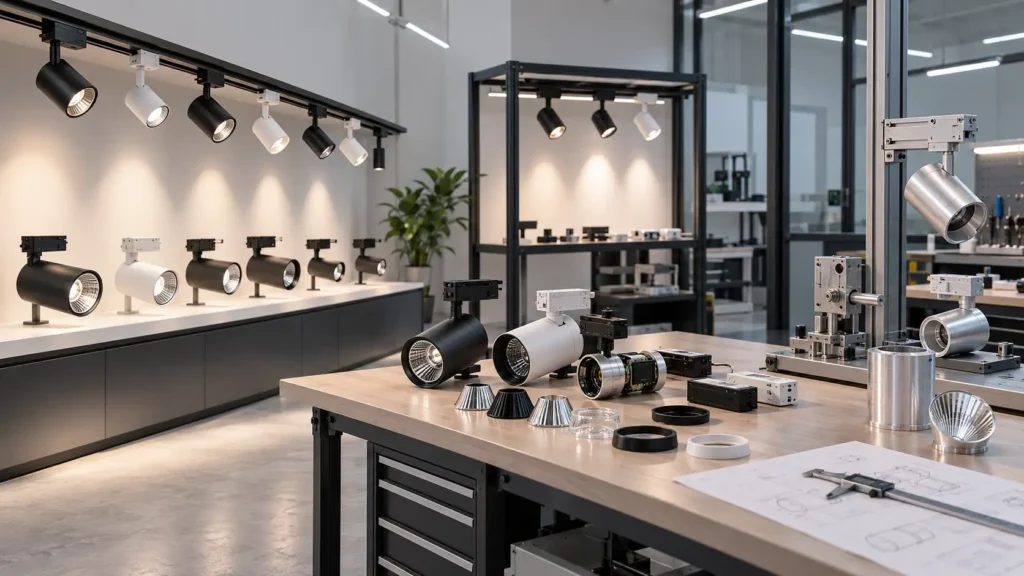
📦 Standard Range: Buying From a Proven Product Platform
A standard range lets you choose from options the manufacturer has already engineered, tested and put into production.
What usually stays the same
- housing structure
- thermal structure
- optical platform
- mounting method
- main mechanical parts
These are the parts that took the most development and validation. In a standard range, you inherit them as they are.
What you can usually select
- wattage
- angle de faisceau
- CCT
- CRI
- conducteur
- dimming method
- protocole de contrôle
- finish colour
Selecting a configuration is not developing a product.
If a track light already comes in 15°, 24°, 38° and 60°, choosing the 24° version is a selection. Calling it ODM would only blur what you are actually buying.
The advantage is predictability. The optics, heat path and mechanics have already been proven, so you are buying a known result.
🎯 Is choosing a listed beam angle customisation?
No. It is a standard selection, because that optic is already designed, tested and in production.
🏷️ OEM: Your Own Version Without Redesigning the Product
In this framework, an OEM-level request is not just a logo and a box. It defines a customer’s own version of a proven platform.
Building on an existing platform
On the same housing and optical platform, an OEM-level request can define:
- a specified LED
- a specified driver
- CRI 90, 95 or 98
- a tighter SDCM requirement
- a different beam family from the existing optics
- DALI, Casambi, TRIAC or 0/1–10V control
- a different finish colour
- the customer’s own brand identity
The platform stays. What changes is the recipe that goes into it.
When an OEM-level request really changes the product
Once you change the LED, the driver, the output, the optical configuration or the control method, you can affect:
- electrical performance
- efficacité
- light output
- thermal behaviour
- dimming compatibility
- existing test results
Changing the LED or drive current can change the thermal load. For example, higher input power or a lower-efficacy LED may increase the heat that the same housing must dissipate. A different driver can change the dimming curve and how the fixture behaves with a control system. These are real engineering questions, even when no new part is designed.
In this framework, an OEM-level request is not just “changing a logo”. It redefines a product version on a proven platform, and the manufacturer should re-check what that version changes.
🎯 Why can an OEM-level version need new tests?
Because a new LED, driver or control changes electrical, thermal and light output from the tested version.
🛠️ ODM: When the Existing Platform Is No Longer Enough
In this framework, a project moves toward ODM-level development when the request needs something the existing platform physically cannot provide.
Changes that usually mean redevelopment
- a new housing size
- a new structure
- a new optical system
- a new lens
- a new reflector
- a new thermal structure
- a new module
- a new mounting structure
- new tooling
Why ODM-level development is not only appearance
A structural change rarely stays on the surface. It pulls in:
- optical validation
- thermal validation
- electrical testing
- tooling
- assembly method
- certification scope
A slimmer body, for example, leaves less room for the driver and less mass for heat. The optics, driver choice and thermal path may all have to be reworked around it.
Once the product architecture starts to change, it is no longer a configuration adjustment.
🎯 What moves a request toward ODM-level work?
A change the current platform cannot absorb: new size, structure, optics, thermal path or tooling.
⚖️ Standard Range, OEM and ODM: What Actually Changes?
In this framework, the three levels differ in how many layers of the product are open to change.
| Standard range | OEM-level request | ODM-level development | |
|---|---|---|---|
| Basic structure | Existing structure | Usually existing structure | Can be redesigned |
| Optical platform | Existing optics | Usually based on existing optics | Can be newly developed |
| LED / driver | Existing options | Defined to the customer’s requirement | Can be re-matched |
| angle de faisceau | Existing options | Combined from existing optics | New optics can be developed |
| Contrôle | Existing configurations | Can be redefined | Deeper integration possible |
| New tooling | Inutile | Usually not needed | May be needed |
| Development depth | Faible | Moyen | Haut |
📏 Where Exactly Is the Line Between OEM and ODM?
In this framework, the line is drawn by how much of the product changes, not by the word a supplier uses.
The industry often uses OEM and ODM loosely. Change by change, the picture is clearer:
| Change | In this framework, usually handled as |
|---|---|
| Switch to a different driver | Configuration / OEM-level request |
| Switch to a different LED | OEM-level request |
| Change CRI or CCT | OEM-level request |
| Choose an existing beam angle | Standard selection, not ODM-level development |
| Specify an existing DALI or Casambi version | Usually not ODM-level development |
| Develop a new reflector | Moves toward ODM-level development |
| Develop a new lens | ODM-level development |
| Change the housing size | ODM-level development |
| Change the thermal structure | ODM-level development |
| Open a new mould | ODM-level development |
A practical rule in this framework: if the change can be made with parts that already fit the platform, it would usually be handled as an OEM-level request. If a part has to be designed to make it fit, the project moves toward ODM-level development.
🎯 Where does a new reflector sit in this framework?
It moves the project toward ODM-level development: the reflector is new optical work, even if the housing stays.
🧱 One Wholesale Product Line Can Use All Three Models
One wholesale product line can contain standard, OEM and ODM products at the same time.
For example, one distributor’s track lighting range could include:
- a 24° track spotlight bought exactly as listed in the manufacturer’s standard range
- an OEM-level version of the same spotlight with a specified CRI 95 LED, a DALI driver and the distributor’s own brand
- an ODM-level slim spotlight developed with a new housing and a new reflector
The three products sit in the same catalogue, but each one was scoped, developed and tested at a different depth.
🎯 Can one range mix standard, OEM and ODM products?
Yes. The same catalogue can hold listed products, customer-defined versions and newly developed ones.
📍 How XHLUX Supports Standard, OEM and ODM
XHLUX is a commercial LED lighting manufacturer, and we work with customers at all three levels on our own platforms.
Standard range
Our existing platforms include:
- Projecteurs sur rail LED
- spots encastrés LED
- luminaires linéaires à LED
- éclairage sur rail magnétique
Depending on the series, existing options cover different wattages, beams such as 15°, 24°, 38° and 60°, CRI and CCT choices, drivers, and dimming and control versions.
OEM
On an existing platform, we can define:
- the LED configuration
- the driver configuration
- CRI and CCT
- the beam
- DALI, TRIAC, 0/1–10V or Casambi control, where the series supports it
- the product colour
- a branded version
ODM
When an existing platform cannot meet the requirement, our customization work can move into new products, including:
- new structure
- new optics
- new dimensions
- new modules
- new tooling
- special control integration
Available options depend on the specific platform. Not every XHLUX product supports every configuration or every level of change.
🎯 Can XHLUX start standard and move to ODM later?
Yes. A range can begin on an existing platform and add developed products once it needs them.
FAQ
🏁 Conclusion: Standard Range, OEM or ODM?
For scoping a wholesale lighting project, the useful difference between standard range, OEM and ODM is not what the manufacturer calls it, but which layer of the product platform is changed.
In this framework, a standard product selects configurations inside an existing platform. An OEM-level request redefines a product version on a proven platform. ODM-level development starts to change the structure, the optics or the product architecture itself.
Explorez nos articles de blog connexes :
- Comment choisir un fabricant d'éclairage LED commercial
- Ce que les acheteurs de projets recherchent chez les fournisseurs d'éclairage commercial
- Comment choisir le bon fournisseur d'éclairage commercial en gros
📌 Summary
In the project-scoping framework used here:
- Standard range: existing product platform, existing configurations.
- OEM-level request: a customer-specific version built on a proven platform.
- ODM-level development: real product or structural development.
- The deciding factor: how much of the product architecture changes.
Notes et sources
- XHLUX — About Us: Shenzhen commercial LED lighting manufacturer since 2011; LED track, magnetic low-voltage track, downlight and linear ranges; TRIAC, DALI, 0/1-10V, RF, WiFi and ZigBee control options (xhlux.com/about-us).
- XHLUX — Customization: OEM and private label; customisation based on current products or completely new products, covering optics, appearance and light source (xhlux.com/customization).
- XHLUX — D65 downlight product page: 15°/24°/38°/60° beams, CRI80+ to CRI98+, SDCM <3, LED and driver options, DALI, TRIAC, 0/1-10V and ZigBee dimming (xhlux.com/products).
- XHLUX — Casambi Tunable White Track Light: 2700K–6500K (xhlux.com/news).
- IECEE CB Scheme and comparable safety-certification schemes: test reports list critical components, and component changes are evaluated by the certification body.
Planning Standard, OEM or ODM Products?
Tell XHLUX which platform you are starting from, what you need to change and which markets you sell into, and we will tell you which level the request really sits at.