XHLUX
Neither 4-inch nor 6-inch recessed LED ceiling lights are automatically better. Modern 4-inch heads can match or exceed some ceiling lights 6 inch models on published lumens. The better choice depends on the exact fittings, their beam distribution, how many you place, and how quiet you want the ceiling to look.
The practical decision is usually this: should you use fewer 6-inch lights, ou more 4-inch lights, for the same room?
Compare lumen output, beam spread, fixture count, spacing, ceiling height, glare and cutout constraints. Do not treat surface-mounted “ceiling lights” as the same product as recessed downlights just because the brochure uses a similar inch label.
For the wider commercial parameter map, see our commercial LED downlights specification guide.
TL;DR : Read luminaire lumens and beam data for the codes you will buy—not the inch size alone. Six lower-output 4-inch heads can out-total four higher-output 6-inch heads on paper and still fail uniformity if spacing or optics differ. Build two candidate layouts, then pick the one that meets the lighting task, glare and ceiling appearance—while the cutouts you actually have can accept.
Table des matières
- 💡 1. Are 6 Inch Ceiling Lights Brighter Than 4 Inch Lights?
- 🔢 2. Do You Need More 4 Inch Lights Than 6 Inch Lights?
- 📏 3. How Does Ceiling Height Affect the 4 Inch vs 6 Inch Decision?
- 👁 4. Which Size Looks Better and Causes Less Glare?
- 📋 5. How to Compare 4 Inch and 6 Inch Lighting Layouts for the Same Room
- 🔄 6. When Should You Keep 6 Inch Ceiling Lights Instead of Switching to 4 Inch?
- 🏁 Conclusion
- FAQ
💡 1. Are 6 Inch Ceiling Lights Brighter Than 4 Inch Lights?
No. Nominal fixture diameter does not set lumen output or beam angle.
“4 inch” and “6 inch” are size class labels. They usually describe the trim / housing family people recognise—not a guaranteed lumen package. Luminaire lumens (delivered output of the finished fitting) are what belong in a brightness comparison. Source or chip lumens alone can overstate what leaves the optic.
Beam angle is an optical design choice. The same catalogue family can offer 50° and 80° options on both 4-inch and 6-inch housings. Diameter does not invent the beam.
Documented examples from public sheets (fetched 17 October 2026):
| Product (public sheet) | Nominal size | Watts (listed) | Published lumens (examples) | Beam / notes | Cutout / aperture notes |
|---|---|---|---|---|---|
| Liteline SKYE SLMB | 4″ | 12 W | 810–900 lm by CCT | 75° | Hole Ø 4¼”; OD 4¾”; luminous ID 2⅜” |
| Liteline SKYE SLMB (same sheet) | 6″ | 16 W | 1,360–1,520 lm by CCT | 80° | Hole Ø 6¼”; OD 6¹³⁄₁₆”; luminous ID 4³⁄₁₆” |
| Halo LT4-DM | 4″ | ~7.5–7.9 W (by CCT on sheet) | ~620–700 lm class | Beam ~87° on sample photometry | Direct-mount / canless family |
| Halo LTC6 | 6″ | ~8.6–8.8 W | ~750–835 lm by CCT (795 lm @ 3000K on sheet) | Beam ~92° | Cutout 5.69″ listed |
| RAB NDLED | 4″ / 6″ | 12 W (4″); 20 W (6″) examples | ~981–1,004 lm (4″ 12W); ~1,391–1,418 lm (6″ 20W) on sample optics | 50° or 80° offered on both sizes | Cutout 5″ (4″ round); 7″ (6″ round) |
| ETI Capella CCDL | 4″ / 6″ | 7/9/12 W; 14/18/24 W | Selectable 600/800/1,000 lm (4″); 1,100/1,500/2,000 lm (6″) | Commercial selectable package | Same series, different size packages |
A high-output 4-inch commercial package can out-lumen a low-output 6-inch wafer. A same-family 6-inch SKYE sits above its 4-inch sibling on that sheet—because wattage and module differ, not because “6” is magic.
When you shortlist finished LED downlights, compare the lumen and beam lines for the exact codes—not the inch number on the carton.
🎯 Does a larger diameter always mean more lumens?
No. Compare published luminaire lumens and optics for each code; size class alone does not set output.
🔢 2. Do You Need More 4 Inch Lights Than 6 Inch Lights?
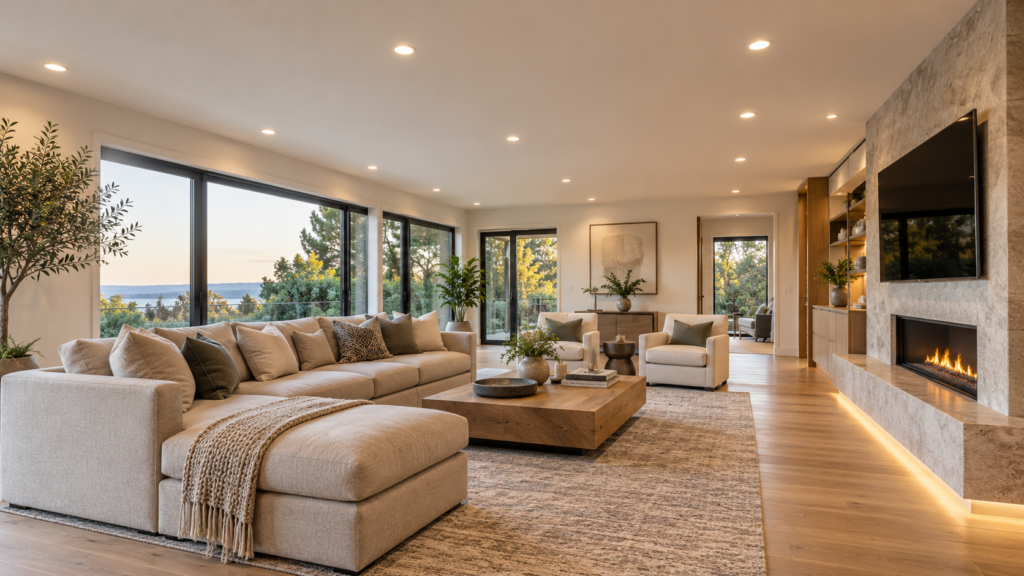
Not automatically. Fixture count follows output, distribution and uniformity—not a fixed “4-inch needs more heads” rule.
A common forum-style comparison looks like this (illustrative rated totals only—not a prediction of floor lux):
| Option | Count × rated output | Total rated lumens |
|---|---|---|
| A — six 4-inch heads | 6 × 750 lm | 4,500 lm |
| B — four 6-inch heads | 4 × 900 lm | 3,600 lm |
In this example, Option A has more total rated lumens. That still does pas prove higher work-plane illuminance. Four brighter pools can leave darker gaps if beams are narrow or spacing is wide. Six heads can improve placement flexibility without guaranteeing better uniformity if the beams do not overlap usefully.
Bigger fittings do not automatically mean fewer fittings. Change the published lumen package or the beam, and the count that “wins” on paper flips.
🎯 Can four 6-inch lights replace six 4-inch lights by default?
Only if the real lumen packages, beams and spacing still meet the same uniformity and task targets—count alone cannot decide.
📏 3. How Does Ceiling Height Affect the 4 Inch vs 6 Inch Decision?
Choose optical performance for the mounting height. Do not pick diameter from height alone.
Illuminance on the work plane falls as mounting height rises for the same intensity distribution. A wider beam spreads light over a larger footprint and usually lowers centre intensity; a narrower beam keeps a hotter centre and needs tighter aiming and spacing discipline.
| Approx. finished ceiling | What to check (not a mandatory size) |
|---|---|
| ~8 ft / 2.4 m | Quiet aperture preference vs wafer glare; wide floods often suit general ambient—still read the SKU beam |
| ~10 ft / 3.0 m | Confirm centre intensity and pool overlap at the task plane; lumen package and optic matter more than “6 inch for tall rooms” |
| ~12 ft / 3.7 m+ | Higher packages and/or narrower useful beams may be needed; large-aperture families can help reduce hole count—verify with photometry |
Hypothetical contrast (assumptions labelled): a 4-inch high-output narrow-beam head at 12 ft can punch a bright circle on the floor while leaving dark gaps between centres. A 6-inch wider-beam head at the same height can look softer but dimmer at centre if its lumen package is modest. Neither statement is a rule that “high ceilings require 6-inch.”
Tall commercial ambient layouts still need the lumen package and useful beam proven at the mounting height—aperture size alone does not clear the height.
🎯 Should every 12-foot ceiling use 6-inch downlights?
No. Match lumen package and beam to height and spacing; diameter is secondary.
👁 4. Which Size Looks Better and Causes Less Glare?
Appearance and glare are separate from diameter and from lumen stickers.
On a finished ceiling, a 6-inch trim is simply more visible. Many designers prefer smaller apertures for a quieter plane when the lumen package still meets the task. That is an aesthetic preference—not proof that 4-inch is always “better lighting.”
Also separate:
- Shallow wafer / disk styles that sit close to the ceiling plane
- Deeper recessed downlights with a regressed optic or baffle
A small wafer with a bright, near-flush source can glare more than a larger, deeper baffle with good shielding—especially when people sit and look across the room. Source luminance, recess depth, baffle colour and viewing angle matter more than the inch class.
Evaluate fixture appearance and glare on their own checklist rows—after lumen and uniformity pass.
🎯 Does a smaller aperture automatically mean less glare?
No. Shielding, recess depth and viewing angle decide comfort; size class alone does not.
📋 5. How to Compare 4 Inch and 6 Inch Lighting Layouts for the Same Room
Decide by comparing two complete layouts—not two diameters in isolation. This is the section that should settle the purchase.
Step-by-step method
- Define the room’s lighting needs. Record length, width, ceiling height, activities and existing light.
- Identify the required lighting level. Use task-specific illuminance guidance (for example maintained lux rows for office or circulation tasks), not a universal “lumens per room” slogan. Our office lighting standards guide shows how EN-style task tables are used on commercial projects.
- Compare real fixture specifications. Luminaire lumens, beam (or IES/LDT), CCT/CRI, trim style, cutout and depth.
- Create two candidate layouts. One 4-inch grid and one 6-inch grid on the same reflected ceiling plan.
- Check coverage and uniformity. Look for dark corners, walls, desks and seating.
- Review glare and ceiling appearance. Seating sightlines, reflections, visible hole count.
- Compare installation constraints. Existing openings, cavity depth, IC/airtight notes.
- Select the layout that meets the lighting task and the visual brief.
Worked example (illustrative)
Room: 4.0 m × 5.0 m living / meeting zone (20 m²), finished ceiling 2.7 m (~9 ft). Target: comfortable general ambient for conversation and casual reading—not a drafting task.
| Candidate | Assumed fittings (labelled assumptions) | Grid sketch |
|---|---|---|
| Layout 4″ | Six heads @ 750 lm, ~75–80° flood (similar class to mid SKYE 4″ / Halo LT packages—verify your SKU) | 2 × 3 centres |
| Layout 6″ | Four heads @ 900 lm, ~80–90° flood (illustrative mid package—verify your SKU) | 2 × 2 centres |
What you can assess from published specs alone: total rated lumens (4,500 vs 3,600 in this sketch), rough beam class, cutout sizes, and whether the ceiling already has holes.
What needs photometric files or lighting software: min/avg lux on the sofa plane, uniformity ratios, and glare metrics. Do pas treat total fixture lumens ÷ floor area as verified room illuminance—that ignores beam, height, reflectance and light loss.
If Layout 4″ wins on total rated flux and placement flexibility, it still loses if the client rejects six visible holes. If Layout 6″ wins on a quieter hole count, it still loses if the chosen 900 lm / beam package leaves dark corners at 2.7 m. Re-run the table with the même datasheets before the PO.
🎯 How should you pick between the two sizes?
Build two layouts with real codes, then choose on task light, uniformity, glare and cutout reality—not on the inch label.
🔄 6. When Should You Keep 6 Inch Ceiling Lights Instead of Switching to 4 Inch?
Existing openings can make “I prefer smaller lights” expensive. Decide on feasibility, not preference alone.
Nominal “6 inch” is not one universal hole diameter. Cutouts for 6-inch families commonly sit near 5.5–6.5 inches depending on the sheet; 4-inch families often need ~4–5 inches. Dropping a smaller head into a larger hole usually needs a manufacturer-approved adapter / oversized trim—or a ceiling repair and new layout.
Compromis :
- A 4-inch optic in a 6-inch hole with a large adapter ring can still read as a big ceiling interruption.
- Retaining the 6-inch openings and upgrading to a better optic, baffle or lumen package often costs less than re-plastering.
- Full ceiling repair makes sense when the layout itself is wrong (spacing, glare, wrong beam)—not only when the inch fashion changed.
Before you force a size swap, walk the cutout and depth checks in Spots encastrés pour tous types de plafonds : points à vérifier avant de commander.
🎯 Should you always re-cut 6-inch holes to fit 4-inch lights?
No. Weigh adapter options, repair cost and layout quality; keeping improved 6-inch fittings is often the cleaner path.
🏁 Conclusion: How Do You Decide Between 4 Inch and 6 Inch Ceiling Lights?
Choose by comparing actual fixture lumens, optical distribution, hauteur d’installation, quantité, de l’espacement et visual appearance.
A larger fixture does not automatically produce more light or cover more area. The complete installation matters more than the nominal size.
Explorez nos articles de blog connexes :
- Quelle luminosité choisir pour un spot LED encastré ? Lumens ou watts ?
- Comment choisir des luminaires encastrés commerciaux
- Grand spot encastré pour hauts plafonds : découpe, faisceau et espacement
FAQ
Can a 4 inch LED ceiling light be as bright as a 6 inch light?
Yes—when its published luminaire lumens and useful beam match or beat the 6-inch code you are comparing. Diameter alone does not set brightness.
Are four 6 inch recessed lights enough for a living room?
Only if room size, ceiling height, target illuminance and the fixtures’ lumen/beam data support it. Four is not a universal living-room rule.
Are 6 inch recessed lights too big for an 8-foot ceiling?
Not as a technical ban. It is mainly a visual preference plus product-specific glare and spacing check—some 6-inch floods suit low ceilings; some look oversized.
Do 6 inch downlights have a wider beam angle than 4 inch downlights?
No. Beam angle comes from the optic. Many families offer the same beam options on both sizes.
Recessed LED Downlights for Commercial Projects
XHLUX fabrique des luminaires commerciaux, notamment des spots encastrés LED, including adjustable options. Aperture, cut-out, lumen package, beam and trim style vary by series; we specify them model by model. Une configuration OEM/ODM is available when a project needs defined apertures and optical packages for 4-inch or 6-inch class layouts.
If you already have ceiling plans, mounting height, preferred aperture and quantities, send those for a configuration review. We do not claim a single universal 4-inch or 6-inch SKU without a matching datasheet.