XHLUX
XHLUX

Two track heads arrive on the same quote. Both say 5W COB.
After install, one throws a tight, punchy accent. The other looks softer and less intense on the same display.
The usual first reaction is “one must be overstated.” Often that is the wrong diagnosis.
Buyers searching cob spot light 5w are usually asking how bright a finished 5W COB spotlight will look—and 5W never answers that alone.
TL;DR : 5W is input power, not a brightness guarantee. Read finished lumen output, beam angle, intensity and throw distance against the real target before you decide “how bright.”
Table des matières
- 💡 Quick answer: how bright is a 5W COB spotlight?
- 🚫 1. Why 5W alone cannot tell you brightness
- 📊 2. Start with the COB spotlight lumen output
- 🔁 3. Why two 5W COB spotlights can have different lumens
- 🔦 4. Same lumens can still look different
- 📏 5. Distance changes how bright the target looks
- 👁️ 6. Lumens and “looks bright” are not the same thing
- ❓ 7. Is a 5W COB spotlight bright enough?
- 📋 8. What should you compare between two 5W COB spotlights?
- 🧪 9. How to check a 5W sample before ordering
- ❌ Common mistakes
- 📝 Final checklist — how bright is this 5W COB spotlight really?
- 🗣️ What to ask the supplier
Quick Answer: How Bright Is a 5W COB Spotlight?
There is no single brightness value for a 5W COB spotlight. The 5W rating tells you its electrical power, while actual brightness depends on the finished lumen output, beam angle, optical design and throw distance.
Two 5W COB spotlights can therefore produce noticeably different lighting results.
| What you see | What it tells you |
|---|---|
| 5W | Input power |
| Lumens | Total light output |
| angle de faisceau | How widely that light is spread |
| Candela / lux data | How much light reaches a direction or target |
| Test distance | Changes the illuminance seen on the target |
5W tells you power. It does not give you a fixed answer to “how bright?”
🚫 1. Why 5W Alone Cannot Tell You Brightness
Many buyers still map “higher watts = brighter” from older lighting habits onto LED spotlights.
For a cob spot light 5w class product, 5W only places the luminaire in a power band.
It does not directly state:
- delivered lumens
- beam spread
- centre intensity
- target illuminance
- the result you see in the room
Two products can both be rated 5W and still deliver different amounts of light.
That is why a wattage line on a quote is a starting label—not a brightness specification.
🎯 Does 5W fix how bright the spot looks?
No. 5W names the power class; finished output, beam and distance still decide the result on the target.
📊 2. Start With the COB Spotlight Lumen Output
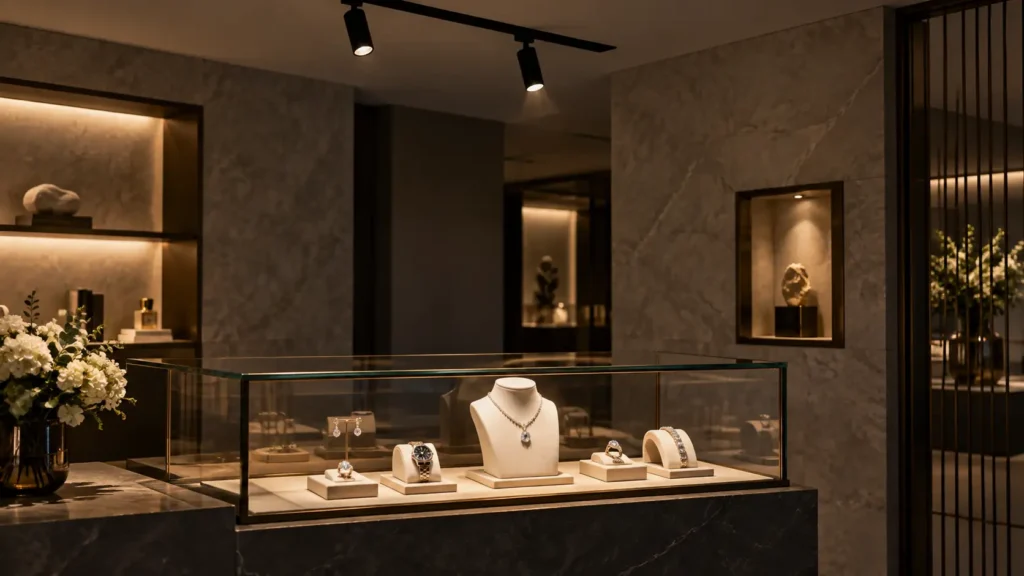
If the question is “how bright is this 5W?”, the first figure to request is COB spotlight lumen output for the finished luminaire.
That means the light leaving the complete spotlight—not a chip headline.
Chip output
This is LED-package performance under a stated test condition.
Fixture output
This is what remains after the driver, thermal path, reflector or lens, and protective parts have done their work.
Pour low-wattage COB spotlighting, the useful number is the finished spotlight lumen figure.
For a finished spotlight, use the finished spotlight lumen figure—not a COB chip headline number.
Skip “equivalent wattage” marketing when you need a real brightness decision.
🎯 Which lumen number should buyers trust?
Use finished-luminaire lumens for the exact optic and CCT/CRI version you will order—not a package maximum.
🔁 3. Why Two 5W COB Spotlights Can Have Different Lumens
Teams often ask: both say 5W—why are the lumen ratings different?
A fair COB chip brightness comparison starts with the complete design, not the wattage stamp alone.
COB / LED package performance
Different COB packages can deliver different light at the same power class.
Driver operating condition
How the LED is driven changes real output even when the label still reads 5W.
conception thermique
Higher junction temperature usually reduces usable light in service.
Optical losses
Reflectors, lenses and covers remove some light before it leaves the head.
The 5W rating sets the power class; the complete design determines how much usable light leaves the fixture.
🎯 Why can two 5W heads publish different lumens?
Because package, drive, heat and optics set delivered light; the wattage class only sets the power band.
🔦 4. Same Lumens Can Still Look Different
Even when two 5W spotlights sit in a similar lumen class, the scene can still look unequal.
angle de faisceau
The same total light behaves differently when spread changes.
- Narrow beam → light concentrates on a smaller patch
- Wide beam → light covers a larger area
Illustrative only (not product data):
| Mettre en lumière | Same general lumen class | Faisceau | Typical centre feel |
|---|---|---|---|
| A | Similar total output | Étroit | Higher target centre illuminance |
| B | Similar total output | Large | Softer, wider wash |
A can look “brighter” on a small display without producing more total lumens.
A narrower beam can look brighter on a small target without producing more total light.
For how commercial beam choice is usually framed after you know the lumen class, see Quel angle de faisceau est optimal pour l'éclairage sur rail commercial ?.
🎯 Can equal lumens look unequal on a display?
Yes. Beam concentration changes centre illuminance even when total output is similar.
📏 5. Distance Changes How Bright the Target Looks
The same 5W COB spotlight is not “one brightness” at every throw.
At a short distance, more illuminance reaches the target.
At a longer distance, the same beam covers a larger area and target illuminance falls.
So “Is 5W bright enough?” still needs:
- mounting height
- throw distance
- target size
- angle de faisceau
A 5W spotlight that works at a short throw may not give the same result from a much higher ceiling.
There is no universal “5W reaches X metres” rule that replaces project geometry.
🎯 Does mounting distance change how bright 5W feels?
Yes. Longer throw usually lowers target illuminance for the same beam and aiming.
👁️ 6. Lumens and “Looks Bright” Are Not the Same Thing
Datasheet lumens describe fixture output.
What people call “bright” is still a scene judgment.
Related factors that stay in this article’s scope:
- beam concentration
- target reflectance and colour
- surrounding ambient light
- mounting distance
- aiming accuracy
A white display surface and a dark surface can read differently under similar illumination.
High ambient light can make the same 5W accent look weak.
Brightness is experienced in a scene; lumens are measured at the fixture.
🎯 Why can similar lumen sheets still feel different on site?
Because reflectance, ambient light, aim and distance change what the eye reads on the target.
❓ 7. Is a 5W COB Spotlight Bright Enough?
Sometimes—but “5W” alone is not enough to decide.
Typical 5W COB fixture uses succeed when the task is a small, aimed target—not when 5W is treated as a room-fill guarantee.
Check conditions, not slogans:
Target size
Small objects are easier to accent with low power than large wall fields.
Distance
Longer throws raise the intensity demand for the same visual result.
angle de faisceau
Narrow and wide beams cannot share one “5W is enough” answer.
Lumière ambiante
High ambient light makes accent contrast harder.
Required illuminance
Commercial work still needs a target illuminance idea for the object, not only a wattage class.
The correct question is not “Is 5W bright enough?” but “Is this 5W spotlight bright enough for this target, beam and distance?”
🎯 Is “5W enough?” a complete buying question?
No. Pair wattage with target size, throw, beam and ambient conditions first.
📋 8. What Should You Compare Between Two 5W COB Spotlights?
If both products say 5W, the comparison has only just started.
Suggested order:
- Finished lumen output
- angle de faisceau
- Candela / intensity data
- Lux values at stated distances
- CRI and CCT
- Fixture dimensions / optic
- IES / LDT data if available
- Sample at the real project distance
| Vérifier | What it answers |
|---|---|
| 5W | How much power the fixture uses |
| Lumens | How much total light leaves the fixture |
| angle de faisceau | How concentrated the light is |
| Candela | Intensity in a direction |
| Lux at distance | Light reaching the target |
| CRI / CCT | Whether comparison conditions are similar |
| IES / LDT | How the fixture performs in the project |
If two products both say 5W, the comparison has only just started.
When you review a published commercial head sheet, an adjustable D90 round LED spot downlight shows how wattage and optic options sit on one finished-product page—then match that habit to the 5W COB spotlight SKU you are quoting.
🎯 What comes after matching the 5W label?
Finished lumens, beam, intensity or lux-at-distance, then CRI/CCT and a real-distance sample.
🧪 9. How to Check a 5W Sample Before Ordering
Use the intended distance
Do not judge a 3 m ceiling job from a 0.5 m bench test alone.
Use the intended beam
A 15° sample and a 60° sample are not a fair “who looks brighter” contest.
Use the real target
Merchandise, artwork and wall finishes reflect differently.
Compare under the same ambient condition
Otherwise the sample race is noise.
Record the chosen configuration
Note wattage, lumen, CCT, CRI, beam angle and optic so production does not collapse back to “5W COB” only.
🎯 What should a 5W sample prove before order?
That the exact lumen–beam–CCT package still works at the real throw and target—not only on a close bench.
❌ Common Mistakes
Mistake 1 — Treating 5W as a brightness specification
5W is power. It is not a fixed brightness grade.
Mistake 2 — Comparing chip lumens with fixture lumens
Those figures sit on different layers of the product.
Mistake 3 — Looking only at total lumens
Spotlights are directional; distribution changes target illuminance.
Mistake 4 — Ignoring mounting distance
Change the throw and the same head can feel very different.
Mistake 5 — Comparing different beam angles as if they were identical
A narrow beam that “looks brighter” is not proof of higher total light.
Mistake 6 — Asking whether 5W is enough without defining the target
You still need what you light, how far, and how wide the beam is.
📝 Final Checklist — How Bright Is This 5W COB Spotlight Really?
- [ ] Is 5W the complete fixture input power?
- [ ] What is the finished lumen output?
- [ ] Is the lumen figure for the luminaire or COB package?
- [ ] What beam angle is being quoted?
- [ ] Is candela data available?
- [ ] Are lux values provided at stated distances?
- [ ] What is the actual mounting distance?
- [ ] What size target needs to be illuminated?
- [ ] Are CRI and CCT the same between samples?
- [ ] Is an IES/LDT file available?
- [ ] Has the actual configuration been sample-tested?
🗣️ What to Ask the Supplier
Do not stop at: “How bright is your 5W COB spotlight?”
Demander:
- What is the finished luminaire output in lumens?
- What beam angles are available?
- What is the centre intensity / candela?
- Do you have lux data at different distances?
- Is the quoted lumen figure for the COB or complete spotlight?
- What CRI and CCT apply to that lumen figure?
- Is IES or LDT photometric data available?
- Can the exact 5W + beam + CRI configuration be sampled?
Que faire ensuite ?
- Rewrite the brief from “need 5W COB” to “need this lumen class, beam and throw on this target.”
- Put finished lumens, beam angle, CRI/CCT and any candela or lux-at-distance notes on one comparison row for each 5W option.
- Need a project review or quotation? Contact the XHLUX team with target size, mounting height, preferred beam and the 5W configurations under review.
Quotes become misleading when 5W is treated as a brightness grade instead of a power class tied to a finished optic.
🏁 Conclusion: How bright is a 5W COB spotlight?
A 5W COB spotlight does not have one fixed brightness. The wattage tells you the power level, while lumen output, beam angle, intensity and mounting distance determine what the target actually receives.
Do not ask only how many watts the spotlight uses. Ask how much light the exact 5W configuration delivers where you need it.
Explorez nos articles de blog connexes :
- What Are Surface-Mounted COB Lights and When Should You Use Them?
- Quand utiliser des projecteurs sur rail à faisceau étroit dans les espaces commerciaux
- What Is an Eyeball Spotlight Used For?