 XHLUX
XHLUX
Dining room track lighting can outperform a centred pendant when the table regularly moves, extends or divides into different service layouts. The advantage is not that track lighting is automatically better. It is that each head can follow a new target without moving the ceiling feed.
Use this page when choosing a track light for dining room layouts that must adapt between everyday meals, larger gatherings, events or changing restaurant table plans.
For the wider choice between line-voltage, three-circuit, magnetic and proprietary rail families, start here:
→ Guide des systèmes d'éclairage sur rail : types, composants et comment choisir
For target-first aiming principles used in changing commercial displays, use this related guide:
→ Conseils d'aménagement pour l'éclairage sur rail LED dans les présentoirs de magasins
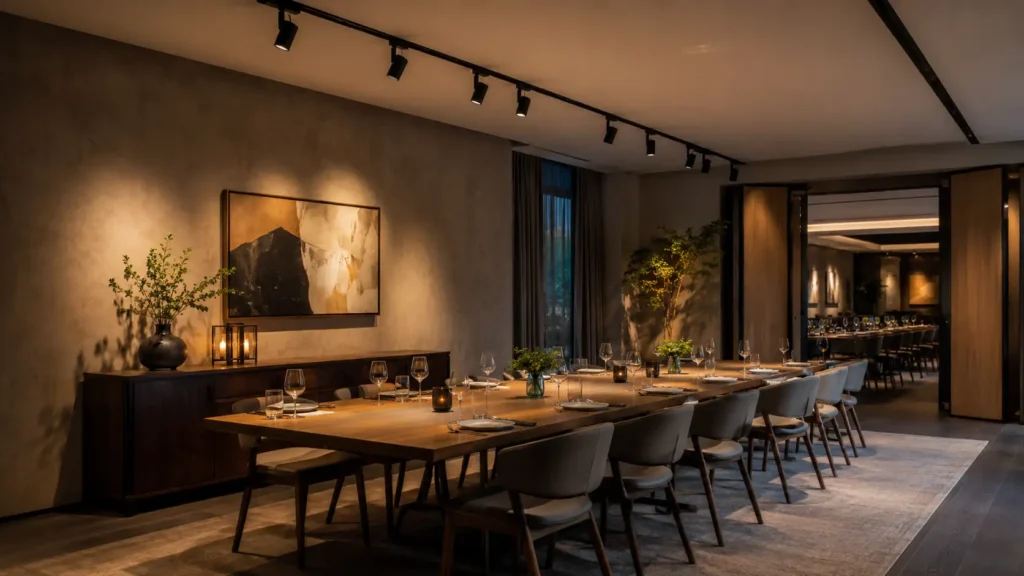
TL;DR : Choose a pendant when one table has a permanent centre and the fixture is part of the room’s identity. Choose track lighting when credible table positions change. Draw every table position, place the rail where heads can reach those targets, control glare from seated sightlines, approve warm dimming and define how the heads will be reset after each change.
1. Prove that the table really needs to move
Track flexibility has value only when the room will use it. A table that could move someday is not the same as one reconfigured every week.
Document the credible operating modes before selecting a ceiling system:
| Dining condition | What changes below the ceiling | What the lighting must do |
|---|---|---|
| Everyday layout | One fixed table or one regular restaurant plan | Hold a stable, comfortable scene |
| Extended table | Leaves or extra tables lengthen the target | Add or redirect coverage along the new length |
| Split layout | One long table becomes two or more smaller tables | Create separate pools without lighting empty floor |
| Mode événementiel | Furniture moves for presentations, receptions or service | Re-aim selected heads and retain useful circulation light |
| Seasonal restaurant reset | Tables, artwork or displays change together | Recommission aim, scenes and group control |
If only the chair count changes while the tabletop centre remains fixed, a pendant may remain simpler. Track solves a real problem when the table moves beyond the useful beam of that fixed fixture.
🎯 Does a table with extension leaves automatically need track lighting?
No. Track becomes useful when the illuminated length or centre changes enough that a fixed fixture cannot serve every approved layout.
2. Start with every table position, not the rail centreline
A neat rail centred in the ceiling can still miss the dining target. Draw the furniture first.
For every approved table position, mark the:
- Tabletop outline and centreline
- Occupied chair zones and seated eye positions
- Serving and circulation routes
- Reflective glass, polished stone and mirrors
- Artwork, sideboards or walls needing a separate accent
Then draw aiming lines from possible head positions to those targets. The rail belongs where several credible aiming paths remain available, not necessarily where the ceiling looks most symmetrical.
The wrong sequence is:
Centre the rail in the room, divide the heads evenly and hope each table position falls under a beam.
The better sequence is:
Map table positions, choose target points, test aiming directions, locate the heads and then confirm the rail can support those positions.
A single rail may serve a long table that slides along the same axis. Parallel rails may provide better reach when tables move sideways or split. Joined layouts can serve complex plans, but every connector, feed and control zone must belong to the approved system family.
An evenly spaced row is not a photometric result. Head positions should respond to table ends, centre zones, place settings, reflective finishes and the beam distribution of the exact optic.
🎯 Should the rail always be centred over the dining table?
No. It should sit where compatible heads can reach every approved target without creating uncomfortable aiming angles or blocked sightlines.
3. Compare track and pendant by the job each one does best
A pendant and a track organize the room differently.
| Decision factor | Fixed pendant | Éclairage sur rail |
|---|---|---|
| Permanent table centre | Strong visual anchor | Can work, but may add unnecessary ceiling hardware |
| Moving or split tables | Usually remains tied to the original centre | Heads can be repositioned or re-aimed within system limits |
| Decorative identity | Fixture can become the focal object | Rail and heads can remain visually secondary |
| Layered targets | Often needs additional sources | Multiple heads can separate table, wall and sideboard targets |
| Reset discipline | Little aiming adjustment after installation | Requires an approved method for restoring aim and scenes |
| Ordre visuel | One centred object can simplify the ceiling | Poorly coordinated heads can look busy or commercial |
Track lighting need not remove every decorative layer. A project can retain a pendant for identity and use discreet heads for art or changing tables. The risk is visual competition when the rail, cylinders and pendant all demand attention.
Decide which element leads. A formal private room may centre on its pendant; a flexible restaurant may need the rail to recede while tables change below it.
🎯 Can a dining room use both a pendant and track lighting?
Yes, when their roles are separated. Let one provide the visual anchor and use the other only for targets the anchor cannot serve.
4. Aim at the meal without aiming into diners’ eyes
The useful target is the tabletop and selected vertical surfaces, not the top of a diner’s head.
A track spotlight over dining table positions must be checked from occupied seats. A head that looks harmless from the doorway may expose a bright aperture when someone looks across the table or leans back.
Use a seated sightline check:
- View every head from both long sides and both table ends
- Check direct view into the LED or reflector
- Check reflected images in glass, polished stone, framed art and mirrors
- Confirm that re-aiming for another table position does not create a new glare path
CIE glare guidance treats observer position and viewing direction as part of the assessment. That matters in dining spaces because occupants face several directions, not one fixed workstation orientation.
Beam geometry helps with the first layout. A nominal beam diameter can be estimated as:
diamètre du faisceau ≈ 2 × distance à la cible × tan(angle du faisceau ÷ 2)
At a 1.8 m aiming distance, a nominal 24° beam is about 0.77 m wide, while a 36° beam is about 1.17 m wide. Those figures describe initial geometry only. They do not predict maintained illuminance, field light, tabletop reflectance, glare or visual comfort.
Do not solve a dark table by aiming every head at its centre. That can create a hotspot and hard facial shadows. Use the exact photometric file and a mock-up to balance centre light, edge coverage and vertical light on diners.
The diagram shows decision logic, not a universal rail position, head count or aiming angle.
🎯 Does a narrower beam always give better dining-table light?
No. It may increase contrast but can also create hotspots and dark gaps; choose the distribution from target size, distance and overlap.
5. Plan for long tables, round tables and split layouts
Different table movements create different aiming problems.
Long or extendable tables
Place potential heads along the usable table length, including the extension zone. Allow for feeds, connectors and end restrictions; do not rely on severe cross-aiming from one end.
Round tables
A permanent round table often suits a pendant. Track becomes useful when it is removed, split or shifted. Confirm the rail can serve both plans without heads pointing across occupied sightlines.
Restaurant tables that join and separate
Treat each operating plan as a separate scene. A banquet table may need continuous coverage, while individual tables need smaller target zones. Dimming alone may not be enough; positions and aim may also change.
C'est ici que adjustable dining room lighting has operational value. Store a marked ceiling plan or commissioning record for each arrangement so staff do not improvise after every reset.
🎯 Should track heads be divided evenly along the rail?
Not by default. Position them from the approved targets and beam distributions, then check that the resulting ceiling rhythm remains visually ordered.
6. Keep the food warm without making the room dim
Warm appearance, useful task light and good colour rendering are separate decisions.
Spécifier warm track lighting for dining by reviewing the complete light source and control package:
- Correlated colour temperature at full and dimmed output
- Colour rendering data relevant to food, skin tones and interior finishes
- Colour consistency between track heads and decorative luminaires
- Dimming range, curve and low-end stability
- Driver and dimmer or control-system compatibility
- Flicker behaviour across the operating range
- Beam distribution and shielding at the selected output
A warm CCT does not guarantee comfort. An exposed aperture can still glare, and poor dimming can cause flicker, drop-out or visible differences between heads.
If a pendant remains, compare physical samples. Two products labelled 3000 K can still differ because of chromaticity tolerance, spectral distribution, optics and surrounding materials.
Separate a bright preparation or cleaning scene from the dining scene. Artwork or joinery may also need control independent of the table layer.
🎯 Does warm colour temperature remove the need for glare control?
No. CCT describes colour appearance; aperture luminance, shielding, aim and seated sightlines still determine visual comfort.
7. Approve the reset process before approving the flexibility
Track lighting remains flexible only when staff can use it safely and consistently.
For every approved table plan, record:
- Which heads move and which remain fixed
- Head positions measured from a known rail reference
- Aiming targets and orientation
- Circuit, group or scene assignments
- Required output or dimming scene
- Access method, responsible person and manufacturer instructions
- A final seated glare and tabletop-uniformity check
Do not assume every head can move while energized. Follow the exact system instructions and electrical safety procedure. Attachment, retention and electrical contact are system-specific.
Commission at least two real furniture modes before handover. A plan that works only for the opening-night table arrangement has not demonstrated the flexibility promised by the specification.
The purchase order should identify the rail family, feeds, connectors, adapters, heads, optics, CCT, colour quality, drivers, controls and finishes. The label dining room accent lighting does not prove those parts fit or perform together.
🎯 What is the final test for a flexible dining layout?
Move the furniture to another approved position, reset the heads and scenes, then repeat the tabletop and seated-sightline checks.
FAQ
Que faire ensuite ?
- Draw every table layout that the room will genuinely use.
- Decide whether a pendant, track or layered combination should lead visually.
- Plot seated sightlines before fixing rail and head positions.
- Test the exact optic, output, CCT and dimming package with a real sample.
- Record one repeatable reset and commissioning plan for each furniture mode.
XHLUX can coordinate commercial track rails, heads, optics, finishes and control requirements against an approved dining or hospitality lighting schedule.
Notes et sources
- CIE S 017:2020, ILV: International Lighting Vocabulary, for beam-angle and lighting terminology.
- CIE 117:1995, Discomfort Glare in Interior Lighting, for observer position and viewing-direction principles.
- CIE 232:2019, Discomfort Caused by Glare from Luminaires with a Non-Uniform Source Luminance, for non-uniform LED-source glare considerations.
- ISO/CIE 8995-1:2025, Light and Lighting, Lighting of Work Places, Part 1: Indoor, for the broader relationship between illuminance, glare, colour and visual conditions.
- Numerical beam examples are nominal geometry checks, not maintained-lighting calculations or universal dining prescriptions.
![Qu’est-ce qu’un luminaire encastré classé IC : Guide de sécurité critique [2025]](https://www.xhlux.com/wp-content/uploads/2025/07/What-is-IC-Rated-Downlight-560x560.webp "Qu’est-ce qu’un luminaire encastré classé IC : Guide de sécurité critique [2025]")