XHLUX
A 6000k led downlight sits in the cool, daylight-white part of the white-light scale. Buyers often treat that Kelvin number as a brightness upgrade. It is not.
Correlated colour temperature (CCT) describes how white light looks—warmer or cooler—not how many lumens leave the fixture or how much lux lands on a work surface. Colour rendering, glare control and product-to-product colour match still need their own checks.
This guide is for commercial buyers, distributors, contractors and lighting designers who need to specify 6000k led downlights, compare a 6000k downlight against neighbouring daylight options, and decide when 6000k daylight white is the right tool rather than a default label.
TL;DR
- Look: Cool white / daylight-white appearance, often crisp beside warmer sources.
- Cas d'utilisation courants : Task-heavy commercial and functional zones where detail visibility matters—not every room by default.
- Brightness: 6000K does not mean higher lumen output; check published lm and calculated lux.
- Selection: Evaluate CCT with lumen package, CRI/R9 or TM-30, optics/glare, colour consistency and whether you need fixed or selectable CCT.
Table des matières
- 1. What Does 6000K Mean in LED Downlights?
- 2. Where Are 6000K LED Downlights Best Used?
- 3. How Bright Is a 6000K LED Downlight?
- 4. How Does 6000K Affect Colour Appearance?
- 5. Can 6000K LED Downlights Cause Glare or Visual Discomfort?
- 6. Why Do Different 6000K LED Downlights Look Different?
- 7. How Does 6000K Compare with 5000K and 6500K LED Downlights?
- 8. Is 6000K Too Cool for Residential and Open-Plan Spaces?
- 9. Should You Choose Fixed 6000K or CCT-Selectable LED Downlights?
1. What Does 6000K Mean in LED Downlights?
1.1 What Is the Colour Temperature of 6000K?
Kelvin (K) is the unit used for correlated colour temperature. CCT places a white light source near a theoretical black-body radiator on a chromaticity diagram and reports that nearest temperature.
Per the U.S. Department of Energy’s LED Color Characteristics guidance, CCT characterises how “cool” (bluish) or “warm” (yellowish) nominally white light appears. It describes the colour of the emitted light, not the colour of illuminated objects and not luminous output.
A 6000K rating therefore means the white light is correlated with a cool-white appearance associated with a high CCT. It does not state brightness, efficacy or colour-rendering quality.
1.2 What Does 6000K Light Actually Look Like?
In practice, 6000K reads as cool white or daylight white: crisp, relatively bluish beside 2700K–3000K sources, and cooler than typical 4000K neutral commercial white.
Beside warmer light, the contrast is obvious. Beside other high-CCT products, the difference can be subtler and depends on chromaticity, spectrum and the surrounding finishes.
Some 6000K products look relatively neutral cool white. Others lean more bluish. That variation is expected once you remember CCT compresses a full spectrum into one number.
1.3 Is 6000K the Same as Natural Daylight?
Daylight is a moving target. Laboratoire de conception d'éclairage notes that summer sunlight at noon on a clear day can appear very cool—around 5500K—while morning and late-afternoon daylight can look warmer.
Matching a nominal 6000K CCT does not reproduce the full spectral distribution of outdoor daylight. LED white light is usually built from a blue (or near-UV) pump plus phosphor conversion, or from mixed coloured LEDs. Natural daylight has a different continuous spectrum.
So “daylight white” as a commercial label for a daylight white led downlight means a cool appearance band, not a claim that the LED spectrum equals the sky.
🎯 Does 6000K mean the light is brighter or simply cooler in appearance?
Simply cooler in appearance. Brightness still depends on lumen output, distribution and illuminance on the task.
2. Where Are 6000K LED Downlights Best Used?
Cool daylight-white light is a candidate when the room has a clear functional job: edge detection, mark finding, surface inspection or short-duration task work. It is not a universal commercial default. Needing “bright light” is not, by itself, evidence that 6000K is the right CCT.
2.1 6000K for Kitchen Task Lighting
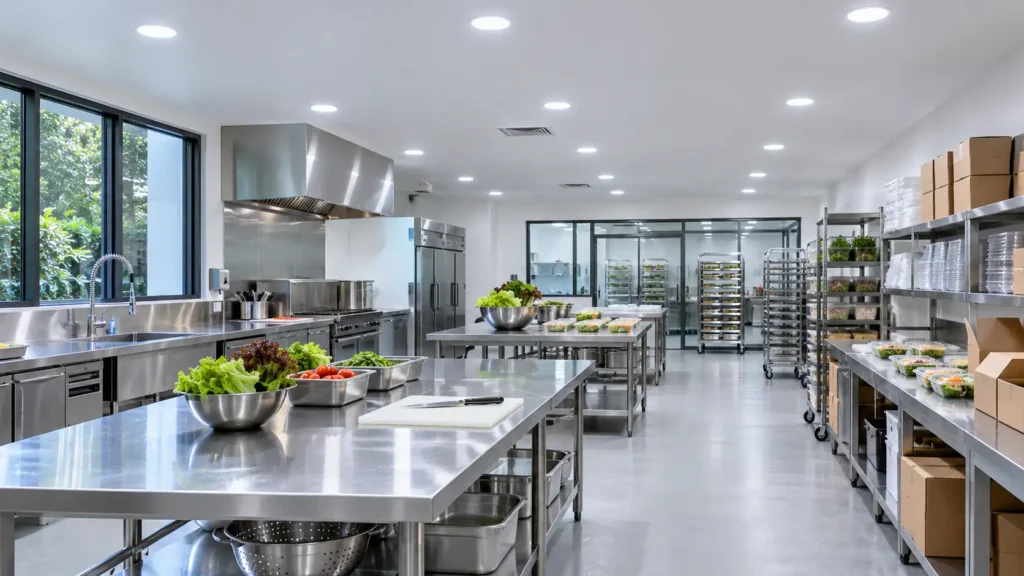
In commercial food-preparation areas, 6000K may be considered when the lighting specification calls for a cool daylight-white appearance. However, the suitability of this CCT depends on the visual task, colour-rendering requirements, illuminance and the overall lighting design. It is not a default CCT for every commercial kitchen.
Distinguish prep areas from dining, lounge or guest-facing rooms, where atmosphere usually outweighs a clinical white point. Food appearance still depends on colour rendering: a high CCT with weak red rendering can make proteins and produce look less natural even when the ceiling looks “bright.”
Where a schedule does call for 6000K over prep surfaces, a commercial multi-CCT downlight that publishes that step—such as the KSR Sorocco II range (3000K / 4000K / 6000K; published lumen rows appear with the brightness section below)—is one product route for meeting the specified Kelvin. Product availability of a 6000K option is not evidence that kitchens in general should be lit at 6000K.
2.2 6000K for Inspection and Quality Control Areas
Inspection benches and quality-control points are among the stronger candidates for cool daylight-white light because they rely on edge contrast and visible defect recognition. Lighting Design Lab’s fundamentals materials place Daylight (5000K+) in an application band associated with “Bright / Alert / Color Match,” including industrial and healthcare-adjacent contexts (LDL 103 Light Sources and Luminaires).
That association supports considering a high CCT such as 6000K for inspection tasks. It does not prove that CCT alone delivers accurate inspection: working-plane illuminance, glare control and colour-rendering data still have to match the task. Two 6000K fittings can differ in spectrum, glare and delivered lux.
2.3 6000K for Commercial and Back-of-House Areas
Back-of-house storage, packing and operational zones may adopt cool white when the lighting schedule selects a daylight-white CCT for label reading, stock checking or cleaning visibility. Commercial recessed ranges that publish a 6000K option—again illustrated by Sorocco II’s selectable 6000K commercial downlight listing—show that manufacturers supply this CCT for commercial interiors, not that every warehouse or facility requires it.
Ceiling height, beam distribution and working-plane illuminance still decide whether the layout works. Many general commercial interiors remain better served by neutral white unless the task brief says otherwise.
2.4 Can 6000K Be Used in Laboratories and Technical Workspaces?
Cool-white illumination may be considered for general technical workspaces where detail visibility is valued. Specialised laboratory lighting is a separate discipline: some tasks need controlled spectrum, strict colour criteria or dedicated task luminaires beyond a recessed downlight CCT choice.
Avoid recommending 6000K universally for laboratories. Match the visual task, rendering needs and comfort constraints first.
For a broader daylight-white placement map (including where high CCT often fails), see Spots encastrés à DEL à lumière du jour : leurs avantages et leurs inconvénients.
🎯 Is 6000K suitable for every commercial workspace?
No. It can support detail-focused functional zones, but glare, lux, colour rendering and atmosphere still decide the fit.
3. How Bright Is a 6000K LED Downlight?
3.1 Does 6000K Determine the Brightness of an LED Downlight?
No. CCT and luminous output are separate specifications.
Two 6000K LED downlights can share the same Kelvin label and deliver very different lumen packages because wattage, LED efficacy, optics and thermal design differ. DOE notes that higher-CCT LEDs within the same product family often tend to be more efficacious, but that is a technology tendency—not a rule that every 6000K SKU produces more lumens than every warmer-CCT SKU at equal wattage.
3.2 How Many Lumens Can a 6000K Downlight Produce?
Use manufacturer datasheets for the exact CCT you will order. One published commercial example is the KSR Lighting Sorocco II range: dual-wattage, 3CCT selectable at 3000K / 4000K / 6000K, with lumen rows listed by CCT on the product data sheet.
| Product (datasheet) | Puissance | 3000K | 4000K | 6000K |
|---|---|---|---|---|
| Sorocco II S | 6W | 510 lm | 565 lm | 530 lm |
| Sorocco II S | 8W | 685 lm | 735 lm | 765 lm |
| Sorocco II M | 10W | 850 lm | 930 lm | 920 lm |
| Sorocco II M | 15W | 1250 lm | 1435 lm | 1375 lm |
| Sorocco II L | 20W | 1785 lm | 2005 lm | 1925 lm |
| Sorocco II L | 30W | 2516 lm | 2830 lm | 2785 lm |
Source: KSR Sorocco II LED Downlight data sheet (KSRDL388–KSRDL390).
These are manufacturer-published lumen ratings for the specified selectable-CCT product configurations, not universal brightness values for all 6000K downlights. The same sheet also lists circuit power including driver losses separately from the nominal wattage labels; if you calculate lm/W, use one consistent power basis.
On several wattage rows, 6000K publishes fewer lumens than 4000K at the same wattage. On the 8W row, 6000K is slightly higher than 4000K. That is exactly why you read the lumen line for the CCT you buy.
Luminous efficacy (lm/W) is lumen output divided by input power for the stated condition. Compare like-for-like CCT, driver and optic—not Kelvin alone.
3.3 What Is the Difference Between Lumens and Lux?
- Lumens (lm) : total luminous flux emitted by the source or luminaire.
- Lux (lx) : illuminance received on a surface (lumens per square metre).
Mounting height, beam angle, reflectance and fixture quantity change lux even when lumen output is fixed. A high-lumen narrow beam can leave peripheral areas under-lit; a lower-lumen wide distribution can feel more even.
Room “brightness” is therefore a layout result, not a CCT property.
3.4 Why Can 6000K Light Feel Brighter?
Perceived brightness is not the same as measured illuminance. Cool white can increase contrast and feel sharper beside warmer light, especially on pale surfaces.
Visual adaptation, surrounding luminance and spectrum all influence that sensation. It is not safe to claim that 6000K always looks brighter than warmer light at equal lux.
🎯 Can a 6000K downlight produce fewer lumens than a 4000K downlight with the same wattage?
Yes. Published multi-CCT datasheets can list lower 6000K lumens than 4000K at equal wattage—verify the CCT-specific lumen row.
4. How Does 6000K Affect Colour Appearance?
4.1 How Does 6000K Affect White and Grey Surfaces?
Cool-white illumination interacts with surface reflectance. Painted whites, cool greys, stainless steel and pale laminates often look clean and high-contrast under 6000K.
Warm timber, beige fabrics and skin tones may appear cooler under 6000K illumination than under warmer white lighting. The actual colour appearance also depends on the light source’s spectral distribution and the reflectance of the materials. Always sample on the real finishes, not only on a white card.
4.2 How Does CRI Affect Colour Rendering Under 6000K Lighting?
Colour Rendering Index (CRI / Ra) estimates how faithfully a source renders a set of test colours relative to a reference at a similar CCT. CCT and CRI answer different questions: one is white appearance; the other is object-colour fidelity versus that reference.
As a published example at 6000K, the KSR Sorocco II sheet specifies CRI Ra>80 across its selectable CCT steps, while many commercial cool-white platforms—including XHLUX modular downlights in neighbouring high-CCT bands—publish multiple CRI tiers such as Ra80+ through Ra95+/Ra98+. Same cool CCT class, different rendering packages.
Where the project brief is utility-only, an Ra80-class product may meet the written requirement. Where critical visual judgement of materials, food or branded colour is required, specifiers often request Ra90+ and stronger red performance (R9)—but those thresholds should come from the project specification, not from a universal industry rule attached to every kitchen or inspection room.
4.3 Why Should You Check R9 and TM-30?
R9 is the special index for a saturated red sample. It is not averaged into general CRI Ra, so a product can look acceptable on Ra while reds still fall short.
ANSI/IES TM-30 adds fidelity (Rf) and gamut (Rg) metrics that give a broader colour-rendition picture than a single Ra number. Not every project needs the same colour-rendering package—match the metric depth to the visual risk.
Higher CRI does not automatically make a 6000K source look less blue. CRI does not “warm up” CCT; it changes how object colours compare with the reference.
🎯 Does a higher CRI make a 6000K downlight look less blue?
No. CRI addresses object-colour fidelity versus a reference; it does not change the nominal cool-white CCT appearance.
5. Can 6000K LED Downlights Cause Glare or Visual Discomfort?
5.1 Is 6000K Itself the Cause of Glare?
Glare is driven by source luminance, size, position, viewing angle and contrast with the background—not by Kelvin alone.
A high-CCT aperture can feel more conspicuous in a dark ceiling, which people sometimes blame on “cold light.” The engineering fix is still optical and layout control, not simply changing the CCT label while leaving a bright unprotected source in the field of view.
5.2 How Do Beam Angle and Optical Design Affect Visual Comfort?
Narrow beams raise peak intensity; wide beams spread light but can still glare if the LED is shallow and visible. Recessed optics, deep reflectors, baffles and anti-glare accessories reduce direct view of the source.
UGR (Unified Glare Rating) is a room-and-layout metric used in many commercial schemes. Treat published UGR claims in context—fixture optic, spacing, reflectance and observer position all matter. The Sorocco II sheet, for example, states that its faceted reflector and prismatic diffuser help designers achieve UGR19 within schemes; that is a design outcome, not a CCT property.
5.3 Can Dimming Improve the Comfort of 6000K Lighting?
Dimming lowers light output and can ease discomfort when levels are simply too high. Fixed-CCT dimming keeps the nominal white point while reducing intensity.
That is different from Dim-to-Warm, which shifts warmer as output falls. Dimming a fixed 6000K product does not automatically convert it into warm white. Confirm driver and dimmer protocol compatibility before promising smooth control.
This guide does not treat 6000K as a medical cause of eye strain. Comfort issues should be addressed through illuminance, glare control, contrast and usable hours—not unsupported health claims.
🎯 Can a well-designed 6000K downlight provide comfortable lighting without excessive glare?
Yes, when optics, shielding, layout and light levels are controlled; CCT alone neither creates nor removes glare.
6. Why Do Different 6000K LED Downlights Look Different?
6.1 How Does Spectral Power Distribution Affect Light Appearance?
Spectral power distribution (SPD) is the relative power of the source across wavelengths. CCT is a one-number summary of chromaticity near the Planckian locus.
Identical CCT values do not guarantee identical SPDs. Different LED dies and phosphor formulations can produce similar 6000K chromaticity while distributing spectral energy differently. This explains why the Kelvin rating alone cannot fully describe the spectral characteristics of an LED downlight.
6.2 What Do Chromaticity Coordinates and Duv Mean?
CIE chromaticity coordinates (for example x, y) locate the colour point. Duv is the signed distance of that point from the black-body (Planckian) locus at the same CCT.
As the same DOE LED Color Characteristics fact sheet explains, at one CCT a positive Duv can look slightly greenish and a negative Duv slightly pinkish. Two “6000K” labels can therefore sit on different sides of the locus and disagree visually even before SPD differences are considered.
6.3 How Do SDCM and LED Binning Affect Colour Consistency?
MacAdam ellipses describe noticeable colour difference; SDCM (standard deviation of colour matching) is commonly used in commercial LED specifications as a tolerance language (for example SDCM <3 on many project sheets).
LED binning sorts devices by chromaticity (and often flux/voltage) so luminaires can be built from tighter groups. On a multi-fixture commercial ceiling, loose binning shows up as patchy whites even when every carton says 6000K.
Keep the four ideas separate:
| Concept | Ce que cela permet de vérifier |
|---|---|
| SPD | How energy is distributed across wavelengths |
| Duv | How far chromaticity sits above/below the black-body locus |
| SDCM | How tight the colour tolerance is (consistency language) |
| Binning | How LEDs are sorted in manufacturing for that consistency |
🎯 Why can two LED downlights labelled 6000K still look noticeably different?
Because CCT collapses spectrum and chromaticity into one number—SPD, Duv and binning/SDCM can still diverge.
7. How Does 6000K Compare with 5000K and 6500K LED Downlights?
7.1 What Does 5000K Look Like Compared with 6000K?
Nominally, 6000K is cooler than 5000K on the CCT scale. In a side-by-side mock-up with matched optics and output, many observers read 6000K as a step more “daylight cool.”
Without measured chromaticity, avoid absolute statements such as “5000K is always white and 6000K is always blue.” Finish colours, adaptation and Duv can shrink or exaggerate the gap.
7.2 How Does 6000K Differ from 6500K?
6500K sits higher on the nominal CCT scale than 6000K. The difference is 500K, but how noticeable it appears depends on the actual chromaticity, Duv, spectral distribution and viewing conditions.
If your project is already debating high-CCT daylight options against neutral white, the live comparison LED Downlight 6500K vs 4000K covers that wider contrast without repeating this article’s 5000/6000/6500 focus.
7.3 Why Do Manufacturers Describe Similar CCTs Differently?
Marketing names—Cool White, Daylight, Cool Daylight, Daylight White—are not standardised worldwide. Lighting Design Lab materials note that colour descriptions are especially inconsistent at higher CCTs, and that “daylight” fluorescent/LED products are often associated with roughly 5000–6500K (see also the LDL Green Home Lighting Guide).
Always read the numeric CCT (and, where available, chromaticity/Duv) on the datasheet. Do not award a purchase decision to the word “daylight” alone.
🎯 Is 6000K closer in appearance to 5000K or 6500K?
Numerically, 6000K is closer to 6500K, with a 500K difference compared with 1000K from 5000K. However, perceived similarity also depends on chromaticity, Duv and viewing conditions.
8. Is 6000K Too Cool for Residential and Open-Plan Spaces?
8.1 Does 6000K Make Living Spaces Feel Too Cold?
For many residential users, 6000K may feel too cool for lounges and bedrooms, where a warmer and more relaxed atmosphere is preferred. However, suitability depends on personal preference, the room’s function and the overall lighting design.
A focused task area may use a cooler CCT than the surrounding ambient lighting, provided the visual task, user preference and overall lighting design support it. Separate functional task needs from ambient comfort before locking one CCT for an entire open plan.
8.2 Is 6000K Suitable for Kitchens and Home Offices?
Residential kitchen task areas, including focused downlight illumination over worktops, may use cool white if the household prefers a crisp visual appearance. Home offices sometimes prefer cooler light for paperwork, but screens introduce glare and reflection risks that CCT cannot fix.
This is not the same decision as commercial kitchen prep lighting in Section 2. Domestic dining adjacency, evening use and mixed family preferences usually argue for restraint.
8.3 Can 6000K Be Combined with Warmer Lighting?
Yes—when zones are visually separated. A cool task niche beside a warmer living zone can work if the boundary is intentional.
Where ceilings read as one continuous field, mixed CCTs often look like a coordination error. Keep uniformity where the eye expects one white, and change CCT only across clear activity boundaries.
🎯 Is 6000K too cool for a residential kitchen or home office?
Often for whole-room ambient use; it can still fit focused task zones if preference, glare and neighbouring warmer spaces are checked.
9. Should You Choose Fixed 6000K or CCT-Selectable LED Downlights?
9.1 What Is the Difference Between Fixed and Selectable CCT?
- Fixed 6000K: one engineered white point; simplest SKU when the project CCT is already decided.
- Multi-step CCT selectable: discrete presets (commonly set by a switch or selector on the luminaire) such as 3000K / 4000K / 6000K on commercial ranges like Sorocco II.
- Continuous Tunable White: ongoing adjustment across a CCT range under control gear—not the same as a few fixed switch steps.
9.2 Can a CCT-Selectable Downlight Be Set to 6000K?
If 6000K is one of the published steps, yes—set the selector to that position during installation or commissioning, depending on the design.
Selectable CCT usually means stepped presets, not smooth colour tuning. Multi-step CCT is not continuous Tunable White. The DOE overview of LED color-tunable products separates dim-to-warm, white-tunable and full-color systems from fixed CCT. For how continuous TW systems mix channels in track applications, see How Does Tunable White Track Lighting Work?.
9.3 When Is a Fixed 6000K Downlight More Suitable?
Choose fixed 6000K when the CCT is locked in the lighting schedule, when every fixture must match without installer switch risk, and when selectable flexibility would only add unnecessary SKU complexity and commissioning work.
XHLUX commercial spots encastrés LED such as the live X20S modular series publish discrete CCT options in the cool band (including 5000K and 6500K on the checked product page). A dedicated stock 6000K step is not listed on that public specification—confirm the exact Kelvin list on the quotation rather than assuming every cool-white label includes 6000K.
For OEM/ODM projects, contact XHLUX to discuss whether a project-specific 6000K configuration or multi-step CCT option can be developed. Availability and technical feasibility should be confirmed for each project. See customisation / OEM-ODM et Contactez-nous.
🎯 Does a CCT-selectable downlight offer an advantage over a fixed 6000K model?
Yes when the final Kelvin is still open or stock flexibility matters; fixed 6000K wins when the schedule is locked and consistency is non-negotiable.
Conclusion
6000K describes cool daylight-white appearance. It does not define lumen output, delivered lux, colour fidelity or glare performance.
Suitability depends on the task, finishes, viewing positions and how neighbouring spaces are lit. Different products labelled 6000K can still disagree once SPD, Duv and binning enter the picture.
Specify the CCT you need, then prove the rest of the datasheet—and sample it on the real materials—before you use it throughout the installation.
Explorez nos articles de blog connexes :
- Spots encastrés à DEL à lumière du jour : leurs avantages et leurs inconvénients
- Spots encastrés LED 6500K vs 4000K : quelle température de couleur choisir ?
- Choisir la température de couleur des LED pour différentes zones commerciales