 XHLUX
XHLUX

Table des matières
- 1. What Is Museum Lighting for Paintings?
- 2. Key Technical Design Principles
- 3. Lighting Strategies for Different Types of Paintings
- 4. Technical Implementation: The Core of High-End Museum Lighting
- 5. Case Scenarios and Lighting Configurations
- 6. Choosing the Right Museum Lighting Supplier
- 7. Frequently Asked Questions (FAQ)
- 8. Conclusion
Lighting in a museum is far more than a functional necessity.
It is a silent interpreter of art — revealing colors, shaping textures, and preserving heritage.
For curators, architects, and lighting professionals, understanding museum lighting for paintings is essential to balance visual brilliance and artistic preservation.
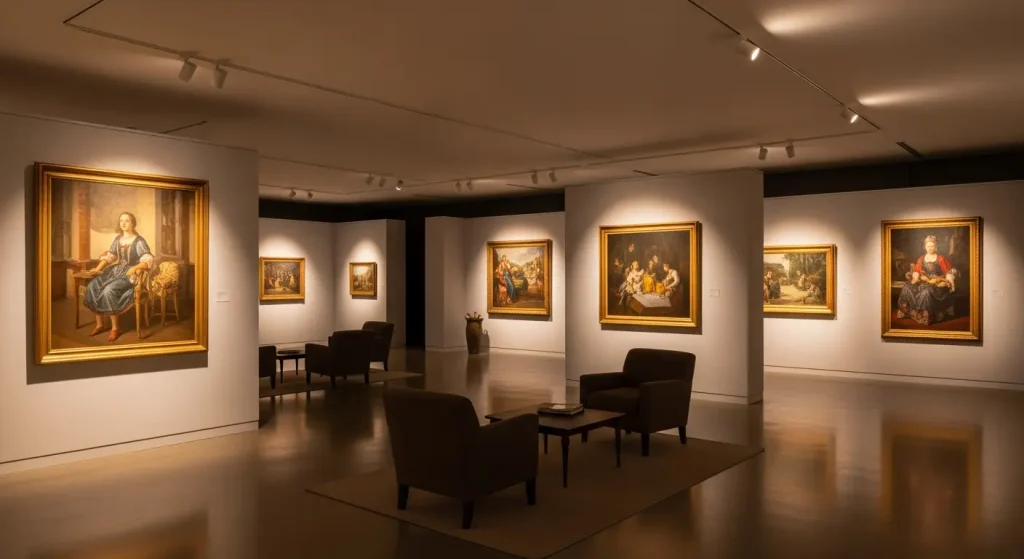
This guide explores what professional museum lighting truly means, the design principles behind it, and how the latest LED and smart control technologies help galleries and museums across Europe deliver exhibitions that are both inspiring and sustainable.
1. What Is Museum Lighting for Paintings?
1.1 Definition and Purpose
Museum lighting for paintings refers to a lighting system specifically engineered for flat art displays such as oil paintings, watercolors, or murals.
Unlike ordinary luminaires, these fixtures use full-spectrum, low-radiation LED sources to ensure faithful color rendering while protecting sensitive materials from UV and infrared damage.
The core objectives of a museum lighting system are:
- To reveal every detail and tone of an artwork accurately.
- To prevent photochemical damage by filtering UV/IR wavelengths.
- To provide consistent and controllable illumination that meets international conservation standards.
In practice, this means the lighting must enhance perception while never altering or harming the artwork — a delicate balance between aesthetics and science.
1.2 Why Museum Lighting Differs from Commercial Lighting
| Comparison Criteria | Museum Lighting for Paintings | Standard Commercial Lighting |
|---|---|---|
| Indice de rendu des couleurs (IRC) | ≥ 95 / R9 ≥ 90 | CRI 80–90 |
| Illuminance Control | Precisely regulated (50–200 lux) | Not controlled |
| Glare Limitation | UGR < 19 | No specific limit |
| UV / IR Radiation | Fully eliminated | Often unfiltered |
| Dimming System | DALI / Casambi smart control | Simple on/off or analog dimming |
While commercial lighting focuses on visibility and ambiance, museum lighting prioritizes color fidelity, conservation, and visual comfort.
It requires advanced optics, dedicated control protocols, and strict compliance with EN12464-1, CIE 157:2004, et CIBSE LG8 recommendations.
💡 CTA – Download Catalog
Discover the most advanced LED museum lighting solutions for painting exhibitions — featuring CRI 95+, DALI-2 dimming, and anti-glare optics.
👉 Download the XHLUX Product Catalog ›
2. Key Technical Design Principles
Designing museum lighting for paintings involves more than selecting fixtures; it is about controlling every parameter of light.
Below are the five fundamental principles followed by lighting designers and specifiers across Europe.
2.1 Illuminance and Uniformity Control
Appropriate brightness levels preserve both the visual balance and the longevity of the artwork.
- Recommended range: 50–200 lux depending on the artwork’s material and age.
- Uniformity: > 0.8 to ensure smooth transitions without visible bright spots.
- Accent-to-ambient ratio: 3 : 1 – 5 : 1 for depth and focus.
- Avoid glare and reflection, particularly on varnished surfaces or framed works behind glass.
A proper lighting design ensures the viewer perceives every tone transition exactly as intended by the artist.
2.2 Spectrum and Color Rendering (CRI & CCT)
Color fidelity is the soul of painting illumination.
Professional museum fixtures use full-spectrum LED sources with CRI ≥ 95 et R9 ≥ 90, reproducing reds, yellows, and skin tones naturally.
- Warm white (3000 K ± 200 K) is ideal for classical oil paintings.
- Neutral white (3500–4000 K) suits photography and modern art.
- Avoid excessive blue peaks that can accelerate pigment degradation.
Data Example:
| Paramètre | Valeur recommandée | But |
|---|---|---|
| CRI (Ra) | ≥ 95 | True color rendering |
| R9 (Red fidelity) | ≥ 90 | Rich pigment expression |
| CCT | 2700–4000 K tunable | Adaptable mood & color temperature |
| Flicker | < 1 % | Comfortable viewing and imaging |
2.3 Light Damage and Artwork Protection
Every lumen matters.
Exposure to radiation outside the visible spectrum can cause irreversible fading or material degradation.
Key protection measures include:
- UV emission < 75 µW/lm
- Infrared radiation < 3 W/m²
- Compliance with CIE 157:2004 – Control of Damage to Museum Objects by Optical Radiation
Modern LED museum lighting virtually eliminates UV and IR risk, combining optical filters and heat management to protect priceless collections.
2.4 Anti-Glare and Visual Comfort
Visitors should see the artwork — not the light source.
High-end recessed or surface luminaires feature:
- Deep reflectors or honeycomb louvers to keep UGR < 19
- Optimal aiming angle: 30°–45° to minimize reflections
- Polarized or low-reflectance trims for glass-framed pieces
The result is a calm, immersive atmosphere that invites longer engagement.
2.5 Smart Control and Energy Management
Digital lighting control ensures precision and sustainability.
- DALI-2 systems enable zone dimming and programmable scenes (exhibit, cleaning, night).
- Casambi Bluetooth mesh allows wireless upgrades in historical buildings.
- Récolte de la lumière du jour sensors adjust illuminance automatically to maintain constant lux while saving energy.
With rising EU energy standards, smart systems deliver measurable ROI while safeguarding exhibits.
📈 CTA – Explore Smart Museum Solutions
See how XHLUX integrates DALI-2 & Casambi technologies into European art institutions to achieve precise lux control and energy efficiency.
👉 View Our Solutions ›
3. Lighting Strategies for Different Types of Paintings
Every painting tells a different story, and light is the narrator.
The ideal lighting setup depends on the medium, surface texture, and artistic intent of each piece.
Below are the most effective strategies used by European museums and galleries.
| Artwork Type | Lighting Focus | Recommended Optical Configuration |
|---|---|---|
| Oil Paintings | Deep color layers, soft transitions | 24° narrow beam, CRI 95+, 3000 K warm white |
| Watercolor / Sketch | High contrast, fine details | 36° beam, CRI 95+, 4000 K neutral white |
| Murals / Large Canvases | Uniform coverage and surface balance | 60° wide beam + diffuse reflection |
| Photography Exhibits | Accurate grayscale, no color shift | 3500–4000 K neutral white with anti-glare optics |
3.1 Oil Paintings – Enhancing Color and Texture
Oil paintings contain thick pigment layers and varnish surfaces that reflect light differently across the canvas.
To preserve depth and contrast:
- Utiliser warm white 3000 K lighting with 24° focused beams.
- Position luminaires at a 35–40° angle to reduce glare and reflections.
- Keep illuminance below 150 lux for old master works, and up to 200 lux for contemporary oils.
💡 Pro Tip: Install DALI dimming presets to adjust brightness for special exhibitions or photography sessions.
3.2 Watercolors and Sketches – Protecting Fragile Media
Watercolors are highly sensitive to both intensity and spectral quality.
These works demand soft, even illumination with minimal UV content.
- Utiliser neutral white 4000 K LEDs for accurate tonal gradation.
- Limit illuminance to 50–100 lux depending on age and pigment.
- Avoid harsh directional lighting; combine wide flood fixtures with wall washers for diffusion.
Key Metric: Light exposure should not exceed 150,000 lux-hours/year as per CIE 157 conservation guidance.
3.3 Murals and Large Canvases – Achieving Uniformity
Large-scale artworks such as wall frescoes or panoramic pieces require even coverage.
- Utiliser 60° beam angles or linear wall washers for balanced distribution.
- Maintain uniformity ≥ 0.8 to prevent visual patchiness.
- Integrate sensors to maintain constant lux levels regardless of daylight variation.
Museums often combine recessed floodlights et track-mounted projectors to achieve balance between architecture and flexibility.
3.4 Photography and Modern Art – Maintaining Neutrality
Photography and contemporary prints demand faithful whites and precise gray balance.
- Utiliser 3500–4000 K CCT with high TM-30 fidelity scores.
- Ensure flicker-free performance for accurate reproduction.
- For digital art or mixed-media installations, integrate tunable white LEDs (2700–4000 K) to match curatorial themes.
📘 CTA – Download Lighting Guide
Get the full Museum Lighting Application Handbook, including lux charts and color temperature recommendations for all art forms.
👉 Download PDF ›
4. Technical Implementation: The Core of High-End Museum Lighting
4.1 High-CRI LED Light Sources (CRI 95+)
Color fidelity defines the success of museum lighting.
XHLUX LED engines deliver CRI 95–97 with superior red rendering (R9 > 90), ensuring lifelike reproduction across all pigment tones.
Technical highlights:
- Full-spectrum COB modules for balanced wavelength output
- Tunable White 2700–4000 K for different exhibition themes
- Flicker < 0.5% (per IEEE 1789 standard) for visual comfort and photography compatibility
- ENEC / CE / RoHS / LM80 certified for EU compliance
| Specification | Standard | XHLUX Typical Value |
|---|---|---|
| CRI (Ra) | ≥ 95 | 95–97 |
| R9 | ≥ 90 | 92–95 |
| CCT Options | 2700–4000 K | Blanc accordable |
| Flicker | < 1% | < 0.5% |
| Lifetime | ≥ 50,000 hrs | L80/B10 verified |
4.2 Professional Optical Design
Optics are the painter’s brush of lighting.
The fixture’s internal structure determines how light behaves on an artwork’s surface.
High-end museum lighting fixtures use:
- Dual-reflector systems to ensure even light distribution.
- Honeycomb or anti-glare shields to maintain visual comfort.
- UV-resistant PMMA lenses to avoid yellowing over time.
XHLUX optics are precisely engineered to create soft-edged light, preventing the hard halos common in generic spotlights.
4.3 Thermal Management and Longevity
Excessive heat shortens LED lifespan and may affect beam stability.
To counter this, museum fixtures adopt:
- Dissipateurs thermiques en aluminium moulé sous pression with vertical fins for airflow.
- Separated driver chambers to isolate heat from optical components.
- Active airflow or passive convection designs for continuous use in 12+ hour operations.
Result:
- Luminous maintenance >90% at 50,000 hours
- Temperature rise (ΔT) under 25°C, even at full output
These parameters ensure both long-term stability and consistent spectral output — critical for gallery calibration.
4.4 Intelligent Dimming and Scene Control
The future of museum lighting is smart and adaptive.
Modern museums rely on DALI-2, Casambi, ou 0–10 V systems for seamless control.
Applications include:
- Scene presets (Exhibition, Cleaning, Night Security)
- Timed automation to extend artwork life by limiting exposure time
- Wireless commissioning for heritage sites where cabling is restricted
In advanced setups, light sensors feed back to maintain constant lux (±10%) regardless of daylight changes.
This integration aligns perfectly with EU Green Building Directives on sustainability and energy reduction.
🔧 CTA – Speak With an Engineer
Need technical specifications or EN12464-compliant photometric files?
👉 Contact XHLUX Engineering Team ›
5. Case Scenarios and Lighting Configurations
Lighting design is both art and engineering.
The following examples show how professional lighting configurations elevate museum environments across Europe — from classical galleries in Florence to modern exhibition spaces in Berlin.
| Application Scene | Lighting Objective | Recommended Fixture Configuration |
|---|---|---|
| Classical Oil Painting Hall | Preserve authentic color while preventing aging | 24° spotlight + 3000 K warm white + DALI dimming |
| Modern Art Gallery | Enhance ambiance and visual rhythm | 36° medium beam + 3500 K + Casambi control |
| Museum Corridor or Pathway | Provide visual guidance and even illumination | 60° floodlight + UGR < 19 + Tunable White |
| Temporary Exhibition Space | Flexible lighting for diverse artwork | Adjustable recessed spotlights + Casambi wireless mesh |
These setups combine CRI 95+ fidelity, UGR < 19 glare control, et DALI smart dimming, meeting European lighting standards while maintaining artistic intent.
5.1 Design Insight: Balancing Consistency and Adaptability
European museums often need to accommodate rotating exhibitions.
The ideal lighting system must:
- Support flexible optical adjustment (from 15° spot to 60° flood).
- Integrate with existing heritage architecture using recessed or semi-recessed luminaires.
- Maintain consistent light color across mixed fixture types (CCT deviation ≤ 3 SDCM).
Result: The gallery remains visually balanced regardless of theme or artwork rotation.
💡 CTA – Explore Project Cases
See how XHLUX lighting has been implemented in museums and cultural centers across Europe — from fine art to contemporary exhibitions.
👉 View European Project Cases ›
6. Choosing the Right Museum Lighting Supplier
For B2B buyers, selecting the correct partner ensures both product quality and project success.
The supplier you choose must align with European technical standards and provide long-term reliability.
6.1 Certification and Compliance
Always verify the following certifications:
- CE / ENEC / CB / RoHS / LM80
- Compliance with CIE 157:2004 et EN12464-1 guidelines
- Proof of third-party testing (TÜV, Intertek, or SGS)
These standards guarantee your lighting system is safe, eco-compliant, and museum-grade.
6.2 Technical and Design Support
A reliable manufacturer should provide:
- IES / LDT photometric data for Dialux and Relux simulations
- BIM / STEP models for architectural integration
- On-demand customization of beam angles, trims, and reflectors
- Dedicated engineering support for project consultation
This professional support helps design firms and system integrators deliver consistent lighting outcomes across multiple locations.
6.3 ODM / OEM Customization Capabilities
For lighting brands and distributors, private-label solutions can be a strategic differentiator.
XHLUX offers:
- Custom reflector finishes (black, silver, gold)
- Personalized CCT / CRI combinations
- Driver options: DALI-2, Casambi, 0–10 V
- Custom packaging and branding
Partnering with an ODM-certified EU supplier reduces lead time, improves design flexibility, and enhances your brand’s professional credibility.
6.4 Track Record and After-Sales Support
Choose a supplier with proven project experience in:
- Museums, galleries, cultural centers, and heritage restorations
- 5-year product warranty and replacement assurance
- 24–48-hour technical response service
A trustworthy manufacturer doesn’t end the relationship at shipment; they provide continuous lifecycle support for each installation.
📞 CTA – Partner With XHLUX
Ready to collaborate with a CE & ENEC-certified lighting manufacturer specializing in museum and gallery solutions?
👉 Demander un devis | Discutez sur WhatsApp
7. Frequently Asked Questions (FAQ)
These common questions are optimized for Google rich results to increase your article’s visibility.
Q1: What is the ideal illuminance level for museum paintings?
It varies between 50–200 lux, depending on artwork age and pigment stability.
Old master paintings typically stay below 100 lux, while modern acrylics may tolerate up to 200 lux.
Q2: Do LED lights damage artworks?
Haute qualité LED museum fixtures produce no UV or IR radiation and emit minimal heat, ensuring zero photochemical damage to sensitive materials.
Q3: Can museum lighting integrate with smart systems?
Yes.
Professional solutions use DALI-2 or Casambi Bluetooth Mesh, enabling wireless dimming, scene programming, and daylight-based automation.
Q4: Can lighting be customized for my brand or project?
Absolutely.
XHLUX provides full OEM/ODM customization, including branding, optical configuration, driver selection, and packaging.
Q5: What is the typical lifetime and maintenance cycle?
Premium museum fixtures operate for 50,000+ hours (L80/B10).
Front-serviceable designs allow easy driver or reflector replacement, ensuring minimal downtime.
📘 CTA – Download Technical Pack
Access product datasheets, IES files, and Dialux-ready models for your project specifications.
👉 Download Now ›
8. Conclusion
A single beam of light can reveal centuries of human creativity — or destroy it if handled improperly.
That is why museum lighting for paintings must combine scientific precision, visual artistry, and conservation discipline.
In modern European museums, lighting has become part of the storytelling process:
- High CRI accuracy (≥95) ensures authenticity.
- Smart control systems (DALI/Casambi) balance preservation with flexibility.
- Anti-glare optics and architectural integration enhance visitor comfort.
XHLUX helps curators, engineers, and lighting brands achieve this harmony — transforming light into a guardian of art.
✨ Why Choose XHLUX for Museum Lighting
- 15+ years of LED manufacturing experience
- Certified under CE / ENEC / CB / SAA / ISO 9001
- Expertise in CRI 95+ LED optics, anti-glare design, and DALI integration
- Dedicated OEM/ODM support for EU lighting brands
- Proven projects in museums, galleries, and cultural venues across Europe
📞 Take immediate action
Looking for museum-grade lighting that enhances artworks and protects them for decades?
Let’s design a tailored solution together.
👉 Discutez sur WhatsApp | Demander un devis | View Projects | Télécharger le catalogue