 XHLUX
XHLUX

Table des matières
Light is the language of art.In galleries and museums, illumination is not just functional—it shapes perception, emotion, and atmosphere.A professional art track lighting system transforms static exhibits into vivid visual stories, revealing every texture and hue exactly as the artist intended.
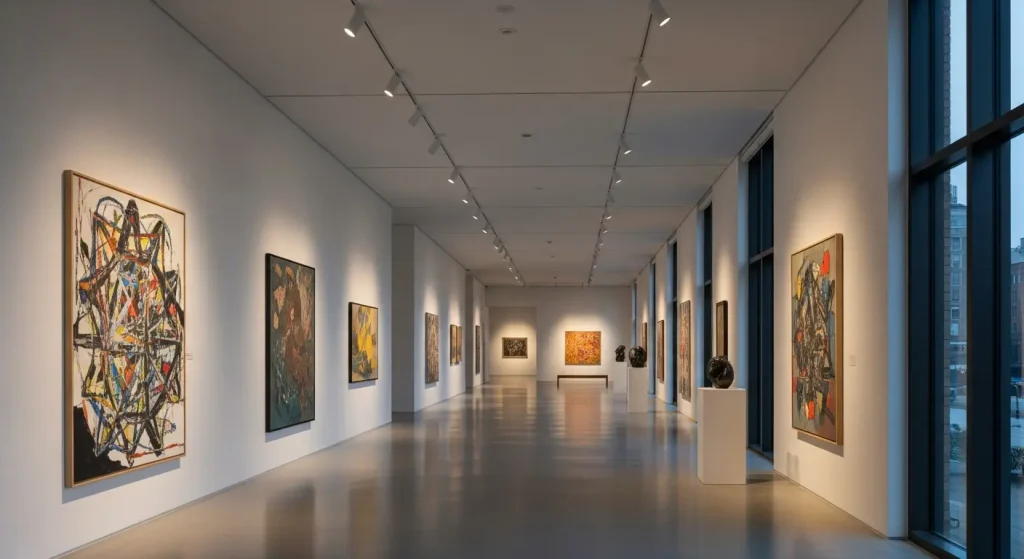
This article explains what art track lighting is, how it works, and which design features define professional-grade performance.You’ll also learn why architects, lighting designers, and integrators worldwide are upgrading to CRI 95+ LED track lights with DALI or Casambi control for premium art spaces.
💡 Download Product Catalog
Explore XHLUX CRI 95+ LED art track lights compatible with Global, Eutrac, and Stucchi systems.
👉 Download Catalog ›
1. What Is Art Track Lighting?
1.1 Definition and Working Principle
Art Track Lighting refers to adjustable LED fixtures mounted on electrified tracks, engineered specifically for art environments such as galleries, museums, and brand showrooms.
The track delivers both power and mechanical support, allowing each light head to slide, rotate (350 °), and tilt (90 °) for perfect positioning.
Compared with standard commercial track lights, art track lights feature superior optical precision, higher CRI, and anti-glare architecture, ensuring both flexibility and visual comfort.
1.2 Core Structural Components
| Module | Function | Technical Highlight |
|---|---|---|
| Housing Body | Holds LED module and optics | Aluminum die-cast body for optimized heat dissipation |
| Système optique | Shapes beam angle and distribution | High-reflectivity reflector / secondary lens |
| Electrical Module | Provides power & smart dimming | Integrated driver with DALI / Casambi interface |
| Track Mounting System | Supplies power & mechanical support | Compatible with Global, Eutrac, Stucchi standards |
The result is a modular, serviceable fixture that can be repositioned or upgraded without rewiring—ideal for rotating exhibitions and evolving spatial layouts.
💡 Track Compatibility Guide
Check system compatibility for your next project.
👉 Download Track System Sheet ›
2. Key Design Features of Art Track Lighting
2.1 High CRI and Spectral Consistency
Color accuracy defines credibility in art presentation.
Professional art track lighting uses full-spectrum LED chips with CRI ≥ 95 and R9 ≥ 90, reproducing reds, yellows, and skin tones with natural realism.
| Paramètre | Recommended Standard | Impact on Art Display |
|---|---|---|
| CRI (Ra) | ≥ 95 | True color fidelity for pigments |
| R9 Index | ≥ 90 | Accurate rendering of warm tones |
| SDCM (Color Tolerance) | ≤ 3 | Consistent CCT between fixtures |
| Blue-light Peak | Contrôlé | Prevents pigment aging |
These full-spectrum LEDs eliminate harsh blue peaks, providing a balanced, museum-grade light that protects delicate artworks while maintaining chromatic richness.
2.2 Beam Angle and Optical Control
Every artwork requires its own light geometry.
Art track lights offer multiple beam options—10°, 15°, 24°, 36°, and 60°—each serving a specific curatorial purpose.
| Angle du faisceau | Application | Effet |
|---|---|---|
| 10°–15° | Spotlighting small objects or sculptures | Precise focus, dramatic contrast |
| 24° | Medium paintings or portraits | Balanced light spread |
| 36° | Large canvases or photography | Soft, even illumination |
| 60° | Wall-washing and ambient zones | Uniform background lighting |
Optical modules such as interchangeable reflectors, honeycomb louvers, et anti-glare snoots help designers fine-tune directionality while maintaining consistent light quality.
2.3 Anti-Glare Design and Visual Comfort
Comfort equals credibility.
High-end galleries demand lighting that enhances artwork without distracting reflections.
Key anti-glare features include:
- Deep-set reflector housing (UGR < 19).
- Optional black or matte-silver reflector finishes.
- Honeycomb and cross-baffle accessories.
- Smooth beam edges to eliminate “hard cut” shadows.
By ensuring the light source remains visually hidden, the viewer’s focus stays solely on the art.
2.4 Flexibility and Maintainability
Art evolves — and so should your lighting.
Track systems enable quick reconfiguration: simply slide, twist, or swap fixtures to adapt to new exhibitions.
- 350° rotation / 90° tilt mechanics.
- Modular lamp head replacement without tools.
- Field-replaceable optics and drivers.
- Front maintenance design for minimal downtime.
Such flexibility makes art track lighting the preferred choice for galleries, museums, and retail-art hybrid spaces.
2.5 Smart Control and System Integration
Lighting for art must respond to curatorial intent.
Modern track lights integrate seamlessly with smart control protocols like DALI-2, Casambi, 0–10 V, et DMX512, allowing precise scene management.
| Système de contrôle | Taper | Avantages |
|---|---|---|
| DALI-2 | Wired bus control | Reliable zoning & scene programming |
| Casambi | Bluetooth mesh | Wireless setup for retrofit projects |
| DMX512 | Digital protocol | Dynamic color & interactive art control |
| 0–10 V | Analog | Cost-effective dimming for small spaces |
These systems enable multi-scene operation—from exhibition to cleaning to after-hours ambience—while optimizing energy use and artwork protection.
🔧 Intégration de la commande intelligente
See how DALI and Casambi systems simplify curation lighting management.
👉 Consult Our Lighting Engineer ›
3. Advantages and Application Value of Art Track Lighting
3.1 Flexibility and Adjustability
One of the greatest advantages of art track lighting is its unparalleled flexibility.
Unlike fixed recessed luminaires, track-mounted systems allow curators and designers to modify layouts instantly as exhibitions evolve.
Key benefits:
- 360° horizontal rotation et 90° vertical tilt for precise aiming.
- Quick repositioning without rewiring or cutting ceilings.
- Compatible with single-phase, three-circuit, and low-voltage tracks.
- Scalable systems—add or remove fixtures as space requirements change.
This adaptability is ideal for rotating exhibitions, pop-up installations, et brand showrooms where spatial dynamics and artwork configurations shift frequently.
💡 Example:
A modern gallery in Milan uses XHLUX CRI 95+ adjustable track lights on Eutrac rails. The curators can reorient the entire room’s lighting in 15 minutes—without a single tool.
3.2 High-Quality Light Rendering (Color Fidelity)
Art is all about emotion through color.
Low-quality LEDs distort hues and flatten textures, while high-CRI (≥95) full-spectrum LEDs bring life back to each pigment.
Performance benefits:
- Accurate pigment rendering: True representation of reds (R9), yellows, and skin tones.
- Improved depth and contrast: Highlights texture in oil paintings and sculptures.
- Soft, flicker-free output: Ensures comfortable long-term viewing.
- CCT stability: Color temperature remains consistent across multiple fixtures.
This ensures that the light enhances rather than alters the artist’s vision—one of the most important standards in museum-grade illumination.
3.3 Architectural Integration and Minimalism
Lighting should disappear into the architecture while enhancing the art.
Modern art track lights are designed with sleek, minimalistic aesthetics that complement contemporary interiors.
- Slim cylindrical or rectangular housings.
- Finishes in black, white, silver, or custom RAL colors.
- Concealed drivers and connectors.
- Perfect alignment with flush-mount or recessed tracks.
The result is a clean, architectural integration where the light source blends seamlessly with ceiling design, maintaining visual purity.
3.4 Future-Proof Design and Easy Maintenance
Sustainability and long-term usability are core to professional lighting systems.
Art track lights are built with modular, serviceable components that can be upgraded or maintained easily.
Maintenance and lifecycle advantages:
- Front-serviceable optics and drivers.
- Modular replacement for reflectors, COB LEDs, or accessories.
- Compatible with next-generation control protocols (DALI → Casambi).
- 50,000+ hour lifespan (L80/B10 standard).
Ce future-proof design minimizes replacement costs and ensures long-term performance stability in demanding environments.
🏛️ View European Project References
Discover how XHLUX art track lighting enhances real gallery and museum spaces.
👉 View Project References ›
4. Typical Application Scenarios and Design Recommendations
Art track lighting can be applied across diverse art and design contexts — from traditional galleries to high-end retail spaces.
Below are typical use cases and their recommended technical configurations.
| Scenario | Lighting Objective | Configuration recommandée |
|---|---|---|
| Oil Painting Gallery | Highlight texture, brushstroke, and color layering | 15° / 24° beam, CRI 95+, 3000 K |
| Sculpture Zone | Enhance volume and shadow interplay | 15° narrow beam, 3500 K neutral white |
| Photography Exhibit | Maintain true grayscale and color accuracy | 36° beam, 4000 K |
| Brand Art Space | Create ambiance and rhythm through lighting flow | DMX control + Tunable White (2700–4000 K) |
| Multi-Functional Exhibition Halls | Support both ambient and focused lighting | Mix of 24° + 60° beam angles |
4.1 Oil Painting Galleries
Oil paintings benefit from warm white tones (2700–3000 K) that preserve depth and texture.
Utiliser 15°–24° beams to focus on artwork surfaces without creating glare on protective glass frames.
Soft, angled lighting at 30°–35° is ideal to minimize reflections.
4.2 Sculpture and Installation Spaces
Sculptures require three-dimensional lighting to emphasize contours.
Combining narrow-beam (15°) spotlights from different angles creates natural shadow play and depth perception.
For large installations, integrate DMX control for dynamic lighting sequences that match the theme of the exhibit.
4.3 Photography and Digital Art Exhibits
Precision in tone is crucial here.
Neutral white light (3500–4000 K) ensures correct grayscale balance and prevents color shift.
A wide beam (36°) provides uniform illumination without hotspots, ideal for mounted photographs or digital prints.
4.4 Brand Art and Commercial Spaces
Luxury retail stores increasingly integrate art gallery lighting concepts to elevate visual storytelling.
Tunable white systems (2700–4000 K) and Casambi wireless control allow real-time scene adjustments to create emotional impact and brand differentiation.
💡 Exemple :
A premium fashion brand in Paris uses programmable DMX track lights to synchronize product lighting with background music during collection launches.
4.5 Lighting Composition for Balanced Design
When planning an art lighting composition, combine three light layers:
- Éclairage d'accentuation : 15°–24° beams to highlight focal artworks.
- Ambient Lighting: 36°–60° beams to create general brightness.
- Wall Washing: Wide floodlights for background balance and depth.
Maintaining a 3:1 ratio between accent and ambient light ensures an immersive yet comfortable environment.
📘 Download Art Track Lighting Design Guide
Access beam-angle charts, CCT recommendations, and layout templates.
👉 Download Lighting Guide ›
5. How to Choose a Reliable Art Track Lighting Supplier
The art of light requires the science of precision — and that precision depends on a trusted manufacturing partner.
Whether you’re a lighting brand, integrator, or design studio, choosing the right art track lighting supplier ensures your project meets both aesthetic and technical standards.
5.1 Verify Product Certifications and Quality Standards
High-end art projects, especially in Europe, demand fixtures that comply with rigorous safety and performance benchmarks.
| Certification | But | Importance for Art Lighting |
|---|---|---|
| CE / ENEC | EU electrical safety compliance | Mandatory for European projects |
| CB / RoHS | International safety & environmental standards | Ensures sustainability & reliability |
| LM80 / TM21 | LED lifetime and lumen maintenance | Guarantees long-term performance |
| CIE 157:2004 | Optical radiation control | Confirms protection against UV/IR damage |
| ISO 9001 | Manufacturing quality management | Ensures consistent product output |
✅ Tip: Always request ENEC or LM80 documentation. These ensure that the LED modules are tested for 50,000+ hours with >90% lumen maintenance — critical for museums and galleries that operate 12+ hours daily.
💡 Request Certification Pack
Need CE/ENEC documentation for your next tender?
👉 Download Technical Compliance File ›
5.2 Evaluate Technical and Optical Support
A professional lighting partner should offer more than products — they should deliver engineering expertise.
Look for suppliers who provide:
- IES / LDT photometric files for Dialux or Relux simulations.
- BIM / STEP 3D models for architectural coordination.
- Custom optical design for unique beam or reflector requirements.
- Pre-installation layout support and after-sales calibration guidance.
This technical support ensures your lighting concept performs exactly as planned — in both design intent and real-world effect.
5.3 Assess ODM/OEM Capabilities
For lighting brands, distributors, and system integrators, private-label manufacturing can create market differentiation and long-term brand equity.
Top ODM/OEM capabilities include:
- Customizable housing shape, finish, and color (black, white, silver, or RAL code).
- Adjustable optics and beam customization (10°–60°).
- Private-logo printing and packaging design.
- Driver and dimming customization (DALI-2, Casambi, DMX, 0–10V).
- Quick sample turnaround (3–4 weeks standard) and EU warehouse delivery.
Partnering with an experienced ODM manufacturer like XHLUX allows you to offer museum-grade fixtures under your own brand — without extensive R&D costs.
💬 Build Your Private Label Line
Start your ODM collaboration with our engineering team today.
👉 Contact XHLUX ODM Team ›
5.4 Review Warranty and Service Commitments
Long-term reliability is a must for art environments.
Choose a manufacturer with transparent warranty terms and responsive after-sales service.
Recommended minimum standards:
- 5-year warranty covering both driver and LED module.
- 48-hour response time for technical inquiries.
- Spare-parts availability for at least 5 years post-purchase.
- Optional on-site commissioning or online installation guidance.
A reliable partner safeguards not only your lighting investment — but also the visual integrity of the artworks you illuminate.
6. FAQ About Art Track Lighting
Q1: What makes an art track light different from a standard track light?
Art track lights use CRI 95+ full-spectrum LEDs, anti-glare optics, et precise beam control tailored for galleries and museums, while standard models are designed for retail or office use.
Q2: Are art track lights compatible with all track systems?
Yes.
XHLUX art track lights are compatible with most Global, Eutrac, and Stucchi three-circuit systems, ensuring easy integration across European standards.
Q3: What is the lifespan and maintenance requirement?
Each fixture provides a minimum 50,000-hour lifespan (L80/B10).
Front-maintenance design allows quick driver or module replacement without dismantling the track system.
Q4: Can art track lights support smart control?
Absolutely.
All XHLUX models are compatible with DALI, Casambi, DMX, et 0–10 V dimming systems, allowing scene presets, wireless control, and energy optimization.
Q5: Does XHLUX offer ODM/OEM services?
Yes.
We provide custom housing designs, optical modules, and branded packaging, serving lighting brands and integrators across Europe, the Middle East, and Asia.
📘 Download Case Studies Pack
Explore how art track lighting transforms European gallery projects.
👉 View Project Gallery ›
7. Conclusion
Lighting is not just about visibility — it’s about interpretation.
The right art track lighting doesn’t merely illuminate a painting; it defines how the world experiences it.
A professional-grade lighting system blends engineering precision, visual aesthetics, et curatorial intent.
It must deliver:
- True color fidelity (CRI 95+)
- Low-glare optical comfort (UGR < 19)
- Smart control adaptability (DALI, Casambi, DMX)
- Architectural minimalism
These principles transform light from a technical requirement into an artistic instrument.
For over 15 years, XHLUX has empowered galleries, museums, and lighting brands worldwide with ENEC-certified, CRI 95+ LED art track systems.
Each beam of light we design aims to protect, enhance, and celebrate art — because in the right light, art speaks louder.
✨ Why Professionals Choose XHLUX
- 15+ years of manufacturing experience in museum & gallery lighting
- Certified under CE / ENEC / CB / RoHS / ISO 9001
- Expertise in full-spectrum CRI 95+ optics & anti-glare designs
- Compatibility with DALI / Casambi / DMX / 0–10V
- ODM/OEM capability for private-label brands
- 5-year warranty & EU-based warehouse logistics
📞 Take immediate action
Looking to create your own professional-grade art lighting collection?
Partner with XHLUX for custom-engineered LED track systems built for galleries and museums.
👉 Discutez sur WhatsApp | Demander un devis | Télécharger le catalogue | View Projects