 XHLUX
XHLUX

Table des matières
- 1 What Is Low Glare Recessed Lighting
- 2 Understanding UGR (Uniform Glare Rating)
- 3 How Low Glare Lighting Relates to UGR
- 4 Key Design Elements of Low Glare Fixtures
- 5 Applications of Low Glare Lighting in Different Spaces
- 6 How to Choose Fixtures That Meet UGR Standards
- 7 FAQ About Low Glare Recessed Lighting
- 8 Conclusion
Modern architecture prioritizes visual comfort as much as aesthetics. Harsh light or uncontrolled glare can cause eye fatigue, distraction, and reduced productivity.
Low-glare recessed lighting—often measured by the UGR (Uniform Glare Rating) standard—has become the benchmark for professional lighting design.
This guide explains what low-glare lighting means, how UGR is calculated, and how to choose compliant fixtures for commercial projects.
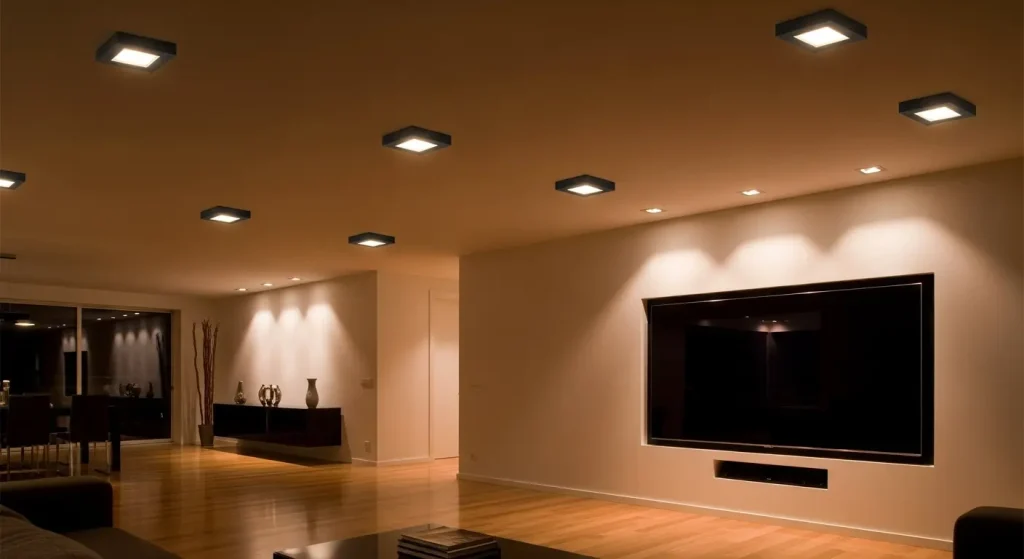
1 What Is Low Glare Recessed Lighting
Low-glare recessed lighting is designed to minimize direct and reflected glare by controlling how light exits the luminaire.
It typically combines deep optical reflectors, cut-off angles, et anti-glare accessories such as honeycomb grids or matte black baffles.
Key Characteristics
| Design Element | Function | Result |
|---|---|---|
| Deep Recess Housing | Shields the LED source | Lower direct glare |
| Cut-off Angle > 30° | Prevents high-angle light | Softer edge lighting |
| Anti-Reflective Coating | Reduces specular reflection | Uniform luminance |
| Precision Optics | Directs light only where needed | Improved efficiency |
These fixtures produce smooth, comfortable illumination ideal for offices, hospitality, healthcare, and retail environments.
2 Understanding UGR (Uniform Glare Rating)
UGR, defined by the CIE 117 standard, quantifies discomfort glare perceived by an observer.
Simplified Formula
UGR = 8 × log₁₀ [ 0.25 × (L² / (Lb × ω²)) ]
Where L = luminance (cd/m²), Lb = background luminance, and ω = solid angle of the luminaire.
Recommended UGR Values
| Application Area | Recommended UGR Value | Comfort Level |
|---|---|---|
| Offices / Workstations | ≤ 19 | Comfortable for long tasks |
| Classrooms / Healthcare | ≤ 16 | High visual accuracy |
| Retail / Exhibition | ≤ 22 | Balanced brightness |
| Industrial Areas | ≤ 25 | Tolerable glare level |
Insert chart: UGR value vs. visual comfort curve—showing how glare perception increases exponentially beyond UGR 19.
3 How Low Glare Lighting Relates to UGR
Low-glare luminaires are specifically engineered to achieve lower UGR values.
Each design variable—optical depth, beam control, and diffuser type—directly affects glare performance.
| Fixture Type | Typical UGR | Description |
|---|---|---|
| Standard Recessed Downlight | 22 – 25 | Noticeable glare |
| Shallow Anti-Glare Version | 20 – 22 | Moderate comfort |
| Deep Recessed Low-Glare Design | 16 – 19 | Professional standard |
| Specialized UGR≤16 Fixture | 13 – 16 | Premium visual comfort |
Insight: Reducing UGR from 24 to 19 can cut discomfort complaints by nearly 40 % in open offices (based on CIE empirical data).
4 Key Design Elements of Low Glare Fixtures
4.1 Recess Depth
A deeper light chamber hides the LED chip and reduces the viewer’s direct sightline.
Recommended depth ≥ 25 mm for UGR≤19 applications.
4.2 Cut-off Angle
Angles above 30° prevent high-angle light reaching the eye.
Premium architectural downlights use 40°–45° cut-off for conference rooms and hotels.
4.3 Reflector and Finish
Matte black or anodized low-reflectance materials absorb stray light.
Specular or silver reflectors are reserved for high-ceiling spaces where the viewing angle is steeper.
4.4 Optical Control
Use secondary lenses or honeycomb grids to balance beam uniformity and efficiency.
Add illustration: cross-section diagram showing beam cut-off vs. UGR reduction.
5 Applications of Low Glare Lighting in Different Spaces
| Espace | Recommended UGR | Lighting Purpose | Fixture Example |
|---|---|---|---|
| Office Areas | ≤ 19 | Visual comfort for screens | Deep recessed UGR 19 downlight |
| Hotel Corridors / Guest Rooms | ≤ 22 | Warm ambience | Trimless low-glare fixture |
| Retail Stores / Showrooms | ≤ 19 – 22 | Highlight products without glare | Adjustable anti-glare spotlight |
| Hospitals / Classrooms | ≤ 16 | Prevent eye strain | Uniform UGR ≤ 16 panel light |
Include a photo grid showing “glare vs. no-glare” effect to improve engagement metrics (time on page).
6 How to Choose Fixtures That Meet UGR Standards
- Check Certified Reports – Request IES or LM-79 files with UGR data.
- Verify UGR Value on Specification Sheet – Look for “UGR≤19” label.
- Examine Optical Design – Deep reflector, low-reflective finish.
- Consider Control Systems – TRIAC, 0-10 V, DALI, Bluetooth dimming compatibility.
- Check Certifications – CE, RoHS, ETL for B2B project compliance.
- Compare Samples on Site – Measure luminance ratios between task area and background.
Example Comparison
| Fonctionnalité | Standard Downlight | Low-Glare UGR≤19 Downlight |
|---|---|---|
| UGR Value | 24 – 26 | 16 – 19 |
| Luminous Efficacy | 105 lm/W | 100 lm/W |
| Visual Comfort Rating | Modéré | Excellent |
| Price Difference | — | +10 – 15 % |
| ROI (Comfort vs Cost) | — | Payback in < 1 year by reduced complaints / errors |
7 FAQ About Low Glare Recessed Lighting
Q1 : What does UGR ≤ 19 mean?
It means the fixture’s glare rating is 19 or below, the recommended limit for office and commercial applications.
Q2 : Is a lower UGR always better?
Not necessarily. UGR ≤ 16 provides maximum comfort, but too low brightness may make the space feel dim.
Q3 : How is UGR tested?
Manufacturers use photometric labs to generate IES files; software like Dialux or Relux calculates UGR for specific layouts.
Q4 : Does low-glare lighting reduce lumen output?
Slightly, but the effective visual brightness remains higher because the light is more comfortable and better distributed.
Q5 : Can I mix low-glare and standard lights in one project?
Yes—use low-glare fixtures in task zones and standard ones in background areas to balance cost and comfort.
8 Conclusion
Low-glare recessed lighting is not only a design choice—it is a requirement for human-centric, professional environments.
Complying with UGR standards ensures visual comfort, regulatory approval, and long-term energy efficiency.
Need UGR≤19 certified fixtures?
Our team develops and manufactures custom OEM / ODM LED downlights for office, hotel, and architectural projects.Contactez-nous to get photometric data files and a tailored lighting proposal.