 XHLUX
XHLUX

Table des matières
- What You’ll Get By Upgrading
- Benefit 1 — Deep, measurable energy savings
- Benefit 2 — Maintenance: fewer truck rolls, fewer headaches
- Benefit 3 — Superior light quality your teams and customers will notice
- Benefit 4 — Smart, Connected Controls
- Benefit 5 — Compliance and future-proofing
- Benefit 6 — ESG gains and credible reporting
- Benefit 7 — Health & wellbeing aligned with modern metrics
- Benefit 8 — Design flexibility for branding, comfort, and tasks
- Benefit 9 — Utility rebates & procurement confidence via DLC QPL
- Benefit 10 — Fast payback and durable ROI
- Quick-Spec Guide
- Frequently Asked Questions
- Quick Table — Which LED for which space?
- Sourcing Tip
- The Market Is Moving (why act now)
- Final Takeaway
- Primary Sources Cited
If you manage facilities, design fit-outs, or source lighting for retail, hospitality, offices, or industrial spaces, this guide distills the business reasons to switch—backed by current data, standards, and field results. It’s written for decision-makers, not lab techs.
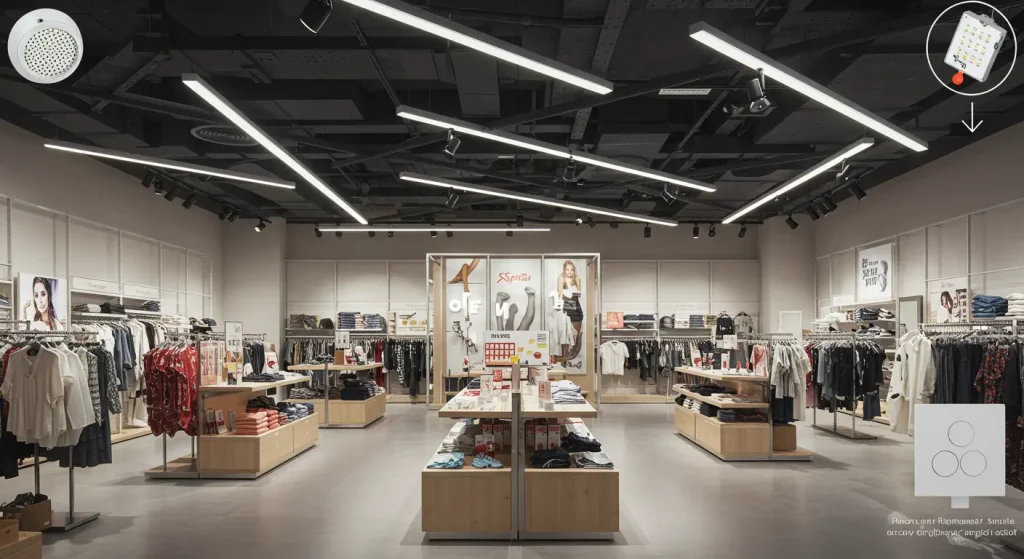
What You’ll Get By Upgrading
- 50–70% lower lighting energy vs. legacy sources; another ~49% on top when you add networked lighting controls (NLCs), per the DesignLights Consortium (DLC). (The Department of Energy’s Energy.gov)
- Maintenance slashed with typical L70 ≥ 50,000 hours lifetimes and better lumen maintenance than fluorescent/HID. (DesignLights, betterbuildingssolutioncenter.energy.gov)
- Visibly better light (color fidelity, gamut, glare control, flicker safety) with modern TM-30 metrics, UGR limits, and IEEE 1789 guidance. (The Department of Energy’s Energy.gov, DesignLights, IEEE Standards Association)
- Compliance built-in (DOE’s 45 lm/W GSL backstop in the U.S.; EU RoHS phase-out of T5/T8) so you’re not buying stranded assets. (The Department of Energy’s Energy.gov, assets.signify.com)
- Health & productivity alignment using melanopic EDI (CIE S 026) and WELL glare control—without over-lighting or blue-heavy spectra. (PMC, Wikipedia)
- Rebates and procurement confidence via DLC QPL (Standard & Premium) and utility programs. (DesignLights)
Benefit 1 — Deep, measurable energy savings
Modern LED luminaires deliver far higher efficacy than fluorescent/HID, and they emit light directionally so less output is wasted in the ceiling. DOE notes LED use at least 75% less energy than incandescent (consumer context) and project massive national savings by 2035; in commercial applications, directional optics amplify the advantage. (The Department of Energy’s Energy.gov)
Controls multiply savings. DLC’s multi-year research shows networked lighting controls (NLCs)—high-end trim, occupancy, daylighting, task tuning—cut an additional ~49% of lighting energy on average across projects. That’s incremental to the LED baseline.
What this means for you: If your baseline is T8/T5 fluorescent running 12 hours/day, LED can halve lighting kWh, and a well-commissioned NLC can halve it again.
Benefit 2 — Maintenance: fewer truck rolls, fewer headaches
With L70 lifetimes of ~50,000 hours (often more), commercial LED drastically reduce re-lamping cycles. DLC requirements rely on LM-80/TM-21 projections and set floor expectations (e.g., L70 ≥ 50,000 h for listed products; L90 ≥ 36,000 h for many Premium products). (DesignLights)
Even ENERGY STAR product records routinely show 50,000-hour ratings on downlights and retrofit kits. That’s 10+ years at 12 h/day with planned lumen depreciation rather than sudden failures. (ENERGY STAR)
Benefit 3 — Superior light quality your teams and customers will notice
Color you can trust. Move beyond single-number CRI: TM-30 provides fidelity (Rf), gamut (Rg), and a Color Vector Graphic to judge both accuracy and saturation shifts—now widely used by specifiers and supported by DOE/IES tutorials. (The Department of Energy’s Energy.gov)
Comfort without glare. Many programs (DLC Premium, EN 12464-1) emphasize UGR thresholds to control discomfort glare; DLC publishes UGR guidance and Premium thresholds by application. You’ll see fewer complaints about “harsh” LED. (DesignLights)
Flicker risk managed. Specify drivers and dimming that follow IEEE 1789 recommended practice to avoid temporal light artifacts—especially in dimmed retail, offices, studios. (IEEE Standards Association)
Benefit 4 — Smart, Connected Controls
Networked (wired or wireless) control layers—LLLC, DALI-2, Bluetooth Mesh, BACnet gateways—enable granular scheduling, occupancy/daylight response, task tuning, fault alerts, and space-use analytics.
- DLC documents that correctly set up NLCs deliver the largest, most persistent savings; they’ve also expanded resources for NLC–HVAC integration, which can trim HVAC loads by leveraging occupancy data. (DesignLights)
Practical tip: Require sequences of operation in spec, commissioning checklists, and owner training. “Controls present” without setup is the #1 missed opportunity (and a common reason savings underperform).
Benefit 5 — Compliance and future-proofing
- U.S.: The DOE’s 45 lm/W backstop for general service lamps prohibits low-efficacy sales; upcoming standards build on this. Specifying high-efficacy luminaires and controls aligns you with ASHRAE 90.1 and state codes. (The Department of Energy’s Energy.gov)
- EU: RoHS mercury restrictions are phasing out T5/T8 fluorescent and CFL variants (e.g., ban dates in 2023), making retrofit plans urgent for facilities still using tubes. (assets.signify.com)
- Codes: ASHRAE 90.1-2022 and California Title 24 (2022) expand mandatory control requirements (automatic shutoff, daylight zones, high-end trim), making networked LED the simplest path to pass inspections. (lightingcontrolsassociation.org)
Benefit 6 — ESG gains and credible reporting
Lighting is a visible, reportable decarbonization lever. The IEA highlights rapid LED adoption, rising efficacy, and policy shifts (e.g., phasing out fluorescents) as critical to aligning with Net Zero pathways. Documented kWh cuts translate into Scope 2 CO₂ reductions your auditors can verify. (IEA)
Benefit 7 — Health & wellbeing aligned with modern metrics
A growing expert consensus (CIE S 026, PLOS Biology guidance) recommends targeting melanopic EDI for daytime alertness (e.g., ≥250 lx melanopic EDI at eye level during the day) and limiting in the evening. In offices and schools, tunable white with scene controls can support these goals while keeping glare and flicker in check. (PMC)
Reality check: “Circadian lighting” is not a magic bulb—it’s a design strategy: spectrum + intensity + timing + glare + controls.
Benefit 8 — Design flexibility for branding, comfort, and tasks
LED families let you mix form factors (linear, track, downlight, wall-wash, high-bay) with consistent colorimetry and beam control. TM-30 tools help retail and hospitality tune saturation (Rg) to make perishables pop or wood tones feel warm—without over-amping CCT. (The DepAartment of Energy’s Energy.gov)
Benefit 9 — Utility rebates & procurement confidence via DLC QPL
Utilities and energy programs across North America anchor incentives to DLC’s Qualified Products List (QPL). DLC Premium differentiates high performers (e.g., stricter efficacy, L90 requirements, UGR for some uses, continuous dimming). This simplifies your RFP language and speeds rebate approvals. (DesignLights)
Benefit 10 — Fast payback and durable ROI
Between energy, maintenance, and rebates, typical paybacks often fall within 1–3 years depending on run-time and tariffs. The key variable is whether you enable controls at commissioning.
ROI Snapshot
| Paramètre | Legacy (T8) | LED (no NLC) | LED + NLC |
|---|---|---|---|
| Input Power (typical open office, per 2×4) | 64 W | 35 W | 18 W (after trim/controls) |
| Hours/year | 3,000 | 3,000 | 3,000 |
| kWh/year per fixture | 192 | 105 | 54 |
| At \$0.14/kWh | \$26.88 | \$14.70 | \$7.56 |
| Energy \$ saved/fixture | — | \$12.18 | \$19.32 |
| Maintenance (annualized) | High (re-lamps, ballasts) | Faible | Faible |
Your actuals vary. Replace with your tariff, hours, and fixture count; layer rebates on top. DLC’s NLC research supports the ~49% control savings figure used here.
Quick-Spec Guide
Minimums for open offices / classrooms
- Efficacy: Target ≥120–140 lm/W luminaire level (higher for Premium SKUs).
- Quality: TM-30 Rf ≥ 80, Rg 95–105 for natural but vibrant color; UGR ≤ 19 where applicable. (DesignLights)
- Flicker: Drivers meeting IEEE 1789 low-risk recommendations across 1–100% dimming. (IEEE Standards Association)
- Controls: LLLC or NLC-capable (occupancy, daylight, scheduling, high-end trim), BACnet or API for BMS integration; require commissioning deliverables.
- Listings: DLC QPL (Premium if available); safety (UL/ETL/CE); RoHS.
- Documentation: LM-79, LM-80 + TM-21 projections, IES files, NLC spec sheets.
Retail & hospitality
- Beam control: Multiple optics (narrow spots for accent, wide for flood).
- Color: Plus haut Rf/Rg combinations to suit merchandise (e.g., Rg > 100 for fresh foods/beauty; avoid over-saturation for apparel basics). (The Department of Energy’s Energy.gov)
- Glare: UGR and shielding critical for visual comfort in dwell areas. (DesignLights)
Warehouses & industrial
- High-bay with uplight options for visual comfort; occupancy + daylight zones by aisle.
- Environmental: IP ratings; surge protection; ambient temperature specs.
Frequently Asked Questions
Q: Are LED always more efficient than fluorescent?
Yes—and the gap keeps widening. The IEA notes typical LED efficacy well above fluorescent and rising; best-in-class exceeds 200 lm/W at the package level. (IEA)
Q: What about glare complaints with “harsh” LED?
Use luminaires/specs that respect UGR and apply high-end trim + task tuning. DLC Premium products help filter options that address glare and controllability. (DesignLights)
Q: Is “circadian lighting” proven?
There’s strong consensus recommendations (e.g., ≥250 melanopic EDI in daytime), but outcomes depend on design and operations. Aim for good daylight, appropriate spectra, controls, and low glare/flicker. (PMC)
Q: How do I avoid poor-quality LED?
Stick to DLC-listed products, demand TM-30 reporting, confirm IEEE 1789 driver performance, and review IES/LM test data. (DesignLights, The Department of Energy’s Energy.gov, IEEE Standards Association)
Quick Table — Which LED for which space?
| Type d'espace | Recommended Fixture | Key Metrics | Control Must-Haves |
|---|---|---|---|
| Open office | Recessed panel or linear | TM-30 Rf ≥80, Rg 95–105; UGR ≤19 | LLLC/NLC: occupancy, daylight, high-end trim |
| Conference | Downlight + wall-wash | Dimming to 1%; low flicker (IEEE 1789) | Scenes + scheduling |
| Retail | Track + accent | Higher Rg for pop; tight beams | Scenes per campaign; occupancy after hours |
| Hospitalité | Downlight + indirect | Warm ranges, low UGR | Vacancy + corridor hold |
| Warehouse | High-bay w/ optics | High efficacy, ambient rating | Aisle sensors + daylight zones |
Standards & references embedded earlier. (IEEE Standards Association, DesignLights)
Sourcing Tip
Shortlist vendors with verifiable QPL listings and export experience (UL/DLC/ETL/CE/ENEC as needed). If you need OEM/ODM support for Projecteurs sur rail LED, spots encastrés LED, luminaires linéaires à LED, and smart/NLC-ready solutions, review product families and regional certifications on manufacturer sites such as XHLUX to align with your market (retail, hospitality, office).
The Market Is Moving (why act now)
Independent analysts project strong growth in industrial & commercial LED et lighting controls markets through 2030, reflecting code pressure and smart-building upgrades. (Examples: Grand View Research shows industrial & commercial LED market roughly doubling 2023–2030; lighting control systems growing at double-digit CAGR.) (Grand View Research)
Final Takeaway
Commercial LED—with networked controls—are no longer a “nice upgrade.” They’re the default, code-aligned path to lower OpEx, better visual environments, credible ESG reporting, and future-ready smart spaces.
Primary Sources Cited
- DOE: LED Lighting Basics (energy, longevity, directionality). (The Department of Energy’s Energy.gov)
- DesignLights Consortium (DLC): NLC savings (~49%); UGR guidance; SSL V5.x requirements; QPL & rebates. (DesignLights)
- EU RoHS fluorescent phase-out (T5/T8 2023 ban dates). (assets.signify.com)
- Standards on quality & comfort: TM-30 (DOE/IES); UGR (CIE/DLC); IEEE 1789 (flicker). (The Department of Energy’s Energy.gov, DesignLights, IEEE Standards Association)
- Circadian metrics: CIE S 026; PLOS Biology melanopic EDI recommendations. (PLOS)