 XHLUX
XHLUX

Table des matières
- What Defines a Great Lighting Control System in 2025?
- The 2025 Power List: The 5 Best Commercial Lighting Control Systems
- 1. Lutron (Vive & Quantum): The Scalable Market Leader
- 2. DALI (Digital Addressable Lighting Interface): The Open Protocol Standard
- 3. Crestron: The King of High-End Integration
- 4. Casambi: The Leader in Bluetooth Mesh Wireless Control
- 5. PoE (Power over Ethernet) Lighting: The Convergence of IT and Lighting
- At-a-Glance: A Comparative Analysis
- The Crucial Role of the Fixture Manufacturer
- How to Make the Right Choice
- Conclusion
In the landscape of modern commercial buildings, the conversation around lighting has fundamentally shifted. For decades, the focus was on the light source—the bulb, the tube, the fixture. In 2025, that has been turned on its head. With high-efficiency LED now the ubiquitous standard, the fixture is merely the endpoint. The true intelligence, the source of the deepest energy savings, and the foundation for a genuinely smart building now resides in the commercial lighting control system.
Choosing a control system is no longer a simple matter of picking a wall switch. It’s a long-term investment in your building’s digital infrastructure. The right system can slash energy consumption by 50-70%, enhance employee productivity and well-being, and provide invaluable data on space utilization. The wrong choice can lead to a frustrating user experience, a maintenance nightmare, and a stranded asset that is obsolete within years.
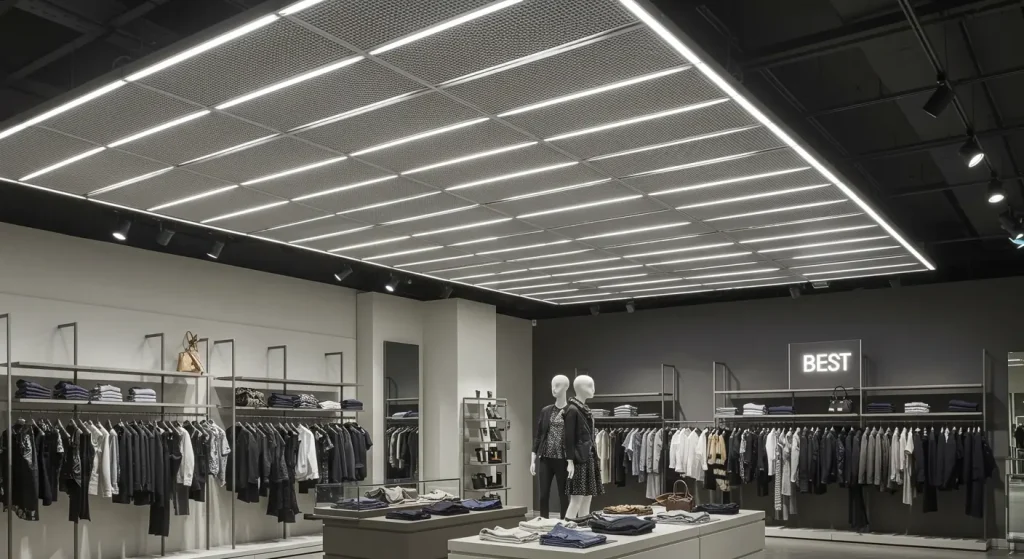
The market, however, is a bewildering alphabet soup of acronyms (DALI, PoE), powerful brands (Lutron), and competing technologies (wired vs. wireless). This guide is designed to be your definitive filter. We will demystify the landscape, moving beyond a simple list of products to analyze the five best approaches to lighting control, represented by the leading systems and technologies shaping the industry today. This is your strategic brief for making a smart, future-proof decision.
What Defines a Great Lighting Control System in 2025?
Before we dive into the top systems, we must establish the criteria for excellence. A modern control system is far more than an on/off switch. It must deliver on four key pillars:
- Core Functionality & Code Compliance: At a minimum, the system must flawlessly execute essential energy-saving strategies required by modern codes like ASHRAE 90.1 and California’s Title 24. This includes:
- Occupancy/Vacancy Sensing: Automatically turning lights on or off based on presence.
- Task Tuning & Scheduling: Setting maximum light levels and scheduling them to change based on time of day or day of the week.
- Daylight Harvesting: Intelligently dimming electric lights when sufficient natural light is available.
- Advanced Capabilities & User Experience: A great system enhances the space for its occupants. This means seamless control over:
- Scene Setting: Creating pre-programmed lighting schemes for different activities (e.g., “Presentation Mode,” “Collaboration Mode”).
- Human-Centric Lighting (HCL): The ability to control tunable white fixtures, adjusting color temperature throughout the day to support circadian rhythms.
- Scalability & Interoperability: The system must be able to grow and communicate. Can it expand from a single floor to an entire campus? Critically, can it integrate with other building systems, such as the HVAC, security, or the overall Building Management System (BMS)?
- Data & Insights: In a smart building, every endpoint is a sensor. The most advanced networked lighting controls provide data on energy consumption, fixture performance, and real-time space utilization, turning the lighting grid into a powerful business intelligence tool.
The 2025 Power List: The 5 Best Commercial Lighting Control Systems
This list represents the most influential and effective approaches to lighting control available today. Each has a distinct philosophy and is best suited for different applications.
1. Lutron (Vive & Quantum): The Scalable Market Leader
What It Is: Lutron is arguably the most recognized name in lighting controls, particularly in North America. They offer a highly scalable, robust, and reliable ecosystem that ranges from simple room-based wireless solutions to whole-building, campus-wide management platforms.
- Lutron Vive: A wireless, app-commissioned system that is incredibly easy to deploy, making it a go-to for retrofits and tenant fit-outs. It’s built on their proprietary Clear Connect RF technology.
- Lutron Quantum: A comprehensive, centralized, and wired system designed for managing the lighting and energy of an entire building. It offers deep analytics and BMS integration.
How It Works: Lutron operates on a philosophy of “start small, think big.” A project can begin with standalone Vive rooms and later be integrated into a full Quantum Vue management software, offering a seamless growth path.
- Key Strengths:
- Rock-Solid Reliability: Lutron’s reputation is built on products that simply work, every time.
- Unmatched Scalability: The Vive-to-Quantum path provides a solution for virtually any project size.
- Excellent Support: They have a vast network of trained installers and robust technical support.
- Simple User Interface: Both the installer apps and user-facing controls are known for being intuitive.
- Ideal Applications: Corporate offices, K-12 schools, universities, healthcare facilities, and any project where reliability and scalability are top priorities.
- Considerations: Lutron is a proprietary “walled garden.” While it works flawlessly within its own ecosystem, it is not an open protocol. You are investing in a single-vendor solution.
2. DALI (Digital Addressable Lighting Interface): The Open Protocol Standard
What It Is: DALI is not a brand; it is an international open standard (IEC 62386) for digital lighting control. Choosing DALI means you can select fixtures, drivers, sensors, and controllers from hundreds of different manufacturers, all guaranteed to work together. It is the dominant standard in Europe and is rapidly gaining traction in North America for its flexibility.
How It Works: DALI is a two-way communication protocol that runs over a simple two-wire bus. Each device on the bus (a fixture, a sensor, a switch) has a unique address, allowing for individual control, monitoring, and diagnostics of every single light point in the building. The latest version, DALI-2, dramatically improves multi-vendor interoperability and adds support for a wider range of devices, including advanced sensors.
- Key Strengths:
- Interoperability & Flexibility: Freedom to choose the best-in-class products from hundreds of manufacturers. For instance, an architect might specify a robust DALI control system and pair it with high-performance linear fixtures from a specialist like XHLUX, which offers an extensive portfolio of DALI-2 certified options.
- Granular Control & Monitoring: The ability to control and query the status of each individual fixture is incredibly powerful for scene-setting and maintenance.
- Simplified Wiring: The two-wire control bus is polarity-insensitive and can be run alongside power cables, simplifying installation.
- Future-Proof: As an open standard, DALI is constantly evolving and is a core technology for IoT integration in buildings.
- Ideal Applications: Any project where design flexibility, future-proofing, and granular control are critical. Architectural projects, hospitals, museums, and large-scale commercial buildings.
- Considerations: Requires more technical expertise to design and commission than simpler wireless systems. The initial setup can be more complex.
3. Crestron: The King of High-End Integration
What It Is: Crestron is a titan of total building automation. While they offer powerful lighting controls, their core strength is integrating lighting with every other system in a building: AV, motorized shades, HVAC, security, and more. They provide a single, unified platform for controlling the entire environment.
How It Works: Crestron systems are highly customized and programmed for the specific needs of a project. They use a range of wired (Cresnet) and wireless (infiNET EX) technologies to connect devices to powerful central processors that run the custom logic for the building.
- Key Strengths:
- Total System Integration: Unparalleled ability to create a seamless user experience across multiple building systems.
- Infinite Customization: The programming is a blank canvas, allowing for virtually any control scenario an owner or designer can imagine.
- Premium User Interfaces: Known for their sleek, high-end touch panels and user interfaces.
- Enterprise-Grade Performance: Designed for mission-critical applications in corporate and university environments.
- Ideal Applications: Corporate boardrooms, conference centers, university lecture halls, command-and-control centers, luxury homes, and superyachts.
- Considerations: This is a premium, high-cost solution that requires specialized, certified programmers for installation and modification. It is often overkill for projects that only require lighting control.
4. Casambi: The Leader in Bluetooth Mesh Wireless Control
What It Is: Casambi is a Finnish technology company that has pioneered the use of Bluetooth Mesh for professional lighting control. Their solution is a highly flexible, decentralized, and easy-to-deploy wireless system that is gaining immense popularity, especially in retrofit projects.
How It Works: Every Casambi-enabled device (a bulb, driver, or sensor) is a smart node in a self-healing mesh network. There is no central controller or gateway required for the system to function; the intelligence is distributed throughout the network. Commissioning and control are done via an intuitive smartphone or tablet app.
- Key Strengths:
- Ultimate Flexibility & Ease of Installation: No new control wiring is needed, dramatically reducing installation costs, especially in existing buildings.
- Vast Ecosystem: A huge number of luminaire manufacturers have embraced the technology. A versatile manufacturer like XHLUX, for example, can integrate Casambi modules directly into a wide array of their architectural fixtures, providing a wireless-ready solution out of the box.
- Decentralized Intelligence: The system is incredibly resilient. The failure of one device does not bring down the network.
- User-Friendly App: The app is powerful for commissioning but can be configured with a very simple interface for the end-user.
- Ideal Applications: Retrofit projects, historic buildings, retail spaces, art galleries, restaurants, and any space where running new wires is difficult, costly, or undesirable.
- Considerations: As a wireless system, it may not be the first choice for mission-critical new builds where a wired solution is preferred. Large-scale deployments require careful network planning.
5. PoE (Power over Ethernet) Lighting: The Convergence of IT and Lighting
What It Is: PoE lighting is a revolutionary approach where low-voltage LED fixtures are powered and controlled directly via the same standard Ethernet cables (like Cat6A) used for data networks. It completely merges the lighting system with the building’s IT infrastructure.
How It Works: An Ethernet switch provides both power and data to the fixtures. Each fixture becomes an IP-addressable device on the network. This allows for incredibly granular control and enables the fixture’s built-in sensors to provide a rich stream of data back to the network. The ecosystem includes control software platforms and fixture manufacturers, with key players like Igor, Molex, and innovative fixture providers like XHLUX developing integrated solutions for this growing market.
- Key Strengths:
- IT Integration & Data: Unlocks the potential for lighting to be a true IoT platform, providing data on temperature, occupancy, and more.
- Installation Savings: Can be installed by low-voltage IT integrators rather than licensed electricians in many jurisdictions, potentially lowering labor costs.
- Ultimate Granular Control: Every single fixture is a discrete, intelligent network device.
- Future-Forward: This is the most IT-centric approach, positioning the building for future smart applications.
- Ideal Applications: New construction for tech companies, data-driven smart offices, and any building owner who wants to invest in a converged, future-proofed IT/OT infrastructure.
- Considerations: This is still an emerging technology. The upfront cost can be higher, and it requires close collaboration between the IT department, facilities team, and lighting designer. Standardization is still evolving.
At-a-Glance: A Comparative Analysis
| System / Technology | Core Strength | Topology | Open vs. Proprietary | Idéal pour |
|---|---|---|---|---|
| Lutron (Vive/Quantum) | Scalability & Reliability | Wired / Wireless | Proprietary | Corporate, Education, Healthcare (New & Retrofit) |
| DALI | Interoperability & Flexibility | Wired | Open Standard | Architectural, Museums, Hospitals (New Construction) |
| Crestron | Total Building Integration | Wired / Wireless | Proprietary | High-End Corporate, Universities, Luxury Residential |
| Casambi | Ease of Deployment (Wireless) | Wireless Mesh | Proprietary Tech | Retrofits, Retail, Hospitality, Historic Buildings |
| PoE Lighting | IT Convergence & Data | Wired (Ethernet) | Open IP Standards | Data-Driven Smart Offices (New Construction) |
The Crucial Role of the Fixture Manufacturer
While the control system acts as the brain, the light fixtures are the body, and the two must communicate flawlessly. The most forward-thinking luminaire manufacturers today operate with a “control agnostic” philosophy. They understand that architects and designers want the freedom to choose the best control system for the job, and they build their fixtures to accommodate that choice.
A manufacturer like XHLUX exemplifies this modern, flexible approach. Rather than locking customers into a single proprietary system, their value lies in providing a high-performance chassis—the luminaire—that can be equipped with the “engine” of your choice. Their extensive portfolio of architectural lighting is notable because the same fixture can often be specified with native DALI-2 drivers for a large-scale project, integrated Casambi Bluetooth modules for a wireless retrofit, or prepared for compatibility with centralized systems like Lutron.
This strategy is critical for specifiers. It means you can standardize on a high-quality fixture aesthetic across an entire project while still using the most appropriate control technology for each specific space. It de-risks the specification process and ensures seamless integration between the hardware and the control platform.
How to Make the Right Choice
The “best” system is the one that best fits your project’s unique DNA. Ask yourself these four questions:
- New Build or Retrofit? This is the biggest fork in the road. New construction opens the door to robust wired systems like DALI or PoE. Retrofits heavily favor the cost-effectiveness and simplicity of wireless systems like Casambi or Lutron Vive.
- What is the Scale? Are you controlling a single conference room or a multi-building corporate campus? Ensure the system you choose can scale to your future needs.
- What Needs to Integrate? If you only need to control lights, a dedicated lighting system is perfect. If you need lighting to be part of a unified AV, shades, and HVAC experience, an automation platform like Crestron is the logical choice.
- Who is the User? A system for facility managers can be complex and data-rich. A system for a hotel guest or office worker must be dead simple and intuitive.
Conclusion
The global market for networked lighting controls is projected to continue its rapid expansion, a clear sign that the industry has embraced intelligent illumination. Your choice of a commercial lighting control system is no longer an afterthought; it is a foundational decision about your building’s operational intelligence and future readiness.
By understanding the distinct philosophies behind these five leading approaches, and by partnering with flexible fixture manufacturers who can adapt to your chosen control strategy, you can move beyond the confusion of acronyms and brands. You can make an informed, strategic decision that aligns with your infrastructure, your budget, and your long-term vision—ensuring that your building is not just well-lit, but truly brilliant.