 XHLUX
XHLUX

Table des matières
- 1. Commercial Lighting vs Residential Lighting: Why They Are Not the Same
- 2. Complete Overview of Commercial Lighting Fixture Types (2025 System Version)
- 3. Choosing Fixture Types by Industry Application
- 4. Optical Parameters You MUST Check Before Selecting Any Commercial Fixture
- 5. Selecting Fixtures Based on Space Size & Ceiling Height
- 6. Photometric Verification: The Critical Step Most Suppliers Never Mention
- 7. How Wholesalers & Contractors Should Choose Fixtures from Suppliers
- 8. Common Mistakes Buyers Make (and How to Avoid Them)
- 9. Why XHLUX Is a Trusted Global Partner for Commercial Lighting
- 10. FAQ About Types of Commercial Lighting Fixtures
- Conclusion
Commercial lighting is undergoing a rapid transformation. Driven by new building standards, workplace wellbeing priorities, brand experience requirements, and energy-efficient technologies, selecting the right types of commercial lighting fixtures has become more complex—and more important—than ever.
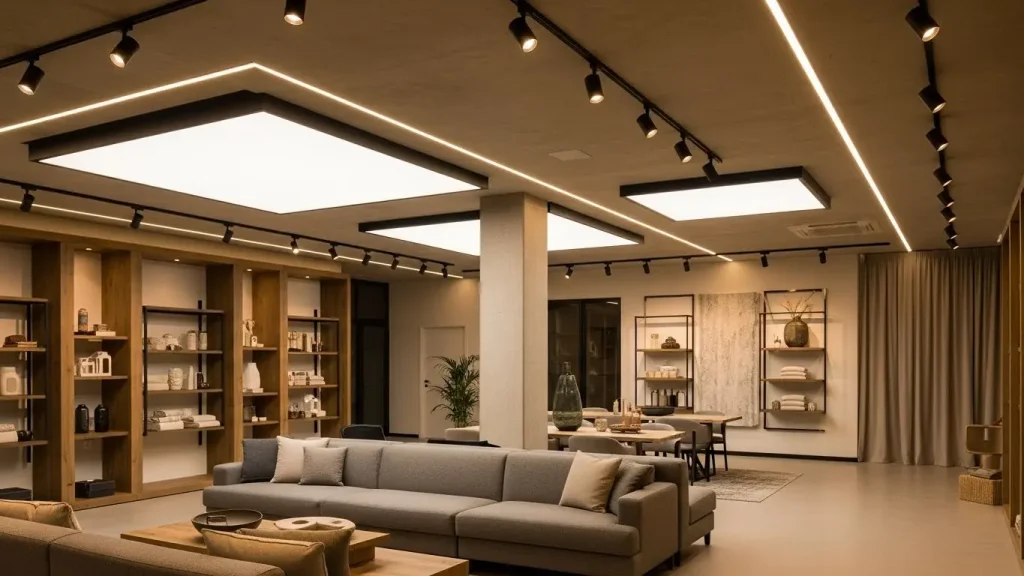
Whether you are a lighting distributor, commercial contractor, engineering firm, OEM/ODM buyer, or a project consultant, choosing the wrong fixture type can lead to:
- Failed lighting performance
- Poor visual comfort & glare issues
- Client dissatisfaction
- Re-design and re-installation costs
- Elevated long-term maintenance
- Project delays and lost profit
This guide provides a deep, engineering-grade, fully structured methodology for selecting the right types of commercial lighting fixtures for different interior applications.
If you need help selecting fixtures for your current project, you can reach our engineering team directly via Discutez sur WhatsApp or submit drawings through Contact Our Team.
1. Commercial Lighting vs Residential Lighting: Why They Are Not the Same
Commercial lighting must satisfy technical, operational, ergonomic, and brand-related requirements that residential luminaires simply cannot meet.
1.1 Commercial Spaces Demand Higher Optical Performance
Key metrics where commercial lighting outperforms residential lighting:
- UGR (Unified Glare Rating)
Offices, schools, and corporate interiors require UGR < 19. - CRI & R9
Retail, hospitality, gallery environments often need CRI 90–95+. - SDCM (Color Consistency)
Commercial-grade fixtures require SDCM ≤ 3 for batch uniformity. - Luminous Efficacy (lm/W)
Higher efficiency reduces total cost of ownership (TCO). - Beam Angle Options
Various distributions for accent lighting and merchandising displays.
Residential lighting rarely meets any of these consistently.
1.2 Commercial Spaces Use Far More Fixtures and Applications
Commercial environments include many distinct lighting zones:
- Open offices
- Corridors & breakout areas
- Boardrooms
- Reception & lobby
- Retail shelving & display zones
- Hotel lounges
- Gallery exhibition walls
Each zone has unique lux, glare, and ambience requirements.
1.3 Commercial Lighting Requires Longer Lifetimes and Stability
Commercial spaces typically run lighting 10–16 hours/day, sometimes 24/7.
This demands:
- Professional thermal design
- High-quality drivers
- Better component selection
- Stringent aging tests
- Long-term color stability
1.4 Project Timelines Are Strict and High-Risk
Commercial projects involve:
- Coordinated trades
- Installation deadlines
- Commissioning schedules
- Multi-phase delivery
- Penalty clauses
Choosing the wrong fixtures can delay entire construction phases.
💡 Download Tip: If you want a comparison sheet for training your sales team or clients, you can request the “Commercial vs Residential Lighting Technical Comparison Table” via Lighting Solutions.
2. Complete Overview of Commercial Lighting Fixture Types (2025 System Version)
2.1 Ambient / General Lighting
These luminaires create the baseline illumination for functional visibility.
• LED Panel Lights (Backlit / Edge-lit)
Used in offices, schools, meeting rooms.
- Even illumination
- High uniformity requirements
- Works with grid ceilings
• Linear Lights (Recessed / Suspended / Surface-Mounted)
2025’s most important commercial fixture type.
- UGR < 19 options
- High lm/W
- Architectural integration
• Downlights (Fixed / Anti-Glare / Deep Reflector)
Used for lobbies, corridors, retail general lighting.
• Highbay Lights
Used in large commercial atriums and warehouses.
2.2 Task Lighting
Focused illumination for work surfaces.
- Suspended linear task lights
- Desk/task lamps
- Workstation-specific modular lighting
2.3 Accent & Display Lighting
These are the soul of retail, hospitality, and gallery lighting.
• Track Lights (Adjustable / Zoomable / CRI95+)
Applications: retail windows, displays, exhibitions, galleries
- Beam angles (10°/24°/36°/60°)
- Accessories (honeycomb, snoots)
• Spotlights (Fixed / Adjustable)
Used for architectural features, artworks, meeting rooms.
• Adjustable Downlights (Gimbal / Tiltable)
Used where ceiling lines must stay clean.
2.4 Decorative Lighting
Used for branding, identity, mood.
- Sculptural chandeliers
- Pendant lights
- Appliques murales
- Artistic ambient fixtures
Note: Decorative lighting is not suitable as main commercial lighting.
2.5 Specialty Commercial Fixtures
Applications with advanced requirements:
- Wall washer luminaires
- Linear wall grazer systems
- Showcase & cabinet lighting
- IP65 waterproof luminaires
- Smart IoT lighting (DALI, Casambi, BLE Mesh)
💡 Explore More: If you want a complete A-to-Z list, view the full Lighting Product Catalog.
3. Choosing Fixture Types by Industry Application
3.1 Office Lighting
Best Fixture Types:
- Linear recessed or suspended luminaires
- Panel lights
- UGR<19 anti-glare downlights
- Wall washers for meeting rooms
Key Requirements:
- UGR < 19
- Uniformity (U0 ≥ 0.6)
- CCT 3500–4000K
- Minimal shadowing
Conseil de pro :
Combine linear fixtures (ambient) + downlights (accent) + wall washers (visual comfort).
3.2 Retail Lighting (Shop, Boutique, Mall)
Best Fixture Types:
- Track lights (CRI95+, beam control)
- lave-murs
- Asymmetric linear lighting for shelves
Key Requirements:
- CRI 90–95+, R9 > 50
- Beam flexibility
- High contrast for merchandise
Retail lighting determines sales conversion, not just visibility.
3.3 Hospitality (Hotels, Lounge, Restaurants)
Best Fixture Types:
- Decorative pendants
- Deep anti-glare downlights
- Ambient cove lighting
- Warm Dim luminaires
Key Requirements:
- Warm CCT (2700–3000K)
- High emotional ambience
- Layered lighting (ambient + accent + decor)
3.4 Gallery / Museum Lighting
Best Fixture Types:
- Track lights with high precision optics
- Zoomable spotlights
- lave-murs
Key Requirements:
- CRI 95–98+
- No UV/IR
- Flicker-free
- Controlled lux levels (50–200 lux)
3.5 Commercial Lobby & Public Areas
Best Fixture Types:
- Large chandeliers
- Suspended linear systems
- Accent downlights
- Ambient indirect lighting
Key Requirements:
- Visual identity
- Strong vertical illumination
- High ceilings compatibility
💡 Want ready-made layouts? Download the Commercial Lighting Design Templates via Lighting Solutions.
4. Optical Parameters You MUST Check Before Selecting Any Commercial Fixture
4.1 UGR (Glare Control)
- Offices → Mandatory UGR < 19
- Hospitality → UGR < 22
- Retail → Medium UGR acceptable
- Gallery → Depends on accent levels
Poor glare control = complaints + fatigue + visual discomfort.
4.2 CRI (Color Rendering Index)
- Retail, Gallery, Hospitality → CRI95+
- Office → CRI90
- Public areas → CRI80–90
Higher CRI improves skin tones, textiles, food, artwork, natural materials.
4.3 CCT (Correlated Color Temperature)
- Office: 3500–4000K
- Retail: 3000–4000K
- Hotel: 2700–3000K
- Gallery: 3000–3500K
4.4 Luminous Efficacy (lm/W)
Higher lm/W = fewer fixtures needed = lower energy cost.
2025 commercial range: 100–150 lm/W.
4.5 Beam Angle
Determines focus and contrast.
- 10°: Highlighting jewelry, objects
- 24°: Typical retail displays
- 36°: General accent lighting
- 60°: Wide illumination
4.6 SDCM (Color Consistency)
SDCM ≤ 3 = no visible color variation in large batches.
💡 Request your Optical Spec Cheat Sheet via Discutez sur WhatsApp.
5. Selecting Fixtures Based on Space Size & Ceiling Height
Key rules:
5.1 Small vs Large Spaces
- Small spaces → downlights + compact linear
- Large spaces → suspended linear + high-output systems
5.2 Ceiling Height & Fixture Type
< 3m
- Spots encastrés
- Low-profile linear luminaires
3–5m
- Suspended linear luminaires
- Medium pendants
> 5m
- High-output pendants
- Highbay luminaires
- Narrow-beam accent lights
5.3 Panel/Linear vs Accent Lighting Ratio
- Offices: 80% ambient, 20% accent
- Retail: 40% ambient, 60% accent
- Hospitality: 50% ambient, 30% accent, 20% decorative
💡 Want automatic calculations? Get our Lighting Layout Estimation Form from Lighting Solutions.
6. Photometric Verification: The Critical Step Most Suppliers Never Mention
To ensure your lighting design is correct:
6.1 IES Files
Required for Dialux/Relux simulations.
6.2 Dialux or Relux Simulation
Ensures your design meets lux and uniformity standards.
6.3 Beam Angle Testing
Confirm accent lighting performance.
6.4 Avoiding Rework
Dialux verification can prevent expensive re-installations.
💡 Need help? Request free Dialux simulation support via Contact Our Team.
7. How Wholesalers & Contractors Should Choose Fixtures from Suppliers
A practical commercial procurement guide:
7.1 Ensure the Product Line Covers All Major Commercial Types
A good supplier should offer:
- Projecteurs sur rail
- Spots encastrés
- Lumières linéaires
- Smart lighting options
(See full portfolio inside the Lighting Product Catalog.)
7.2 Look for Technical Documentation
- IES files
- 3D and BIM files
- Photometric reports
- Installation sheets
7.3 Evaluate ODM Capabilities
True commercial suppliers can customize:
- CCT
- Optique
- Housing
- Driver technology
- Mounting systems
7.4 Check Project Experience
Suppliers with real project experience provide better risk control.
Explore case studies:
Commercial Lighting Projects
7.5 Ensure Quality Traceability
- SMT lines
- Aging racks
- Testing equipment
- Quality control logs
💡 Download the full Supplier Evaluation Checklist via À propos de XHLUX.
8. Common Mistakes Buyers Make (and How to Avoid Them)
8.1 Using Residential Fixtures in Commercial Spaces
Causes failures and non-compliance.
8.2 Focusing Only on Wattage Instead of Lumens
Lumens determine brightness—not watts.
8.3 Ignoring Glare Control
Leads to complaints and project rejection.
8.4 Allowing Color Inconsistency
SDCM > 3 = visible color patches.
8.5 Skipping Dialux Verification
Results in over-lighting or under-lighting.
9. Why XHLUX Is a Trusted Global Partner for Commercial Lighting
9.1 Complete Product Ecosystem
Track / Downlight / Linear / Smart Lighting
View portfolio → Lighting Product Catalog
9.2 Engineering-Grade Light Quality
CRI95+, UGR<19, SDCM ≤ 3, high lm/W.
9.3 ODM Excellence
Optics, structure, thermal, and driver customization.
9.4 Full Project Support
IES files, Dialux design, installation guidance.
Learn more → Lighting Solutions
9.5 5-Year Warranty + Reliable Delivery + Global Projects
See applications → Commercial Lighting Projects
10. FAQ About Types of Commercial Lighting Fixtures
Q1: Which lighting fixtures are best for commercial spaces?
It depends on application. Offices → linear. Retail → track lights. Hospitality → ambient + accent.
Q2: When should I use linear lights?
For offices, corridors, meeting rooms, and architectural spaces requiring uniformity.
Q3: Why do retail stores rely on track lights?
Because track lights create contrast, highlight merchandise, and increase visual interest.
Q4: What CCT is best for offices?
3500–4000K for productivity and visual comfort.
Q5: How do I evaluate fixture quality?
Check CRI, UGR, lm/W, SDCM, driver stability, and IES data.
Conclusion
Selecting commercial lighting fixtures is both an art and a science.
You must consider:
- The application environment
- The optical requirements
- The brand and visual experience
- The glare control and uniformity
- The energy efficiency
- The ease of installation
- And the long-term reliability
A correct selection leads to:
✔ Higher client satisfaction
✔ Better visual comfort
✔ Energy savings
✔ Fewer complaints
✔ Professional brand positioning
If you want expert support for your project, you can:
- Discutez sur WhatsApp
- Email Our Team
- Contact Our Team
- Download the Lighting Product Catalog
- Request a custom lighting proposal via Lighting Solutions
With the right commercial lighting fixtures—and the right partner—you can deliver exceptional spaces that elevate brands, improve performance, and create lasting visual impact.