 XHLUX
XHLUX

Table des matières
- 1. What Are Commercial LED Lighting Fixtures?
- 2. Key Technical Criteria for Choosing Commercial LED Fixtures
- 3. Commercial LED Fixture Types (Professional Matrix)
- 4. Choose LED Fixtures Based on Industry Application
- 5. Essential Documents Required for Commercial Lighting Projects
- 6. How to Choose a Reliable Commercial LED Supplier
- 7. Common Mistakes to Avoid When Choosing LED Fixtures
- 8. Why Choose XHLUX for Your Commercial LED Projects?
- 9. FAQ About LED Lighting Fixtures Commercial
- 10. Conclusion
Modern commercial environments—offices, retail chains, hospitality venues, corporate lobbies, shopping malls, galleries, and warehouses—rely heavily on high-performance LED lighting systems. However, choosing LED lighting for commercial use is fundamentally different from choosing lights for residential spaces. The stakes are higher:
✔ light quality directly affects customer experience
✔ glare control impacts productivity and comfort
✔ energy efficiency drives ESG performance
✔ product stability impacts long-term maintenance
✔ optical quality affects brand identity
✔ and supplier capability determines whether your project succeeds or fails
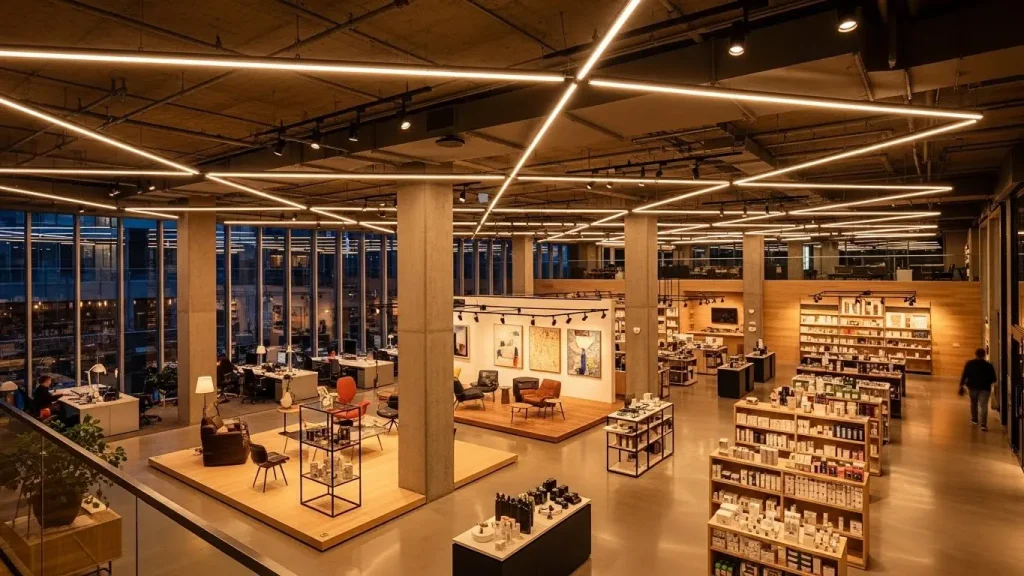
This guide provides the most complete, engineering-level selection framework for choosing the best LED lighting fixtures for commercial applications in 2025. It integrates optical science, industry-specific design logic, commercial project requirements, and procurement best practices. It also includes actionable tools, technical checklists, and direct access to professional resources such as Dialux simulations, project cases, and the XHLUX commercial lighting catalog.
1. What Are Commercial LED Lighting Fixtures?
(Commercial vs Residential: The Essential Differences). Commercial LED fixtures are specifically engineered for high-demand, long-operation, large-scale spaces such as offices, retail environments, hotels, restaurants, galleries, museums, malls, and warehouses.
Unlike residential lamps, commercial LED systems must meet strict performance criteria:
✔ Higher Energy Efficiency
Commercial facilities run lighting for 10–16 hours per day, so LED efficacy often exceeds 100–150 lm/W.
✔ Stricter Glare Control (UGR)
Office workers and retail customers are sensitive to glare.
Commercial downlights, linears, and panels often require UGR < 19 to comply with visual comfort standards.
✔ Higher Color Accuracy
Retail, museums, and hospitality spaces rely on high color fidelity.
CRI 90+ or CRI 95+ is the norm for high-end projects.
✔ Advanced Compatibility
Commercial LED fixtures must support smart control systems:
• DALI / DALI-2
• Casambi Bluetooth mesh
• 0–10V
• Motion & daylight sensors
✔ Longer Lifespan & Lower Maintenance
Commercial LED systems typically last 50,000–100,000 hours, minimizing downtime and operational costs.
👉 To better understand the critical differences, you can always Learn About XHLUX
2. Key Technical Criteria for Choosing Commercial LED Fixtures
Choosing LED lighting for commercial use requires evaluating eight critical criteria. These determine the balance between visual quality, performance, comfort, efficiency, and lifespan.
1. Luminous Efficacy (lm/W)
High-efficiency lighting directly reduces electricity cost and improves LEED/ESG performance.
Typical commercial levels:
• Good: 90–110 lm/W
• Excellent: 110–130 lm/W
• Premium: 130–150 lm/W+
High efficacy is essential in offices, malls, warehouses, and public facilities.
2. Glare Control (UGR)
Glare is the No.1 complaint in commercial lighting.
Industry standards:
• Offices / Education → UGR < 19
• Galleries / Premium Retail → UGR ≤ 16
• Hospitality → warm, low-contrast illumination
Deep anti-glare downlights and lens-based linear fixtures are widely used to meet these requirements.
3. Color Rendering Index (CRI)
Defines color accuracy and visual realism.
Recommendations:
• Retail / Gallery → IRC 95+ (premium)
• Hospitality / Restaurant → IRC 90+
• Office / Public Areas → CRI 80–90
High CRI improves brand presentation and customer experience.
4. Beam Angle (Optical Distribution)
Beam angles determine how light interacts with products or surfaces.
Typical commercial beam angles:
• 10° – spotlighting (jewelry, boutique, artwork)
• 24° – focused retail presentation
• 36° – general accent lighting
• 60° – wide flood illumination
Retail lighting relies heavily on beam angle portfolios, often requiring 4–6 options per SKU.
5. Color Temperature (CCT)
The mood and function of the space define the CCT:
• Office → 3500–4000K
• Retail → 3000–3500K
• Hospitality → 2700–3000K
• Restaurants → 2700K
• Galleries → 3000K
• Warehouse → 4000–5000K
Warm white enhances ambiance; natural white improves productivity.
6. Color Consistency (SDCM)
This is the most overlooked—but most critical—professional metric.
Commercial standards:
SDCM ≤ 3
ensures no visible color variation between fixtures.
Inconsistent color temperature is a major cause of project complaints.
7. Lifespan & Thermal Design
Premium LEDs reach up to 100,000 hours, but only if the thermal structure is well designed.
Key checks:
• Aluminum housing?
• Heat sink design?
• Driver brand (Lifud, Tridonic, Philips)?
• LM80 / TM21 available?
8. Smart Lighting Compatibility
Modern commercial lighting = smart lighting.
Compatibility checklist:
• DALI-2 for offices, malls, public buildings
• Casambi for boutique retail & hospitality
• Sensors for warehouse/parking
• 0–10V for cost-sensitive projects
👉 To get a complete specification template, you can View Commercial Lighting Solutions
3. Commercial LED Fixture Types (Professional Matrix)
1. General Lighting (Ambient)
• LED Panel Lights
• LED Linear Lights
• LED Downlights
Application: Offices, retail, public corridors, malls
2. Accent Lighting
• Track lights
• Adjustable downlights
• Spotlights
Application: Retail, gallery, museum, restaurants
Accent lighting shapes brand identity and improves product visibility.
3. Task Lighting
• Suspended office lights
• Desk/task lamps
• Reading lamps
Application: Workstations, hotels, schools
4. Decorative Lighting
• Chandeliers
• Pendant lamps
• Wall sconces
Application: Hotels, restaurants, lobbies
5. Specialty Lighting
• Wall washers
• Grid anti-glare downlights
• IP65 waterproof fixtures
• Smart lighting systems
👉 To explore real-world applications, you may Explore Project Cases
4. Choose LED Fixtures Based on Industry Application
1. Office Lighting
Best choices:
• UGR<19 linear lights
• High-efficiency panel lights
• Adjustable meeting room downlights
Design logic:
• uniformity
• glare control
• daylight integration
2. Retail Lighting
Best choices:
• CRI95+ track lights
• Multiple beam angles
• Adjustable accent lighting
Design logic:
• highlight merchandise
• create depth & contrast
• increase dwell time & sales
3. Hospitality Lighting
Best choices:
• Warm dim
• Low-glare downlights
• LED linear mood lighting
Design logic:
• soft contrast
• warm color temperature
• guest comfort & luxury experience
4. Gallery / Museum Lighting
Best choices:
• CRI95+ museum-grade optics
• Tight beam control
• UV-free, flicker-free LEDs
Design logic:
• protect artworks
• ensure accurate color
• provide clean beam shaping
5. Warehouse / Industrial Lighting
Best choices:
• Highbay UFO LED
• Sensor-integrated fixtures
• 5000K natural white
Design logic:
• maximize efficiency
• reduce energy cost
• adaptive lighting controls
👉 To obtain complete solution packs for each industry, you may Download our Product Catalog
5. Essential Documents Required for Commercial Lighting Projects
✔ IES / LDT Photometric Files
For Dialux or Relux lighting simulations.
✔ Wiring Diagram & Installation Guides
Avoids installation errors.
✔ Product Testing Reports
• LM80 / TM21
• CE / CB / ENEC
• RoHS / EMC
• Flicker test reports
✔ Complete BOM (Bill of Materials)
Ensures consistency for large projects.
👉 If you need a simulation for your upcoming project, simply Demander un devis and ask for a free Dialux plan.
6. How to Choose a Reliable Commercial LED Supplier
1. Optical & Structural ODM Ability
Can they customize:
• beam angle
• CRI
• CCT
• lenses & reflectors
• housing
• installation method
Factories with true ODM capability ensure you always have a competitive product.
2. Project Support Capability
A true commercial supplier must offer:
• IES files
• Dialux layout
• 3D/CAD drawings
• fixture schedules
• BOM lists
• compliance documents
3. Mass Production Consistency
Key metrics:
• SDCM control
• driver uniformity
• LED binning
• QC inspection procedures
4. Certifications & Compliance
Commercial-grade suppliers should have:
• CE
• CB
• ENEC
• SAA
• LM80/TM21
5. Proven Project Experience
Choose suppliers with real project portfolios.
👉 You can Explore Project Cases anytime
7. Common Mistakes to Avoid When Choosing LED Fixtures
❌ Using residential lights for commercial spaces
Leads to poor lifespan and inconsistency.
❌ Only checking wattage instead of lumens
Power ≠ brightness.
❌ Ignoring glare (UGR)
Major cause of worker discomfort and customer complaints.
❌ Buying low-quality LEDs with poor SDCM
Creates visible color shifts across the ceiling.
❌ Ordering without Dialux simulation
Leads to insufficient illuminance and costly rework.
8. Why Choose XHLUX for Your Commercial LED Projects?
✔ CRI95+
Premium color accuracy for retail & hospitality.
✔ UGR < 19
Comfort-focused visual design.
✔ SDCM ≤ 3
Guaranteed color consistency.
✔ Track / Downlight / Linear / Smart Full Portfolio
Covers all commercial applications.
✔ Advanced ODM
Optics, mechanics, thermal engineering, lensing, reflectors, beam angles.
✔ Engineering Support
IES files, Dialux simulations, wiring diagrams, CAD drawings.
✔ Global Experience
Serving Europe, Middle East, Australia, Southeast Asia.
👉 To know more, simply Learn About XHLUX
👉 Or Discutez sur WhatsApp with engineering support
9. FAQ About LED Lighting Fixtures Commercial
Q1: How do I choose the best LED fixtures for commercial use?
Evaluate glare control (UGR), CRI, beam angle, lumen output, SDCM, thermal structure, and smart compatibility.
Q2: What are the best LED fixtures for offices?
UGR<19 linear and panel lights with 3500–4000K.
Q3: Why CRI 95+ is important for retail?
It enhances true color representation and improves product appeal.
Q4: What color temperature is best for commercial lighting?
Depends on the industry: offices (4000K), retail (3000–3500K), hospitality (2700K).
Q5: How to evaluate LED lighting quality?
Check IES files, SDCM values, CRI, beam angles, and test reports.
10. Conclusion
Choosing the best LED fixtures for commercial use requires understanding optical science, industry-specific requirements, engineering standards, and supplier capabilities.
High-quality commercial lighting delivers:
✨ Better visual comfort
✨ Enhanced customer experience
✨ Increased productivity
✨ Stronger brand identity
✨ Reduced energy cost
✨ Long-term operational stability