 XHLUX
XHLUX

Table des matières
- 1. What Is a Trimless Downlight? (Definition and Design Concept)
- 2. Design Advantages of Trimless Downlights (Architectural Lighting Value)
- 3. Typical Applications in Architectural Projects
- 4. Installation and Construction Overview
- 5. How to Choose a Trimless Downlight Supplier (Buyer Guide)
- 6. Trends in High-End Architectural Lighting
- 7. Partnering with a Professional Trimless Lighting Manufacturer
- 8. Trimless Downlight Questions and Answers
- 9. Conclusion
- 10. Global Architectural Lighting Market (2025 Forecast)
Architectural lighting has shifted from simple illumination to an art of spatial expression.
Among the most refined solutions available today, the trimless downlight stands out as a symbol of purity, precision, and sophistication.
This article explains what trimless downlights are, their advantages, installation methods, key applications, and how to choose the right supplier for high-end architectural projects.
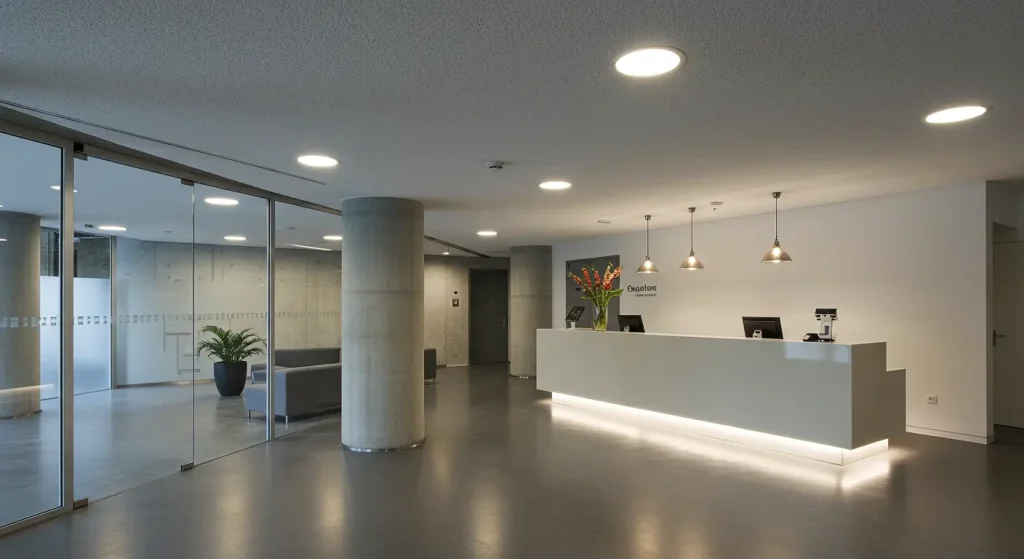
1. What Is a Trimless Downlight? (Definition and Design Concept)
A trimless downlight—also known as a frameless or minimalist recessed light—is a ceiling-mounted luminaire designed to blend perfectly with the surrounding architecture.
Once installed, the fixture sits completely flush with the ceiling surface, leaving no visible trim or rim.
1.1 Design Philosophy
Trimless fixtures follow the principle of “light without the luminaire.”
They allow designers to highlight architecture, materials, and volumes without exposing the light source.
This approach supports clean, continuous ceilings and an uncluttered visual language in modern interiors.
1.2 Structural Features
- Mounting frame integrated with plaster or gypsum board
- LED light module inserted post-finishing
- Precision reflector for controlled beam spread
- Optional adjustability for focus lighting
The result is a seamless ceiling where light appears to emerge directly from the architecture itself.
2. Design Advantages of Trimless Downlights (Architectural Lighting Value)
| Fonctionnalité | Description | Benefit for Architectural Projects |
|---|---|---|
| Minimalist Aesthetic | Hidden frame, pure ceiling line | Creates seamless contemporary interiors |
| Seamless Integration | Flush mounting with gypsum board | Eliminates visual clutter |
| Professional Optics | COB LED with low-UGR reflectors | Delivers comfortable, glare-free light |
| Adjustable Beam Options | 15°–60° rotatable optics | Supports both accent and ambient use |
| Flexible Configuration | Single, double, multi-head modules | Fits any spatial layout |
High-quality trimless luminaires are engineered to maintain CRI > 90 for accurate color rendering and UGR < 19 for visual comfort.
3. Typical Applications in Architectural Projects
| Application Area | Lighting Objective | Recommended CCT / Beam | Installation Note |
|---|---|---|---|
| Hotel Lobbies & Suites | Create relaxing ambience | 3000 K / 24° | Flush ceiling trimless type |
| Luxury Residences | Invisible light source, purity | 3500 K / 36° | Align with plasterboard level |
| Art Galleries & Museums | Highlight exhibits precisely | 4000 K / 15° | Adjustable trimless module |
| Retail & Showrooms | Enhance product texture | 4000 K / 24° | Linear multi-head trimless |
| Offices & Meeting Rooms | Visual comfort, low glare | 4000 K / UGR < 19 | Use anti-glare baffle design |
These fixtures provide architects and lighting consultants with total design freedom—delivering brightness where needed while keeping ceilings perfectly clean.
4. Installation and Construction Overview
4.1 Typical Structure
A trimless downlight generally includes:
- Mounting frame (embedded in ceiling)
- Light engine module (COB or SMD LED)
- Reflector / lens system
- External driver (Triac, 0–10 V, DALI)
4.2 Installation Steps
- Cut opening in plasterboard and secure metal or gypsum mounting frame.
- Apply plaster or putty to achieve a seamless finish.
- Paint ceiling; ensure opening edge is perfectly smooth.
- Insert LED module and connect driver cables.
- Adjust beam direction and test lighting.
4.3 Best Practices
- Use professional installers familiar with recessed framing.
- Verify dimming compatibility (Triac / 0-10 V / DALI).
- Select detachable modules for easier maintenance.
Illustration Suggestion: include a section diagram showing ceiling profile and beam distribution.
5. How to Choose a Trimless Downlight Supplier (Buyer Guide)
| Evaluation Aspect | What to Check | Recommended Standard |
|---|---|---|
| Craftsmanship | Aluminium housing, reflector precision, surface finish | CNC-machined, powder-coated |
| Optical Performance | Luminous efficacy, CRI, UGR, beam angles | CRI > 90, > 100 lm/W |
| Certifications | CE, ETL, SAA, LM-80 test | Mandatory for export markets |
| OEM / ODM Capability | Custom optics, logo, structure | Fast sampling ≤ 10 days |
| Project Experience | References in hotels, galleries, villas | Proven architectural track record |
5.1 Quality Verification Tips
- Request IES photometric files et LM-80 reports.
- Check step-MacAdam colour tolerance (≤ 3 SDCM).
- Evaluate uniformity and driver flicker rate (< 3 %).
6. Trends in High-End Architectural Lighting
The next generation of recessed luminaires combines trimless aesthetics with systèmes de contrôle intelligents.
6.1 Dimming and Control
- DALI / 0-10 V / Triac dimming for integrated control.
- Smart Lighting Protocols (Tuya, Zigbee, KNX) enable wireless configuration and scene scheduling.
6.2 Human-Centric Lighting
Adjustable CCT (2700 K – 6500 K) follows the natural daylight rhythm, enhancing comfort and productivity.
6.3 Emerging Design Directions
- Modular trimless systems (interchangeable light modules)
- Ultra-slim micro-frame designs
- High CRI COB sources with flicker-free drivers
- Replaceable optical accessories (lenses / louvers)
| Technologie | Design Impact | Adoption Rate (2025 Forecast) |
|---|---|---|
| DALI 2.0 | Unified building integration | 45 % of architectural projects |
| Smart wireless control | Flexible retrofit options | 28 % annual growth |
| Human-centric CCT | Wellness-focused spaces | 35 % corporate adoption |
7. Partnering with a Professional Trimless Lighting Manufacturer
A capable supplier should offer not only production but also engineering, optical design, and customization support.
7.1 Expertise
- Decade of experience in architectural recessed lighting
- Full range of trimless, linear, and modular systems
- Compatibility with DALI / 0-10 V / CCT controls
7.2 Quality Assurance
- CRI > 90 COB LEDs
- SDCM < 3 for colour consistency
- CE, ETL, SAA, RoHS certifications
7.3 OEM / ODM Support
- Private mould designs and custom logo engraving
- Photometric simulation and layout advice
- Rapid sampling and 25-day lead time
7.4 Representative Projects
- Luxury hotel ceiling renovations in the Middle East
- Art gallery installations in Europe
- High-end residential projects in Australia
8. Trimless Downlight Questions and Answers
| Question | Répondre |
|---|---|
| Q1: What differentiates a trimless downlight from a standard recessed light? | Trimless units eliminate the visible rim, creating a cleaner architectural finish. |
| Q2: Is installation complex? | It requires a plaster frame and finishing but provides a superior seamless result. |
| Q3: Are trimless fixtures dimmable? | Yes, compatible with Triac, 0-10 V, and DALI control systems. |
| Q4: Can products be OEM-customized? | Yes, optics, structures, and branding can all be tailored. |
| Q5: What types of projects use them? | Luxury homes, hotels, galleries, museums, and corporate offices. |
9. Conclusion
The trimless downlight represents the purest intersection of light and architecture.
By concealing the luminaire, designers allow the architecture itself to speak through illumination.
Whether used in a museum, retail flagship, or luxury residence, this solution merges design intent with visual comfort.
When selecting a partner, prioritize suppliers offering optical expertise, precision engineering, and verified certifications—ensuring the light is as flawless as the space it defines.
✅ Contact for architectural lighting solutions
✅ Download Trimless Downlight Catalog (PDF)
✅ Request a Sample for Evaluation
10. Global Architectural Lighting Market (2025 Forecast)
| Segment | Share 2023 | Projected Growth 2023-2025 | Main Driver |
|---|---|---|---|
| Hospitality & Retail | 35 % | +9.6 % CAGR | Aesthetic lighting renovations |
| Corporate Offices | 27 % | +8.1 % CAGR | Human-centric lighting trend |
| Residential Luxury Market | 20 % | +10.3 % CAGR | Minimalist design demand |
| Museums & Galleries | 10 % | +11.5 % CAGR | Accent and anti-glare solutions |
| Others | 8 % | +7.8 % CAGR | Smart control integration |
Source: Lighting Europe / IHS Markit Architectural Lighting Report 2025
This data underscores growing demand for seamless, high-performance recessed systems driven by architectural minimalism and intelligent lighting control.