XHLUX
XHLUX
A supplier calls a new range of office fixtures “human-centric.” The datasheet shows a colour-temperature slider and an app.
Is that what human-centric lighting actually is? Not quite.
Iluminación centrada en el ser humano (HCL) is a lighting approach that considers both what people need to see and how light affects people beyond vision.
In an office, that means asking more than “is the desk bright enough?” It also asks what light people receive, and when.
TL;DR: Human-centric lighting is a design approach, not a type of fixture. It weighs visual needs and the non-visual effects of light, and timing matters as much as brightness and colour. Tunable white can be one tool inside an HCL scheme, but a tunable-white fixture on its own is not HCL.
Tabla de contenido
- What is human-centric lighting?
- Why is it different from normal office lighting?
- How does it work?
- Why does light affect more than vision?
- What does it look like in an office?
- Real benefits, and what not to expect
- HCL vs tunable white vs circadian lighting
- What an office needs to use it
- Is it right for every office?
- Resumen
💡 1. What Is Human-Centric Lighting?
Human-centric lighting starts with people, not with a product.
It looks at two jobs of light at the same time:
- the visual job: seeing tasks, faces and surfaces comfortably
- the non-visual job: how light exposure influences the body across the day
The International Commission on Illumination (CIE) calls this idea integrative lighting: lighting that integrates visual and non-visual effects to benefit people.
CIE also notes that “human centric lighting” is used with a similar meaning.
In an office, HCL design considers:
- light level
- spectrum and light colour
- timing
- how people actually use the space
Two things it is not:
- It is not one kind of lamp.
- It is not the same as tunable white.
HCL does not require tunable-white or continuously changing light; dynamic lighting is one way to implement the approach.
🎯 Can you buy human-centric lighting as a product?
No. HCL describes how a scheme is designed and run; a fixture can support it but cannot be HCL on its own.
🔍 2. Why Is Human-Centric Lighting Different From Normal Office Lighting?
Many fixed office lighting systems are designed mainly around the visual task.
HCL goes a step further. It also considers the light people are exposed to through the working day.
| Standard office lighting mainly considers | HCL also considers |
|---|---|
| Whether work areas are bright enough | What light people actually receive at different times |
| Glare and visual comfort | When light exposure happens and how long it lasts |
| Colour rendering and uniformity | Changes in spectrum and light colour |
| Fixtures and layout | How daylight and electric light work together |
The right-hand column does not replace the left one. Good visual lighting is still the base.
🎯 Does HCL skip the usual office lighting checks?
No. Light levels, glare, colour rendering and uniformity still come first; HCL adds time and exposure on top.
⚙️ 3. How Does Human-Centric Lighting Work?
A time-varying HCL scheme may manage three practical variables: light level, light colour or spectrum, and timing.
Brightness / light level
Light can become stronger or softer depending on the time and how the space is being used.
Light colour / spectrum
The appearance and spectral content of the light can change.
Timing
It matters not only what light people receive, but when they receive it.
The CIE position statement on integrative lighting frames the goal as “proper light at the proper time.”
It also notes that responses to light depend on intensity, spectrum, duration, timing and a person’s earlier light exposure.
The pattern above is one possible example, not a formula. There is no single time-and-colour-temperature curve that fits every office.
Many commercial HCL systems do shift brightness and light colour through the day to echo daylight. That is one way to implement the idea, not its definition.
CIE also calls it unhelpful, and potentially misleading, to use colour temperature to label a light “healthy” or “unhealthy.”
🎯 Is cool light by day and warm light at night the rule?
It is a common example, not a rule; the right pattern depends on the space, the people and their working hours.
👁️ 4. Why Does Light Affect More Than Vision?
Your eyes do more than help you see.
Light also gives the body information about the time of day. That signal is linked to:
- circadian rhythm
- alertness
- sleep-wake timing
That is why HCL pays attention to what kind of light people receive, and when.
Responses are not identical from person to person. Age, whether someone is naturally a morning or evening person, and earlier light exposure all change how someone responds.
🎯 Why would office light matter after work hours?
Light received during the day feeds the body clock, so office light is one part of the daily pattern behind sleep timing.
🏢 5. What Does Human-Centric Lighting Look Like in an Office?
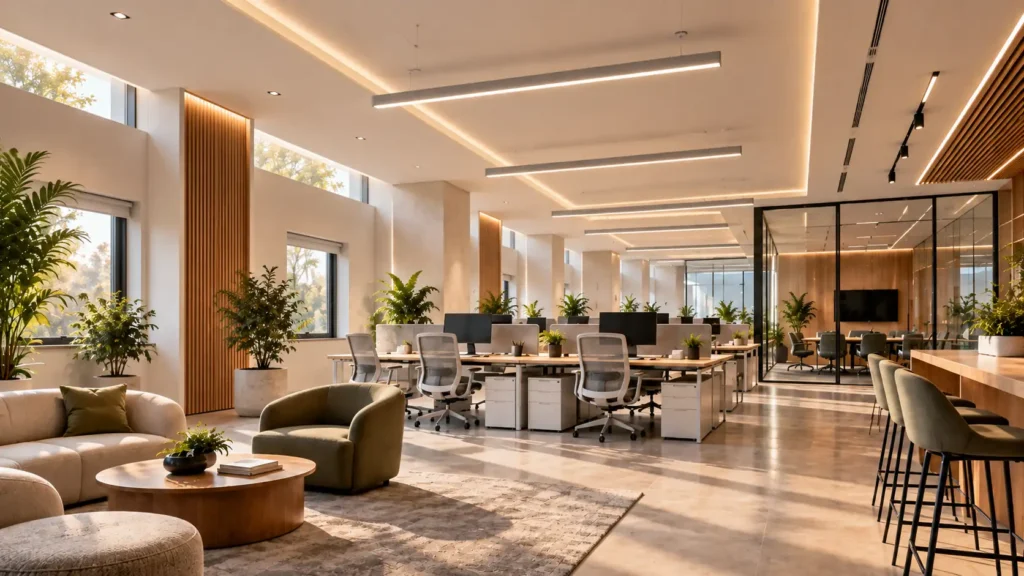
A human-centric lighting office usually looks less futuristic than people expect.
In a typical project, you might see:
- electric lighting that works with daylight where windows are available
- different lighting settings at different times of the working day
- work areas that still meet normal visual task needs first
- changes run by a lighting control system rather than by hand
- manual adjustment kept for occupants where the scheme allows it
HCL office lighting is not about making the lights change constantly.
It is about creating the right light conditions when they are useful.
🎯 Should staff feel the lights changing all day?
They should not feel like a show; changes exist to give useful conditions at useful times, not constant visible motion.
⚖️ 6. What Are the Real Benefits, and What Should You Not Expect?
Keep reasonable expectations separate from sales promises.
What it can reasonably offer
- a better overall lighting experience
- support for visual comfort
- electric lighting that adapts better to different times and tasks
- light exposure that may influence alertness, sleep timing and wellbeing
What it should not promise
- guaranteed higher productivity
- guaranteed better sleep
- guaranteed better concentration
- healthier staff simply because HCL is installed
Research shows that light exposure can influence circadian timing and sleep.
When looking at office lighting and sleep cycles, remember that office lighting is only one part of a person’s total daily light exposure. Results still vary between studies, between people and between exposure conditions.
The UK Society of Light and Lighting (SLL) advises that claims for specific health, wellbeing or performance benefits should be backed by published evidence and should not imply certainty.
🎯 Should an HCL proposal promise productivity gains?
No. Treat any guaranteed productivity or sleep figure as a sales claim unless published evidence backs it for similar conditions.
🔀 7. Human-Centric Lighting vs Tunable White vs Circadian Lighting
| Term | Simple meaning |
|---|---|
| Iluminación centrada en el ser humano | A whole lighting approach built around people’s visual and non-visual needs |
| Circadian lighting | Focuses more narrowly on how light relates to the body clock |
| Blanco ajustable | A fixture’s ability to change the colour temperature of its white light |
In the market, these labels are often used loosely, sometimes interchangeably. Circadian office lighting usually leans on the body-clock part of the idea.
Tunable white can help create an HCL system, but a tunable-white fixture by itself is not an HCL design.
🎯 Which of the three is a fixture feature?
Tunable white. The other two describe design goals, so they depend on how a scheme is planned and run.
🧩 8. What Does an Office Need to Use Human-Centric Lighting?
HCL is not finished when you buy a lamp.
A typical scheme may include:
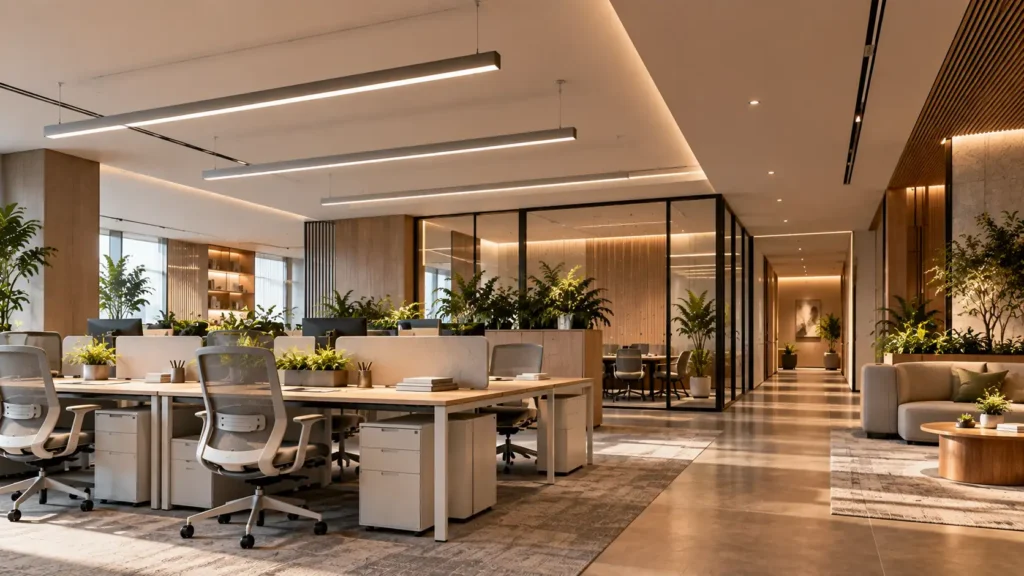
Adjustable fixtures → compatible drivers → lighting controls → programmed changes and sensors
Dónde tunable white office lights are used, they are one link in that chain.
Mayoría human-centric LED systems only work as intended when fixtures, drivers and controls are chosen to work together. The exact setup depends on the project.
If a supplier says “this fixture supports tunable white, so it is human-centric lighting,” the claim is incomplete.
HCL also depends on how the light is controlled, when it changes and why it changes that way. The SLL puts it plainly: no lighting product is intrinsically human-centric.
🎯 What should you ask when a fixture is sold as HCL?
Ask how it will be controlled, when the light changes and why; the answer should describe a scheme, not a feature.
✅ 9. Is Human-Centric Lighting Right for Every Office?
Not every office needs HCL.
If a project has not yet solved the basics, fix those first:
- deslumbramiento
- basic light levels
- fixture layout
- colour rendering
- use of daylight
HCL fits best on top of that base, when the team wants lighting that responds to time as well as task.
If the fixture layout is still open, choosing linear LED luminaires for office ceilings is a practical place to start.
🎯 When is HCL the wrong first investment?
When glare, light levels, layout or daylight use are still unresolved; sort the base before adding time-based control.
📌 Summary
- HCL is a lighting design approach, not a type of lamp.
- It considers both visual needs and the non-visual effects of light.
- Timing matters, not only brightness and colour temperature.
- Tunable white can be a tool, but it is not the same as HCL.
Preguntas frecuentes
Is human-centric lighting the same as circadian lighting or tunable white?
No, although suppliers often use the three labels as if they were interchangeable. When a proposal uses one of them, ask what it actually delivers: a design for visual and non-visual needs, a focus on the body clock, or simply a fixture that changes colour temperature.
Does human-centric lighting really improve sleep?
Light exposure can influence sleep timing, but an office HCL scheme cannot guarantee better sleep. Sleep also depends on outdoor daylight, evening light and screens at home, and personal schedules, none of which the office controls.
Does human-centric lighting require special LED fixtures?
Not always; it depends on what the plan changes. A scheme that only varies light level can work with dimmable fixtures and compatible drivers, while a scheme that also shifts light colour needs fixtures that can change colour temperature.
Can human-centric lighting be used in a normal or existing office?
Yes, in some cases. Check whether the existing luminaires, drivers and controls can deliver the changes the HCL design requires; otherwise, hardware upgrades may be needed.
Is human-centric lighting a form of light therapy?
No, human-centric lighting is general lighting for everyday spaces such as offices, not light therapy. The CIE definition of integrative lighting excludes lighting used mainly for therapeutic purposes, which is treated as a separate clinical use.
Where is light measured when designing human-centric lighting?
For non-visual effects, light is assessed at the eye rather than only on the desk. CIE guidance uses the plane of the observer’s eye, usually vertical and facing the direction of gaze, instead of the horizontal work surface.
Does human-centric lighting use more energy?
Not necessarily; the energy impact depends on the design. Higher daytime light levels can add load, but good use of daylight, dimming and time-based control can offset part of it.
Is there a standard that tells offices how to set up human-centric lighting?
There is no single mandatory standard that sets one HCL recipe for every office. CIE S 026:2018 gives a common way to measure light for non-visual responses, and building certification schemes such as WELL include circadian lighting criteria.
Conclusión
Human-centric lighting is less about a special lamp and more about a decision: what light should people receive, and when?
Start with good visual lighting. Then decide whether time-based changes in level and colour would help the people using the space, and choose fixtures and controls that can deliver that plan.
Bring Your Human-Centric Office Lighting Plans to Life with OEM/ODM Support
When an office project needs fixtures that fit a time-based lighting plan, development can cover:
- linear lighting and downlights for office ceilings
- driver and control options matched to the project’s dimming or scene plan
- colour-temperature options to suit the brief
- OEM/ODM development for a consistent series
- 5-year warranty on supported product lines
Email: [email protected]
Website: www.xhlux.com
Browse luces lineales LED y focos LED empotrables when comparing office fixture forms.