XHLUX
XHLUX
La frase de búsqueda incómoda track light hanging can describe two different assemblies: a pendant added to fixed track, or a complete track suspended from the ceiling. They use different hardware and must not be specified as if they were interchangeable.
Use this page when a pendant concept looks simple on the reflected ceiling plan, but the adapter family, electrical contact, load path or drop height has not been approved.
For track families, feeds, circuits and compatibility, start here:
→ Guía de sistemas de iluminación de riel: tipos, componentes y cómo elegir
For the checks that belong in a complete track package, use:
→ Qué comprobar antes de comprar un kit de iluminación para rieles
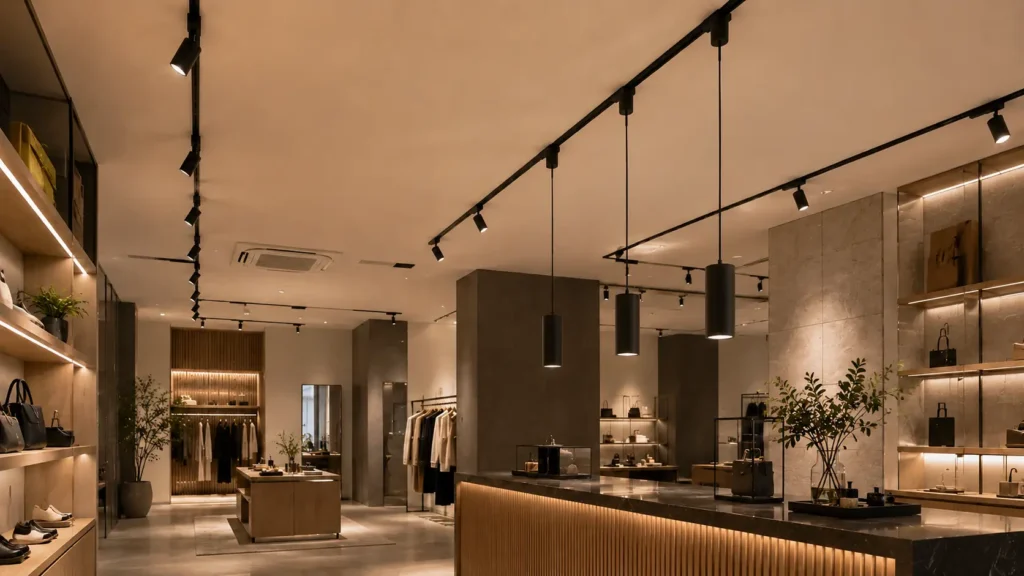
TL;DR: A pendant can hang from track only when the exact track family has an approved pendant adapter and every electrical and mechanical limit is documented. Verify voltage, circuit selection, grounding, fixture weight, drop length, movement, layout and service access. If one link in that chain is unproven, use a separate ceiling outlet or a purpose-made suspension system.
1. Limit 1: Identify what is actually hanging
What must be identified before any product is selected?
First decide whether the pendant hangs from fixed track or the entire track hangs from ceiling supports.
En track-mounted pendant lighting, the rail stays fixed to the ceiling. A purpose-made adapter enters the track and supplies the pendant through a cord, stem or chain. The adapter must match the rail’s mechanical profile and electrical contact arrangement.
En un suspended track light installation, rods, cables or pendant stems support the rail itself. Ordinary heads or pendant adapters may then attach to that suspended rail, but the suspension kit carries the complete track load.
The distinction changes the load path:
| Assembly | Ceiling supports | Track connection | What hangs below |
|---|---|---|---|
| Pendant on fixed track | Track fixings | Pendant adapter | One pendant fixture |
| Suspended complete track | Suspension kit at approved intervals | Track couplers and feeds | Track, heads and any permitted pendants |
| Separate pendant outlet | Junction box or structural fixing | Ninguno | One independent pendant |
Nora Lighting’s NT-336 kit, for example, suspends the complete track and specifies support spacing for that product family. It is not a substitute for a pendant adapter, and a pendant adapter is not a track suspension point.
The diagram shows load paths only. It is not an installation detail or a universal support-spacing plan.
🎯 Is a suspended track the same as a pendant attached to track?
No. One system suspends the rail; the other uses the rail and an adapter to support a permitted pendant.
2. Limit 2: Match the adapter to the exact track family
Can a mechanically similar adapter be treated as compatible?
No; the adapter must match the manufacturer-approved track profile, contacts, circuit arrangement and locking method.
H, J and L are common North American line-voltage families, but those labels do not cover every regional or commercial system. Three-circuit track, proprietary architectural rails and magnetic low-voltage systems use different contacts and retaining details.
A hanging fixture track adapter can appear to enter a rail yet still place its contacts in the wrong position. It may fail to lock, select the wrong circuit or create an intermittent connection after the cord starts moving.
Satco’s TP232 is documented as an H-style, single-circuit, 120V adapter for its stated use. That description is useful because it identifies a family and electrical arrangement. It does not make the part universal.
Before approval, record these items on one line of the fixture schedule:
- Track manufacturer and exact series
- Regional track family or proprietary profile
- Number of circuits or phases
- Adapter model and locking method
- Pendant connection type: cord, stem or chain
- Permitted fixture weight and location rating
🎯 Can any pendant adapter fit any track?
No. Visual similarity is not evidence of matching contacts, polarity, locking geometry or load rating.
3. Limit 3: Verify the complete electrical system
What electrical checks come before connecting the pendant?
Confirm voltage, frequency, circuit selection, conductor arrangement, grounding, driver input and dimming for the exact assembly.
IEC 60570 covers track systems for luminaires within its stated voltage, frequency and current scope. It sets a system-level safety framework, but it does not turn unrelated adapters and rails into compatible components. The applicable regional adoption and manufacturer instructions still control the project.
Mechanical fit proves very little electrically. A pendant may contain an integral driver, a remote driver or a replaceable lamp. Each route changes the input requirements and control behaviour.
Use this pre-order electrical checklist:
- Rated input voltage and frequency
- Track circuit or phase selected by the adapter
- Protective earth or Class II construction, as applicable
- Driver location, accessibility and ambient limit
- Dimming protocol and minimum load behaviour
- Inrush current across the planned pendant quantity
- Dry, damp or other location marking for the complete assembly
Do not splice a low-voltage pendant onto a line-voltage adapter. Do not assume a dimmable lamp makes the adapter, driver and control combination compatible.
🎯 Does a pendant work if the adapter locks into the rail?
Not necessarily. The electrical contacts, voltage, grounding and control system must also match.
4. Limit 4: Prove every mechanical load rating
Which part determines how much pendant weight the track can support?
The lowest documented rating anywhere in the complete load path sets the limit.
That path can include the building structure, ceiling fixing, track support, rail, coupler, adapter, strain relief, cord or stem, canopy detail and pendant body. A strong rail does not rescue an underrated adapter.
Manufacturer documents show why a universal weight claim would be unsafe. Nora Lighting’s NT-368 pendant adapter states a maximum weight of 5 lb for its described configuration. A Signify Lightolier 7599 adapter document gives different limits for cord-mounted and stem- or chain-mounted fixtures. Those numbers belong to those exact systems, not to track lighting in general.
Failure often starts gradually. An overloaded connection may twist the rail, pull an adapter out of alignment or loosen contacts before anything visibly falls.
| Síntoma | Likely cause | Correct response |
|---|---|---|
| Rail twists near pendant | Concentrated load or weak support spacing | Stop use; verify rail, fixing and adapter ratings |
| Pendant sways excessively | Long drop, air movement or unsuitable suspension | Shorten through an approved method or use separate support |
| Light flickers when moved | Loose contact, wrong adapter family or damaged track | Isolate power and inspect the matched system components |
| Adapter creeps or unlocks | Incorrect locking method or overload | Replace with the approved adapter; do not improvise a retainer |
| Ceiling fixing moves | Track support not anchored to suitable structure | Redesign the fixing with the responsible contractor |
🎯 Can you use the track’s total load rating as the pendant limit?
No. The individual adapter, suspension component and local fixing may have lower ratings than the complete rail.
5. Limit 5: Control drop height, movement and sightlines
How should the pendant drop be approved?
Set the lowest point from the finished space, then check clearance, glare, sway, cleaning and collision paths.
A long pendant can look correct in elevation but fail during normal use. Doors, movable displays, tall shelving, service ladders and air-conditioning flow all matter. In public projects, local clearance and accessibility rules also apply.
Use simple geometry before choosing a cord length. Suppose a track is 3.6 m above the floor, the project requires a 2.1 m clear zone, and the pendant body is 0.35 m tall. The maximum geometric drop from track to the top of the body is:
3.6 m - 2.1 m - 0.35 m = 1.15 m
That 1.15 m is only a starting dimension. It does not approve the clearance, cord, adapter, sway or local compliance.
Also check the source from seated and standing views. A pendant over a counter may place the bright aperture directly in a customer’s sightline even when its bottom edge clears the work surface.
🎯 Is the longest available cord a safe maximum drop?
No. Available cord length does not establish clearance, stability, adapter loading or visual comfort.
6. Limit 6: Build the layout from the target and service plan
What makes a pendant layout workable after installation?
Each pendant needs a defined target, balanced loading, practical access and a documented route for replacement.
A pendant track lighting layout should follow counters, tables, displays or circulation edges rather than rail symmetry alone. Record the target, beam angle, mounting height and aiming requirement for every pendant type.
Avoid clustering several heavy drops at one unsupported section of rail. Keep pendants away from track joints unless the system documentation permits that position. If the track supplies multiple circuits, record the circuit selection so commissioning does not become trial and error.
Finish with a 90-second approval sequence:
- Is there an approved adapter for the exact track series? If no, use a separate ceiling outlet.
- Do voltage, circuit, grounding and dimming match? If no, redesign the electrical route.
- Is every load rating documented above the actual pendant weight? If no, add independent structural support.
- Does the drop clear people, doors, displays and maintenance equipment? If no, shorten or relocate it.
- Does each pendant light a defined target without glare? If no, change position, optic or fixture.
- Can the driver, adapter and pendant be inspected and replaced safely? If no, revise access before ordering.
If the complete rail needs to sit lower, specify a track suspension kit. If one heavy decorative pendant needs independent support, give it a separate structural fixing and electrical outlet.
🎯 When should a pendant use a separate ceiling outlet instead of track?
Use a separate outlet when no approved adapter exists, the load exceeds a documented limit or the pendant needs independent structural support.
¿Qué hacer a continuación?
- Identify whether the concept suspends one pendant or the complete rail.
- Use the track-system guide linked in the introduction to confirm the rail family and circuit arrangement.
- Use the track-kit checklist linked above to verify feeds, couplers and documentation as one system.
- Request the adapter data sheet, pendant weight, driver data and installation instructions for the exact models.
- Build and test one representative drop at the real height before releasing the full quantity.
- Ask XHLUX or another project supplier to confirm compatibility in writing; do not approve a mixed system from catalogue photos alone.
Preguntas frecuentes
Notas y fuentes
- IEC 60570:2003 with Amendments 1:2017 and 2:2019, consolidated edition 4.2, Luminaires: Track systems for luminaires.
- Nora Lighting NT-368 Pendant Adapter documentation, used as a model-specific compatibility and weight-limit example.
- Nora Lighting NT-336 Pendant Assembly Kit documentation, used to distinguish complete-track suspension from a pendant adapter.
- Signify Lightolier 7599 Pendant Adapter specification sheet, used to show that cord, stem and chain limits are product-specific.
- Satco TP232 Track Pendant Adapter specification, used as an H-style single-circuit product example.
- Las autoridades externas se mencionan únicamente en texto plano. Ningún sitio web externo recibe un enlace clicable.