 XHLUX
XHLUX

Tabla de contenido
- 1. Why Restaurant Lighting Design Matters More Than Ever
- 2. The Four Layers of Commercial Restaurant Lighting
- 3. Essential Technical Specifications for Restaurant Lighting
- 4. Lighting Strategies for Different Restaurant Types
- 5. Step-by-Step: Restaurant Lighting Design Workflow
- 6. Common Lighting Mistakes in Restaurants (and How to Avoid Them)
- 7. FAQ About Commercial Restaurant Lighting
- 8. Conclusión
Commercial restaurant lighting refers to a professionally designed lighting system that combines ambient, task, accent, and decorative fixtures to create the ideal dining atmosphere, enhance food presentation, improve staff productivity, and reduce energy and maintenance costs using high-performance LED lighting technologies.
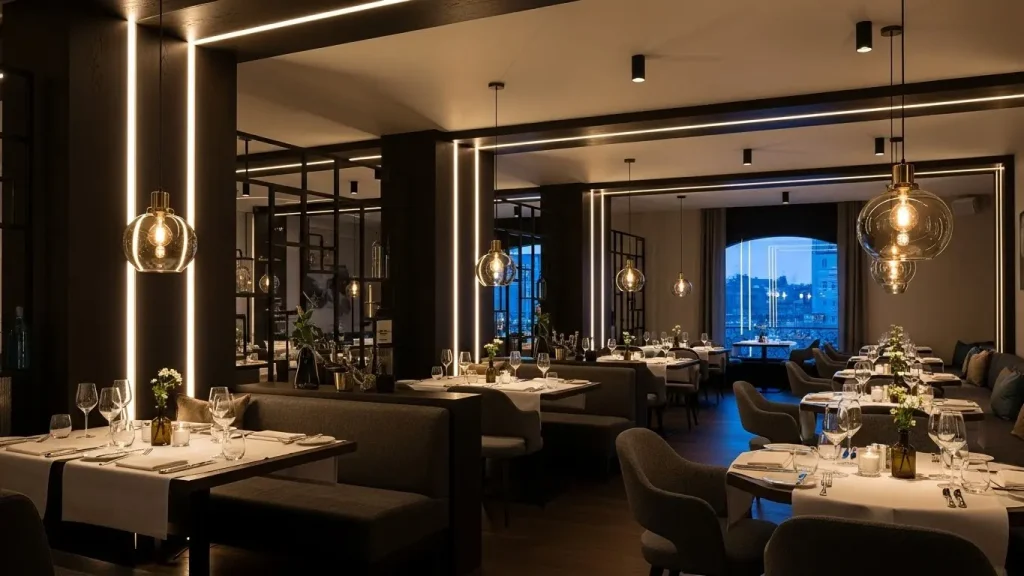
1. Why Restaurant Lighting Design Matters More Than Ever
Lighting is one of the most powerful tools in modern restaurant design. Customers often remember ambience more vividly than furniture or décor—and lighting shapes 80% of that ambience.
In competitive markets such as the U.S. hospitality and food service industry, restaurant lighting directly affects:
- Guest comfort and mood
- Dwell time & repeat visits
- Perceived food quality
- Average check size
- Photo appeal for social media
- Brand identity & dining style
- Energy cost and operational efficiency
A well-designed lighting plan blends:
- Atmosphere (warm, inviting, memorable)
- Functional illumination (for staff, service, and food prep)
- eficiencia energética (up to 70% cost savings with LED)
- Brand expression (lighting as part of interior storytelling)
- Maintenance & reliability (50,000h LED lifetime)
That is why successful restaurants—from casual cafés to Michelin-style dining rooms—prioritize lighting as a foundational design element.
2. The Four Layers of Commercial Restaurant Lighting
Restaurants are complex environments, and a single lighting layer can never create the right dining experience. The most successful spaces use a structured, layered approach:
2.1 Ambient Lighting (General Illumination)
Ambient lighting sets the baseline visibility for the entire restaurant.
Common fixtures:
- Recessed downlights
- Linear ceiling fixtures
- Architectural LED strips
- Suspended linear luminaires
- Ceiling-mounted track systems
Explore ambient options at XHLUX:
👉 Luces lineales LED
👉 Focos LED empotrables
Ideal characteristics:
- Soft, uniform illumination
- UGR < 19 for comfort
- 3000–3500K warm neutral color
- CRI ≥ 90 for food accuracy
2.2 Task Lighting (Functional Illumination)
Task lighting ensures staff can work efficiently and safely.
Utilizado en:
- Kitchen & prep zones
- Bar counters
- Host stands
- POS & checkout stations
- Server stations
- Dish plating counters
Task lighting requires:
- High brightness (500–1000 lux)
- 3500–4000 K
- CRI ≥ 90
- Clear visibility with minimal shadows
2.3 Accent & Decorative Lighting (Mood & Visual Drama)
This is where the dining mood is truly created.
Perfect fixtures include:
- Track spotlights
👉 Iluminación comercial tipo riel - Lavadoras de pared
- LED mini spotbars
- colgantes decorativos
👉 Pendant Light Collection - Shelf / bottle display lighting
Accent lighting should:
- Highlight art, architectural elements, plants, wine displays, or textured walls
- Add dimension, contrast, and emotional depth
- Use beam angles 10°–36° for precision
- Be dimmable for day/night ambience shifts
2.4 Table Lighting (The Most Critical Layer)
Restaurant tables are emotional zones. Customers photograph food, celebrate special events, and make memories here.
Mejores partidos:
- Pendant lights
- Small cone-shaped track heads
- Mini wall sconces
- Suspended linear micro-fixtures
- Rechargeable table lamps (optional)
Because food presentation is crucial, table lighting must use:
- CRI 95+
- 2700–3000K warm tones
- Soft, localized cone of light
XHLUX offers high-CRI precision spotlights:
👉 Zoomable LED Track Lights
3. Essential Technical Specifications for Restaurant Lighting
This section addresses U.S. design standards using data from IES y ENERGY STAR guidelines.
3.1 Recommended Illuminance (Lux) Levels
| Área | Recommended Lux | Notas |
|---|---|---|
| Dining tables | 150–250 lux | Warm and intimate |
| Fine dining | 50–150 lux | Very soft ambience |
| Cafés & casual dining | 200–350 lux | Brighter, lively environment |
| Bar & lounge | 30–120 lux | Low, dramatic lighting |
| Reception / waiting | 150–250 lux | Welcoming & clear visibility |
| Kitchen / prep | 500–1000 lux | High visibility task zone |
| Passageways | 100–200 lux | Safe navigation |
| Outdoor dining | 100–200 lux | Depends on ambient light |
3.2 Color Temperature (CCT) Recommendations
| Restaurant Type | Ideal CCT |
|---|---|
| Fine dining / wine bars | 2200–2700K |
| Casual dining / family restaurants | 2700–3000 K |
| Cafés / modern restaurants | 3000–3500K |
| Bakeries / bright daytime venues | 3000–4000K |
| Kitchens | 4000–5000K |
3.3 CRI (Color Rendering Index)
Food presentation quality depends heavily on CRI.
| Food Category | Recommended CRI |
|---|---|
| Meat | CRI 95 |
| Vegetables & fruit | CRI 95 |
| Desserts & pastries | CRI 90–95 |
| Wine & drinks | CRI 90+ |
| General dining | CRI 90+ |
High-end restaurants often standardize on CRI 95–97 lighting—available in XHLUX Track Lights y Downlights.
3.4 Beam Angles & Optical Control
- 10–15°: Dramatic highlight for wine bottles, desserts, sculpture
- 24–36°: Best for table lighting
- 60°+: General ambience
- Asymmetric wash: Wall textures, murals, branding elements
3.5 Dimming & Smart Control Systems
Restaurant lighting must be adjustable for:
- Day vs. night
- Weekday vs. weekend
- Lunch vs. dinner atmosphere
- Seasonal decor
- Event setups
Best systems:
- 0–10V
- Triac dimming
- DALI-2 (See: https://www.dali-alliance.org/)
- Bluetooth / WiFi smart control
- PIR motion sensors (restrooms, back-of-house)
4. Lighting Strategies for Different Restaurant Types
4.1 Fine Dining Restaurants & Wine Bars
Objetivos:
- Intimacy
- Warmth
- Emotional depth
- Premium food presentation
Best approach:
- Warm CCT: 2200–2700K
- CRI 95+
- Soft ambient light + strong focal table lighting
- Pendant lights 600–900 mm above table
- Wall-grazing lights to reveal textures
4.2 Casual Dining, Cafés, Family Restaurants
Objetivos:
- Comfortable atmosphere
- Lively daytime feel
- Visual clarity
Lighting strategy:
- CCT 2700–3000K
- Medium brightness
- Mix of linear ambient + decorative pendants
- Track lighting for bakery displays, shelves, coffee counter
Explore XHLUX pendant options:
👉 Pendant Lights
4.3 Fast Food, QSR, Take-Out Restaurants
Objetivos:
- Bright, energetic space
- High visibility
- Efficient workflow
Best specs:
- CCT 3000–4000K
- Higher brightness levels
- Efficient linear lighting
- Durable, easy-clean fixtures
- Anti-glare downlights near counters
4.4 Bars, Cocktail Lounges, Night Venues
Objetivos:
- Drama
- Contrast
- Moody atmosphere
Usar:
- Wall washers for bottles
- RGB or tunable white accents
- CRI 90+ for drinks
- ≤ 120 lux ambient
4.5 Outdoor Seating & Patio Areas
Considerations:
- Weatherproof fixtures
- Soft warm lighting
- Avoid glare on reflective surfaces
- Path lighting for safety
xhlux lighting real-world case study
A boutique fusion restaurant in Miami redesigned its ambience using XHLUX CRI 97 track lights and suspended pendants over each table. After installation, customer satisfaction scores increased by 18%, and night-time dining revenue grew by 22%.
5. Step-by-Step: Restaurant Lighting Design Workflow
Step 1 – Define Brand Identity & Atmosphere
Modern, romantic, fast casual, premium classic?
Lighting is part of branding.
Step 2 – Map Key Areas & Their Functions
- Dining zones
- Booth & VIP zones
- Bar
- Host stand
- Kitchen
- Restrooms
- Patio
Step 3 – Choose Lighting Layers & Fixture Types
Combine ambient + task + accent + decorative layers.
Step 4 – Specify Technical Requirements
- CCT
- CRI
- Salida de lúmenes
- ángulo del haz
- UGR
- Control interface
Step 5 – Layout Planning & Photometrics
XHLUX proporciona:
👉 Soluciones de iluminación including
- CAD layout
- Simulaciones DIALux
- Light uniformity analysis
Step 6 – Installation & Commissioning
- Mount heights
- Cable routing
- Dimming calibration
- Scene presets
Step 7 – Maintenance & Upgrades
- LED lifetime (50,000 hours)
- Replaceable drivers
- Modular fixture upgrades
6. Common Lighting Mistakes in Restaurants (and How to Avoid Them)
❌ Only using overhead lighting → flat, boring space
❌ Mixing color temperatures → inconsistent ambience
❌ Too little table lighting → shadows on food
❌ Ignoring CRI → food looks dull
❌ Under-powered accent lighting → no visual drama
❌ No dimming → cannot change mood
❌ Cheap fixtures → high heat, failures, maintenance cost
Correct these and your restaurant instantly looks higher class.
7. FAQ About Commercial Restaurant Lighting
What is the best color temperature for restaurants?
2700–3000K for most dining environments; 2200K for fine dining.
Do restaurants need high CRI lighting?
Yes. CRI 90–95 is essential for accurate food and interior presentation.
Is LED good for restaurant lighting?
Absolutely—LEDs deliver 50–70% energy savings and long lifetimes.
Should restaurant lighting be dimmable?
Yes. Dimming is critical for changing day/night atmosphere.
How bright should restaurant tables be?
150–250 lux with a controlled beam angle.
8. Conclusión
A perfectly designed restaurant lighting system balances:
- Ambience
- Technical precision
- eficiencia energética
- Brand identity
- Guest comfort
- Operational reliability
XHLUX offers a full suite of commercial-grade restaurant lighting fixtures: