 XHLUX
XHLUX

Tabla de contenido
An organization’s most valuable asset is its people. Every day, business leaders invest in technology, ergonomics, and amenities to support their team’s well-being and productivity. Yet, one of the most powerful factors influencing daily comfort, focus, and health is often the most overlooked: the light they work under. Bad lighting is a hidden drain on an organization—a silent contributor to eye strain, headaches, fatigue, and the dreaded afternoon slump.
For decades, the goal of office lighting was simply to achieve a target brightness level, often resulting in sterile, monotonous, and visually harsh environments. That paradigm is now obsolete. In 2025, we understand that the quality of light is infinitely more important than the mere quantity. Choosing commercial office lighting fixtures for comfort is no longer a luxury; it is a strategic imperative for attracting and retaining top talent and fostering a high-performance culture.
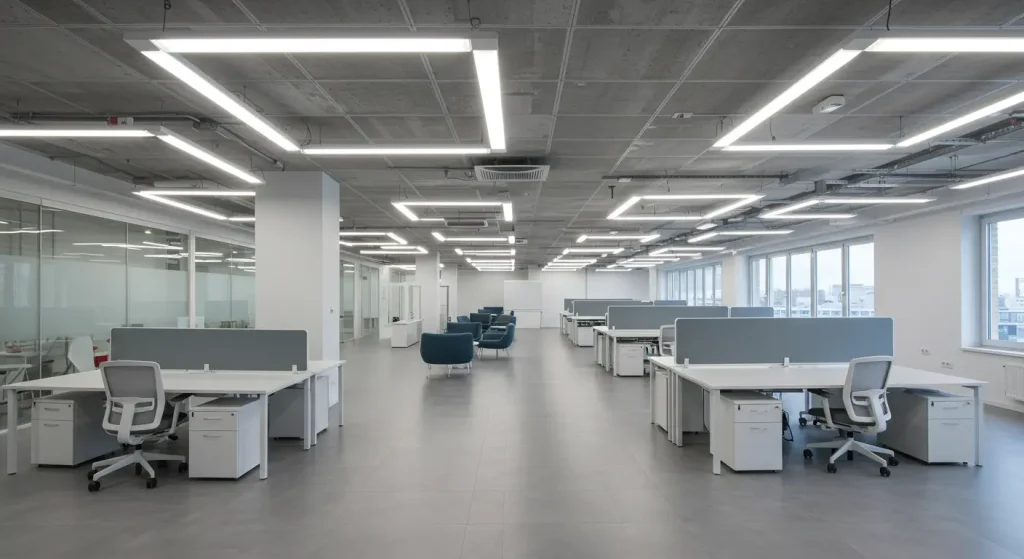
This guide moves beyond simple illumination. It is a definitive resource on how to create a visually, psychologically, and even biologically comfortable environment through the intelligent selection of lighting. We will demystify the key technical concepts—glare, flicker, and color—and introduce the transformative potential of human-centric office lighting. This is your blueprint for creating a workspace that doesn’t just function, but actively contributes to the well-being and success of your team.
The New Definition of Comfort
To specify lighting for comfort, we must first define it. In modern lighting design, “comfort” is not a vague feeling; it’s a multi-faceted concept built on three distinct pillars.
- Visual Comfort: The absence of physical irritation and strain. This is about what your eyes don’t notice—harsh glare, distracting shadows, or imperceptible flicker.
- Psychological Comfort: The emotional and aesthetic quality of the space. This is about how the light makes people feel—whether the environment is inviting and vibrant, or cold and clinical.
- Biological Comfort: The alignment of light with our innate human biology. This is about how the light interacts with our internal body clocks to support natural rhythms of energy and rest.
Visual Comfort – The Battle Against Glare and Flicker
This is the foundational layer of comfortable lighting. If you get this wrong, nothing else matters.
Conquering Glare: The UGR <19 Gold Standard
Glare—excessive brightness that causes visual discomfort—is the number one enemy of a comfortable office. It can be direct (seeing a painfully bright fixture) or reflected (blinding spots of light bouncing off screens and desktops). The lighting industry uses a standardized metric to quantify this discomfort: the Clasificación Unificada de Deslumbramiento (UGR).
For computer-based office work, the Sociedad de Ingeniería de Iluminación (IES) and other international standards bodies recommend a UGR of 19 or less (UGR<19). This is the single most important technical specification to look for when selecting a primary ambient light fixture for your office.
How to Choose Low-Glare Fixtures:
| Tipo de accesorio | Glare Control Mechanism | Comfort Level & Best Use |
|---|---|---|
| Direct/Indirect Pendants | The majority of light (60-70%) is directed upwards to bounce off the ceiling, creating a soft, diffuse ambient layer. | Excellent (The Gold Standard). This method provides the most comfortable, shadow-free illumination for open-plan offices. |
| Recessed Troffers (UGR<19) | High-quality troffers use specialized micro-prismatic or volumetric lenses to diffuse the light and shield the LEDs from direct view. | Very Good. A reliable and cost-effective choice for achieving low-glare lighting in standard grid ceilings. A massive upgrade over old parabolic fixtures. |
| Deeply Regressed Downlights | The LED light source is set far back into the housing, and the interior of the trim is often a matte black finish to absorb stray light. | Good for Accent/Circulation. Ideal for hallways, lobbies, and accenting features, but less so for general ambient light over workstations. |
| Standard Lensed Troffers | A basic acrylic lens with no advanced optics. | Poor. These are often the cause of glare and visual fatigue. While cheap, they are a poor choice for any task-oriented workspace. |
Eliminating the Unseen Irritant: Flicker
Even when it’s too fast for the eye to consciously perceive, the rapid modulation of light known as flicker can be detected by our brains, leading to headaches, migraines, and neurological strain. Low-quality LED products are notorious for this.
The Solution: A comfortable lighting system must be flicker-free. This is achieved not by the LED chips themselves, but by the LED driver—the electronic component that powers them. When specifying fixtures, insist on high-quality, flicker-free drivers from reputable manufacturers. This is a key differentiator between cheap, commodity-grade fixtures and professional-grade lighting designed for human comfort.
Psychological Comfort – Shaping the Mood and Feel
Once visual irritants are removed, you can focus on creating a pleasant and engaging environment.
- Color Temperature (CCT): The color appearance of white light has a significant psychological impact. For primary workspaces, a neutral CCT is best for maintaining alertness without feeling sterile.
- 3000K (Warm Neutral): Good for collaborative areas, break rooms, and spaces where a more relaxed, hospitality-like feel is desired.
- 3500K – 4000K (Neutral White): This is the sweet spot for most modern offices. It promotes focus and renders the environment cleanly and accurately.
- 5000K (Cool White): Can feel overly clinical and harsh for all-day exposure, often reserved for technical or healthcare environments.
- Color Rendering (CRI): To create a vibrant and natural-feeling workspace, a high CRI is essential. A CRI of 85 or higher ensures that skin tones, interior finishes, and even the food in the breakroom look rich and true-to-life, preventing the washed-out, monotonous feeling of poor-quality lighting.
- Layered Lighting: A single, uniform type of light is monotonous. A comfortable office uses layers:
- Ambient: The primary, low-glare overhead lighting.
- Task: User-controlled lighting at the desk (e.g., a high-quality desk lamp).
- Accent: Light used to highlight architectural features, artwork, or branding. This creates visual interest and makes the space more dynamic.
Biological Comfort – The Frontier of Human-Centric Lighting
This is the most advanced and impactful strategy for creating a truly comfortable and high-performance workplace. Iluminación centrada en el ser humano (HCL), also known as biodynamic lighting, is based on the simple scientific fact that our bodies are hard-wired to respond to the daily and seasonal patterns of natural sunlight.
- The Science of Circadian Rhythm: Our internal body clock, or circadian rhythm, controls our cycles of sleep and wakefulness. It is primarily regulated by the intensity and color temperature of the light we are exposed to. The cool, blue-rich light of the morning and midday sun energizes us, while the warm, dim light of the evening signals our bodies to rest.
- How HCL Works:Tunable white lighting systems are designed to mimic this natural pattern indoors. They use advanced LED fixtures and control systems to automatically adjust the CCT and intensity of the office lighting throughout the day:
- Morning (8-10 AM): Shifts from warm to a neutral, moderately bright light to ease into the day.
- Midday (10 AM – 2 PM): Increases to a cooler, brighter CCT (e.g., 4000K-4500K) to promote peak alertness and focus.
- Afternoon (2 PM – 5 PM): Gradually shifts back to a warmer, less intense CCT to wind down the day and prevent over-stimulation before staff head home.
- The Proven Benefits: As championed by standards like the WELL Building Standard, the benefits of HCL are significant: increased alertness, improved mood, better cognitive performance, and, crucially, better sleep quality at night.
- The Hardware: Implementing HCL requires specifying fixtures that are “tunable white” enabled and pairing them with a control system that can manage the changes (often using the DALI DT8 protocol). Leading manufacturers, like XHLUX, offer a comprehensive portfolio of architectural fixtures—from linear pendants to recessed troffers—that are HCL-ready, allowing designers to build these wellness-focused systems without compromising on aesthetics or performance.
Conclusión
The mandate for 2025 and beyond is clear: the best workplaces are the ones that prioritize the well-being of their people. Choosing commercial office lighting fixtures for comfort is no longer a soft benefit; it is a hard-edged, strategic investment in your organization’s greatest asset.
By building your lighting strategy on the three pillars of comfort—eliminating visual irritants like glare (UGR<19) and flicker, creating a psychologically pleasing environment through color and layers, and embracing the biological benefits of human-centric lighting—you create more than just a well-lit office. You create a space where people can do their best work, feel their best, and thrive. Stop lighting the space. Start lighting for the people within it. The return on their comfort and productivity will be immeasurable.