 XHLUX
XHLUX

Tabla de contenido
- 1. Why Gothic Style Lighting Still Matters Today
- 2. What Is Gothic Style Lighting?
- 3. Core Fixture Types & Recommended Technical Specifications
- 4. How Gothic Style Lighting Applies to Different Modern Spaces
- 5. Advantages and Limitations of Gothic Lighting
- 6. How to Design a Successful Gothic Lighting Scheme
- Gothic Style Lighting vs. Contemporary Minimalist Lighting
- 7. FAQ About Gothic Style Lighting
- 8. Conclusión
Gothic architecture has fascinated designers and architects for centuries. Defined by towering verticality, pointed arches, ribbed vaults, textured stone, ironwork, and deep spatial drama, Gothic design creates an atmosphere that is both mysterious and monumental. Lighting—especially in contemporary contexts—plays a crucial role in interpreting and enhancing these attributes.
1. Why Gothic Style Lighting Still Matters Today
According to the historical overview of Gothic architecture from Wikipedia, Gothic spaces were originally designed to manipulate natural light. Today, artificial lighting takes on this storytelling role and expands it, allowing designers to control mood, depth, shadow, and texture with extreme precision.
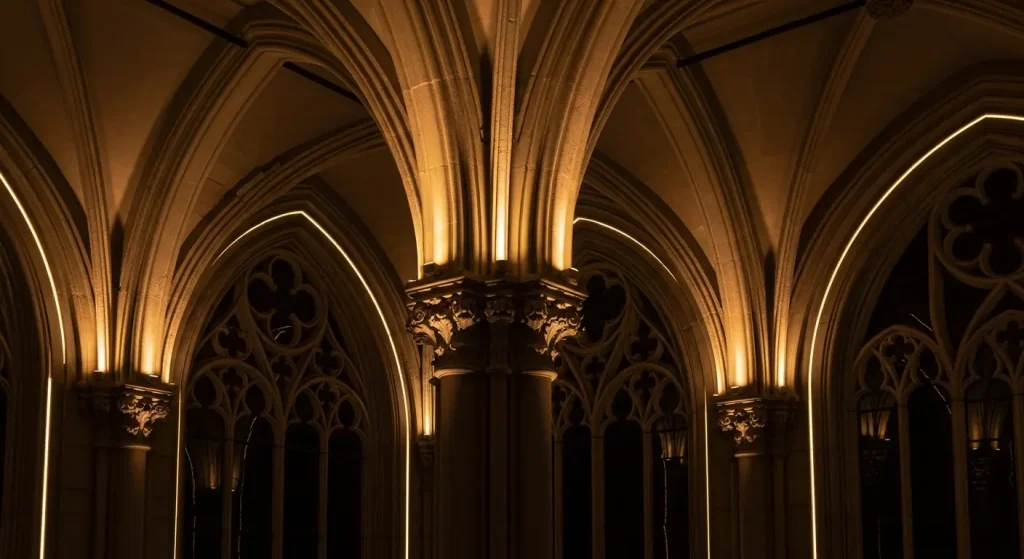
Gothic Style Lighting is not simply about installing antique chandeliers or lanterns. It is a lighting philosophy driven by:
- High contrast (light vs. darkness)
- Dramatic shadow play
- Emphasis on vertical forms and height
- Grazing light to reveal stone or textured surfaces
- Warm, atmospheric tones that evoke mystery or reverence
In modern hotels, bars, restaurants, galleries, private residences, and cultural venues, Gothic lighting has re-emerged as a powerful design language—one that merges theatricality with architectural clarity.
2. What Is Gothic Style Lighting?
2.1 High Contrast Lighting (Light vs. Shadow)
Gothic architecture thrives on dramatic contrast. Lighting should reinforce this through:
- Bright focal accents
- Deep shadow zones
- Controlled light spill
ERCO, one of the most respected architectural lighting manufacturers, emphasizes precise beam control and contrast-driven illumination for sculpting form and guiding perception. Their lighting principles align closely with Gothic environments.
This interplay of highlight and darkness gives Gothic spaces their characteristic sense of depth and mystique.
2.2 Vertical Lighting for Height & Spirituality
Vertical emphasis is essential in Gothic architecture. Light must draw the eye upward to:
- Arches
- Columns
- Ribbed vaults
- High ceilings
Techniques include:
- Uplighting
- Iluminación indirecta
- Vertical wall-washing
- Column grazing
Vertical illumination enhances the “soaring” psychological effect—one of the core ideas behind Gothic design.
2.3 Spotlighting, Wall-Washing & Grazing
These three tools define Gothic lighting:
Spotlighting (10°–24° beams)
Used to illuminate:
- Sculptures
- Architectural reliefs
- Vault ribs
- Decorative stonework
- Altars or focal areas
Wall-Washing
Creates smooth, even vertical light for:
- Tall walls
- Textured plaster
- Decorative surfaces
Grazing Lighting (Close-to-wall accent)
Essential for showcasing:
- Stone texture
- Rough surfaces
- Brickwork
- Ironwork reliefs
Zumtobel’s lighting research highlights grazing as one of the best ways to enhance material authenticity and depth.
2.4 Color Temperature & Color Rendering
For warm, dramatic Gothic atmospheres, recommended CCT is:
- 2200–2700K for medieval or candlelit ambience
- 2700–3000 K for hospitality and commercial settings
CRI ≥ 90 ensures accurate rendering of:
- Stone
- Wood
- Iron details
- Artworks
- Fabrics
Warm tones feel historically authentic and psychologically intimate.
2.5 Fixture Style & Materiality
Two design directions work well:
Traditional Gothic Lighting Fixtures
- Wrought iron chandeliers
- Lantern-style pendant lights
- Candle-like wall sconces
Modern Minimal Fixtures Integrated with Gothic Spaces
- LED track spotlights with narrow beams
- Downlights empotrables antideslumbrantes
- Linear uplights
- Discreet wall grazers
Signify (Philips Lighting) notes in its heritage architecture lighting insights that modern LED technology enables designers to mimic the warmth of old lighting while offering better control and energy efficiency.
3. Core Fixture Types & Recommended Technical Specifications
3.1 Wall-Washers & Wall-Grazers
Ideal para:
- Textured stone
- Brick
- Arches
- Columns
Especificaciones recomendadas:
| Specification | Suggested Value |
|---|---|
| ángulo del haz | 10°–30° (for grazing) |
| CCT | 2200–3000K |
| CRI | ≥ 90 |
| Óptica | Asymmetric or linear lens |
| SDCM | < 3 for color consistency |
3.2 Uplighting & Cove Lighting
Uplight enhances lofty Gothic architecture.
Key considerations:
- Uniformidad
- Low glare
- Adequate distance from the wall
- Long lifetime (L70/B50 ≥ 50,000 hrs recommended)
EU lighting guideline EN12464-1 recommends UGR < 19 for visual comfort.
3.3 Spotlights / Accent Lights
The most expressive tool in Gothic lighting.
Specs recommended:
- 10° / 15° / 24° beam options
- Anti-glare (deep baffle or honeycomb)
- CRI ≥ 90 or 95+
- COB LED with TIR lens
- Dimmable (0–100%)
Spotlighting is ideal for storytelling in retail, galleries, or religious spaces.
3.4 Gothic Chandeliers & Decorative Pendants
These fixtures act as architectural statements.
Aplicaciones:
- Cathedrals
- Hoteles
- Luxury restaurants
- Cultural venues
Use warm-dim or adjustable CCT to shift ambience from “historic” to “modern dramatic.”
3.5 Smart Control & Dimming Systems
Modern Gothic lighting thrives on flexibility.
Recommended systems:
- DALI-2 for large-scale projects
- Wireless dimming for residential projects
- Scene presets (Ambient / Dramatic / Architectural Focus / Intimate Mode)
4. How Gothic Style Lighting Applies to Different Modern Spaces
4.1 Churches, Cathedrals & Heritage Restorations
Gothic lighting originated here—uplight and grazing recreate the sacred mood.
Best combinations:
- Uplighting on arches
- Grazing on stone
- Narrow-beam accent on sculptures
- Candle-style pendants
El Illuminating Engineering Society (IES) outlines best practices for lighting religious and historic interiors.
4.2 Hotels, Restaurants, Bars & Theme Hospitality
Hospitality environments benefit from:
- Warm atmospheric tones
- Dramatic contrasts
- Iron pendants + architectural lighting
- Wall grazing for mood textures
- Shadow-rich dining zones
Gothic ambiance increases emotional engagement y Instagrammability, boosting branding.
4.3 Retail, Luxury Boutiques & Antique Shops
Retailers use Gothic elements to create immersive thematic experiences.
Lighting strategies:
- Spotlighting for merchandise
- Grazing for textured backdrops
- Decorative fixtures for identity
- Vertical illumination to create depth
This creates a cinematic shopping journey that strengthens brand differentiation.
4.4 Residential / Loft / Industrial-Gothic Hybrid Interiors
Suitable for:
- High ceilings
- Brick or stone walls
- Arched or vaulted structures
Designers often combine:
- Track lighting
- Grazing
- Iron decorative pendants
- Warm, moody accent lighting
Works beautifully in luxury lofts or modern Gothic-inspired homes.
4.5 Public Lobbies, Cultural Venues & Themed Spaces
Gothic lighting enhances:
- Brand storytelling
- Visitor immersion
- Architectural expression
Utilizado en:
- Art centers
- Libraries
- Museos
- Boutique hotel lobbies
- Entertainment venues
5. Advantages and Limitations of Gothic Lighting
Advantages
- Powerful visual drama
- Enhances architectural storytelling
- Ideal for experiential branding
- Highlights textures and historic materials
- Works well with modern LED technologies
Limitations
- Requires expert-level aiming and control
- Risk of excessive contrast if not balanced properly
- Not suitable for minimalistic environments
- Higher installation and maintenance complexity for tall spaces
- Potential glare issues if optics are not well controlled
6. How to Design a Successful Gothic Lighting Scheme
Step 1 — Spatial Analysis
Evaluate:
- Height
- Structure
- Materiality
- Visitor pathways
- Functional requirements
Step 2 — Define Mood & Visual Intent
Common themes:
- Dramatic
- Sacred
- Moody
- Historic
- Theatrical
Use these themes to determine contrast ratios and lighting distribution.
Step 3 — Specify Fixtures & Technical Parameters
Recommended baseline:
- CCT: 2200–3000K
- CRI: ≥ 90
- Beam angles: 10°–40°
- Dimmable drivers
- Diseño antirreflejos
- Matching SDCM
Step 4 — Create Multi-layered Lighting
Four core layers:
- Iluminación ambiental
- Iluminación de acento
- Architectural lighting (uplight/grazing)
- Decorative lighting (chandeliers/wall sconces)
Step 5 — Installation, Safety & Maintenance Considerations
- Gestión del calor
- High-ceiling access
- Structural load for chandeliers
- Electrical code compliance
- Optical quality consistency
Step 6 — Control Systems & Scene Programming
Usar:
- DALI-2
- Programmable dimming
- Time-based scenes
- Hospitality “experience mode” presets
Step 7 — Testing & Final Tuning
Measure:
- Shadow depth
- Uniformidad de la luz
- Glare levels
- Texture visibility
- Color consistency
Fine-tuning is essential to achieve theatrical Gothic atmospheres.
Gothic Style Lighting vs. Contemporary Minimalist Lighting
| Attribute | Gothic Style Lighting | Minimalist Lighting |
|---|---|---|
| Atmosphere | Dramatic, moody, historic | Clean, neutral, functional |
| Light Distribution | High contrast, shadow-rich | Even, low contrast |
| CCT | 2200–3000K warm | 3000–4000K neutral |
| Feature Elements | Pendants, ironwork, textured walls | Linear lights, recessed forms |
| Suitable Spaces | Hospitality, churches, themed spaces | Offices, modern homes |
| Emotional Impact | Strong, immersive | Calm, understated |
7. FAQ About Gothic Style Lighting
1. What is Gothic Style Lighting?
A lighting approach that uses contrast, shadow, vertical emphasis, and warm tones to evoke Gothic architectural emotion and depth.
2. Can LED lighting recreate Gothic ambience?
Yes. Modern LED provides warm tones, high CRI, adjustable beams, dimming, and precise control—allowing designers to recreate historic atmospheres authentically.
3. Is Gothic lighting suitable for commercial projects?
Absolutely. It works exceptionally well in:
- Hoteles
- Restaurantes
- Bars
- Retail boutiques
- Cultural venues
Just ensure compliance with installation, safety, and maintenance standards.
4. What mistakes do designers often make?
- Over-lighting the space
- Eliminating shadows (removing drama)
- Mixing inconsistent fixture styles
- Poor beam alignment on architectural features
- Ignorar el control del deslumbramiento
5. Is Gothic lighting appropriate for residential spaces?
Yes—especially lofts, heritage homes, or industrial-Gothic hybrids.
Spaces with low ceilings or ultra-modern minimalism may not be suitable.
8. Conclusión
Gothic Style Lighting is a powerful design language combining architectural expression, material storytelling, and theatrical ambience. It excels in spaces where designers aim to create:
- Emotional depth
- Memorable guest experiences
- Texture-rich visual layers
- A sense of historic or atmospheric identity
Thanks to advancements in LED technology, beam control, optical precision, and smart lighting systems like DALI-2, Gothic lighting is now more versatile and controllable than ever.
Designers, architects, hospitality developers, and cultural venue planners can use Gothic lighting to create immersive, Instagram-worthy, story-driven environments that resonate with modern audiences.
If you’re exploring ways to integrate Gothic-inspired lighting into hospitality, retail, cultural, or residential projects, feel free to request:
- Concept lighting layouts
- Fixture type recommendations
- Moodboard directions
- Technical parameter guidance
Lighting is not just illumination—it is narrative architecture.And Gothic lighting tells one of the most dramatic stories of all.