 XHLUX
XHLUX
![Was ist dimmbare Schienenbeleuchtung für Museen? Der beste Leitfaden [2025]](https://xhlux.com/wp-content/uploads/2024/05/news.webp)
Inhaltsverzeichnis
- The Museum Lighting Mandate: The Non-Negotiable Pillars of Excellence
- A Deep Dive into Conservation: Beyond Basic Dimming
- Specifying the Light Source: The Science of Visual Fidelity
- The Physical System: Track and Fixtures Built for Flexibility
- The Control Brain: Why Professional Control Systems (DALI) are the Standard
- The Visitor Experience: Mastering Glare Control
- Market Insights: The High-Tech, High-Touch Museum
- Your Lighting System is a Core Curatorial Asset
In the hallowed halls of a museum, light serves a dual, often contradictory, purpose. It is the medium of revelation, tasked with unveiling the subtle textures of an ancient textile or the vibrant hues of a masterwork. Yet, it is also a potential agent of decay, a silent, cumulative force that can diminish the very artifacts it is meant to celebrate.
Navigating this paradox is the highest calling of museum lighting design. It demands a solution that is not just flexible and beautiful, but also scientifically precise and archivally responsible. This is the domain of the professional Dimmable Track Lighting for Museum system—a sophisticated toolkit engineered to meet the world’s most stringent standards for conservation and visual fidelity.
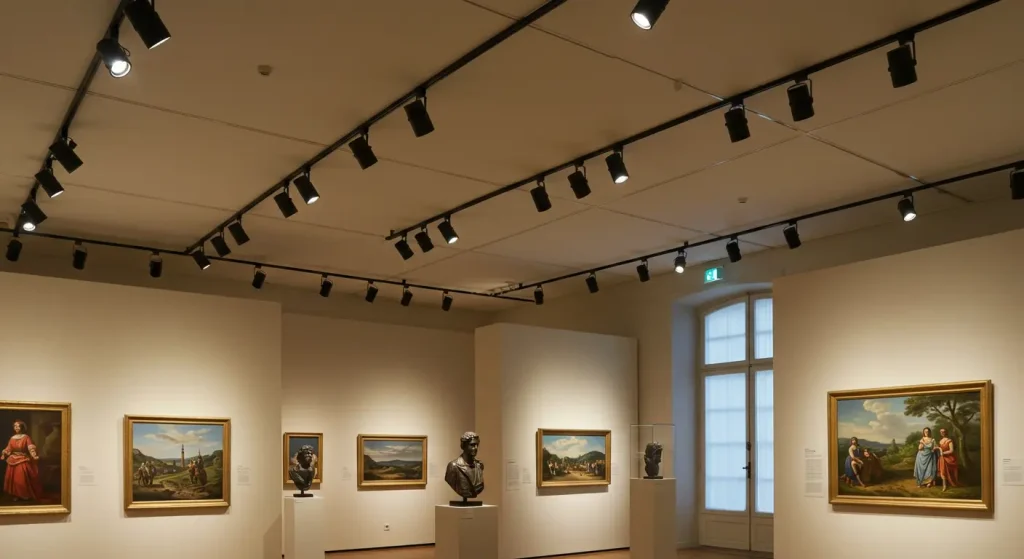
But what elevates a track light from a simple gallery fixture to a true museum-grade instrument? What are the non-negotiable technical requirements for lighting irreplaceable objects? And how can a modern system provide both uncompromising protection and an unforgettable visitor experience?
The Museum Lighting Mandate: The Non-Negotiable Pillars of Excellence
For a lighting system to be worthy of a museum environment, it must be built upon four pillars of performance. These are not suggestions; they are the baseline requirements for professional practice.
- Preservation First (Conservation-Grade Illumination): The system’s primary duty is to protect. This means precise control over light intensity and the elimination of harmful radiation.
- Absolute Visual Fidelity (Exceptional Color Rendering): The light must present artifacts with complete colorimetric accuracy, ensuring visitors see the true intent of the creator.
- Curatorial Flexibility (Adaptable Systems and Optics): As exhibits change, the lighting must adapt with effortless precision. The system must be a versatile curatorial tool.
- The Visitor Experience (Perfect Visual Comfort): The lighting must showcase the collection brilliantly without causing distracting glare or visual discomfort for the audience.
A professional Dimmable Track Lighting for Museum system is one that integrates solutions for all four of these pillars into a single, cohesive platform.
A Deep Dive into Conservation: Beyond Basic Dimming
Light damage is cumulative and irreversible. Therefore, a conservation-focused lighting strategy is the top priority.
The Enemy: Understanding Light Damage (Lux, UV, and IR)
- Lux Levels (Intensity): The sheer amount of light falling on an object (measured in lux) is a primary driver of damage. More light equals faster degradation.
- UV and IR Radiation: Ultraviolet (UV) and Infrared (IR) radiation, found in sunlight and older lighting technologies (like halogen), are particularly damaging, causing fading and chemical breakdown. The good news is that modern, high-quality LED produce virtually no UV and negligible IR radiation, making them the default choice for museum applications.
Your Primary Tool: Precision Dimming to Control Lux Levels
This is the most critical function of a Dimmable Track Lighting for Museum system. Different materials have different tolerances for light exposure. Authoritative bodies like the Getty Conservation Institute and standards like the IES (Illuminating Engineering Society) RP-30-20 for Museum Lighting provide clear guidelines.
| Material Sensitivity | Material Examples | Recommended Maximum Lux Level |
|---|---|---|
| Highly Sensitive | Textiles, watercolors, manuscripts, dyed leather, prints, drawings. | 50 Lux |
| Moderately Sensitive | Oil and acrylic paintings, most wood, bone, ivory, undyed leather. | 150 – 200 Lux |
| Insensitive | Metal, stone, ceramics, glass, enamel. | Generally unlimited, but controlled for visual effect. |
A professional dimmable system with a smooth, stable dimming curve (down to 0.1%) allows a curator to use a light meter to set the exact required lux level for each specific artifact, ensuring compliance with conservation best practices.
Calculating Cumulative Exposure: The Concept of Lux Hours
Conservation is not just about the intensity (lux), but the duration of exposure. This is often calculated in lux hours per year. For example, a highly sensitive object lit at 50 lux for 8 hours a day, 365 days a year, receives about 146,000 lux hours of exposure. A control system that incorporates timers or integrates with occupancy sensors to turn lights off when a gallery is empty is a powerful tool for minimizing total exposure and extending the life of an artifact.
Specifying the Light Source: The Science of Visual Fidelity
Once an object is safely lit, it must be rendered with perfect accuracy.
Why CRI 95+ is Just the Beginning
As discussed in retail and gallery lighting, a high Color Rendering Index (CRI) is essential. For museums, CRI 95+ is the absolute minimum acceptable standard. However, the discerning curator looks deeper.
The Critical Role of R9 and Spectral Power Distribution (SPD)
- R9 (Saturated Red): For historical artifacts, which often feature rich reds in woods, textiles, and pigments, a high R9 value is critical. An R9 of 90 or higher is the goal for museum-grade fixtures to ensure these vital colors look vibrant and true, not dull or brown.
- Spectral Power Distribution (SPD): Der highest-quality LED manufacturers provide SPD charts, which show the exact “recipe” of light wavelengths the LED produces. A full, continuous spectrum with no significant gaps is the hallmark of a source that will render all colors with the highest fidelity, closely mimicking natural daylight.
The Physical System: Track and Fixtures Built for Flexibility
A museum’s collection is never static. The lighting infrastructure must be a versatile platform for change.
The Track Infrastructure
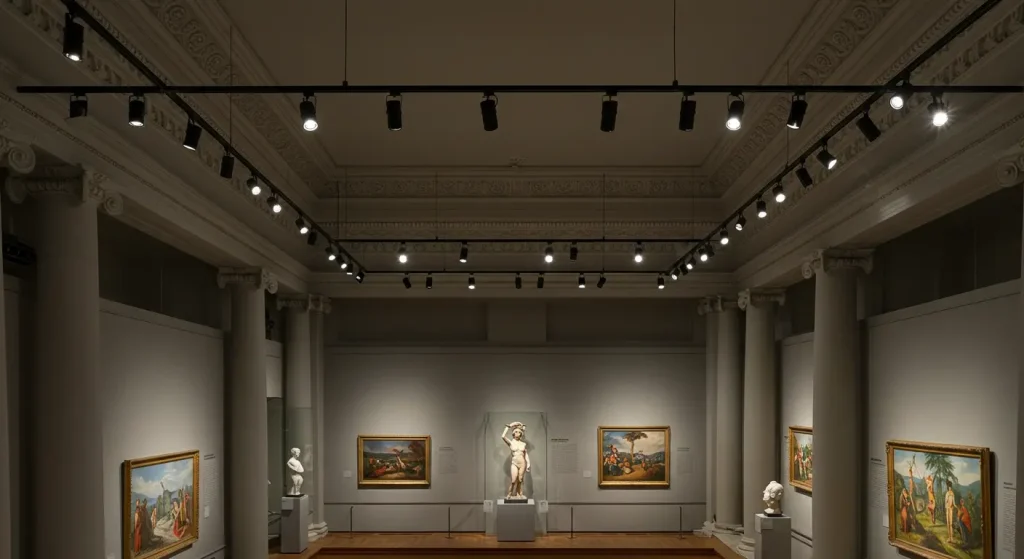
- Multi-Circuit and DALI Tracks: A 3-circuit oder 4-circuit (3+Data) DALI track is the professional standard. This allows for complex layering of light—for instance, a general wall wash on Circuit 1, accent spots on Circuit 2, and specialized highlights on Circuit 3, all controlled independently from the same track run.
- Magnetic Systems: Low-voltage 48V magnetic track systems are increasingly used in modern museum extensions and for temporary exhibits due to the unparalleled ease with which staff can move, add, or remove fixtures without tools or ladders.
The Optical Toolkit: Zoomable Fixtures and Framing Projectors
The fixtures themselves must be precision instruments.
- Zoomable Spotlights: Ein adjustable beam angle gallery spotlight (e.g., 10° to 50° zoom) is invaluable. It allows a single fixture to be perfectly adapted to illuminate a small artifact one day and a large vitrine the next, reducing the need for a large inventory of different fixtures.
- Contour Framing Projectors: This is the ultimate tool for lighting two-dimensional works. These fixtures can shape the light into a precise square or rectangle that illuminates a canvas right to the edge, with zero light spill onto the surrounding wall. The effect is stunning, making the artwork appear to glow from within.
The Control Brain: Why Professional Control Systems (DALI) are the Standard
For a museum, a reliable, repeatable, and scalable control system is not a luxury.
- DALI (Digital Addressable Lighting Interface): A wired DALI system is the robust, international standard for museum control. It allows for:
- Individual Addressing: Every single fixture can be controlled independently.
- Precise Dimming: Set and recall exact dimming percentages (e.g., 27.5%).
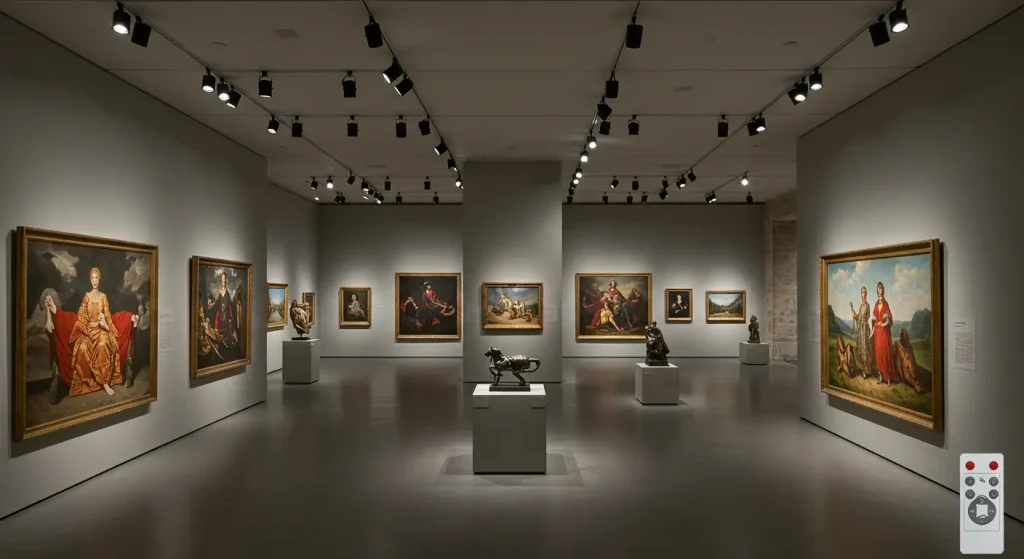
- Complex Scene-Setting: Create and save scenes for entire galleries that can be recalled with a single button press.
- System Feedback: The system can report lamp/driver failures, allowing for proactive maintenance.
- Professional Wireless (e.g., Casambi): For existing buildings or where new wiring is impossible, professional-grade wireless mesh systems offer a powerful and flexible alternative to DALI.
The Visitor Experience: Mastering Glare Control
The final pillar is ensuring visitors can enjoy the collection comfortably. Every fixture specified as Dimmable Track Lighting for Museum use must have superior glare control. This means:
- Deeply recessed optics.
- High-quality “darklight” reflectors or baffles.
- The availability of accessories like honeycomb louvers and snoots to eliminate any possibility of distracting glare.
Market Insights: The High-Tech, High-Touch Museum
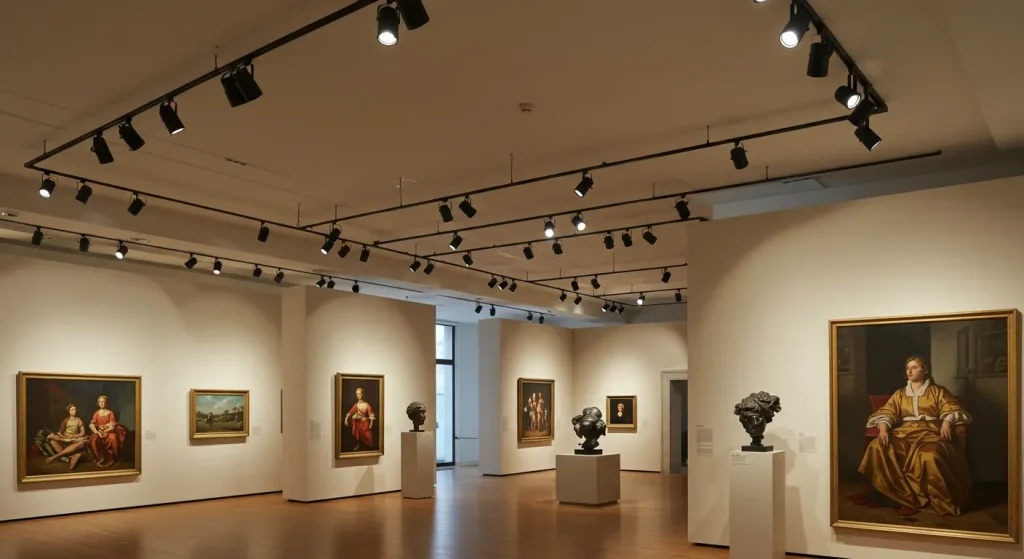
The modern museum is a dynamic institution. As reported by the American Alliance of Museums and other cultural bodies, there is a major trend towards more interactive, temporary, and immersive exhibitions. This requires an infrastructure that is equally dynamic. The demand for flexible, networked, and data-driven lighting systems that can be reconfigured quickly and efficiently is higher than ever. Investing in a high-performance track lighting system is a direct investment in a museum’s ability to be an agile, modern curatorial powerhouse.
Your Lighting System is a Core Curatorial Asset
Is a professional-grade Dimmable Track Lighting for Museum system an essential investment?
For any museum, gallery, archive, or serious private collection, it is the only responsible choice.
The lighting system is an active participant in the mission of the institution. It is the tool that makes viewing possible, the guardian that ensures long-term preservation, and the flexible platform that enables dynamic storytelling. A substandard lighting system actively works against this mission. By investing in a system that meets the highest standards of conservation, fidelity, flexibility, and comfort, you are safeguarding your collection and maximizing its impact for generations to come.
Your collection tells a story that spans history. It deserves to be lit with precision, care, and the best technology available.
If you are tasked with the responsibility of illuminating priceless artifacts, the specification process can be daunting. Our team of museum lighting specialists is here to provide the expert consultation required to design and implement a system that meets the world’s most rigorous standards.
Contact us today for a professional consultation, and let’s create a luminous future for your collection.