 XHLUX
XHLUX

Inhaltsverzeichnis
- Understanding DALI Dimmable Track Lighting
- Why DALI Dimmable Track Lighting is the Superior Choice
- DALI Dimmable Track Lighting vs. Conventional Dimming Protocols: A Clear Comparison
- Where DALI Dimmable Track Lighting Excels
- Retail Environments: Dynamic and Engaging
- Art Galleries & Museums: Precision and Preservation
- Hospitality (Hotels, Restaurants, Bars): Crafting Ambiance
- Modern Workplaces & Offices: Productivity and Well-being
- High-End Residential Projects: Sophisticated Smart Living
- Educational & Healthcare Facilities: Adaptable and Efficient
- Installing & Commissioning DALI Dimmable Track Lighting
- The Future is Bright and Addressable: DALI Market Growth & Innovations
- Illuminate Your Future with DALI Dimmable Track Lighting
The world of lighting is undergoing a profound transformation. No longer merely a source of illumination, lighting systems are evolving into intelligent networks that enhance ambiance, optimize energy consumption, and offer unprecedented control. At the forefront of this revolution, particularly for dynamic and adaptable spaces, stands DALI Dimmable Track Lighting. This comprehensive guide delves into the intricacies of this sophisticated technology, exploring its myriad benefits, diverse applications, and its pivotal role in shaping the future of smart buildings. If you’re seeking a lighting solution that combines cutting-edge control with aesthetic versatility and long-term value, understanding DALI is paramount.

Understanding DALI Dimmable Track Lighting
At its heart, DALI (Digital Addressable Lighting Interface) is an international standard (IEC 62386) protocol for digital communication between lighting control devices and a building’s lighting fixtures. Unlike older analog systems, DALI enables robust, two-way communication, allowing not just commands to be sent to lights, but also for feedback to be received from them.
What is DALI and How Does it Integrate with Track Lighting?
When integrated with track lighting systems, DALI unleashes a new realm of flexibility. Track lighting, already prized for its adaptability in positioning light sources, becomes exponentially more powerful with DALI. Each fixture or a small group of fixtures on the track can be individually addressed and controlled, allowing for intricate lighting schemes that can be modified at the touch of a button, without any physical rewiring.
Key DALI Features
- Individual Addressing: Each DALI-compatible device (like an LED driver for a track light) can be assigned a unique short address (0-63 per DALI line). This allows for granular control over individual light points.
- Group Control: Fixtures can be programmed into up to 16 groups per DALI line, enabling synchronized control of multiple lights within a zone.
- Scene Recall: Up to 16 lighting scenes (predefined settings of light levels for different groups/fixtures) can be stored in each control gear and recalled with a single command.
- Status Reporting: The bi-directional nature of DALI allows control gear to report status information, such as lamp failure, driver failure, or even operational hours and energy consumption (with appropriate DALI parts).
- Standardized Dimming Curve: DALI defines a standard dimming curve, ensuring consistent and smooth dimming performance (often down to 1% or even 0.1%) across fixtures from different manufacturers, mitigating issues like flicker or stepping.
The Evolution to DALI-2: Enhanced Capabilities
The DALI standard has evolved significantly with the introduction of DALI-2. While the original DALI focused primarily on control gear (like LED drivers), DALI-2 extends its scope to include control devices such as application controllers, push-buttons, occupancy sensors, and light sensors. Key improvements with DALI-2 include:
- Enhanced Interoperability: Stricter testing and certification requirements by the DALI Alliance (DiiA) ensure that DALI-2 certified products from different manufacturers work together seamlessly.
- Inclusion of Control Devices: Standardizes the behavior of input devices, leading to more predictable and robust system integration.
- Clearer Specifications: More detailed specifications reduce ambiguity and improve product compatibility.
- Bus Power Supply Requirements: Defined specifications for DALI bus power supplies.
For anyone considering a new DALI installation, opting for DALI-2 certified components is highly recommended to ensure future-proof, reliable, and interoperable lighting control.
Why DALI Dimmable Track Lighting is the Superior Choice
Choosing DALI dimmable track lighting isn’t just about adopting new technology; it’s about unlocking a host of tangible benefits that address common pain points in lighting design and management.
Unparalleled Control & Precision
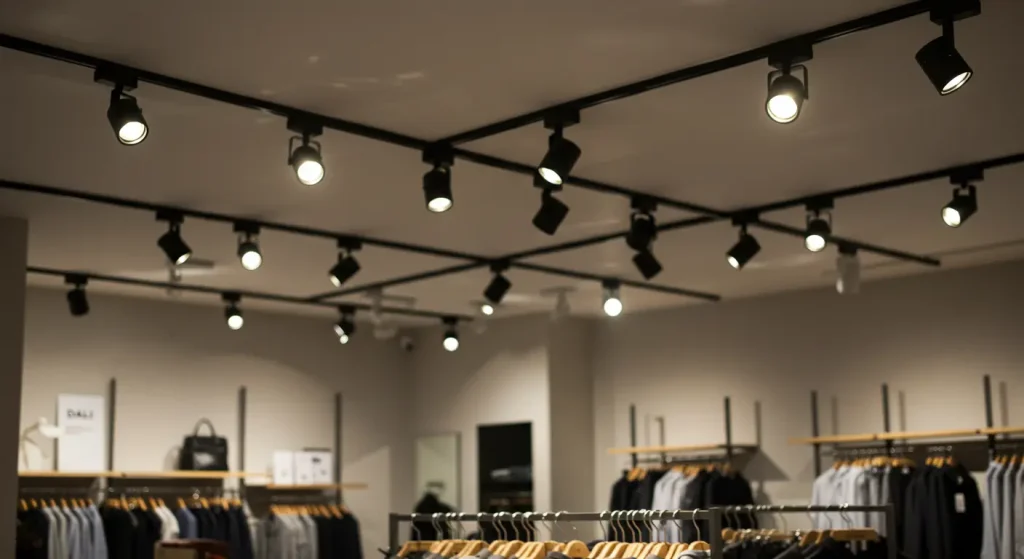
DALI offers exceptionally granular control over light intensity, often enabling dimming from 100% down to 0.1% with smooth, imperceptible transitions. This precision allows for the perfect ambiance to be set for any activity or time of day. Individual and zonal control means specific areas or objects can be highlighted or subdued dynamically.
Significant Energy Efficiency & Cost Reduction
This is a cornerstone of DALI’s value. By enabling precise dimming, daylight harvesting (dimming artificial lights when natural light is sufficient, using DALI light sensors), occupancy sensing (turning lights on/off or dimming based on presence, using DALI occupancy sensors), and scheduled lighting scenes, DALI systems can drastically reduce energy consumption. Reports suggest potential energy savings of up to 80-85% in optimally configured systems (Source: XHLUX, based on IEA Lighting Report 2023). This translates directly to lower electricity bills and a reduced carbon footprint, offering a strong return on investment (ROI).
Ultimate Flexibility & Scalability
The digital nature of DALI means lighting zones, groups, and scenes can be reconfigured via software without the need for costly and disruptive physical rewiring. This is invaluable for spaces with evolving layouts like retail stores, galleries, or modular offices. A single DALI line can support up to 64 control gear addresses and 64 control device addresses, and multiple DALI lines can be integrated into larger building-wide systems, making it highly scalable.
Enhanced Ambiance & User Well-being
The ability to precisely control light levels and, with DALI Device Type 8 (DT8) drivers, color temperature (tunable white) and color (RGBWAF), empowers designers to create lighting environments that enhance mood, improve concentration, and promote well-being (Human-Centric Lighting). Flicker-free dimming, a hallmark of well-implemented DALI systems, also contributes to visual comfort.
Seamless Integration & Future-Proofing
DALI systems are designed to integrate with Building Management Systems (BMS) or other smart building platforms via gateways, allowing lighting to become an integral part of overall building automation and energy management strategy. The adoption of DALI-2 and the emergence of wireless DALI solutions like DALI+ (e.g., DALI over Thread) ensure that investments in DALI technology are future-proof and ready for the next wave of IoT advancements.
Simplified Installation & Maintenance
While initial setup requires understanding the DALI protocol, the wiring itself is often simpler than traditional multi-zone relay-based systems. A single 2-core DALI bus cable (polarity insensitive) carries both power (for some low-power devices) and data. The feedback capabilities of DALI significantly simplify maintenance by pinpointing faulty lamps or drivers, reducing troubleshooting time and costs.
DALI Dimmable Track Lighting vs. Conventional Dimming Protocols: A Clear Comparison
To fully appreciate DALI’s capabilities, it’s helpful to compare it with other common dimming protocols.
Comparative Analysis Table
| Besonderheit | DALI (Digital Addressable Lighting Interface) | 0-10V Analog | Phase-Cut (Triac/Leading Edge/Trailing Edge) | DMX (Digital Multiplex) | Wireless (Zigbee/Bluetooth Mesh – typical) |
|---|---|---|---|---|---|
| Communication | Digital, Bi-directional | Analog, Uni-directional | AC Powerline based, Uni-directional | Digital, Uni-directional (typically) | Digital, Bi-directional |
| Addressing | Individual & Group (up to 64+64 devices/line) | Typically Zonal (1 driver output) | Zonal | Individual (up to 512 channels/universe) | Individual & Group |
| Control Granularity | Very High (e.g., 0.1-100%), Standardized curve | Moderate, curve can vary | Limited, potential flicker, steps | Very High, fast refresh rates | Varies, generally good |
| Wiring Complexity | Simple 2-wire bus (data & low power possible) | Requires dedicated low-voltage control pair per zone/driver | Uses existing power lines, can be simple | Shielded twisted pair, daisy chain | Minimal/None (wireless infrastructure) |
| Feedback/Status | Yes (lamp/driver failure, energy use, etc.) | NEIN | NEIN | No (typically, RDM adds some) | Yes (often, protocol dependent) |
| Scalability | High (multiple lines via gateways) | Mäßig | Mäßig | High (multiple universes) | High, potential mesh network limitations |
| Interoperability | Excellent (with DALI-2 certification) | Varies by manufacturer | Varies, driver/dimmer compatibility critical | Good within DMX ecosystem | Varies, improving with standards (e.g., Matter) |
| Best Applications | Commercial, Retail, Architectural, Offices, Smart Buildings, Galleries, Museums | Simpler dimming tasks, some commercial | Residential, Retrofit, simple applications | Dynamic, Stage, Architectural Façades, Entertainment | Retrofit, Smart Home, areas hard to wire, IoT integration |
| Approx. Cost | Medium to High initial, lower Total Cost of Ownership (TCO) | Low to Medium | Niedrig | Hoch | Medium to High, infrastructure dependent |
Key Takeaways: Why DALI Often Leads
- For Precision & Intelligence: DALI stands out for its digital, addressable nature, bi-directional communication, and standardized control, making it ideal for applications requiring precise, flexible, and intelligent lighting.
- 0-10V: Simpler and often cheaper for basic dimming of zones, but lacks individual control, feedback, and the sophistication of DALI.
- Phase-Cut: A common, low-cost residential solution, but often suffers from limited dimming range, potential flicker, and no advanced control features.
- DMX: The go-to for dynamic, fast-changing colored lighting in entertainment and architectural applications, but can be overly complex and expensive for general commercial or functional lighting where DALI excels.
- Wireless: Offers great flexibility in retrofit scenarios and is rapidly evolving. However, for mission-critical reliability and the depth of features in large commercial installations, wired DALI often remains preferred, though DALI+ is bridging this gap.
Where DALI Dimmable Track Lighting Excels
The unique combination of flexibility offered by track systems and the intelligent control of DALI makes this pairing exceptionally well-suited for a variety of demanding applications:
Retail Environments: Dynamic and Engaging
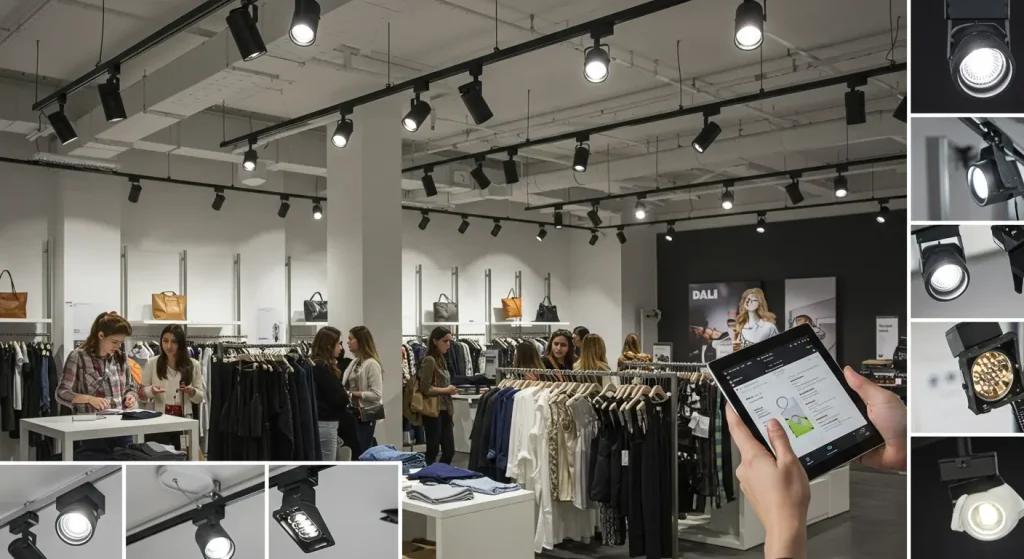
From high-end boutiques to large department stores, “intelligent DALI track lighting systems” allow for dynamic product highlighting, adapting to changing merchandise displays and seasonal promotions without physical rewiring. Scenes can be created to evoke specific moods, guide customer flow, and save significant energy during off-peak hours or in response to daylight. (Long-tail keyword: “DALI track lighting for retail displays”)
Art Galleries & Museums: Precision and Preservation
The conservation of artifacts and the accurate rendition of artwork demand precise lighting control. DALI allows for individual dimming of track lights to meet specific lux level requirements, protect sensitive objects from overexposure, and create dramatic accent lighting. Scene changes for different exhibitions or times of day can be automated seamlessly. (Long-tail keyword: “DALI track lighting for art galleries”)
Hospitality (Hotels, Restaurants, Bars): Crafting Ambiance
Ambiance is key in hospitality. DALI dimmable track lighting enables the creation of sophisticated lighting schemes that can transition smoothly from bright and welcoming during the day to intimate and cozy in the evening. In hotels, it can be used for energy management in guest rooms and public areas, and to create specific moods in restaurants and bars.
Modern Workplaces & Offices: Productivity and Well-being
Employee well-being and productivity are increasingly linked to lighting quality. DALI systems facilitate task-specific lighting, human-centric lighting (adjusting color temperature and intensity throughout the day to mimic natural light rhythms), and integration with occupancy and daylight sensors for optimal “DALI lighting control energy savings” and a comfortable working environment.
High-End Residential Projects: Sophisticated Smart Living
For discerning homeowners seeking sophisticated smart home solutions, DALI offers unparalleled control over lighting. Custom scenes for activities like dining, entertaining, or relaxing can be easily programmed and recalled. Its robustness makes it a reliable choice for luxury homes.
Educational & Healthcare Facilities: Adaptable and Efficient
Adaptable lighting is crucial in classrooms, lecture halls, and patient rooms. DALI allows for easy adjustment of light levels to suit different activities, from presentations to focused work or patient rest, while also contributing to energy efficiency and simplifying maintenance routines.
Installing & Commissioning DALI Dimmable Track Lighting
While offering immense benefits, a successful DALI dimmable track lighting installation requires careful planning and understanding of its components and processes.

Key System Components for DALI Track Lighting
- DALI-Compatible Track Fixtures: These are track lights equipped with DALI-certified LED drivers. (Long-tail keyword: “DALI dimmable LED track fixtures”)
- DALI Controllers: These can range from simple wall-mounted scene recall panels to sophisticated application controllers that manage multiple DALI lines, schedules, and sensor inputs.
- DALI Bus Power Supply Unit (PSU): Each DALI line requires a dedicated PSU to provide the necessary power for communication and for bus-powered devices. These are typically limited to 250mA.
- DALI Track System: This is typically a 3-circuit track (or 4/5 conductor) that includes dedicated conductors for the DALI bus, alongside the mains power lines.
- DALI Input Devices (DALI-2): Sensors (occupancy, light), switches, sliders, etc., that provide input to the DALI system.
DALI Wiring Essentials
The DALI bus itself is a 2-wire, polarity-insensitive network. Standard electrical cable (e.g., 1.5mm²) can often be used, but specific DALI-rated cables are also available. It can be run alongside mains cables (check local regulations). There are limits on DALI line length (typically 300m depending on cable cross-section and capacitance) and the number of devices (64 control gear + 64 control devices).
The DALI Commissioning Process: A Step-by-Step Overview
This is a critical step and involves:
- Addressing: Assigning a unique short address to each DALI device on the line. This can be done automatically or manually by the commissioning software.
- Grouping: Assigning addressed devices to logical groups for collective control.
- Scene Programming: Defining and storing desired light levels for various groups/fixtures as scenes.
This process is typically performed using specialized software and may require a skilled integrator, especially for larger or more complex systems. (Long-tail keyword: “DALI commissioning guide”)
Choosing the Right DALI Components
Prioritize DALI-2 certified components to ensure maximum interoperability and access to the latest features. Consider the specific needs of the application, such as the required dimming range, color tuning capabilities (DT6 for dimming, DT8 for color/tunable white), and sensor integration. (Long-tail keyword: “choosing DALI components for track lighting”)
The Importance of Professional Installation
While the principles are straightforward, for robust and optimal performance, particularly in commercial settings, engaging with experienced lighting designers and DALI-certified installers is highly recommended.
The Future is Bright and Addressable: DALI Market Growth & Innovations
The adoption of DALI technology is not just a trend; it’s a reflection of the broader move towards smarter, more efficient buildings.
Market Significance and Growth Projections
The global Lighting Control System Market is projected to surpass USD 106.73 Billion by 2032, with a robust CAGR of 14.28% from 2024 to 2032 (Source: GlobeNewswire, Feb 2025). DALI is a significant contributor to this growth, particularly in the commercial and high-end residential sectors.
Key Innovations Shaping DALI’s Future (DALI-2, D4i, DALI+)
The DALI Alliance continues to expand the DALI-2 standard, incorporating more device types and functionalities. A key development is D4i, which standardizes data storage and power supply requirements within the luminaire, simplifying integration with IoT nodes and enabling richer data analytics (e.g., energy usage, diagnostics, asset tracking). Addressing the demand for greater installation flexibility, Wireless DALI (DALI+) brings the rich feature set of DALI to wireless networks like Thread and Zigbee, opening new possibilities for retrofits and smart ecosystems. (Long-tail keyword: “future of smart lighting DALI”)
DALI’s Role in IoT, Smart Buildings, and Sustainability
DALI is increasingly seen as a vital data source for smart building platforms. The information gathered (energy consumption, occupancy, device status) aids in advanced building analytics, predictive maintenance, and enhanced automation. Its energy-saving capabilities also directly support sustainability goals and circular economy principles by optimizing luminaire operation.
Expert Perspectives on DALI’s Trajectory
Industry leaders consistently affirm DALI’s position as a cornerstone of professional lighting control. Its open standard nature, robust performance, detailed control capabilities, and continuous evolution through DALI-2 and DALI+ ensure its relevance and growth in an increasingly connected and data-driven world. The focus is on making lighting smarter, more responsive, and more integrated.
Illuminate Your Future with DALI Dimmable Track Lighting
DALI Dimmable Track Lighting represents more than just an upgrade; it’s a strategic investment in intelligent, adaptable, and highly efficient illumination. Its unparalleled control, significant energy savings, design flexibility, and future-proof architecture make it an ideal choice for a vast array of applications, from captivating retail displays and inspiring art galleries to productive offices and luxurious homes.
By embracing DALI technology, you are not only enhancing the aesthetic and functional qualities of your space but also contributing to a more sustainable and smarter built environment. The ability to precisely tailor lighting to specific needs, automate responses to environmental changes, and gather valuable operational data places DALI at the forefront of modern lighting solutions.
Ready to transform your space with the power and intelligence of DALI? Consult with a DALI-certified lighting professional or a knowledgeable supplier to explore the exciting possibilities that DALI Dimmable Track Lighting can bring to your next project. Illuminate your world with precision, efficiency, and unparalleled control.