 XHLUX
XHLUX
![Was ist eine COB-LED-Einbauleuchte? Der beste Technologie-Leitfaden [2025]](https://xhlux.com/wp-content/uploads/2024/05/news.webp)
Inhaltsverzeichnis
- What is a COB LED? The Definitive Breakdown
- The Main Event: COB vs. SMD LED – A Head-to-Head Comparison
- The Benefits of Using a COB LED Downlight
- Where Does a COB LED Downlight Shine? Prime Applications
- Things to Consider When Choosing a COB LED Downlight
- Market Trends: Miniaturization and Power Density
- FAQ About What is COB LED Downlight
- Is COB the Superior Technology?
In the ever-evolving world of LED lighting, it’s easy to assume all LED are more or less the same. But look closer, and you’ll find a fascinating universe of different technologies working behind the scenes. You may have heard designers, architects, or lighting enthusiasts use the term “COB” when discussing high-performance fixtures.
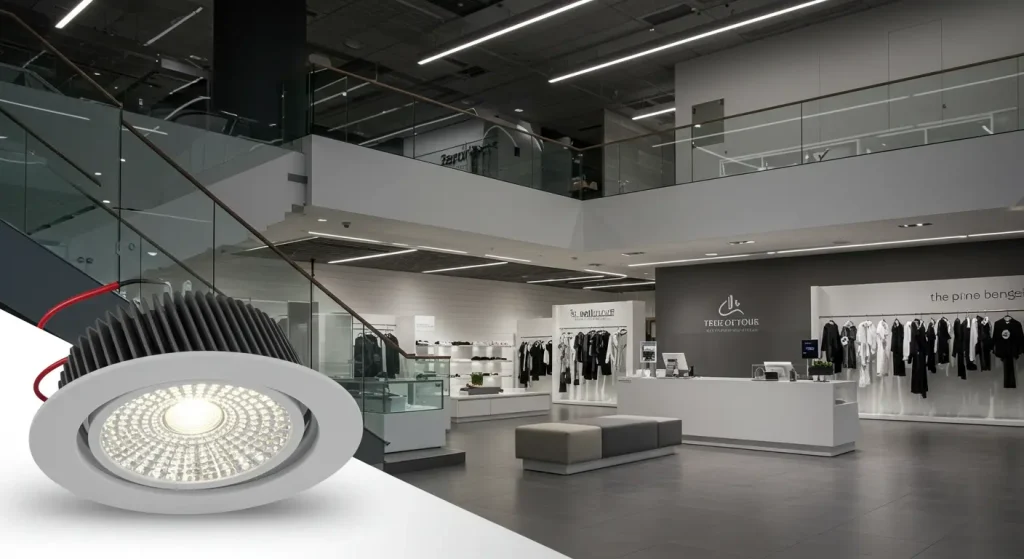
So, what is a COB LED Downlight, and why is it so often the secret ingredient behind a truly stunning, high-impact lighting effect? Is it just another piece of industry jargon, or is it a genuinely superior technology?
What is a COB LED? The Definitive Breakdown
Let’s start with a direct, clear definition. COB stands for Chip on Board. It is an advanced method of packaging LED technology.
Unpacking the Acronym and the Anatomy
Instead of packaging individual LED chips into tiny shells (the way older technologies did), COB technology involves mounting a multitude of tiny LED chips directly onto a single substrate, typically made of ceramic or aluminum. These chips are packed incredibly close together and then covered with a continuous, uniform layer of yellow phosphor.
When you look at a COB LED, you don’t see dozens of individual points of light. You see a single, uniform, bright yellow circle or square when it’s off, and a single, powerful, unified field of light when it’s on.
The “Single Point Source” Advantage
This dense packaging is the key to COB power. It allows this dense array of chips to function as a single, powerful point of light. This is a huge advantage because it mimics the behavior of a traditional halogen bulb. A single point source is far easier to control optically. It allows engineers to use a single reflector or lens to shape the light into a clean, precise beam with crisp shadows and minimal color separation.
A COB LED Downlight, therefore, is a recessed downlight fixture that uses this powerful, single-point COB LED chip as its light source.
The Main Event: COB vs. SMD LED – A Head-to-Head Comparison
To truly understand the benefits of COB, you must compare it to its main alternative: SMD (Surface Mounted Device) LED. SMD LED are individual chips that are soldered onto a printed circuit board (PCB). Think of the individual points of light you might see on an LED light strip—those are SMD LED.
Most standard, consumer-grade LED downlights use an array of SMD LED. High-performance, architectural-grade downlights often use COB technology. Here’s why:
| Besonderheit | COB (Chip on Board) LED | SMD (Surface Mounted Device) LED | Wichtigste Erkenntnis |
|---|---|---|---|
| Light Appearance | A single, unified, intense source of light. | A collection of multiple, distinct points of light under a diffuser lens. | COB creates a cleaner, more traditional “spotlight” look with crisp shadows. |
| Luminous Intensity | Very High. A huge amount of light can be produced from a very small area (high lumen density). | Lower. The chips are more spread out, resulting in a less intense, more diffuse source. | COB provides more “punch” and is better for high ceilings or creating high contrast. |
| Thermal Management | Excellent. The chips are mounted directly to a highly conductive substrate, allowing heat to be drawn away very efficiently. | Good, but more complex. Heat must be managed for each individual chip across the circuit board. | COB superior heat management often leads to better reliability and longevity in high-power applications. |
| Beam Control | Excellent. A single lens or reflector can precisely shape the light from the single point source. | More challenging. Requires complex, multi-faceted optics to blend the light from the multiple sources into one cohesive beam. | COB allows for cleaner, more efficient optics, resulting in higher-quality beams. |
| Color Consistency | Very High. Because all chips are under a single phosphor layer, the color of the light is perfectly uniform across the entire source. | Good, but can vary. Minor variations between the individual SMD chips can sometimes lead to slight color differences across the beam. | COB provides superior color uniformity. |
| Typical Application | Architectural accent lighting, retail spotlights, high-ceiling downlights, gallery and museum lighting. | General ambient lighting, panel lights, consumer-grade downlights, light strips. | COB is the professional’s choice for high-impact, precision lighting. SMD is the workhorse for general illumination. |
The Benefits of Using a COB LED Downlight
Translating the technical advantages above into real-world benefits, here’s why a designer or architect would specify a COB LED Downlight:
1. Superior “Punch” and Intensity
Because of its high lumen density, a COB downlight can deliver a powerful, focused beam of light over a long distance. This makes it the perfect solution for spaces with high or vaulted ceilings where you need the light to reach a task surface or the floor with meaningful intensity.
2. Higher Quality of Light and Consistency
The single point source nature of COB, combined with its uniform phosphor layer, results in a beautifully clean, consistent beam of light. It eliminates the risk of the “multiple shadow” effect that can sometimes occur with multi-source SMD fixtures. The color is pure and even from the center of the beam to the edge.
3. Better Efficacy and Thermal Performance
Heat is the enemy of an LED lifespan and efficiency. COB direct-to-substrate design is one of the most efficient ways to dissipate heat. This superior thermal management means that COB LED can be driven at higher power levels more reliably, leading to greater efficiency (more lumens per watt) and a longer, more stable operational life.
4. Excellent Beam Control for Accent Lighting
This is the key advantage for designers. When you want to create a dramatic highlight on a piece of art, a retail display, or an architectural feature, you need a crisp, well-defined beam. The single-point nature of COB LED makes them ideal for use with high-quality reflectors and lenses that can shape the light with precision, creating the sharp contrast and focus that defines professional accent lighting.
Where Does a COB LED Downlight Shine? Prime Applications
While COB technology can be used anywhere, it truly excels in applications where performance and precision are paramount.
- Luxuseinzelhandel: To create dramatic spotlights on luxury goods, making them sparkle and stand out.
- Galleries and Museums: To provide a powerful, high-CRI, single-point source that can be precisely shaped to illuminate artworks.
- Gastfreundschaft: In hotel lobbies and ballrooms with high ceilings to provide both ambient and accent light.
- Architectural Homes: For creating dramatic wall washes or highlighting specific architectural details from vaulted ceilings.
- Any space requiring high-performance accent lighting.
Things to Consider When Choosing a COB LED Downlight
The COB chip is just one part of the system. To ensure you’re getting a quality product, consider the whole package:
- Heat Sink Quality is Paramount: A powerful COB chip generates significant heat. A well-engineered fixture must have a substantial, high-quality heat sink (often the main body of the downlight) to dissipate this heat effectively. A poor heat sink will lead to premature failure.
- Look at the Whole System (Driver and Optics): The COB chip needs to be paired with a high-quality LED driver to ensure smooth, flicker-free dimming and a long life. The reflector or lens it is paired with will determine the final quality of the beam.
- Light Quality Specs Still Matter: Even with COB technology, you must still check for the essentials: a CRI of 90+ for accurate color, your desired CCT for mood, and tight color consistency (SDCM) for uniformity.
Market Trends: Miniaturization and Power Density
The development of COB technology is part of a larger trend in the lighting industry towards miniaturization and increased power density. Designers want smaller, more discreet fixtures that can still produce a powerful, high-quality beam of light. COB technology is a key enabler of this trend. As the technology continues to improve, we are seeing even smaller and more powerful COB chips, allowing for the creation of tiny, “pinhole” downlights that can deliver the punch of a much larger fixture from just a decade ago.
FAQ About What is COB LED Downlight
Is COB the Superior Technology?
For applications requiring a powerful, high-quality, and easily controllable beam of light from a compact source, the answer is a resounding yes.
While SMD technology is perfectly suitable and cost-effective for general ambient lighting, COB technology is the professional’s choice for performance applications. It represents a more advanced, efficient, and optically superior approach.
When you choose a COB LED Downlight, you are choosing a system designed for:
- Intensity and Punch
- Beam Quality and Precision
- Thermal Stability and Longevity
- Superior Color Consistency
It is an investment in a higher tier of lighting performance.
Ready to bring the power and precision of COB LED technology to your next project?
Understanding the difference is the first step. The next is selecting the specific fixtures that will bring your vision to life. Our team of lighting specialists can help you choose the perfect high-performance COB downlights and design a layout that leverages the full potential of this powerful technology.
Contact us today for a professional consultation and let’s create something brilliant.