 XHLUX
XHLUX

内容
- Lumens in plain English (and why “watts” misleads)
- Will 6000 lumens be “too bright” in my room?
- What a 6000-lumen LED ceiling light looks like in real rooms
- 6000 lumens to watts (LED)
- Why the same 6000 lumens can look different
- Simple sizing math you can do in 60 seconds
- Room-by-room cheat table
- Choosing specs for a 6000-lumen ceiling light
- 6000 lumens vs. 4000 lumens: what’s the difference indoors?
- Safety, efficiency, and operating cost
- How to make 6000 lumens feel comfortable
- Frequently asked questions
- Sample plans you can copy
- A quick visual scale
- Buying checklist
- Bottom line
a 6000-lumen LED ceiling light looks very bright in most homes. Picture the light from about eight “60-watt-equivalent” bulbs all at once (a 60-W equivalent LED is ~800 lumens: 6000 ÷ 800 ≈ 7.5). In a kitchen, garage, laundry, or large room, it can feel crisp and clear. In a small bedroom or hallway, it may feel too intense unless you dim it or bounce it off a light-colored ceiling.
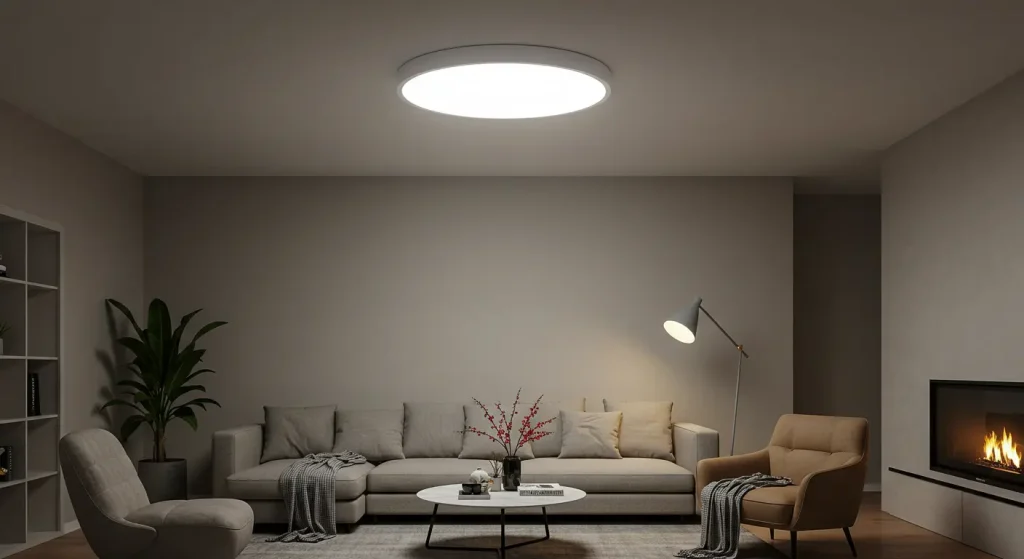
Dieser Leitfaden erklärt how bright 6000 lumens looks in real rooms, how to size a light using simple math, and how color, height, beam angle, Und Dimmen change what your eyes feel.
Lumens in plain English (and why “watts” misleads)
- Lumens (lm) = brightness you see.
- Watts (W) = power used; with LEDs, watts no longer tell you brightness. Two LEDs with the same watts can have very different lumens. The Federal Trade Commission and the U.S. Department of Energy both advise shoppers to compare lumens, not watts.
Useful anchor points
- ~800 lm ≈ the brightness of an old 60 W incandescent (typical LED replacement uses ~9–12 W).
- ~1100–1200 lm ≈ old 75 W incandescent.
- 6000 lm ≈ 7–8× a 60-W-equivalent LED bulb.
Will 6000 lumens be “too bright” in my room?
The right way to judge is to look at illuminance on surfaces, measured as foot-candles (fc) oder lux:
- 1 fc = ~10.8 lux
- Illuminance ≈ (Lumens × Real-world factors) / Area
Lighting guides that align with IES practice suggest rough target ranges by space. Examples you’ll see again and again:
- Living room: ~10–20 fc (≈ 100–200 lux)
- Kitchen general: ~30–50 fc (≈ 300–500 lux)
- Kitchen task island/counters: ~50–100 fc (≈ 500–1000 lux)
- Hallway: ~5–10 fc
- Garage / workbench: ~20–50 fc (more for fine work)
Publicly available foot-candle tables and design lab sheets echo those ranges (they’re not one-size-fits-all, but they’re solid starting points).
Rule of thumb:
Required lumens ≈ Room area × target foot-candles.
(Then add a safety margin because not all lumens reach the work plane.)
Fast scenarios (8- to 9-ft ceilings)
- Small bedroom (10 × 12 ft = 120 ft²) at 10–20 fc: needs 1200–2400 lm.
A 6000 lm ceiling light will feel very bright—use Dimmen or choose a lower output. - Mid kitchen (12 × 12 ft = 144 ft²) at 30–50 fc: needs 4320–7200 lm.
6000 lm is right in the pocket for general light, especially if you also have under-cabinet task lights. - Large garage bay (20 × 20 ft = 400 ft²) at 20–50 fc: needs 8000–20,000 lm.
6000 lm per fixture is great if you install two or three fixtures.
What a 6000-lumen LED ceiling light looks like in real rooms
A) Kitchen (bright, active space) 🍳
- A single 6000-lumen flush-mount at the center gives crisp general light.
- Add under-cabinet strips to push counters to 50–100 fc for chopping and reading labels.
- Choose 3500–4000 K if you like a clean, neutral white that keeps food colors natural. DOE explains white-tunable ranges (warm ~2700 K to cool 5000–6500 K).
What it feels like: shadows shrink, stainless pops, paper recipes are easy to read. If the lens is clear and the beam is narrow, you may see glare; pick a diffused lens or a wider beam.
B) Living room (mixed tasks) 🛋️
- Target 10–20 fc overall, then layer table lamps.
- A single 6000-lumen disc in a small lounge will feel “hospital bright” at full power. Use 0–10 V or TRIAC dimming so you can set mood for TV time.
What it feels like: at 30–40% dim, the same fixture becomes warm and cozy; at 100%, you can clean or host game night.
C) Home office or craft room ✍️
- Aim 30–50 fc general plus a task lamp on the desk.
- Pair a 6000-lm ceiling light with CRI 90+ if color matters (art, fabrics). Energy Star materials and DOE color fact sheets explain CRI Und CCT basics.
D) Laundry / utility 🧺
- One 6000-lm fixture is perfect for seeing stains and sorting colors.
- Neutral white 3500–4000 K keeps whites bright without a bluish cast.
E) Garage & workshop 🔧
- Hier ist der Ort 6000 lumens shines—literally.
- At 2–3 fixtures, you hit 16,000–24,000 lm total, landing in the 20–50 fc range for most bays, with even coverage.
6000 lumens to watts (LED)
Modern residential LED ceiling luminaires typically deliver 90–140 lumens per watt (some higher). That means:
- 6000 lm ≈ 43–67 W (most products land near the middle).
- Der FTC and DOE both emphasize comparing lumens first; then choose the lowest watts for the brightness you want.
Why the same 6000 lumens can look different
Brightness is not just a number on the box. Five design choices shape what your eyes feel:
Room size & color
- Dark paint, dark floors, and heavy textiles absorb light.
- Light matte walls bounce light back (higher reflectance), so the room looks brighter at the same lumens. This is standard guidance in professional lighting documents.
Mounting height
- Der closer the light is to your eyes, the glare-ier it feels.
- At 8–9 ft ceiling height, a wide, diffused lens is your friend.
Beam angle & optics
- Narrow beam = intense hot spot, great for tall ceilings or accent.
- Wide beam (110°+) = soft, even wash for low ceilings.
Lens & diffuser
- Opal/PMMA diffusers spread light and hide LED points.
- Clear lenses look punchy but can cause sparkle/glare.
Color temperature (CCT)
- 2700–3000 K feels warm and cozy.
- 3500–4000 K is neutral, good for kitchens and offices.
- 5000–6500 K looks like daylight—very crisp, may feel harsh at night. DOE’s color guidance and Energy Star materials describe these ranges.
Simple sizing math you can do in 60 seconds
Use this quick calculator to see whether 6000 lumens fits your space.
Step 1 – Find room area
Area (ft²) = length × width
Step 2 – Pick a target
- 10–20 fc living room
- 30–50 fc kitchen general
- 20–50 fc garage/workshop
Step 3 – Multiply
Required lumens ≈ Area × target fc
Step 4 – Compare
Is 6000 lm near the middle of your range? If yes, you’re set. If it’s far above, make sure it’s dimmbar.
These ranges reflect common practice in IES-aligned tables and design-lab summaries available to the public. Always adjust for your ceiling height, wall color, and age/visual needs.
Room-by-room cheat table
| Space (typical) | Example size | Target (fc) | Lumens needed | Is 6000 lm a good single fixture? |
|---|---|---|---|---|
| Small bedroom | 120 ft² | 10–20 | 1200–2400 | Often too bright unless dimmed to ~30–40% |
| Medium bedroom | 150 ft² | 10–20 | 1500–3000 | Bright; dimmer recommended |
| Living room | 200 ft² | 10–20 | 2000–4000 | Very bright; dim or add lamps and run at ~40–60% |
| Kitchen (general) | 144 ft² | 30–50 | 4320–7200 | Ja (great general light) |
| Laundry | 100 ft² | 20–30 | 2000–3000 | Bright; dim helpful |
| Garage bay | 400 ft² | 20–50 | 8000–20,000 | Use 2–3 fixtures for even light |
Why “even light” matters: design labs and IES practice recommend meeting the average light level without big bright/dark patches. Multiple fixtures reduce shadows.
Choosing specs for a 6000-lumen ceiling light
✅ Brightness & control
- Dimmbar: look for 0–10 V, TRIAC/ELV, or smart-dimming support. DOE’s “Lighting Facts” style label and Energy Star product literature help you verify dimmability, life, and costs.
- Flicker control: quality drivers reduce flicker at low dim levels (easier on eyes).
🎨 Color & quality
- CCT: 2700–3000 K for bedrooms/lounges; 3500–4000 K for kitchens/offices; 5000 K only if you like a “daylight” look.
- CRI: aim 90+ if you care about color accuracy for art, makeup, or food. (CRI explains how well colors look under the light.)
🔍 Optics & lens
- Wide beam (≥100–120°) or a large diffused lens for low ceilings to avoid glare.
- If your ceilings are high, a slightly tighter beam can punch light down to the work plane.
🧊 Thermal design & lifetime
- A 6000-lm fixture needs good heat management to keep output and color stable. Check the rated life Und warranty on the label (Energy Star specs require robust testing).
6000 lumens vs. 4000 lumens: what’s the difference indoors?
Think of 4000 lm als strong all-purpose ceiling light for medium rooms, and 6000 lm as high output for larger or task-heavy rooms.
| Attribute | 4000 lm | 6000 lm |
|---|---|---|
| Typical LED watts | ~30–45 W | ~45–67 W |
| Medium living room (200 ft² @ 10–20 fc) | Meets target with dim/lamps | Exceeds target at full power |
| Mid kitchen (144 ft² @ 30–50 fc) | Bottom of range | Center of range |
| Garage bay (400 ft² @ 20–50 fc) | Use 3–5 units | Use 2–3 units |
| Dimming need in small rooms | Helpful | Essential |
If you can only install one fixture and want maximum flexibility, choose 6000 lm with good dimming. That way you can run low for daily use and high for cleaning and projects. The DOE and FTC both stress comparing lumens first, then selecting controls and color to suit your tasks.
Safety, efficiency, and operating cost
- Energy use: For the same brightness, LEDs use far less power than old bulbs. A 6000-lm LED might draw ~50–60 W, while equivalent older solutions would use many times more. DOE’s consumer pages cover this shift and why lumens replaced watts on labels.
- Heat: LEDs still make heat, but much less at the room side. Keep clearances the manufacturer specifies.
- Labels matter: Der Lighting Facts–style label (and Energy Star listings) show lumens, watts, color, life, Und annual cost—use them to compare apples to apples.
How to make 6000 lumens feel comfortable
Use these small tweaks to make big rooms feel balanced:
- Dimmer or smart control 🕹️
Set scenes: Cooking 100%, Dinner 60%, Movie 20%. (Tunable white systems let you shift from warm 2700 K at night to neutral 4000 K by day.) - Layer your light 🧱
Ceiling fixture for general light; task (under-cabinet, desk lamp) for detail; accent (picture lights) for depth. This aligns with standard lighting practice for comfort and visual performance. (cibse.org) - Mind wall colors 🎨
If your walls are dark, add one more fixture or go up in lumens; or repaint to a lighter finish to get more “free” bounce light. (cibse.org) - Pick a good diffuser ⭕
Wide, opal lenses soften the visual hit and spread light at 8–9 ft ceiling height.
Frequently asked questions
Q1) Is 6000 lumens too bright for a bedroom?
Usually yes at full power, because many bedrooms target 10–20 fc. A 6000-lm ceiling light can still work if it dims smoothly to 20–40% and you use warm 2700–3000 K at night.
Q2) What color temperature should I choose?
- 2700–3000 K for cozy rooms (bedroom, lounge).
- 3500–4000 K for kitchens, offices, utility.
- 5000 K+ only if you like a daylight look. DOE and Energy Star materials explain CCT and how to read labels.
Q3) What does 6000 lumens cost to run?
If your fixture is ~55 W and you run it 3 hours/day, that’s 0.055 kWh × 3 = 0.165 kWh/day. At $0.20/kWh, that’s 3.3¢/day (~$1.00/month). Check your local rate.
Q4) Can I replace multiple smaller lights with one 6000-lm disc?
Yes, Aber check your target fc and room size. One central light can leave shadows in corners. Two smaller fixtures give more even coverage (a standard design tip echoed by lighting guides).
Q5) Does CRI matter at this brightness?
Ja. CRI 90+ makes food, skin tones, textiles, and art look more natural. Energy Star and DOE color resources explain why.
Sample plans you can copy
Plan A — 12′ × 12′ kitchen, 8′ ceiling
- One 6000-lm flush-mount (neutral 3500–4000 K, CRI 90+, dimmbar).
- Under-cabinet LED (add 500–1000 lm across counters).
- Ergebnis: 30–50 fc general, 50–100 fc on counters.
Plan B — 10′ × 12′ bedroom, 8′ ceiling
- One 6000-lm disc, but set max to 40–50% via wall dimmer.
- Two bedside lamps with warm 2700 K.
- Result: cozy every day, full bright when cleaning.
Plan C — 20′ × 20′ garage bay, 9′ ceiling
- Two 6000-lm fixtures on a 2-switch or dimmer setup (or add a third if walls are dark).
- Ergebnis: ~20–40 fc average; good for tools, detailing, and safety.
A quick visual scale
800 lm   ≈ 1x 60W-equivalent LED bulb
1500 lm  ≈ bright table/task lamp
3000 lm  ≈ strong small-room ceiling light
4000 lm  ≈ medium room general light
6000 lm  ≈ high-output single ceiling light (kitchen/garage/larger rooms)
>10,000 lm ≈ multi-fixture kits / high-bay / large spaces
Use this only as a feel guide. Always size with your room area × target fc.
Buying checklist
- Brightness: ~6000 lm (dimmable range matters).
- Watts: expect ~45–67 W (higher efficacy = fewer watts).
- CCT: 2700 K (cozy), 3000 K (warm), 3500–4000 K (neutral), 5000 K (daylight).
- CRI: 90+ if color matters (food/art/clothes).
- Driver: low-flicker, listed as dimmbar with your type of dimmer.
- Optik: wide beam and diffused lens for low ceilings.
- Certifications/label: read the Lighting Facts–style panel; Energy Star certification is a plus for quality and efficiency.
Bottom line
A 6000-lumen LED ceiling light indoors looks very bright, clean, and practical—ideal for kitchens, laundry rooms, large living areas, Und garages—if you pair it with the right color temperature, a diffuser, Und Dimmen. In small cozy rooms, it’s usually too much at full power, but with a dimmer it becomes incredibly flexible: one fixture that handles everyday living, deep cleaning, Und project work.
Use the simple formula (room area × target fc) and the checklists above. If your math says you’re over, choose a dimmable 6000-lm light and run it at 40–60% most days. If your math says you’re under, add a second fixture or layer in task/accent lighting. That’s how you make 6000 lumens look exactly right in your home.