 XHLUX
XHLUX
![How to Enlarge Downlight Hole: Pro's Guide to Cut [2025] - XHLUX](https://xhlux.com/wp-content/uploads/2024/05/news.webp)
Inhaltsverzeichnis
- The Core Challenge: The Missing Center
- The Professional Solution: The Hole Saw Guide Jig
- Before You Cut: Essential Preparation and Safety
- How to Enlarge a Downlight Hole: The 5-Step Professional Guide
- Alternative Methods and Tools
- From a Renovation Puzzle to a Professional Skill
- FAQ About How To Enlarge Downlight Hole
Upgrading your Einbaustrahler is one of the most satisfying ways to transform a room. You’ve chosen your new, larger, more modern LED fixtures, and you’re ready for a brilliant new look. But then you’re faced with a common renovation puzzle: the new lights require a 6-inch hole, and your ceiling is dotted with a series of old 4-inch holes.
How do you enlarge those existing holes perfectly, without creating a jagged, off-center mess or destroying your ceiling?
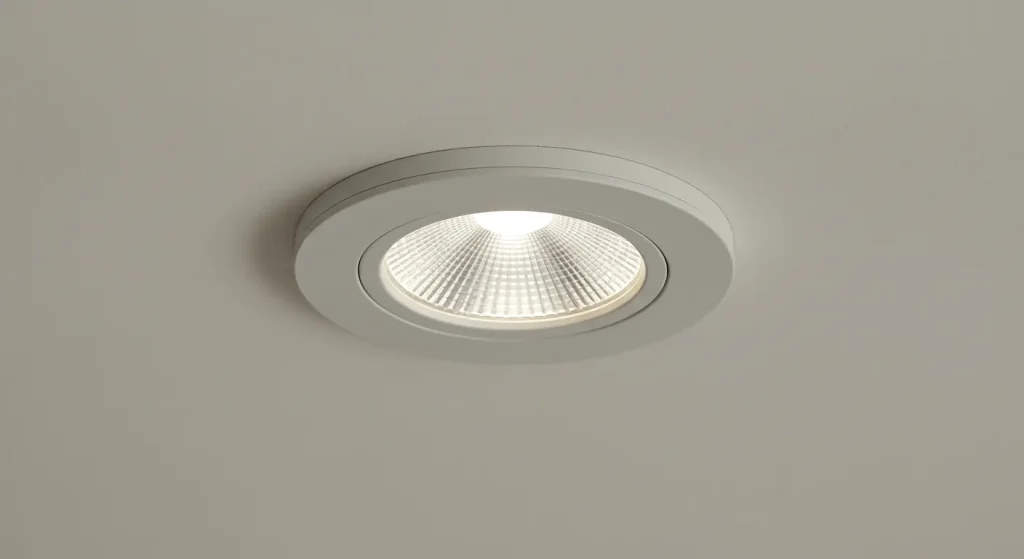
This is where a little professional technique goes a long way. Simply trying to “freehand” a larger circle with a jab saw is a recipe for disaster, and a standard hole saw is useless because its center pilot bit has nothing to drill into. Don’t worry. There is a simple, bulletproof method that professionals use to get a perfectly clean, perfectly centered cut every single time.
The Core Challenge: The Missing Center
Before we get to the solution, it’s important to understand the problem. A hole saw—the best tool for cutting clean, round holes in drywall—relies on its central pilot drill bit to keep the saw steady and centered as it cuts.
When you try to enlarge an existing hole, the pilot bit is left spinning in empty air. Without that central anchor point, the large cutting teeth of the hole saw will immediately grab the edge of the drywall, kicking violently and tearing a jagged, uncontrollable gash in your ceiling. It is impossible to get a clean cut this way. The secret, therefore, lies in creating a temporary, artificial center point.
The Professional Solution: The Hole Saw Guide Jig
The solution that electricians and professional renovators use is as simple as it is brilliant: a temporary guide jig. A jig is simply a template that you temporarily attach to the ceiling. In this case, it’s a piece of scrap wood with a perfectly placed hole that will guide your new, larger hole saw, holding it steady and centered while you cut.
Creating and using this jig is the key to a factory-perfect result.
Before You Cut: Essential Preparation and Safety
A successful project is built on a foundation of good preparation. Do not skip these steps.
Step 1: Critical Safety – Power Off Completely
This is your absolute first step. Even though you are about to remove the old fixture, you must ensure the wiring is not live.
- Go to your main electrical panel (circuit breaker box) and switch off the breaker that controls the lighting circuit you will be working on.
- Confirm the power is off by testing the light switch for that room. For ultimate safety, professionals use a non-contact voltage tester on the wires after removing the fixture.
Step 2: Gather Your Tools and Materials
Having everything on hand makes the job smooth and efficient.
- Safety Gear: Safety glasses and a dust mask are non-negotiable.
- The New Downlight: Have it on hand to double-check the required hole size.
- Hole Saw Kit: You will need two hole saw arbors and two hole saws: one that matches the size of the old, existing hole, and one that matches the required size of the new, larger hole.
- Power Drill: A standard cordless drill will work perfectly.
- For the Jig: A piece of scrap plywood, MDF, or solid wood. It must be at least 1/2 inch (13mm) thick and several inches wider than your new hole size (e.g., a 12×12 inch square is perfect).
- Clamps or Screws: To temporarily secure the jig to the ceiling.
- Measuring Tape & Pencil.
Step 3: Remove the Old Downlight Fixture
- Gently pull the old downlight fixture down from the ceiling. It is held in by large spring clips. Be careful not to let them snap your fingers.
- Once the fixture is hanging, disconnect it from the electrical wiring. This typically involves opening a small junction box and unscrewing the wire connectors. Safely tuck the wires back up into the ceiling for now.
How to Enlarge a Downlight Hole: The 5-Step Professional Guide
This is the core of the process. Follow these steps meticulously for a perfect cut.
Step 1: Create Your Guide Jig
This simple template is the key to the entire operation.
- Take your piece of scrap plywood or MDF.
- Attach the NEW, LARGER hole saw (e.g., the 6-inch one) to your drill.
- Carefully drill a hole directly through the center of your scrap wood. You now have a piece of wood with a perfectly sized hole in it. This is your guide jig.
Step 2: Assemble the Cutting Tool
This is the clever part.
- Take your second hole saw arbor.
- Mount the OLD, SMALLER hole saw (e.g., the 4-inch one) onto the arbor in the normal position.
- Now, take the NEW, LARGER hole saw and thread it onto the same arbor, on top of the smaller one.
- What you have now is a nested tool: the smaller hole saw acts as a self-centering guide that will fit perfectly into the old hole, while the larger hole saw will do the cutting.
Alternative to Step 2 (If you don’t have two hole saws): If you only have the new, larger hole saw, you will rely entirely on the wooden jig. In this case, proceed to Step 3.
Step 3: Secure the Jig to the Ceiling
- Take your wooden guide jig (from Step 1).
- Place it flat against the ceiling, ensuring the hole you drilled in the jig is perfectly centered over the existing hole in the ceiling.
- Secure the jig to the ceiling. You can have a helper hold it firmly, but it’s much safer and more accurate to clamp it to a ceiling joist if possible, or to temporarily drive two drywall screws through the jig and into the ceiling (you can easily patch these small holes later). The jig must not move during cutting.
Step 4: The Moment of Truth – Cutting the New Hole
- If using the nested hole saw method (from Step 2a): The smaller inner saw will slip into the existing hole, perfectly centering your tool. The outer, larger saw is now positioned to cut.
- If using the jig method (from Step 2b): Insert the hole saw into the guide hole in your jig. The pilot bit will go into the center of the old hole, and the jig will keep the saw from wandering.
- Start Cutting: Begin drilling at a slow, steady speed. Let the saw do the work; do not force it. It’s often helpful to run the drill in reverse for a few seconds first to score the ceiling’s paper/paint layer, which helps prevent tearing.
- Complete the Cut: Increase the speed slightly and cut all the way through the drywall. You will be left with a perfect, clean ring of drywall and a beautifully enlarged, centered hole.
Step 5: Remove the Jig and Clean Up
- Unscrew or unclamp your guide jig from the ceiling.
- Vacuum up any dust.
- You are now ready to install your new, larger downlight into its perfectly cut hole by following the manufacturer’s instructions for wiring and fitting.
Alternative Methods and Tools
While the jig/nested saw method is the most reliable, here are other options:
- Adjustable Hole Cutter (Circle Cutter): This tool has a central pilot bit and an adjustable cutting arm. You can set the arm to the exact radius you need. The challenge is still the missing center point, so you would still need to use a wooden guide jig to keep the pilot bit steady. These tools can also create more dust and require a very steady hand.
- Jab Saw and a Template: For those without power tools, you can trace a perfect circle onto the ceiling using a compass or a template. Then, carefully cut along the line with a manual drywall jab saw. This requires significant skill and patience to achieve a clean, round cut.
From a Renovation Puzzle to a Professional Skill
The task of enlarging a downlight hole shifts from a frustrating impossibility to a manageable, precise task the moment you learn the proper technique. By creating a simple guide jig, you are adopting the same problem-solving approach that seasoned professionals use on a daily basis.
This method ensures accuracy, protects your ceiling from damage, and provides a clean, factory-perfect opening for your new fixtures. You haven’t just learned how to fix a problem; you’ve learned a valuable skill in renovation and a key lesson in how preparation is the true secret to quality craftsmanship.
Now that your ceiling is ready, do you need help with the lighting plan?
Solving the physical installation is a huge step. If you need expert guidance on choosing the right new downlights, planning a layout that enhances your space, or selecting the best dimming controls, our team of lighting specialists is here to help.
Contact us today for a professional consultation and let’s complete your lighting transformation.