 XHLUX
XHLUX

Inhaltsverzeichnis
- 1. Why Choosing the Right Museum Lighting Matters
- 2. Key Selection Criteria for Museum Lighting Fixtures
- 3. Recommended Lighting Fixtures by Artwork Type
- 4. Technical Quality: Evaluating a Professional Fixture
- 5. Case Studies: European Museum Lighting in Action
- 6. How to Evaluate and Select a Reliable Supplier
- 7. FAQ About Museum Lighting Fixtures
- 8. Schlussfolgerung
Lighting is the second language of art.
The right illumination reveals every brushstroke and texture — while the wrong one can distort colors or even damage irreplaceable pieces.
In modern European museums, lighting is no longer a background utility; it is an integral part of curatorial storytelling and art preservation.
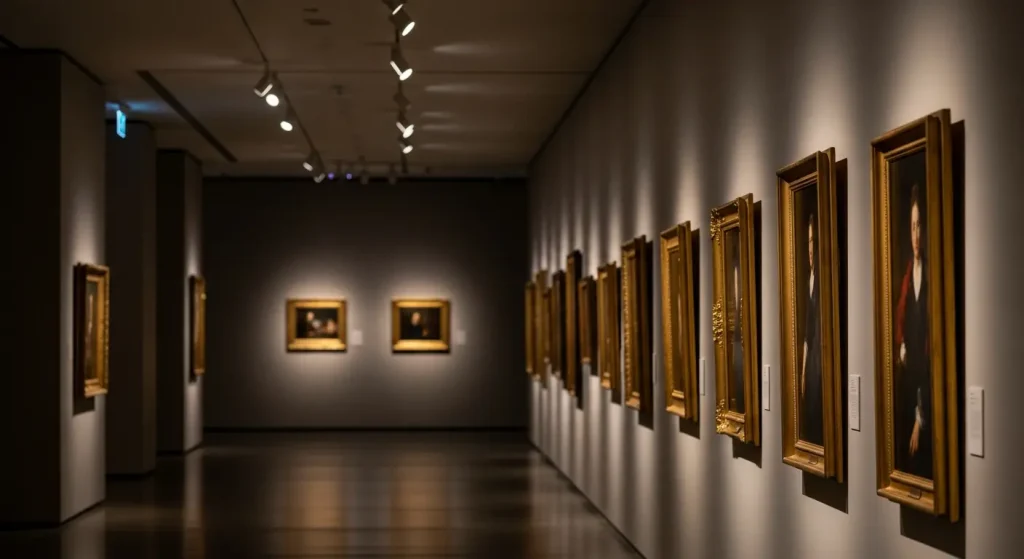
A professional museum lighting system not only recreates the artist’s vision with perfect color fidelity but also protects delicate materials from UV, IR, and thermal degradation.
So, how can architects, designers, and project managers choose fixtures that balance beauty and responsibility?
Let’s explore the technical, aesthetic, and operational criteria behind selecting the right lighting for artworks.
1. Why Choosing the Right Museum Lighting Matters
1.1 Lighting Defines How Art Is Perceived
Light determines how a viewer experiences art — its tone, emotion, and depth.
The right fixture brings pigments to life, reveals hidden layers, and creates a sense of intimacy between the observer and the artwork.
Each lighting choice shapes perception:
- Spectral distribution affects color temperature and realism.
- Beam control defines contrast and focus.
- Glare and reflection influence comfort and engagement.
In short, light guides emotion, comprehension, and memory.
It’s not just about illumination — it’s about interpretation.
1.2 Risks of Using the Wrong Fixtures
When lighting is chosen based solely on cost or appearance, the consequences can be severe:
- Ultraviolet and infrared radiation can cause fading or pigment cracking.
- Uneven illuminance leads to distracting bright spots or dark zones.
- Glare and reflection fatigue the eyes and break immersion.
- Low-quality LEDs cause color drift, flicker, or spectrum distortion.
Even well-known institutions have faced restoration costs due to poor lighting control.
That’s why professional buyers and specifiers now prioritize museum-grade luminaires — designed to protect, not just illuminate.
💡 CTA – Download Professional Lighting Guide
Learn how to balance artistic preservation and modern display performance.
👉 Download the XHLUX Museum Lighting Guide ›
2. Key Selection Criteria for Museum Lighting Fixtures
Choosing the right fixtures requires evaluating both artistic needs Und technical standards.
Below are the five most critical parameters that define high-quality museum lighting systems.
2.1 Color Rendering Index (CRI) and Spectral Consistency
Color fidelity is the foundation of art presentation.
Paintings demand light sources that reveal pigments as they were intended — without exaggeration or washout.
Recommended values for museum environments:
- CRI (Ra): ≥ 95
- R9 (Red Rendering): ≥ 90
- CCT Range: 2700–4000 K
- SDCM: ≤ 3 for color uniformity
Tunable White technology (2700–4000 K) allows curators to adapt lighting to exhibition themes — warmer for Renaissance works, cooler for photography or sculpture.
| Parameter | Empfohlener Wert | Zweck |
|---|---|---|
| CRI (Ra) | ≥ 95 | Natural color reproduction |
| R9 | ≥ 90 | Accurate red tones and skin tones |
| CCT | 2700–4000 K | Match artwork tone and mood |
| SDCM | ≤ 3 | Color consistency across fixtures |
2.2 Beam Angle and Optical Control
Different artworks require distinct lighting geometries.
A narrow beam isolates detail; a wide beam blends the environment.
Typical Recommendations:
- Oil Paintings / Sculptures: 15°–24° narrow beam
- Murals / Photography Exhibits: 36°–60° medium or wide beam
- Large-Scale Artworks: 60°+ flood or linear wall wash
Choose fixtures with interchangeable reflectors or lenses, allowing flexibility across exhibitions.
Advanced optics maintain uniform intensity and smooth gradients — avoiding “hard-edged” light circles that distract the eye.
2.3 Anti-Glare Design for Visual Comfort
Glare is the enemy of appreciation.
Professional museum fixtures employ optical engineering to ensure UGR < 19 and minimal direct brightness.
Key design features include:
- Deep-set reflectors to conceal light sources.
- Honeycomb louvers or anti-glare rings to reduce contrast.
- Matte black or low-reflectance inner housings.
- Tilt adjustability (30°–45°) to minimize reflections on glass frames.
Visitor impact:
Longer dwell times, improved engagement, and reduced visual fatigue — all contributing to better visitor satisfaction.
2.4 Light Damage Control and Thermal Management
Preservation is paramount.
Professional museum-grade fixtures must eliminate harmful radiation and control thermal output.
Critical parameters:
- UV emission: < 75 µW/lm
- Infrared radiation: < 3 W/m²
- Temperature rise on artwork surface: ≤ 25°C
- LED lifespan: ≥ 50,000 hours (L80/B10)
All XHLUX fixtures are tested under LM80 / TM21 standards, ensuring both luminous stability and minimal photochemical risk.
📊 Performance Data Example
| Metrisch | Industry Benchmark | XHLUX Typical Value |
|---|---|---|
| UV Output | < 75 µW/lm | < 50 µW/lm |
| Wärmeabgabe | < 3 W/m² | 2.2 W/m² |
| Surface Temp Rise | ≤ 25°C | 22°C |
| Lebensdauer | ≥ 50,000 h | 60,000 h |
2.5 Smart Dimming and Control Systems
Precision lighting requires precise control.
Modern museum installations rely on digital protocols to tailor light levels for conservation and storytelling.
Recommended systems:
- DALI-2: For central wired control and scene management.
- Casambi Bluetooth Mesh: For wireless retrofits or heritage buildings.
- 0–10V analog dimming: For smaller or cost-sensitive projects.
These systems enable:
- Scene presets (Exhibit / Cleaning / Night modes).
- Tageslichtnutzung for energy efficiency.
- Gradual dimming curves to prevent flicker or abrupt transitions.
💡 CTA – Explore Smart Lighting Solutions
Discover how XHLUX integrates DALI & Casambi technologies into European museum projects for seamless conservation lighting.
👉 View Smart Control Solutions ›
3. Recommended Lighting Fixtures by Artwork Type
No two artworks are alike — nor should they be lit the same way.
Different artistic media respond uniquely to color temperature, beam spread, and intensity.
Below is a practical guide for choosing the best museum lighting fixtures based on the type of artwork.
| Artwork Type | Empfohlener Leuchtentyp | Optical Parameters | CCT (K) | CRI (Ra) |
|---|---|---|---|---|
| Ölgemälde | Recessed or track-mounted spotlight | 15°–24° narrow beam | 3000 K | ≥ 95 |
| Sculptures | Adjustable floodlight | 24°–36° medium beam | 3000–3500 K | ≥ 95 |
| Photography / Digital Art | Linear or floodlight | 36°–60° wide beam | 4000 K | ≥ 90 |
| Murals / Large Pieces | Linear wall washer | Even illumination | 3500 K | ≥ 95 |
3.1 Oil Paintings – Depth, Texture, and Color Fidelity
Oil paintings often contain complex pigments and varnish layers that react to light differently.
To highlight their dimensional depth:
- Choose narrow-beam (15°–24°) spotlights mit CRI 95+.
- Maintain 3000 K warm white for authentic color warmth.
- Verwenden anti-glare reflectors and a 30°–40° beam angle to avoid specular reflections.
- Keep illuminance between 80–150 lux for classical works.
💡 Profi-Tipp: Pair with DALI dimming to adapt brightness for specific exhibitions or restoration assessments.
3.2 Sculptures – Form and Shadow Balance
Sculptures demand light that reveals form and texture through shadow contrast.
- Opt for medium beams (24°–36°) with adjustable tilt and rotation.
- Combine two or more fixtures from different angles to create soft, natural shading.
- Ensure high R9 values (> 90) to maintain material authenticity (bronze, marble, etc.).
Recommended products include gimbal-mounted downlights Und adjustable track floodlights with deep anti-glare design.
3.3 Photography and Digital Art – Precision and Neutrality
Photographic prints and digital artworks rely on precise white balance and controlled brightness.
- Verwenden neutral white 4000 K to maintain grayscale fidelity.
- Avoid warm tones that distort highlights.
- Select CRI ≥ 90 Und SDCM ≤ 3 for consistent color uniformity across the display wall.
Casambi-controlled fixtures are ideal here, allowing curators to switch modes between daylight simulation and soft ambient display.
3.4 Murals and Large Artworks – Even Illumination
Large frescoes or panoramic works require uniform brightness across a wide surface area.
- Choose linear wall washers or asymmetric beam fixtures with wide angles (60°–90°).
- Uniformity (U₀) should exceed 0.8, ensuring smooth visual transitions.
- Integrate daylight sensors for constant-lux control under variable natural light.
This configuration enhances visual continuity while meeting conservation limits for exposure.
📘 CTA – Download the Application Guide
Get the complete Museum Lighting Configuration Manual, including lux charts, beam angle diagrams, and sample project layouts.
👉 Download PDF ›
4. Technical Quality: Evaluating a Professional Fixture
Selecting fixtures goes beyond beam angle or color rendering — the internal design defines stability, safety, and long-term ROI.
Below are four critical aspects that distinguish professional-grade museum lighting systems.
4.1 Optical Quality
Optical performance is the heart of museum lighting.
Premium fixtures should achieve smooth, uniform beam distribution and precise cut-off control.
Key design features include:
- Aluminum vacuum-coated reflectors with ≥ 95% reflectance.
- Dual optical systems (primary lens + secondary reflector) for consistent light fields.
- Interchangeable accessories: honeycomb louver, glare shield, asymmetric lens.
- Anti-UV PMMA lenses to prevent color shift or yellowing.
Metric Snapshot:
| Optical Parameter | Industry Standard | XHLUX Performance |
|---|---|---|
| Reflector Efficiency | ≥ 90% | 94–96% |
| Beam Uniformity | ≥ 0,8 | 0.85–0.9 |
| UGR Rating | < 19 | < 17 |
| Accessory Options | Basic | 5+ modular combinations |
4.2 Structural Integrity and Thermal Design
Heat is the silent killer of LED performance.
Professional fixtures must manage temperature effectively to maintain color and output stability.
- Die-cast aluminum body for rapid heat dissipation.
- Isolated driver chamber to reduce thermal interference.
- Passive cooling system with fin-style heat sinks for silent operation.
- Temperature rise on housing ≤ 25°C.
Warum das wichtig ist: Proper heat management extends LED lifespan and prevents spectral drift — a crucial factor for artwork conservation.
4.3 Lifetime and Luminous Maintenance
Reliability determines cost-efficiency.
Museum lighting systems often operate 10–12 hours daily, making durability non-negotiable.
Performance Benchmarks:
- Average lifetime ≥ 50,000 hours (L80/B10)
- Luminous maintenance ≥ 90% after 30,000 hours
- LM80/TM21 certified COB LEDs
- Consistent chromaticity shift (Δu’v’) < 0.003
| Parameter | Standard Requirement | XHLUX Typical Result |
|---|---|---|
| Luminous Maintenance | ≥ 85% | 92% |
| CRI Consistency | ±1% deviation | ±0.5% |
| Δu’v’ Stability | < 0.005 | 0.003 |
| Garantie | 3 years | 5 Jahre |
4.4 System Compatibility and Control
Compatibility defines scalability.
The best fixtures work seamlessly with smart museum management systems.
Supported protocols include:
- DALI-2: Digital addressable lighting interface for central control.
- Casambi Bluetooth Mesh: Wireless control, perfect for retrofits or listed heritage buildings.
- 0–10V & DMX: For flexible scene control and integration with audiovisual systems.
Such flexibility allows museums to:
- Adjust brightness zones individually.
- Automate exhibition schedules.
- Integrate lighting into Gebäudeleitsysteme (GLS).
🔧 CTA – Request Technical Specs
Need ENEC-certified, CRI 95+ fixtures for your next museum project?
👉 Download Product Data Sheet ›
5. Case Studies: European Museum Lighting in Action
Theory becomes meaningful when proven in real-world applications.
Below are select examples showing how European institutions apply professional lighting design to elevate art presentation and protect cultural heritage.
| Projekttyp | Standort | Fixture Configuration | Key Highlights |
|---|---|---|---|
| Renaissance Art Museum | Florence, Italy | CRI95+ spotlights + DALI dimming | Perfect color recovery for oil paintings, balanced warmth |
| Photography Gallery | Berlin, Germany | Linear wall washers + Casambi smart control | Even illumination, natural gray gradients, wireless control |
| Heritage Restoration Museum | Paris, France | Adjustable recessed fixtures + Tunable White | Achieved light preservation balance while enhancing realism |
Each case demonstrates how precise optical control, CRI 95+ LED modules, Und intelligent dimming systems deliver both visual beauty and long-term conservation benefits.
🏛️ CTA – View Project References
Discover how XHLUX supports museums and art spaces across Europe with customized CRI 95+ lighting solutions.
👉 View European Projects ›
6. How to Evaluate and Select a Reliable Supplier
For curators, specifiers, or brand buyers, the quality of your supplier directly determines project success.
The right partner provides not just luminaires, but also engineering assurance, certification compliance, and long-term support.
6.1 Verify Certification and Compliance
Professional museum lighting must adhere to strict EU safety and quality standards:
- CE / ENEC / CB / RoHS / ISO 9001 certified
- LED sources LM80 / TM21 verified
- CIE 157:2004 compliance for radiation control
- Drivers meet IEC safety and EMC standards
Always request supporting documents — certification numbers, IES test files, and photometric data — before specifying a supplier.
6.2 Technical and Optical Support
A professional manufacturer should act as your technical partner.
Look for suppliers who provide:
- IES / LDT-Photometriedateien for Dialux and Relux simulations
- BIM / STEP models for architectural integration
- Lighting design proposals with uniformity, lux, and UGR simulations
- On-demand optical customization for unique exhibition layouts
Such capabilities simplify your design process and reduce commissioning time.
6.3 ODM / OEM Capabilities
For lighting brands or distributors, private-label collaboration can create strategic differentiation.
XHLUX bietet:
- Reflector and trim customization (black, silver, champagne)
- Tunable White or fixed CCT variants (2700–4000 K)
- Private branding, packaging, and documentation
- Driver options for DALI-2, Casambi, or 0–10V dimming
This modular ODM model allows European brands to scale faster while maintaining quality and design integrity.
6.4 After-Sales and Warranty Assurance
Beyond delivery, long-term reliability defines partnership value.
Look for suppliers who provide:
- ≥ 5 years warranty
- 48-hour technical response
- Remote or onsite training for installation teams
- Replacement or upgrade programs for aging systems
💬 CTA – Partner With XHLUX
Seeking a CE & ENEC-certified ODM supplier for your next museum project?
👉 Contact XHLUX Team › | Chat on WhatsApp ›
7. FAQ About Museum Lighting Fixtures
Q1: What is the recommended illuminance for museum artworks?
Typically between 50–200 lux, depending on the age and pigment sensitivity of the artwork.
Antique or paper-based pieces should stay below 100 lux; contemporary works can reach 200 lux safely.
Q2: Do LED lights damage art?
No — professional LED museum fixtures emit no UV or IR radiation.
Their full-spectrum output is balanced to protect pigment longevity while maintaining true color perception.
Q3: Can fixtures support smart control?
Ja.
Modern systems integrate DALI-2, Casambi, or DMX protocols for multi-scene programming, automatic dimming, and wireless management — ideal for EU museums with rotating exhibitions.
Q4: What is the standard production or customization lead time?
For standard fixtures, approximately 3–4 weeks; for customized ODM designs, 6–8 weeks depending on volume and specification.
Q5: Which certifications ensure EU compliance?
Look for ENEC, CE, CB, RoHS, Und ISO 9001.
These ensure electrical safety, EMC compliance, and environmental responsibility — all required for museum or public projects.
📘 CTA – Download Product & Certification Pack
Access the full technical library including ENEC certificates, IES files, and Dialux-ready data.
👉 Download Now ›
8. Schlussfolgerung
The right lighting fixture doesn’t just show art — it translates it.
It bridges centuries of creative expression with today’s technological precision.
A well-designed museum lighting system reveals truth in color, texture, and meaning, while protecting cultural treasures for generations.
Choosing the right partner, therefore, is as vital as the technology itself.
With over 15 years of manufacturing experience, XHLUX delivers lighting systems engineered for CRI 95+ fidelity, UGR < 19 comfort, Und DALI / Casambi intelligence — combining aesthetics, performance, and conservation integrity.
✨ Why Professionals Choose XHLUX
- 15+ years experience in museum, gallery, and commercial lighting
- Certified under CE / ENEC / CB / SAA / ISO 9001
- Expertise in CRI 95+ full-spectrum LEDs, anti-glare optics, and smart control
- Proven track record with European cultural institutions and lighting brands
- Comprehensive ODM/OEM service with 5-year warranty
📞 Take Immediate Action
Ready to design your next museum or gallery lighting project?
Let our engineers help you build a solution that protects art and inspires audiences.
👉 Chatte auf WhatsApp | Angebot anfordern | Projekte ansehen | Katalog herunterladen