 XHLUX
XHLUX

Inhaltsverzeichnis
- 1. What Is Recessed Art Lighting?
- 2. Why Recessed Lighting Transforms the Gallery Experience
- 3. Core Technical Advantages of Recessed Art Lighting
- 4. Typical Applications and Design Configurations
- 5. Recessed vs Track Lighting — Which Fits Your Gallery Better?
- 6. Core Technical Advantages of Recessed Art Lighting
- 7. Typical Applications and Design Configurations
- 8. Recessed vs Track Lighting — Which Fits Your Gallery Better?
- 9. How to Choose a Reliable Recessed Art Lighting Supplier
- 10. Frequently Asked Questions (FAQ)
- Q1: What is the ideal ceiling depth for recessed art lighting?
- Q2: Can recessed art lights integrate with smart control systems?
- Q3: Are recessed luminaires suitable for paintings, sculptures, and photography displays?
- Q4: Can I customize recessed fixtures under my brand?
- Q5: What’s the average lifetime and maintenance schedule?
- 11. Conclusion
Light is often called the silent curator of every gallery.
It frames each brushstroke, defines texture, and sets the emotional temperature of a visitor’s experience.
In modern European galleries—where architecture, sustainability, and design precision must work together—lighting has become an extension of the artwork itself.
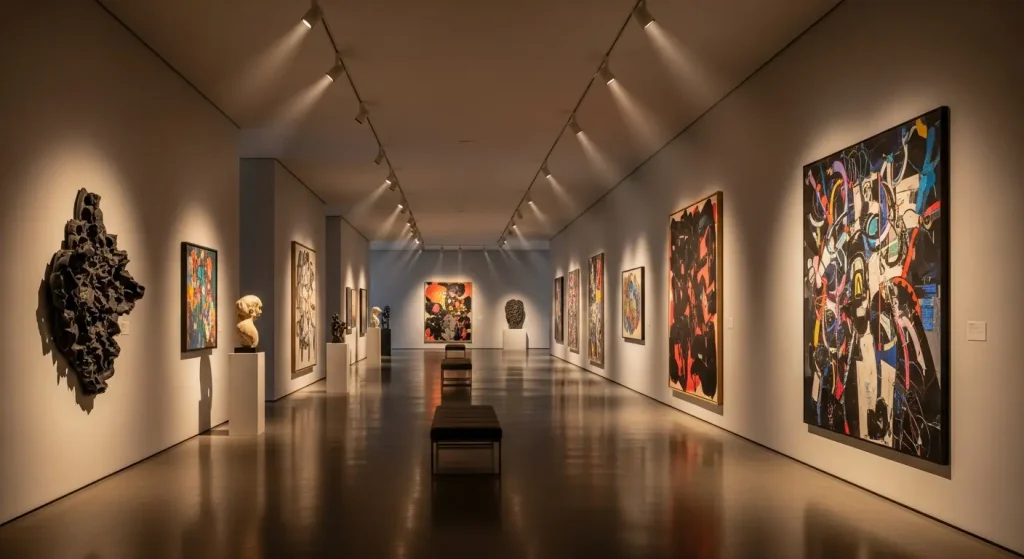
Recessed art lighting answers the need for invisible sophistication: it hides the hardware, highlights the art, and shapes the story of space.
This article explores how recessed fixtures improve presentation quality, energy efficiency, and spatial aesthetics—while helping lighting brands, distributors, and project integrators deliver measurable results.
1. What Is Recessed Art Lighting?
1.1 Definition and Concept
Recessed art lighting refers to luminaires installed within the ceiling so that only the trim or reflector is visible.
Unlike track heads that hang into the visual field, recessed fixtures merge with architecture, achieving a clean, minimalist ceiling plane.
They create architectural silence—allowing visitors to perceive only the illuminated artwork, not the source of light.
In EU projects, recessed lighting is specified wherever architects and curators want:
- seamless ceiling integration,
- consistent beam control, and
- professional visual comfort compliant with EN12464-1 Und CIBSE LG8 standards.
1.2 Role in Art Presentation
A well-designed recessed system performs three vital roles:
- Akzentbeleuchtung – precisely directs light onto paintings, sculptures, or installations.
- Ambient shaping – establishes overall spatial tone without overpowering the exhibits.
- Blendschutz – shields viewers from direct light to preserve comfort and focus.
By concealing the luminaire, designers maintain the purity of architectural form while achieving a museum-grade display effect that supports the curator’s intent.
💡 CTA – Download Catalog
Explore the latest XHLUX Recessed Art Lighting Collection featuring CRI 95+ LED modules, low-glare optics, and DALI-2 smart control.
👉 Download Product Catalog ›
2. Why Recessed Lighting Transforms the Gallery Experience
Lighting can either flatter or flatten a work of art.
Recessed luminaires elevate the visitor experience through technical precision and emotional subtlety.
2.1 Precise Beam Control—Directing Attention with Intent
Each piece in a gallery demands its own visual choreography.
Modern recessed spotlights provide adjustable beam angles (10°, 24°, 36°) that sculpt light precisely where it belongs.
Tight beams dramatize small canvases or sculptures; wider beams unify panoramic installations.
Edge-soft optics prevent harsh halos and ensure a natural gradient between artwork and wall.
Wichtigste Vorteile:
- Maintain consistent illuminance across series of works.
- Reduce spill light to adjacent exhibits.
- Highlight texture and relief without glare.
When paired with DALI scene control, curators can program flexible lighting scenes—opening nights, daily operation, or special exhibitions—at the touch of a button.
2.2 High CRI Lighting—Revealing True Color and Detail
Color fidelity defines credibility.
A deviation in spectrum can distort the artist’s palette or the collector’s perception of authenticity.
That’s why professional gallery lighting specifies CRI ≥ 95 with high R9 (red rendering) values above 90.
XHLUX LED modules employ balanced spectral output with minimal blue shift, ensuring:
- accurate skin tones in portraits,
- natural whites in photography, and
- vivid pigment contrast in oil paintings.
All fixtures comply with LM80 tested LED chips Und ENEC-certified drivers, ensuring both color stability and long lifecycle—critical for galleries operating > 12 hours daily.
📊 Data Insight:
| Parameter | Recommended Standard | XHLUX Typical Value |
|---|---|---|
| Color Rendering Index (CRI) | ≥ 90 for gallery spaces | 95–97 |
| R9 Value (Red Fidelity) | > 80 | > 90 |
| CCT Options (K) | 2700 / 3000 / 3500 / 4000 | Selectable Tunable White 2700-4000 |
| Flicker Percent (IEEE Std 1789) | < 1% | < 0.5% (flicker-free) |
2.3 Low-Glare Comfort—Seeing Art without Seeing Light
The hallmark of professional lighting is what you don’t see.
Deep recess reflectors, black baffles, and honeycomb louvers keep UGR < 19, eliminating visual discomfort even under high lux levels.
Visitors move freely without squinting, photographers capture clean reflections, and the art remains the star.
For heritage buildings with glossy finishes or glass frames, this feature dramatically reduces specular reflections—an essential factor for conservation-grade installations.
2.4 Architectural Integration—Design as a Silent Partner
Recessed fixtures blend structure and light.
Flush-mounted trims or trimless housings align perfectly with gypsum or metal ceilings, complementing minimalist European interior aesthetics.
Finishes such as matte black, anodized silver, or white powder-coat harmonize with gallery palettes.
This integration achieves two strategic goals for B2B buyers:
- Brand consistency – unified visual identity across multiple gallery chains.
- Maintenance simplicity – ceiling access panels remain clear, with front-serviceable designs saving time on re-lamping or driver swap.
🏛️ CTA – View Projects
See how XHLUX recessed lighting transformed galleries in Paris, Milan, and Berlin—combining architectural purity with precision optics.
👉 View Project Cases ›
3. Core Technical Advantages of Recessed Art Lighting
Every gallery project combines aesthetic vision with practical performance.
Below are the four pillars that define professional recessed systems — the same qualities lighting specifiers across Europe now demand.
3.1 Optical Precision – Controlling Light Like a Brushstroke
Great lighting behaves like great curation: deliberate, controlled, and invisible.
High-end recessed luminaires use aluminum reflectors or secondary lenses to direct luminous output exactly where needed.
Key technical options include:
- Beam angle range: 10°, 24°, 36°, 60°
- Optical accessories: honeycomb louver, anti-glare shield, snoot, and lens diffusers
- Field uniformity: > 0.8 ratio ensures consistent illumination across wall art
- Luminous efficacy: up to 130 lm/W for maximum efficiency with minimal heat build-up
These parameters ensure artworks appear alive under controlled contrast, not washed out by stray light.
3.2 Energy Efficiency and Smart Control
In the EU market, sustainability equals profitability.
Modern recessed art lighting leverages high-efficiency LED drivers and intelligent control systems to minimize power use without sacrificing quality.
Smart integration options:
- DALI-2 protocol: precise digital dimming for zoned galleries
- Casambi Bluetooth Mesh: wireless app control, ideal for retrofit heritage sites
- 0–10 V dimming: simple analog option for cost-efficient installations
With power factors > 0.9 Und total harmonic distortion < 10%, these luminaires meet Ecodesign and RoHS directives, helping galleries comply with EU sustainability regulations.
💡 Energy Insight Example:
A 100-piece gallery fitted with XHLUX 20 W recessed fixtures (replacing 50 W halogen) saves ~3,000 kWh annually — reducing CO₂ emissions by 1.4 tons per year.
3.3 Modular Construction for Quick Maintenance
Every curator values flexibility — exhibitions change, and so must the lighting.
Recessed fixtures from professional manufacturers feature modular, front-serviceable designs, allowing tool-free access from below the ceiling.
Advantages for installers and OEM partners:
- Separate driver chamber for heat isolation and longer lifespan
- Interchangeable optical modules for beam reconfiguration
- Plug-and-play connectors simplify upgrades or replacements
This modularity ensures minimum downtime, vital for galleries with continuous visitor flow.
3.4 Built for Longevity and Consistency
Longevity equals brand reputation.
Professional recessed fixtures use LM-80-tested LEDs, thermal-managed die-cast aluminum, Und constant-current drivers rated for 50,000+ hours.
Color shift (Δu’v’) stays below 0.003 over lifetime, guaranteeing consistent visual tone across years of operation — a must for franchise galleries maintaining uniform identity.
🔧 CTA – Consult an Engineer
Need to specify a lighting system that meets EN12464-1 standards for museum comfort?
👉 Contact XHLUX Engineering Team ›
4. Typical Applications and Design Configurations
Recessed art lighting adapts to diverse exhibition formats.
The following table summarizes recommended configurations for key gallery zones:
| Anwendungsgebiet | Beleuchtungsziel | Recommended Specification |
|---|---|---|
| Painting Halls | Highlight color accuracy and brush texture | 24° beam, CRI 95+, 3000 K warm white |
| Sculpture Zones | Accentuate 3-D form and shadow contrast | 15° narrow beam + adjustable gimbal |
| Photography Rooms | Preserve grayscale neutrality and contrast | 36° medium beam, 4000 K neutral white |
| Entrance & Lobby | Create visual guidance and ambience | 24° beam + DALI scene dimming |
Designers often combine multiple beam spreads in layered compositions: narrow beams for focus, medium for body lighting, and wide flood for background wash.
This layered strategy encourages visitor circulation and emotional rhythm within the gallery.
💡 CTA – Download Lighting Solutions PDF
Access XHLUX’s curated Gallery Lighting Design Guide, featuring beam diagrams, lux calculations, and case photos from European projects.
👉 Download Solutions PDF ›
5. Recessed vs Track Lighting — Which Fits Your Gallery Better?
Many buyers ask whether to specify recessed or track systems.
Both have advantages, but the decision depends on project longevity, aesthetics, and maintenance goals.
| Kriterien | Recessed Art Lighting | Schienenbeleuchtung |
|---|---|---|
| Visual Aesthetics | Clean, minimalist ceiling; invisible hardware | Visible track lines and heads |
| Glare Performance | Excellent (UGR < 19) | Moderate (UGR ≈ 21) |
| Adjustability | Fixed or limited tilt; precise focus | Highly adjustable, flexible |
| Wartung | Front-serviceable, compact | Tool-free replacement |
| Ideal Use Case | Permanent exhibitions, premium galleries | Temporary or rotating shows |
| Installation Cost | Slightly higher initial | Lower upfront, higher over time |
Conclusion:
Für long-term or flagship galleries, recessed lighting delivers architectural refinement and stable performance.
Für temporary exhibitions or pop-ups, track systems offer reconfigurable agility.
🏛️ CTA – Compare Solutions
Not sure which system fits your next project? Download our “Recessed vs Track Lighting Comparison Sheet.”
👉 Download Comparison Guide ›
6. Core Technical Advantages of Recessed Art Lighting
Every gallery project combines aesthetic vision with practical performance.
Below are the four pillars that define professional recessed systems — the same qualities lighting specifiers across Europe now demand.
6.1 Optical Precision – Controlling Light Like a Brushstroke
Great lighting behaves like great curation: deliberate, controlled, and invisible.
High-end recessed luminaires use aluminum reflectors or secondary lenses to direct luminous output exactly where needed.
Key technical options include:
- Beam angle range: 10°, 24°, 36°, 60°
- Optical accessories: honeycomb louver, anti-glare shield, snoot, and lens diffusers
- Field uniformity: > 0.8 ratio ensures consistent illumination across wall art
- Luminous efficacy: up to 130 lm/W for maximum efficiency with minimal heat build-up
These parameters ensure artworks appear alive under controlled contrast, not washed out by stray light.
6.2 Energy Efficiency and Smart Control
In the EU market, sustainability equals profitability.
Modern recessed art lighting leverages high-efficiency LED drivers and intelligent control systems to minimize power use without sacrificing quality.
Smart integration options:
- DALI-2 protocol: precise digital dimming for zoned galleries
- Casambi Bluetooth Mesh: wireless app control, ideal for retrofit heritage sites
- 0–10 V dimming: simple analog option for cost-efficient installations
With power factors > 0.9 Und total harmonic distortion < 10%, these luminaires meet Ecodesign and RoHS directives, helping galleries comply with EU sustainability regulations.
💡 Energy Insight Example:
A 100-piece gallery fitted with XHLUX 20 W recessed fixtures (replacing 50 W halogen) saves ~3,000 kWh annually — reducing CO₂ emissions by 1.4 tons per year.
6.3 Modular Construction for Quick Maintenance
Every curator values flexibility — exhibitions change, and so must the lighting.
Recessed fixtures from professional manufacturers feature modular, front-serviceable designs, allowing tool-free access from below the ceiling.
Advantages for installers and OEM partners:
- Separate driver chamber for heat isolation and longer lifespan
- Interchangeable optical modules for beam reconfiguration
- Plug-and-play connectors simplify upgrades or replacements
This modularity ensures minimum downtime, vital for galleries with continuous visitor flow.
6.4 Built for Longevity and Consistency
Longevity equals brand reputation.
Professional recessed fixtures use LM-80-tested LEDs, thermal-managed die-cast aluminum, Und constant-current drivers rated for 50,000+ hours.
Color shift (Δu’v’) stays below 0.003 over lifetime, guaranteeing consistent visual tone across years of operation — a must for franchise galleries maintaining uniform identity.
🔧 CTA – Consult an Engineer
Need to specify a lighting system that meets EN12464-1 standards for museum comfort?
👉 Contact XHLUX Engineering Team ›
7. Typical Applications and Design Configurations
Recessed art lighting adapts to diverse exhibition formats.
The following table summarizes recommended configurations for key gallery zones:
| Anwendungsgebiet | Beleuchtungsziel | Recommended Specification |
|---|---|---|
| Painting Halls | Highlight color accuracy and brush texture | 24° beam, CRI 95+, 3000 K warm white |
| Sculpture Zones | Accentuate 3-D form and shadow contrast | 15° narrow beam + adjustable gimbal |
| Photography Rooms | Preserve grayscale neutrality and contrast | 36° medium beam, 4000 K neutral white |
| Entrance & Lobby | Create visual guidance and ambience | 24° beam + DALI scene dimming |
Designers often combine multiple beam spreads in layered compositions: narrow beams for focus, medium for body lighting, and wide flood for background wash.
This layered strategy encourages visitor circulation and emotional rhythm within the gallery.
💡 CTA – Download Lighting Solutions PDF
Access XHLUX’s curated Gallery Lighting Design Guide, featuring beam diagrams, lux calculations, and case photos from European projects.
👉 Download Solutions PDF ›
8. Recessed vs Track Lighting — Which Fits Your Gallery Better?
Many buyers ask whether to specify recessed or track systems.
Both have advantages, but the decision depends on project longevity, aesthetics, and maintenance goals.
| Kriterien | Recessed Art Lighting | Schienenbeleuchtung |
|---|---|---|
| Visual Aesthetics | Clean, minimalist ceiling; invisible hardware | Visible track lines and heads |
| Glare Performance | Excellent (UGR < 19) | Moderate (UGR ≈ 21) |
| Adjustability | Fixed or limited tilt; precise focus | Highly adjustable, flexible |
| Wartung | Front-serviceable, compact | Tool-free replacement |
| Ideal Use Case | Permanent exhibitions, premium galleries | Temporary or rotating shows |
| Installation Cost | Slightly higher initial | Lower upfront, higher over time |
Conclusion:
Für long-term or flagship galleries, recessed lighting delivers architectural refinement and stable performance.
Für temporary exhibitions or pop-ups, track systems offer reconfigurable agility.
🏛️ CTA – Compare Solutions
Not sure which system fits your next project? Download our “Recessed vs Track Lighting Comparison Sheet.”
👉 Download Comparison Guide ›
9. How to Choose a Reliable Recessed Art Lighting Supplier
Selecting the right partner is as important as selecting the right luminaire.
For European distributors, lighting consultants, or design studios, a dependable supplier ensures both technical precision and project peace of mind.
Below are the key criteria every professional buyer should evaluate before finalizing a recessed lighting partner.
9.1 Verify International Certifications
Ensure the manufacturer complies with CE, ENEC, CB, and RoHS standards.
These certificates guarantee product safety, electromagnetic compatibility, and sustainability for the EU market.
Reputable suppliers also follow ISO 9001 quality systems and provide third-party test reports (such as TUV or Intertek).
✅ Tipp: Always request the ENEC certificate number and photometric test files (IES / LDT) to verify genuine compliance.
9.2 Evaluate Optical and Build Quality
Professional recessed fixtures should demonstrate:
- Consistent CRI performance (≥ 95 for color accuracy)
- UGR < 19 design with deep reflectors
- LM80 / TM21-tested LEDs ensuring long-term lumen maintenance
- Die-cast aluminum housings for optimal thermal management
Ask for sample units or arrange a factory video inspection to confirm reflector depth, lens quality, and finish consistency.
9.3 Assess ODM / OEM Customization Capability
A strong manufacturing partner does more than assemble products — they co-create solutions.
Leading OEM suppliers like XHLUX provide:
- Customized trims, optics, and finishes (black, white, silver, champagne)
- Private-label branding (logo printing, packaging design)
- Flexible driver configurations (DALI 2, Casambi, 0-10 V)
- Joint R&D for exclusive product lines
Such collaboration shortens product development cycles and builds differentiation for European lighting brands.
9.4 Confirm After-Sales & Technical Support
Look for partners that offer:
- Dedicated project engineering support
- IES / LDT photometric files for Dialux and Relux simulations
- 3D models (STEP / Revit) for architectural BIM workflows
- 5-year warranty and 48-hour response service
A reliable supplier becomes an extension of your technical team — not just a vendor.
💬 CTA – Partner With XHLUX
Searching for an ENEC-certified OEM partner to support your EU gallery lighting projects?
👉 Angebot anfordern | Chatte auf WhatsApp
10. Frequently Asked Questions (FAQ)
Lighting specifiers often share similar questions when upgrading or designing gallery illumination.
This FAQ module is optimized for Google rich-results, helping your page gain additional visibility in search results.
Q1: What is the ideal ceiling depth for recessed art lighting?
Most fixtures require 40–70 mm installation depth.
Ultra-shallow models can fit as low as 35 mm, making them perfect for renovation projects or thin ceiling cavities.
Q2: Can recessed art lights integrate with smart control systems?
Ja.
High-end fixtures support DALI-2, 0–10 V, and Casambi Bluetooth protocols, enabling wireless dimming, scene scheduling, and energy monitoring — ideal for modern EU smart-building applications.
Q3: Are recessed luminaires suitable for paintings, sculptures, and photography displays?
Absolut.
With CRI 95+ optics, multiple beam angles, and low-glare design, recessed lights enhance every medium — from flat canvases to 3-D sculptures — without color distortion or reflection glare.
Q4: Can I customize recessed fixtures under my brand?
Ja.
XHLUX offers full OEM/ODM-Anpassung, including branding, reflector finishes, trim color, driver type, and packaging.
This helps European distributors establish exclusive product lines with short lead times.
Q5: What’s the average lifetime and maintenance schedule?
Most recessed art luminaires provide 50,000 hours @ L80/B10 performance.
Front-serviceable modules allow quick driver or reflector replacement, minimizing downtime and maintenance costs.
📘 CTA – Download Product Data Pack
Get technical sheets, IES files, and BIM models for your next Dialux simulation.
👉 Download Here ›
11. Conclusion
Recessed art lighting is more than a fixture; it is an architectural tool for storytelling.
It transforms galleries from mere display spaces into immersive experiences — where every beam guides emotion, every shadow reveals intention, and every lumen reinforces brand identity.
For European gallery owners and lighting professionals, investing in recessed systems means investing in long-term quality, sustainability, and design integrity.
With high CRI accuracy, anti-glare comfort, and smart-control integration, recessed art lighting stands as the gold standard for modern exhibitions.
✨ Why Choose XHLUX
- 15+ years of manufacturing experience in commercial and architectural lighting
- Specialized in LED track, downlight, linear, and art lighting systems
- Certified to CE / ENEC / CB / SAA, ensuring full EU market compliance
- Complete ODM platform with modular optical and housing systems
- Proven track record across retail, gallery, and hospitality projects in Europe
📞 Ergreifen Sie sofort Maßnahmen.
Ready to elevate your gallery or exhibition project?
Our lighting engineers can design a tailored recessed art lighting plan that meets your exact CE & ENEC standards.👉 Chatte auf WhatsApp | Angebot anfordern | View Project Cases | Katalog herunterladen