 XHLUX
XHLUX

Inhaltsverzeichnis
- 1. Why Linear Lighting Is Evolving from Products into Systems
- 2. What Is Continuous Run Seamless LED Linear Lighting?
- 3. Why Ordinary Linear Lights Rarely Achieve True Seamlessness
- 4. Core Spatial Value of Continuous Run Seamless Systems
- 5. Typical Applications for Continuous Run LED Linear Lighting
- 6. Continuous Run Systems vs Individual Linear Fixtures
- 7. What a Mature Continuous Run Seamless System Includes
- 8. Key Considerations When Selecting Continuous Run LED Linear Lighting Systems
- 9. Why Continuous Run Systems Support Standardization and Replication
- 10. Common Mistakes When Using Continuous Run Linear Lighting
- 11. FAQ About Continuous run LED linear lighting
- 12. Why Continuous Run Seamless Linear Lighting Is a Rational Choice
- Business inquiries are welcome.
1. Why Linear Lighting Is Evolving from Products into Systems
Linear lighting is no longer a decorative accent in modern architecture and commercial spaces.
It has become a primary spatial light structure, used to define axes, guide movement, and organize large interiors.
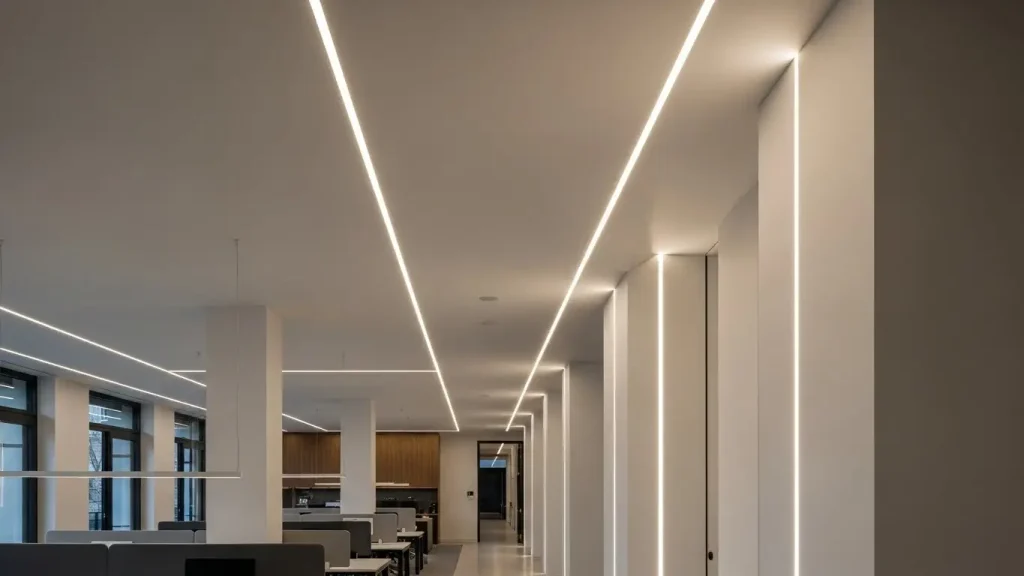
However, many projects still rely on individual linear fixtures, which often leads to visible problems:
- Gaps between luminaires
- Inconsistent brightness
- Obvious joints and interruptions
This is why professionals searching for continuous run LED linear lighting are not asking how to connect fixtures mechanically. They are asking a deeper question:
How can linear lighting appear as one continuous, uninterrupted line of light—without visible joints or performance inconsistency?
The answer lies in continuous run seamless LED linear lighting systems, not standalone products.
2. What Is Continuous Run Seamless LED Linear Lighting?
A continuous run system is designed from the beginning to operate as one integrated lighting solution, even though it is assembled from multiple modules.
What “Continuous Run” Really Means
- Multiple linear segments engineered to connect as a system
- Power, optics, and structure designed for uninterrupted operation
What “Seamless” Actually Refers To
Seamless does not mean “physically touching.”
It means continuity in three critical dimensions:
- Light continuity — no dark gaps or hot spots
- Visual continuity — no visible seams or misalignment
- Structural continuity — joints designed as part of the system
Core Difference
| Ordinary Linear Light | Continuous Run System |
|---|---|
| Individual product | Integrated lighting system |
| Visual continuity depends on installer | Visual continuity engineered into design |
| High risk of inconsistency | Predictable, controlled outcome |
One-sentence definition:Continuous run seamless LED linear lighting is a system-level solution designed to deliver uninterrupted light and appearance over long distances.
3. Why Ordinary Linear Lights Rarely Achieve True Seamlessness
This is the root cause section—and where many projects fail.
Common Problems Seen in “Connected” Linear Lights
- Visible dark zones at joints
- Bright spots caused by overlapping optics
- Inconsistent color temperature between sections
- Slight mechanical misalignment creating “broken lines”
Why This Happens
These issues are not installation mistakes in most cases. They occur because:
- The luminaires were not designed for continuous operation
- Optical systems do not overlap correctly
- Electrical design introduces power drop or segment differences
In architectural and commercial spaces:If you can see the joint, the lighting design has already failed.
4. Core Spatial Value of Continuous Run Seamless Systems
This is where continuous run systems justify their existence.
What They Actually Deliver to the Space
- A truly uninterrupted line of light
- Stronger architectural axes and geometry
- Improved sense of order and spatial rhythm
- Reduced visual clutter from individual fixtures
- Higher perceived quality and refinement
In large-scale spaces, continuous run systems allow lighting to disappear as an object and remain only as a spatial effect.
One-sentence summary:The value of continuous linear lighting is not brightness—it is spatial completeness.
5. Typical Applications for Continuous Run LED Linear Lighting
Continuous run systems perform best in spaces that emphasize scale, alignment, and visual flow.
Common Application Scenarios
- Commercial office spaces
- Retail stores and shopping malls
- Hotel public areas and corridors
- Airports, stations, and transportation hubs
- Educational and civic buildings
- Exhibition halls and cultural venues
Shared Characteristics
👉 Strong architectural lines
👉 Large or elongated spaces
👉 High demand for visual continuity
6. Continuous Run Systems vs Individual Linear Fixtures
From a project standpoint, the comparison is not about lumens or wattage.
Decision Logic
| Aspekt | Individual Linear Lights | Continuous Run Systems |
|---|---|---|
| Procurement | Simple | Requires early planning |
| Visual outcome | Installer-dependent | System-controlled |
| Risk level | Hoch | Niedrig |
| Scalability | Limited | Exzellent |
| Final consistency | Unpredictable | Highly predictable |
For commercial projects:System controllability is more important than unit price.
7. What a Mature Continuous Run Seamless System Includes
Not all “continuous” systems are equal. A professional-grade solution typically includes:
- Dedicated joint designs with no dark zones
- Unified optical layout across all modules
- Continuous internal electrical routing
- Modular length planning based on ceiling grids
- Support for straight runs, corners, T-joints, and custom geometries
- Structural stability for long-distance installation
- Compatibility with control systems such as DALI
Many projects integrate these systems within broader LED Linear Lighting solutions or complete commercial lighting systems.
Key reminder:True seamlessness is solved during design—not on site.
8. Key Considerations When Selecting Continuous Run LED Linear Lighting Systems
This practical checklist filters out unsuitable options early.
Evaluation Checklist
- Are joints truly free of dark or bright spots?
- Is brightness and color consistency guaranteed across batches?
- Can the system support long uninterrupted runs?
- Does the installation allow reasonable tolerance without visual failure?
- Is it compatible with DALI or 0–10V dimming systems?
- Is maintenance possible without breaking visual continuity?
- Does the supplier have real large-scale project experience?
For background on digital lighting control often used with linear systems, see Wikipedia – Digital Addressable Lighting Interface and the DALI Alliance.
Important principle:Continuous operation tests system stability—not individual fixture specifications.
9. Why Continuous Run Systems Support Standardization and Replication
For large owners, developers, and brands, repeatability matters.
Advantages in Multi-Project Deployment
- Unified module logic across locations
- Predictable visual outcomes
- Reduced dependency on installer skill level
- Faster rollout for chain or campus projects
- Lower post-installation adjustment risk
For brands and engineering teams:This is a scalable lighting strategy, not a custom one-off solution.
10. Common Mistakes When Using Continuous Run Linear Lighting
Even good products fail when system logic is ignored.
Typical Errors
- Forcing standard linear lights into long runs
- Ignoring optical joint design
- Underestimating power distribution over distance
- Approving short samples instead of full-run mockups
- Neglecting installation tolerance planning
Key warning:Failures in continuous linear lighting usually come from system neglect, not product defects.
11. FAQ About Continuous run LED linear lighting
Q1: Are continuous run systems only suitable for large spaces?
They are most effective there, but smaller spaces also use them to emphasize architectural lines.
Q2: Can joints really be invisible?
Professional systems make joints visually negligible in real-world conditions.
Q3: Are continuous run systems harder to install?
Systemized design often makes installation more predictable, not harder.
Q4: Do they support smart control systems?
Yes, commonly integrated with DALI-based controls.
Q5: Is maintenance complicated?
Well-designed systems simplify maintenance rather than complicate it.
12. Why Continuous Run Seamless Linear Lighting Is a Rational Choice
Modern architecture values continuity, order, and clarity.
Standard linear fixtures struggle to deliver these qualities consistently when used in long runs.
Continuous run seamless LED linear lighting systems:
- Provide stable, unified visual effects
- Reduce project risk
- Elevate overall spatial quality
For designers, developers, and contractors, this represents a shift:From choosing products to designing lighting systems.
Final takeaway:Continuous run seamless LED linear lighting is a system-level solution built for modern architectural continuity.
Business inquiries are welcome.
If you are planning a project that relies on long, uninterrupted linear light, early system planning is essential.
If you would like support selecting suitable continuous run systems, coordinating layouts, or integrating them into a full commercial lighting solution, you can👉 contact us for a project-based consultation.
This helps ensure your linear lighting looks continuous by design—not by chance.