 XHLUX
XHLUX

Inhaltsverzeichnis
- Quick read
- 1 Why tunable white is becoming the “default” in premium commercial track lighting
- 2 What a “Tunable White Track Light” means in project reality
- 3 Why 2700K–6500K is the most practical tunable-white range
- 4 Why Casambi fits tunable white track projects
- 5 A data-first way to choose CCT scenes
- 6 Human-centric and circadian lighting
- 7 The engineering specs that separate “demo tunable white” from “project-grade tunable white”
- 8) Casambi vs wired controls (DALI / 0–10V): choose by project constraints, not ideology
- 9 What makes a good 2700K–6500K track light
- 10 OEM/ODM + SKD: why control-ready tunable white is a strong private-label platform
- 11 Where Casambi tunable white track lights excel
- 12 FAQ About Casambi Wireless Control Track Light
- Welcome to cooperate
How to spec a future-proof track lighting system that adapts to retail, office, museum, healthcare, and education—without rewiring, over-ordering SKUs, or losing control consistency.
Quick read
If you’ve ever re-aimed track heads after a merchandising change, fought with “scene” commissioning that took days, or watched a space look wrong at night because the color temperature was locked—this article is for you. In 8–10 minutes, you’ll learn why 2700K–6500K is the most usable tunable-white range, why Casambi’s wireless control is often the fastest path to real scene flexibility, and how to spec a commercial-grade track light (UGR, SDCM, CRI/R9, dimming curve, driver, and maintenance) that holds up in projects—not demos.
1 Why tunable white is becoming the “default” in premium commercial track lighting
Commercial lighting used to be a one-time decision: pick 3000K or 4000K, choose beam angles, install, and walk away. That model breaks in modern spaces because the space itself is no longer static:
- Einzelhandel changes product stories weekly (new displays, new finishes, new “hero” items).
- Büro shifts between focus work, collaboration, events, and hybrid schedules.
- Museums & galleries rotate exhibits; different media needs different white points.
- Healthcare & education increasingly ask for lighting that supports comfort and alertness, not just illuminance.
That’s why Tunable White Track Light searches are rising: people aren’t asking “can it change CCT?”—they’re asking: can it do it reliably, smoothly, and fast to commission—without rewiring?
2 What a “Tunable White Track Light” means in project reality
A tunable white track light is a track spotlight or track head that can continuously adjust correlated color temperature (CCT) across a defined Kelvin range. CCT describes the perceived “warmth/coolness” of white light in kelvins. (维基百科)
But in projects, tunable white isn’t a “feature.” It’s a risk-reducer and a SKU reducer:
- One luminaire platform serves warm hospitality scenes and cooler task scenes.
- Commissioning becomes software, not new wiring.
- Future changes become a scene update—not a change order.
So the real buying question is: what Kelvin range is actually useful? Which brings us to 2700K–6500K.
3 Why 2700K–6500K is the most practical tunable-white range
3.1 It covers nearly every commercial “white light” use case
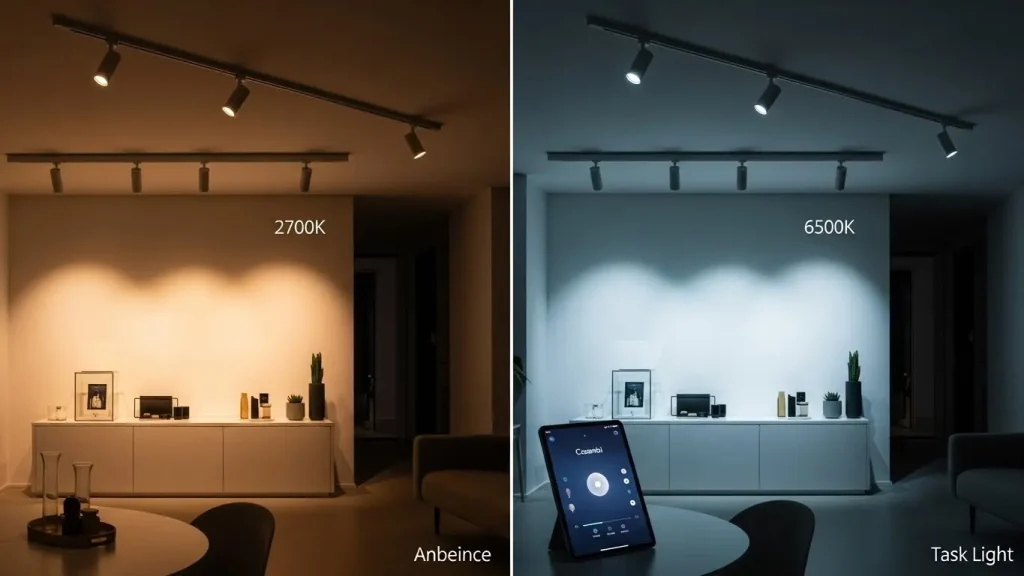
2700K is a classic warm white anchor; 6500K reaches “daylight-like” cool white territory. (维基百科)
Between them you can hit the real-world working set:
- 2700–3000K: hospitality warmth, luxury retail intimacy, lounge atmospheres
- 3500–4000K: balanced commercial general lighting (shops, lobbies, offices)
- 5000–6500K: crisp clarity for display evaluation, clinical/education tasks, daytime alertness
3.2 Narrower ranges leave money on the table
A 2700–4000K tunable system can feel “premium,” but it can’t deliver the crisp daylight modes some projects need. A 3000–6000K range often misses the true warm-end hospitality scenes. And going beyond 6500K rarely improves outcomes—comfort can drop fast.
3.3 It’s the sweet spot between design freedom Und occupant comfort
A wider range only matters if the system is stable: color consistency, dimming smoothness, and driver quality must hold across the full Kelvin sweep.
4 Why Casambi fits tunable white track projects
Casambi positions itself as a smart wireless control solution based on Bluetooth Low Energy. It’s widely used as a wireless lighting control system that can reduce wiring complexity and make changes software-driven.
What that means for track lighting:
Track systems are chosen because they’re flexible (move/aim heads). Casambi complements that with control flexibility:
- scene creation without control cabling rework
- grouping by zone, time, or layout
- faster commissioning for renovations and phased rollouts
- easy reprogramming when the store changes its planogram
Casambi also highlights track lights within its ecosystem, including products that combine beam flexibility and dual-CCT concepts for professional environments.
If you’re planning a retrofit or a multi-phase rollout, shortlist Casambi early—control decisions are easiest before fixture schedules lock.
5 A data-first way to choose CCT scenes
Below is a practical “scene matrix” you can hand to a designer, contractor, or owner.
Table 1 — Recommended tunable-white scenes (2700K–6500K)
| Raumtyp | Typical Scenes | Suggested CCT Targets | Why it works |
|---|---|---|---|
| Luxury Retail / Jewelry | Day / Night / VIP | 3500K day, 2700–3000K night | Clear detail by day, premium warmth by night |
| Fashion / Showroom | Display tuning | 3000–4500K | Neutral-to-cool boosts texture clarity |
| Office / HQ | Focus / Collaboration / Event | 4000–5000K focus, 3500K social | Supports alertness + comfort balance |
| Museum / Gallery | Conservation / Viewing | 3000–5000K (content-dependent) | Helps match artwork intent and materials |
| Education | Morning / Afternoon | 5000K morning, 4000K later | Keeps spaces bright without harshness |
| Hospitality Lobby | Arrival / Evening | 3000K arrival, 2700K evening | Warmth improves perceived comfort |
Mini chart — “Where the range earns its keep”
Usefulness by Kelvin band (typical project frequency)
2700–3000K  ██████████  (hospitality, luxury, evening scenes)
3000–4000K  ████████████████  (most common commercial baseline)
4000–5000K  ████████████  (office, clarity, display accuracy)
5000–6500K  ████████  (education/clinical tasks, daytime alertness)
6 Human-centric and circadian lighting
Clients increasingly ask for “circadian” or “human-centric” lighting—sometimes because of standards, sometimes because HR and facility teams want better daytime alertness.
Der WELL Building Standard includes circadian lighting criteria expressed in equivalent melanopic lux (EML) measured on the vertical plane at eye level, with published thresholds (e.g., 250 EML under defined conditions). (标准认证)
You don’t need to turn every track project into a circadian lab, but tunable white + scene control helps you:
- deliver cooler, higher-stimulus scenes during “day mode”
- shift warmer later to support comfort
- keep the same fixture platform while adjusting schedules
If the client mentions WELL, “circadian,” or “human-centric,” put tunable white + scene control on the table immediately—then validate targets with a lighting calculation workflow.
7 The engineering specs that separate “demo tunable white” from “project-grade tunable white”
This is where many projects fail: tunable white gets selected, but the light quality Und Konsistenz aren’t specified tightly enough.
Here’s a project-grade baseline that works for retail, gallery, and premium commercial interiors:
7.1 Color quality and consistency
- CRI ≥ 90 minimum for commercial display; Ra97 / CRI97 preferred for art, luxury, and framing-style presentation
- Ask for R9 performance (deep reds), not only Ra average
- SDCM < 3 (MacAdam ellipse) target for tight color consistency across heads and across batches
- Stable color behavior across dimming (avoid “pink/green drift” at low levels)
7.2 Glare control and comfort
- Target UGR < 19 where track lights contribute to work areas (office, circulation zones)
- Verwenden deep anti-glare optics: black baffles, honeycomb louver options, proper cut-off design
7.3 Efficiency and lifetime
- Practical commercial efficiency: 100–130 lm/W depending on optics and CRI level
- Lifetime target: L70/B50 50.000 Stunden (or stronger)
- Thermal design: Kühlkörper aus Aluminiumdruckguss (not thin stamped metal)
- Optical materials: PMMA-Linse (common for precision optics)
- Light engine: COB-Chip options for clean beam and smooth blending
7.4 Dimming and driver stability
- Smooth low-end dimming is where cheap systems expose themselves
For professional projects: ensure the driver and control implementation is validated for:
- flicker management (especially at low output)
- consistent dimming curve between fixtures
- stable operation at local mains conditions
Ask suppliers to provide IES files, dimming curve notes, and consistency targets up front—before you commit to fixture schedules.
8) Casambi vs wired controls (DALI / 0–10V): choose by project constraints, not ideology
You’ll see debates like “wireless vs DALI.” The real answer is: pick the system that reduces your risk for this project.
Table 2 — Control approach comparison (project logic)
| Control Path | Am besten geeignet für | Strengths | Watch-outs |
|---|---|---|---|
| Casambi (wireless BLE mesh) | Retrofit, fast rollout, multi-zone scenes | Less rewiring, fast commissioning, easy changes | Plan device placement + network strategy |
| DALI / DALI-2 (wired) | New build, structured BMS integration | Robust wired topology, standardized protocol | More wiring + coordination effort |
| 0–10 V | Cost-driven, simpler zoning | Familiar, widely used | Less granular control, can vary by install quality |
If your project is a renovation with limited ceiling access, Casambi often wins on speed and disruption. If you’re building a new HQ with strict BMS integration, DALI may be the natural backbone. Many global portfolios end up using both—by project type.
9 What makes a good 2700K–6500K track light
The Kelvin range is only the headline. For a premium Casambi Tunable White Track Light 2700K–6500K spec, insist on performance across the entire sweep:
The “7-check” commissioning-safe checklist
- Continuous CCT transition (no stepping)
- Consistent beam shape across CCT changes
- Stable color at low dimming (no ugly tint shifts)
- SDCM < 3 for batch-to-batch repeatability
- UGR strategy (cutoff / baffle / louver) for comfort
- Optics options (10° / 24° / 36° / 60° equivalents or zoom variants)
- Documentation package: IES, cut sheets, wiring/control notes, warranty terms
Request a small mock-up kit and validate: scene change speed, low-end dimming, and color consistency across 6–10 heads. This catches 90% of downstream problems early.
10 OEM/ODM + SKD: why control-ready tunable white is a strong private-label platform
If you’re sourcing for distribution, private label, or multi-market rollouts, tunable white can reduce SKU pressure—if the product platform is designed for it.
How tunable white lowers SKU count
A fixed-CCT portfolio often needs:
- 3000K + 4000K versions
- mehrere Strahlwinkel
- separate controls/dimming variations
A tunable platform can consolidate color-temperature SKUs while preserving application coverage. That simplifies:
- inventory planning
- store rollouts across regions
- service replacements (fewer variants to stock)
Where SKD (Semi Knocked Down) fits
For global shipments, SKD can help optimize logistics and, in some scenarios, reduce landed cost complexity by shipping fixtures in semi-assembled form for local final assembly/pack-out—useful for large orders and distributor operations that have local handling capacity.
If your business is multi-country or multi-client, ask about OEM branding, packaging options, and SKD programs before you finalize the platform.
11 Where Casambi tunable white track lights excel
Retail & flagship stores
- Day mode: crispness for product evaluation
- Night mode: warm luxury ambience
- Seasonal resets: scene reprogramming without rewiring
Offices & headquarters
- Focus scenes for task-heavy areas
- Softer late-day scenes
- Better comfort perception in collaboration zones
Museums, galleries, and showrooms
- Different exhibit materials benefit from different white points
- Scene presets for “tour,” “event,” “conservation,” “cleaning” modes
- Track flexibility + control flexibility = future-proof display system
Healthcare & education
- Functional clarity where needed (cooler scenes)
- Comfort in waiting or lounge zones (warmer scenes)
- Zone-based scheduling for predictable operations
12 FAQ About Casambi Wireless Control Track Light
Q1: Will tunable white reduce CRI or color quality?
Not inherently. A well-designed system maintains CRI ≥ 90, and premium specs can reach Ra97/CRI97—but you must request CRI/R9 targets and consistency requirements.
Q2: Is 2700K–6500K too wide?
For commercial projects, it’s typically the most useful full range—covering warm hospitality through cool clarity. The key is stability across the sweep, not just the range.
Q3: Can Casambi handle larger projects?
Yes—Casambi positions itself as a full-featured wireless lighting control system and ecosystem built on Bluetooth Low Energy. (Casambi) Scale success depends on planning groups, commissioning workflow, and network design.
Q4: Do I need tunable white if I already have dimming?
Dimming controls quantity of light. Tunable white controls the character of light. If your space changes function by time or event, tunable white usually pays back in adaptability.
Q5: What’s the fastest way to reduce risk before a big order?
Do a mock-up with your exact scenes: test low-end dimming, CCT transitions, beam consistency, glare perception, and multi-head matching.
Q6: Is tunable white track lighting only for “high budget” projects?
It’s common in premium projects first, but it’s increasingly used in value-engineered ways because it can reduce long-term modifications, re-aiming labor, and SKU sprawl.
Q7: What specs should I put in my tender document?
At minimum: CRI ≥ 90 (or Ra97), SDCM < 3, UGR strategy (target UGR<19 where applicable), driver/control compatibility, 100–130 lm/W expectation, L70/B50 50,000h, IES files, warranty terms.
Welcome to cooperate
If you’re planning a tunable-white track lighting project (retail, showroom, museum/gallery, office, hospitality, education, or healthcare) and you want a system that’s easy to commission, consistent across batches, and scalable for rollouts, we can help as an indoor commercial lighting product & solution provider—from fixture selection to control-ready specs, OEM labeling, and SKD shipping options.
- Get a fast response via Kontakt/Angebot
- For private label or factory-direct needs: OEM Inquiry
- For layout + specification support: Project Consultation
- Grab the full lineup here: Katalog herunterladen
- Explore relevant product families: Schienenbeleuchtung, Zoombare Schienenleuchten, Lineare Beleuchtung
Referenzen
- Casambi official site and solution overview (Casambi)
- WELL circadian lighting design requirements (EML) (标准认证)
- IES (Illuminating Engineering Society) discussion of EML/WELL feature context (Illuminating Engineering Society)
- Definitions of correlated color temperature / color temperature (维基百科)