 XHLUX
XHLUX

Inhaltsverzeichnis
- What Are Recessed Ceiling Spot Lights?
- Key Benefits for Commercial Lighting
- Commercial Applications
- Buyer Considerations for Commercial Projects
- Why Choose Chinese LED Recessed Spot Light Manufacturers?
- Future Trends in Commercial Lighting
- Key Metrics for Commercial Recessed Ceiling Spot Lights
- FAQ About Recess Ceiling Spot Light
- Abschluss
- Ergreifen Sie sofort Maßnahmen.
In today’s fast-paced commercial environment, lighting is no longer just a utility—it is a strategic asset. For retail chains, hotels, office campuses, exhibition halls and showrooms, the quality, flexibility and design of lighting fixtures can directly influence customer experience, brand perception and operational costs. Among the many lighting solutions, recessed ceiling spot lights (also known as recessed downlights, commercial recessed spotlights, or LED recessed ceiling spot lights) have emerged as a preferred choice for commercial spaces.
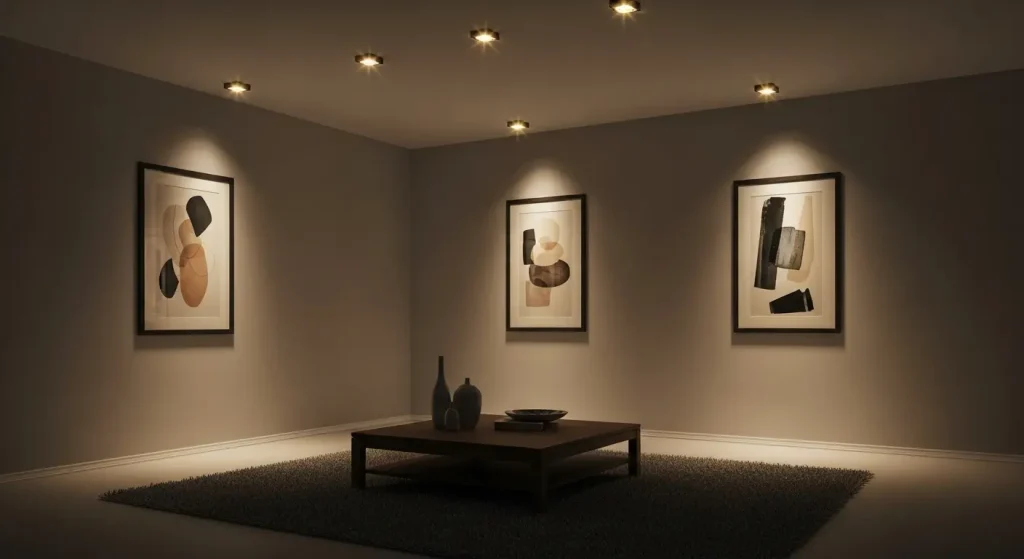
Why? Because these fixtures deliver clean aesthetics, enhanced functionality, energy efficiency and long-term value—all of which matter deeply to lighting brands, wholesalers, project contractors and manufacturers sourcing for commercial clients. This article dives into the key benefits of recessed ceiling spot lights in commercial environments, shows how they support project-based lighting strategies, and gives you a clear roadmap to leverage them for your business growth.
What Are Recessed Ceiling Spot Lights?
Recessed ceiling spot lights are fixtures installed flush with or slightly above the ceiling plane, typically within a housing or trim designed for ceiling integration. They differ from surface-mounted or pendant lights in structure, aesthetic and performance.
- They offer a minimal visual footprint, because the lamp body sits inside the ceiling, leaving only the trim and light output visible.
- They often provide adjustable light beams, allow for narrow or wide angles (e.g., 15°, 24°, 36°, 60°) which gives precise lighting control.
- Compared with traditional fixtures (pendants, exposed track lights, surface mounted spots), recessed ceiling spot lights offer a cleaner ceiling line, reduced glare, more uniform integration into architectural design.
Common application scenarios in commercial spaces include hotel lobbies, retail showrooms, office open-plan areas, museum galleries and reception zones. Their ability to blend into high-end interiors while still delivering performance makes them popular. ([PacLights][1])
Key Benefits for Commercial Lighting
Below are the major advantages of recessed ceiling spot lights in commercial projects—advantages that matter to procurement teams, project managers, lighting brands and wholesalers.
3.1 Aesthetic & Modern Appearance
- Because the fixtures are flush-mounted and unobtrusive, they maintain a clean, seamless ceiling appearance, reinforcing high-end brand image. ([XRZLux][2])
- They integrate easily with minimal disruption to decorative ceilings, making them ideal for upscale hospitality, retail flagship stores, and designer office interiors.
- Their design consistency helps brands maintain visual continuity across multiple locations while delivering lighting performance—important for chain stores and global projects.
3.2 Precision Lighting & Accent Focus
- Recessed spot lights often allow beam angle control (such as 15°, 24°, 36°, 60°) enabling focused illumination on merchandise, artwork or architectural features—exactly what retail, museum or showroom projects require.
- They help create lighting hierarchy: ambient light for general area + accent light for focal points. This layering contributes to visual depth and richness. ([M.T. Kelley Electric][3])
- For commercial buyers, the ability to highlight specific feature zones (e.g., product display, reception desk) with high precision improves customer engagement and design flexibility.
3.3 Energy Efficiency & Long Lifespan
- Many contemporary recessed ceiling spot lights use LED technology offering high luminous efficacy (100–120 lm/W or higher in commercial fixtures) and long lifetime (often 50,000 hours or more). This translates into significantly lower energy and maintenance cost. ([cbmcinc.com][4])
- In large commercial spaces, where hundreds or thousands of fixtures may be used, the cumulative savings are substantial—this is key to ROI for specifiers, project contractors and facility managers.
- Reduced fixture depth and heat generation also benefit HVAC systems, because less heat load from lighting means less cooling energy.
3.4 Comfortable Light Environment & Glare-Free Design
- For commercial spaces (offices, hospitality, retail), occupant comfort and visual quality are critical. Recessed spot lights can be designed with UGR (Unified Glare Rating) < 19 or better, reducing discomfort from glare.
- High CRI (Color Rendering Index) values > 90 ensure true colour rendering—vital when the brand’s image, merchandise presentation or interior finish need accurate color perception.
- Producing a comfortable environment improves end-user experience and supports productivity for staff, or engagement for customers.
3.5 Smart Control & Flexibility
- Modern recessed ceiling spot lights often support smart control systems: DALI, 0–10 V dimming, ZigBee, Tuya, Bluetooth mesh—allowing lighting systems in commercial buildings to adapt to occupancy, daylighting, schedule and scene requirements. ([PacLights][1])
- With intelligent control, facility managers can reduce energy further, fine-tune lighting scenes for hospitality or retail experiences, and integrate with building automation systems.
- This flexibility adds value to lighting brands and contractors, because they can offer “lighting system + smart control” as a turnkey solution to commercial clients.
3.6 Design Variety & OEM/ODM Flexibility
- Recessed ceiling spot lights come in multiple form-factors, trims, finishes, sizes, power ratings, beam angles and colour temperatures. This allows lighting brands or wholesalers to tailor solutions to specific commercial spaces.
- Many manufacturers support OEM/ODM customisation: branding, logo embossing, private-label packaging, custom colour/finish, integrated driver interfaces—critical for brands and large wholesale clients seeking differentiation.
- For engineering contractors handling large commercial builds, this flexibility ensures that lighting fixtures fit architectural ceilings, meet specification requirements and align with brand aesthetics.
Commercial Applications
Below is a table summarising common commercial use-cases of recessed ceiling spot lights, aligned with function and recommended lighting solution.
| Scenario | Function Requirement | Recommended Solution |
|---|---|---|
| Retail store | Product display lighting | Narrow beam angle, high CRI, accent spotlight |
| Hotellobby | Premium ambient & accent lighting | Anti-glare trims, adjustable beam, warm CCT |
| Office open-plan | Comfortable general/ambient lighting | Low UGR, high efficiency, uniform distribution |
| Exhibition / Museum | Feature and artwork lighting | Adjustable gimbal, CRI > 95, beam control angle |
| Restaurant / Café | Mood & ambience lighting | Tunable CCT, dimming scenes, smart control |
These examples highlight how recessed ceiling spot lights adapt to diverse commercial needs—something your buyers will care about when specifying lighting for their own projects.
Buyer Considerations for Commercial Projects
When you as a lighting brand, wholesaler or engineering contractor evaluate recessed ceiling spot lights for a commercial project, these are the critical factors you must check:
- Light Performance & Quality: Look for LM79/LM80 test reports, luminous efficacy, lumen maintenance (L70 > 50,000h), colour consistency (MacAdam 3-step), flicker rate.
- Certifications & Compliance: Ensure CE, RoHS (Europe), ETL/UL (North America), SAA/RCM (Australia), SASO (Middle East) depending on export market. ([houston-building-maintenance.com][5])
- Installation Adaptability: Because commercial ceilings vary (plenum height, trimless, exposed grid), check installation depth, cut-out size, adjustability and maintenance access.
- OEM/ODM Capabilities: For brands and wholesalers, partner with a manufacturer that allows private brand labelling, custom finishes, smart driver integration, packaging solutions.
- After-Sales & Warranty: In large commercial projects, downtime or maintenance cost is expensive—check warranty terms (3-5 years standard), availability of spare parts and supplier’s support system.
Why Choose Chinese LED Recessed Spot Light Manufacturers?
From your vantage as an overseas lighting buyer or project procurement manager, selecting a Chinese LED recessed ceiling spot light manufacturer can bring strategic benefits:
- A complete supply chain ecosystem (chips, drivers, housings, optics) means better cost-structure and faster modifications.
- Established OEM/ODM culture, meaning Chinese manufacturers are experienced working with international brands, private label requirements and export compliance.
- Competitive pricing + rapid lead times – for projects with large volumes and tight schedules this is a major advantage.
- Familiarity with global export standards and project-based demands (lighting brands, commercial projects) makes Chinese partners viable as strategic long-term collaborators.
Of course, for buyers you still need to vet quality, reliability and service—but the potential is strong.
Future Trends in Commercial Lighting
Looking ahead, these are the trends impacting how recessed ceiling spot lights are specified in commercial spaces:
- Smart and IoT integration: Lighting becomes part of building intelligence—controls responding to occupancy, daylight, HVAC, energy management.
- Modular lighting systems: Recessed spot lights designed to work with linear, track, wall-washer systems for flexible layout changes.
- Higher CRI & better visual comfort: As premium spaces demand retail-brand quality or gallery/luxury hotel finishes, expect CRI > 95, UGR < 16 standards becoming more common.
- Sustainability & circular economy: Use of recycled materials, driver modular replacement, upgradeable optics instead of full fixture change.
- Human-centric lighting: Tunable CCT, circadian rhythm support and adaptable light scenes to enhance human performance in commercial workplaces.
Key Metrics for Commercial Recessed Ceiling Spot Lights
| Parameter | Empfohlener Wert | Warum das wichtig ist |
|---|---|---|
| Lichtausbeute | ≥ 100 lm/W | Ensures energy efficiency and lower operating cost |
| CRI (Farbwiedergabeindex) | ≥ 90 | Important for retail, hospitality & premium spaces |
| Beam Angle Range | 15°–60° | Enables both accent and general lighting flexibility |
| UGR (Glare Rating) | < 19 | Ensures visual comfort in workplaces and public areas |
| Warranty Period | 3–5 years (or more) | Reduces risk of maintenance cost and supports long-term reliability |
These benchmarks help you set specification criteria when sourcing recessed ceiling spot lights for commercial clients.
FAQ About Recess Ceiling Spot Light
Q1. What is the difference between recessed and surface-mounted spot lights in commercial settings?
Recessed spot lights are installed flush with or just above the ceiling, providing clean visual lines and low intrusion, whereas surface-mounted lights hang from the ceiling or are visible on the surface. In commercial spaces, recessed lights offer a more premium aesthetic and reduce visual clutter.
Q2. Are recessed ceiling spot lights suitable for 24-hour commercial use?
Yes, if selected properly. Commercial-grade LED recessed spot lights with proper driver design, thermal management and longevity (e.g., 50,000 h) are well suited for continuous/near-continuous operation typical in hotels, retail and airports.
Q3. How should I select the right beam angle for retail lighting?
Consider the height of the ceiling and the area you want to illuminate. For example: high ceilings (4–6 m) may need narrow beam (15°–24°) to accent merchandise; lower ceilings or general lighting zones may use 36°–60°. Always test with photometric simulation or mock-up.
Q4. Can recessed ceiling spot lights integrate into smart control systems?
Definitely. Many commercial-grade recessed spot lights support DALI, 0–10 V dimming, ZigBee, Tuya, Bluetooth mesh etc. This allows integration into lighting control systems, enabling energy management, scene setting and flexible control—critical for modern commercial buildings.
Q5. What certifications are required when exporting commercial lighting fixtures?
Depending on the target market:
- Europe → CE, RoHS
- North America → ETL/UL, DLC (for energy rebate)
- Australia/New Zealand → SAA, RCM
- Middle East → SASO, CB
Ensuring your supplier has these certifications reduces risk of customs delays or project specification issues.
Abschluss
For lighting brands, wholesalers and contractors sourcing solutions for commercial projects, embedding high-quality recessed ceiling spot lights is a strategic move. These fixtures bring together aesthetics, Effizienz, flexibility, Und brand value. They support premium interiors, reduce operating cost, and deliver visual comfort and design sophistication.
When you adopt a sourcing strategy that emphasises quality, OEM/ODM customization, and smart integration, you set your business up for success in capturing high-end commercial opportunities. In short: recessed ceiling spot lights aren’t just lighting fixtures—they are investment pieces in your brand’s or project’s visual and functional performance.
Ergreifen Sie sofort Maßnahmen.
If you’re looking to source commercial LED recessed ceiling spot lights for your brand, wholesale channel or project, we are ready to partner with you. We support:
- OEM/ODM custom design and private-label solutions
- Certifications for global export markets
- High-efficacy LED chips, low glare trims, project-grade reliability
- Smart control integration and large-volume production capability
📩 Contact us today to request our commercial lighting catalog, view our project case studies, and receive a sample quotation. Let’s elevate your commercial lighting portfolio together.