 XHLUX
XHLUX

At a Glance
- Wireless magnetic lights are low-voltage (typically 48V DC) track fixtures that attach to a powered rail using magnets rather than mechanical locking tabs. The term “wireless” refers to the fixture-level connection — each fixture head snaps onto the rail magnetically and draws power through surface contacts, so no per-fixture wiring is needed. The rail itself still requires one mains power connection.
- The key advantage over traditional track is speed of reconfiguration. A fixture can be moved from one position to another in seconds, without tools, without unlocking a mechanical adaptor, and without interrupting power to other fixtures on the same rail. This makes magnetic track the preferred format for spaces where the lighting layout changes frequently — retail displays, exhibition booths, pop-up stores, and co-working areas.
- Unlike traditional line-voltage track, 48V magnetic systems operate at safety extra-low voltage (SELV), meaning the exposed conductors on the rail are touch-safe. This has practical implications for installation and fixture handling — in many jurisdictions, fixture changes on a 48V magnetic rail do not require an electrician.
How the Magnetic Connection Works
The rail contains two continuous copper conductor strips embedded in the surface of the aluminium extrusion. The fixture base contains neodymium magnets and spring-loaded contact pins. When the fixture is placed against the rail, the magnets pull it into position and the contact pins press against the conductor strips, completing the electrical circuit.
There is no locking tab, no rotating adaptor, and no mechanical engagement beyond the magnetic force. To move a fixture, pull it off the rail and place it at the new position — the magnets hold it in place and the contacts engage automatically.
The rail is powered by a remote 48V DC power supply, typically rated at 100–300W depending on the system. The power supply connects to one end of the rail via a feed connector. All fixtures on the rail share the same power supply — the total wattage of connected fixtures must not exceed the power supply rating.
Where Wireless Magnetic Lights Are Used
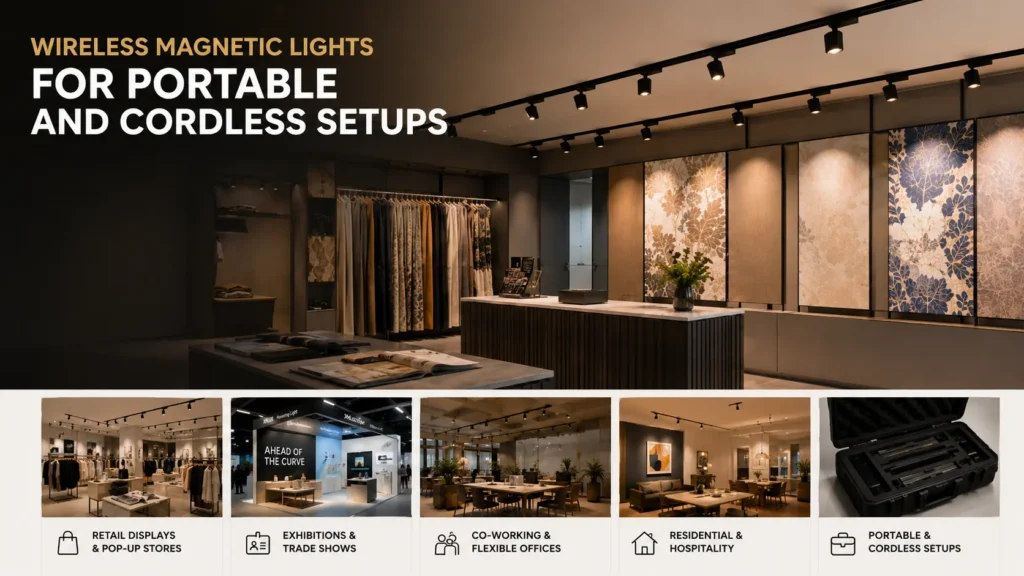
Retail Displays and Pop-Up Stores
Retail environments with seasonal merchandise changes are the primary commercial application for magnetic track. A clothing store can reconfigure its lighting to match a new floor plan in under an hour — slide the fixtures to new positions, add a few extra heads for a new feature display, and swap beam angles where needed. All of this happens on the live rail without an electrician.
Pop-up stores and temporary retail installations benefit from the portability of the format. The track can be installed as a temporary ceiling grid, the fixtures configured for the specific merchandise layout, and the entire system disassembled and moved to the next location.
Exhibitions and Trade Shows
Exhibition booths change layout with every event. Magnetic track allows the booth lighting to be reconfigured on setup day without an electrician — the track and power supply are part of the booth kit, and the fixture positions are adjusted to match the specific display configuration for that event.
Co-Working and Flexible Office Spaces
Co-working spaces that reconfigure desk layouts periodically benefit from magnetic track above the desk clusters. As desk positions move, the lighting moves with them — the track stays in place, and the fixture heads slide to the new positions.
Residential and Hospitality
In high-end residential applications, magnetic track is used for kitchen island lighting, artwork accent lighting, and living area feature lighting — where the ability to adjust fixture positions without tools or visible wiring appeals to design-conscious homeowners. In hotel lobbies and restaurant dining areas, magnetic track supports seasonal décor changes without disrupting operations.
Portable and Cordless Configurations
The term “cordless” in magnetic track lighting refers to the fixture-to-rail connection, not the rail-to-mains connection. The fixture heads have no cords — they draw power directly from the rail through the magnetic contact interface. This creates a clean visual appearance with no visible cables.
For truly portable applications — where the entire lighting system needs to be set up and taken down repeatedly — the track sections, power supply, and fixtures can be transported as a kit. The track sections connect using tool-free mechanical joiners, the power supply plugs into a standard mains outlet, and the fixtures clip onto the rail magnetically. A complete portable kit can be assembled or disassembled by one person in under 30 minutes.
Magnetic vs Traditional Track: When to Use Each
| Faktor | Magnetic Track (48V) | Traditional Track (120–277V) |
|---|---|---|
| Fixture attachment | Magnetic — pull off, place anywhere | Mechanical clip — unlock, reposition, relock |
| Reconfiguration speed | Seconds per fixture | 1–2 minutes per fixture |
| Stromspannung | 48V DC (SELV, touch-safe) | 120–277V AC (insulated) |
| Electrical work for fixture changes | Not required in many jurisdictions — confirm with local electrical code | Typically not required once track is installed |
| Maximum fixtures per circuit | Limited by power supply (e.g. 10 × 30W on 300W supply) | Limited by circuit breaker (far more capacity) |
| Rail profile | Ultra-slim — as narrow as 20mm | Bulkier — typically 30–40mm |
| Fixture cost | Higher per unit | Lower per unit |
| Power supply | Remote DC power supply required | Direct mains connection |
| Am besten geeignet für | Frequent layout changes, architectural interiors, portable setups | Fixed layouts, budget-sensitive projects, high-wattage applications |
The choice is primarily about how often the fixtures will be moved. For a retail store that reconfigures seasonally, the speed advantage of magnetic track pays back quickly. For a fixed-layout office where fixtures will not move for years, traditional track or fixed downlights are more cost-effective.
What to Check Before Buying a Wireless Magnetic System
1. Compatibility. Magnetic track systems from different manufacturers are generally not cross-compatible. The rail dimensions, conductor spacing, and magnetic fixture base geometry are proprietary to each manufacturer. Before purchasing, confirm that the track, power supply, and all fixture types are from the same product family.
2. Power supply sizing. The power supply determines how many fixtures can run on a single rail. Count the total wattage of all planned fixtures, add 20% headroom for future additions, and select a power supply rated for at least that total. A 300W supply supports approximately 10 fixtures at 30W each, or 15 fixtures at 20W each.
3. Rail length and layout. Magnetic track sections are typically available in 1-metre and 2-metre lengths with straight, L, and T connectors. Plan the total rail length and connector types before ordering — the rail layout determines which connector types are needed.
4. Fixture variety. Confirm that the magnetic track system supports the fixture types needed for the space — spotlights, flood heads, linear modules, pendant adaptors, and any sensor or emergency modules. A system with limited fixture options restricts future upgrade paths.
5. Dimming compatibility. If dimming is required, confirm that the power supply and fixtures support the intended dimming protocol. DALI, 0–10V, and wireless protocols (Casambi, Zigbee) are the most common for magnetic track systems. The dimming control works at the system level — all fixtures on the rail respond to the same control signal unless per-fixture addressing is implemented.
Installation Overview
The installation process separates into two phases:
Phase 1 — Electrical (licensed contractor): the track rail is mounted to the ceiling, connected to the remote power supply, and the power supply is connected to the mains. This is the only phase requiring a licensed electrical contractor.
Phase 2 — Fixture placement (any user): once the rail is powered, fixtures are placed on the rail at the desired positions. No tools are needed. Fixtures can be repositioned at any time — pull off, place elsewhere.
For portable or temporary installations, the entire system can be mounted on a freestanding frame rather than a permanent ceiling. This is common in exhibition booths, photo studios, and pop-up retail environments where the lighting must be completely removable.
Frequently Asked Questions
What to Do Next
Wireless magnetic track lighting is worth evaluating if the space will undergo two or more lighting layout changes over the fixture lifespan, or if the installation is temporary or portable. The higher per-fixture cost is offset by the labour savings at each reconfiguration — no electrician, no tools, no downtime.
For fixed-layout installations where fixtures will not move, traditional track or fixed downlights offer comparable light quality at a lower per-fixture cost. The magnetic format’s premium is justified by flexibility — if flexibility is not needed, the premium is not recovered.
Data notes: Power supply ratings, fixture wattages, and magnet holding forces are representative of commercially available 48V magnetic track lighting systems. Specific values vary by manufacturer and model. SELV classification is defined by IEC 61140; local electrical codes may have additional requirements. Verify all specifications against the manufacturer’s product data sheets. Mains electrical connection must be performed by a licensed electrical contractor.


![Was ist eine zoombare, dimmbare Schienenleuchte: Der beste Ratgeber [2025]](https://www.xhlux.com/wp-content/uploads/2025/06/Precision-Beam-Zoomable-Dimmable-Track-Light-for-Product-Displays-560x560.webp "Was ist eine zoombare, dimmbare Schienenleuchte: Der beste Ratgeber [2025]")