XHLUX
XHLUX
A commercial project needs a track light 50 watt head when a long throw, high ceiling, large target or demanding accent level cannot be met by a correctly selected lower-wattage head.
Use this page when the wattage schedule is still open and you need to prove that 50W solves a lighting problem rather than masking a poor beam or layout.
For track families, adapters, circuits and compatibility, start here:
→ Leitfaden für Schienenbeleuchtungssysteme: Typen, Bauteile & Auswahlkriterien
For a direct comparison of head types at a lower wattage, use:
→ Vergleich der Lichtleistung von 20 W bei verschiedenen Schienenstrahlertypen
TL;DR: Specify a 50W track light only after the target illuminance, mounting distance, beam angle and usable photometry show that a lower-wattage head will fall short. Then verify glare, thermal design, driver quality, dimming and total circuit load before approval.
1. When is 50W a justified commercial choice?
A 50W head is justified when the project needs more delivered intensity or coverage at a real working distance, not simply because 50W sounds powerful.
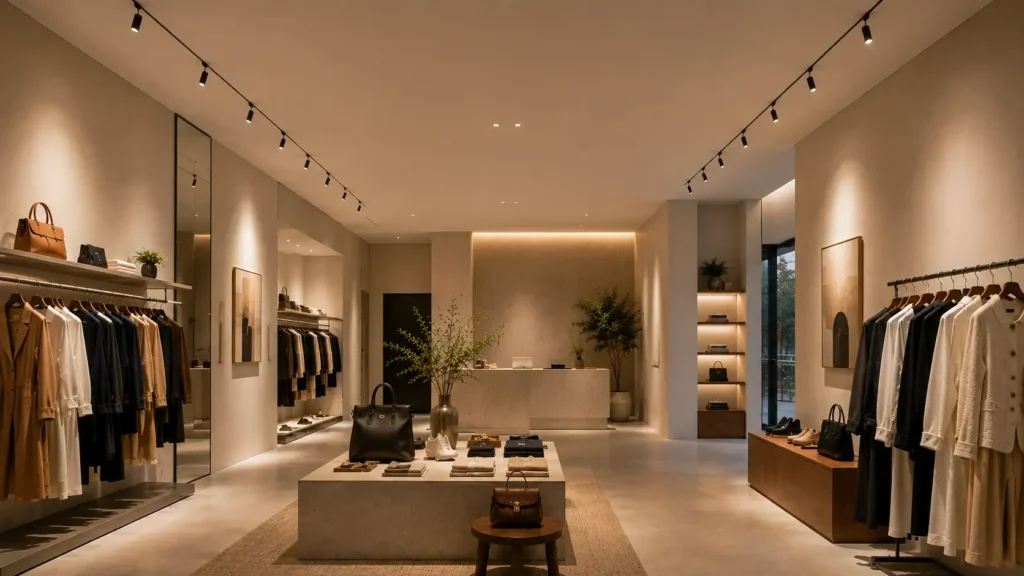
Common cases include tall retail atriums, exhibition halls, car showrooms, large product displays and feature walls viewed from a distance. These applications can require a stronger lumen package, a more capable optic and better thermal management in one housing.
A valid high-wattage track light application normally has at least one measurable constraint:
- The track sits well above the target.
- A large display needs useful light across a wider area.
- A narrow accent must retain intensity over a long throw.
- The design limits the number of ceiling points.
- The target illuminance cannot be achieved by the selected lower-wattage head.
The last point matters most. A high ceiling does not automatically demand 50W, and a large room does not mean every head should be 50W.
🎯 Is 50W automatically better for a high ceiling?
No. Mounting height raises the challenge, but beam angle, aiming distance, target reflectance and required illuminance still determine whether 50W is appropriate.
2. What should you check before raising wattage?
Check fixture lumens, beam intensity, beam angle and working distance before moving from 20W or 30W to 50W.
Wattage measures electrical input. It does not tell you how much light reaches the merchandise, wall or floor. Two 50W heads can perform differently because their LED packages, drivers, reflectors, lenses and thermal systems differ.
Ask the supplier for the exact model’s photometric file or test report. Review:
- Delivered fixture lumens
- Beam angle and field angle
- Centre-beam intensity or candela distribution
- Efficacy in lumens per watt
- CCT, CRI and colour consistency
- Output at the required dimming level
Treat the 50w track head lumen output as model-specific evidence. Do not copy a lumen figure from another 50W product and assume the same result.
For the commercial factors that separate strong and weak wattage packages, see:
→ Preisleitfaden für 30-W-Schienenstrahler: Was beeinflusst den Preis wirklich?
🎯 Can a lower-wattage head outperform a 50W head?
Yes. A more efficient head with the correct optic can place more useful light on the target than a poorly controlled 50W model.
3. How do beam angle and distance change the decision?
A narrow beam concentrates light for punch, while a wide beam spreads the same output across a larger surface and reduces peak intensity.
Use beam diameter as an initial geometry check:
Strahldurchmesser ≈ 2 × Entfernung zum Ziel × tan(Strahlwinkel ÷ 2)
At a 5 m throw, a 20° beam produces an approximate 1.76 m diameter. A 40° beam produces about 3.64 m. The wider beam covers more than twice the diameter, but its centre will not have the same punch if the lumen package stays unchanged.
This diagram shows geometry only. It does not predict maintained illuminance, glare, spill light or surface brightness.
🎯 Should wattage be selected before beam angle?
No. Choose the lighting task and beam family first, then select the wattage that meets the target at the actual distance.
4. When does a large display need 50W heads?
Large displays may need 50W heads when the design combines long throw with substantial target area, but a layered layout is often better than one oversized beam.
Für track lighting for large display areas, divide the scene into visual jobs. A car showroom may need general circulation light, vertical brand-wall light and concentrated highlights on vehicles. One broad 50W flood rarely performs all three jobs well.
Compare these routes before approval:
| Projektzustand | Better first move | When 50W becomes credible |
|---|---|---|
| Tall ceiling, small hero target | Narrow or medium optic | Lower wattage still misses required intensity |
| Wide feature wall | Wall-wash or controlled flood layout | More output is needed after uniformity is solved |
| Large object display | Multiple aimed layers | Each head has a clear target and long throw |
| Low ceiling retail | Lower wattage, deeper shielding | Rarely, because glare and heat can dominate |
More watts cannot correct dark gaps between badly spaced heads. Nor can they turn a round spot into a uniform wall wash.
🎯 Can one 50W flood replace several smaller heads?
Sometimes, but only if its distribution meets the uniformity and aiming brief. Several smaller heads usually provide more control and better visual hierarchy.
5. What glare and thermal risks come with 50W?
A 50W head places more optical and thermal demand into one ceiling object, so shielding and heat management deserve equal weight with brightness.
A bright source near a normal sightline can cause discomfort even when the floor lux looks acceptable. Check the head from entrances, escalators, counters and seated positions, not only from directly below.
Thermally, inspect the complete housing and driver arrangement. A larger heat sink is not decorative. If heat cannot leave the LED board and driver, output can depreciate faster, colour can drift and protection circuits may reduce power.
Before ordering, request:
- Cut-off or anti-glare details for the exact optic
- Rated ambient temperature and installation limits
- Driver manufacturer, current and protection information
- Lifetime and lumen-maintenance conditions, not a headline hour alone
- A physical sample for aiming and visual comfort checks
🎯 What is the fastest way to reject the wrong 50W head?
Test one sample at the real mounting height. Reject it if glare, spill, colour or target coverage fails before comparing headline wattage.
6. What must the track, feed and dimming system support?
The electrical design must support the combined load and operating behaviour of every head, not just the nominal 50W printed on one product.
A high-output track lighting circuit check should include the track manufacturer’s rated load, feed arrangement, number of heads, driver inrush current, protective device, phase or circuit allocation and dimming protocol.
For example, twelve 50W heads represent 600W of nominal connected lighting load before tolerances and control behaviour are considered. That calculation does not prove a circuit is acceptable. The designer must still verify voltage, current, inrush, conductor limits, protective devices and local rules for the exact system.
Do not assume that every H-type, J-type, L-type, three-circuit or magnetic system accepts the same adapter or power level. Mechanical fit is not proof of electrical compatibility.
🎯 Can you add 50W heads until the watt total reaches the track rating?
No. The design must also account for feed limits, driver inrush, circuit allocation, protection, dimming compatibility and the manufacturer’s instructions.
7. A 90-second 50W decision check
Approve 50W only when photometry shows a lower-wattage, correctly aimed alternative cannot meet the brief.
Use this order:
- Define the target and required lighting effect.
- Measure the mounting-to-target distance.
- Select the correct optic and aiming direction.
- Test a 20W or 30W class option using model-specific photometry.
- Move to 50W only if delivered performance still falls short.
- Recheck glare, heat, circuit load, inrush and dimming.
- Approve one real sample before releasing the full order.
If no target illuminance, beam distribution or mounting distance exists, the 50W choice is still a guess.
Was ist als Nächstes zu tun?
- Mark every target zone and record the actual throw distance.
- Compare the exact photometric files, not only wattage and catalogue lumens.
- Use the 20W head-type comparison linked in the introduction to test whether a better optic solves the problem.
- Use the 30W price guide linked above to inspect driver, LED, housing and documentation quality.
- Ask XHLUX or another project supplier for a sample, wiring data and model-specific photometry before final approval.
Häufig gestellte Fragen
Anmerkungen & Quellen
- IEC/EN 60570 is the relevant international track-system standard family; the applicable edition and regional adoption must be confirmed for the project.
- LM-79 photometric reporting can support model-specific lumen and distribution comparisons. Request evidence for the exact ordered configuration.
- All external authorities are named as plain text only. No external website receives a clickable link.
- The beam-diameter calculation is an initial geometry check, not a substitute for an IES file, maintained-light calculation or on-site sample.