 XHLUX
XHLUX
A luxury hotel is not one “premium” luminaire family copied from the porte-cochère to the last guest-room bay.
In the same building:
- the lobby handles arrival, reception and architecture
- the guest room handles reading, desk work, bedside use and general light
- the corridor handles navigation, door recognition and wall brightness
- accent light handles artwork, materials and architectural features
Luxury hotel lighting works when each area gets the fixture and distribution its actual task requires.
TL;DR: Choose hotel lighting room by room. Start with what guests need to see and do in each area, then select the fixture, beam, output and control strategy that serves that task—and write it into a clear fixture schedule.
Inhaltsverzeichnis
- 💡 Quick answer: how should you choose luxury hotel lighting?
- 🎯 1. Start with the lighting job, not the fixture style
- 🏛️ 2. Hotel lobby lighting: build layers around arrival and reception
- 🔎 3. What should you look for in lobby fixtures?
- 🛏️ 4. Guest room lighting: choose fixtures around actual guest tasks
- 🎛️ 5. Guest room fixtures should be easy to control
- 🚶 6. Corridor lighting: light the route, doors and walls
- ↔️ 7. Avoid repeating the same fixture layout down the entire corridor
- ✨ 8. Use accent lighting only where something deserves attention
- 🔦 9. Match beam angle to the target, not the fixture family
- 👁️ 10. Glare control matters differently in each hotel area
- 🎨 11. Choose CCT and colour rendering by material and function
- 🌙 12. Dimming and scenes should be part of fixture selection
- 📋 13. Build a room-by-room fixture schedule
- 📝 14. What should go into the hotel lighting specification?
- 🧪 15. Test representative areas before full ordering
- ⚠️ Common mistakes
- ✅ Final checklist
💡 Quick Answer: How Should You Choose Luxury Hotel Lighting?
Choose hotel lighting room by room. Start with what guests need to see and do in each area, then select the fixture, beam, output and control strategy that serves that task.
| Check in order | What you are settling |
|---|---|
| Bereich | Lobby, guest room, corridor or accent zone |
| Visual task | What guests must see and do |
| Target surface | Desk, art, door, wall, reception |
| Fixture type | Downlight, spot, wash, linear, decorative |
| Distribution | Beam / wall pattern that fits the target |
| Blendung | Source in normal viewing positions |
| Farbe | CCT appearance + colour rendering for materials |
| Kontrolle | Scenes, zones, labels guests can use |
| Spezifikation | Schedule lines the supplier can build |
Area → visual task → target surface → fixture type → distribution → glare → colour → control → specification.
🎯 1. Start With the Lighting Job, Not the Fixture Style
Do not start with black or white trim, trimless versus surface, decorative shape, or an expensive-looking finish.
Write this first:
What does this fixture need to light?
Typical hotel jobs include:
- general visibility
- vertical surfaces
- reception desks
- reading
- Kunstwerk
- signage
- circulation
- architectural materials
The same fixture style does not make the same lighting solution in every hotel area.
A black recessed head that works over a lobby aisle may still fail as a bedside reading tool.
🎯 Should finish come before the lighting job?
No. Decide the visual task and target first; finish follows the architecture brief.
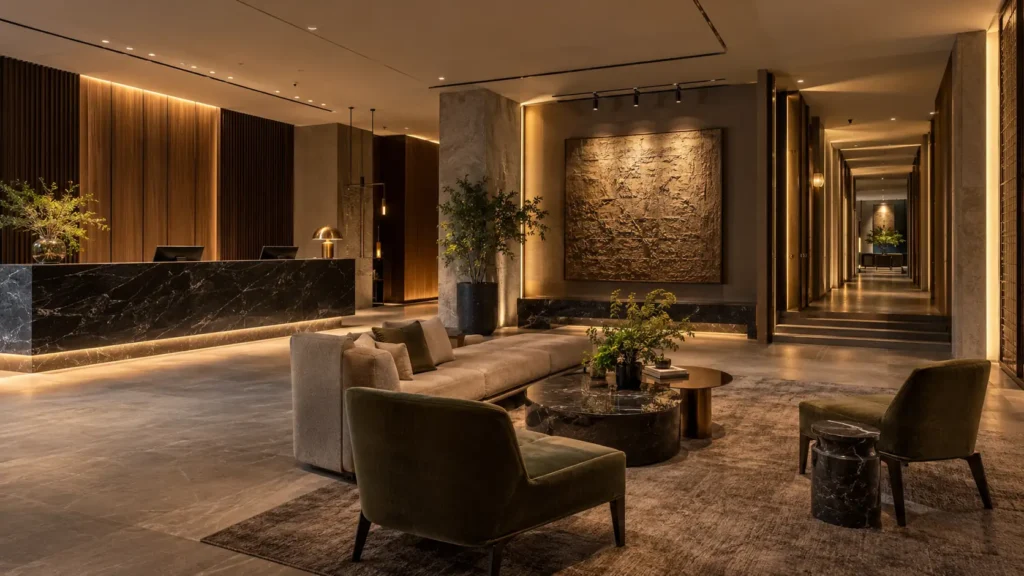
🏛️ 2. Hotel Lobby Lighting: Build Layers Around Arrival and Reception
Hotel lobby lighting design is not “make it bright enough.”
Split the lobby into jobs:
Arrival / entrance
Guests need to understand the space and direction quickly after they enter.
Rezeption
Staff and guests need enough visual communication across the desk.
Architectural surfaces
Walls, columns, materials and backdrop walls set the volume of the room.
Feature / decorative lighting
A chandelier can become a visual centre. It should not default as the only functional light in the lobby.
Akzentbeleuchtung
Art, displays and material highlights need their own aim and beam.
Useful fixture families in a lobby often include recessed downlights, adjustable spotlights, wall washers, linear lighting and decorative fixtures—each assigned to a job, not sprinkled for style alone.
Lobby lighting needs hierarchy, not one uniform brightness level.
🎯 Is one lobby brightness level enough?
No. Arrival, reception, architecture and accents need different layers and aims.
🔎 3. What Should You Look for in Lobby Fixtures?
This section is for shortlisting, not decorating.
Überprüfen:
- beam control
- aiming range
- glare shielding
- colour rendering quality
- finish
- Dimmen
- ceiling integration
- maintenance access
A beautiful downlight still fails if its beam never reaches the reception face or the artwork the brief named.
When you read a commercial head sheet, an adjustable D90 round LED spot downlight shows how type, optic and finish sit on one page—then demand the same completeness for every lobby line.
🎯 Can a good-looking lobby head skip optic checks?
No. Beam, aim, shielding and access decide whether the head serves the job.
🛏️ 4. Guest Room Lighting: Choose Fixtures Around Actual Guest Tasks
Luxury guest room lighting layout should follow guest tasks, not a ceiling grid copied from another room type.
Break the room down:
Allgemeine Beleuchtung
Entering, packing, cleaning and finding belongings.
Bedside lighting
Reading, night use and local control.
Desk lighting
Work and reading at the desk.
Wardrobe / luggage area
Finding clothes and sorting luggage.
Accent / decorative lighting
Mood, wall planes and art—only where a target exists.
A guest room can contain many lights and still be poorly lit if none of them owns the task.
A guest room can end up with switches everywhere and still provide no useful reading or desk light.
🎯 Do more guest-room fixtures mean better lighting?
No. Each head still needs a clear task; extras without owners just add clutter.
🎛️ 5. Guest Room Fixtures Should Be Easy to Control
Luxury should reduce effort, not add switches the guest has to decode.
Überprüfen:
- bedside control
- master OFF
- reading lights independent of general light
- general light independent of reading
- a usable night scene
- dimming that works at low levels
- labels or layouts guests understand without a card
Keep the discussion at scene and zoning level. Do not turn this section into a DALI or KNX protocol tutorial.
🎯 Is a complex panel more luxurious?
No. Independent reading, clear master OFF and a calm night scene matter more than switch count.
🚶 6. Corridor Lighting: Light the Route, Doors and Walls
Luxury hotel corridor lighting is not floor light alone.
Guests need to:
- read direction
- find room numbers and doors
- see corners
- feel depth along the run
- avoid a series of glaring sources
Targets to name on the schedule:
Floor / circulation
Basic safe passage.
Walls
Reduce tunnel or cave feeling.
Doors
Help guests locate rooms.
Signage
Wayfinding must stay readable.
Useful families include recessed downlights, wall washers, linear lighting, wall lights and low-glare directional fixtures—again assigned to targets, not repeated as decoration.
A corridor should guide the guest, not simply illuminate the floor.
🎯 Is floor light enough for a hotel corridor?
No. Walls, doors and signage are part of wayfinding, not optional extras.
↔️ 7. Avoid Repeating the Same Fixture Layout Down the Entire Corridor
Common corridor failures:
- equal-spaced downlights only
- door rhythm ignored
- artwork ignored
- wall brightness ignored
- every bay looking identical regardless of junctions
Work in this order:
door rhythm → wall surfaces → intersections → signage → fixture spacing
Do not copy a single centre-to-centre number from another project. Spacing follows the targets and the distribution you chose.
🎯 Should every corridor bay use identical centres?
No. Doors, walls, junctions and signage change where heads belong.
✨ 8. Use Accent Lighting Only Where Something Deserves Attention
Hospitality accent lighting needs a named target:
- Kunstwerk
- sculpture
- textured wall
- column
- material transition
- reception backdrop
- feature display
Then check beam angle, aiming, spill, hotspots, glare, mounting distance and target size.
If everything is accented, nothing is visually important.
🎯 Can you accent every lobby surface?
No. Accent only where a target deserves attention; otherwise hierarchy collapses.
🔦 9. Match Beam Angle to the Target, Not the Fixture Family
The same spotlight family can serve different hotel objects with different distributions.
Use the beam as a tool, not as a brand badge.
Examples of how distribution choices work in practice:
- smaller artwork → narrower distribution
- larger display → wider distribution
- wall or vertical surface → a wall-oriented distribution
- architectural detail → directional control you can aim
On commercial sheets you will often see named options such as 15° Spot, 24° Medium, 38° Flood Und 60° Wide Flood. Treat them as a menu for the target—not as a rule that one hotel scene may only use one angle.
🎯 Should one beam cover every hotel accent?
No. Match distribution to target size and distance; keep the family if you like, change the optic.
👁️ 10. Glare Control Matters Differently in Each Hotel Area
Do not treat “lower UGR everywhere” as the only brief.
Lobby
Guests look in many directions; sources should not steal the arrival view.
Guest room
Bed, sofa and desk sit at lower viewing angles where open sources show up quickly.
Korridor
Repeated bright points stretch along a long volume and feel louder than a single lobby sparkle.
Akzentbeleuchtung
Hide the source while keeping contrast on the target.
Check source recession, shielding, reflector behaviour, viewing angle, aiming direction and surrounding brightness.
🎯 Is one glare rule enough for the whole hotel?
No. Lobby, guest room, corridor and accent fail in different viewing positions.
🎨 11. Choose CCT and Colour Rendering by Material and Function
Keep CCT and colour rendering as separate decisions.
CCT
Sets whether the interior reads warmer or more neutral overall.
Colour rendering
Affects wood, stone, fabrics, artwork, skin tones and decorative finishes.
Do not write “every luxury hotel must be one Kelvin.” Describe the visual result you want for materials and faces, then pick CCT and colour quality that support it.
A luxury specification should describe the visual result, not rely on one Kelvin number.
🎯 Is CCT the same as colour quality?
No. CCT sets appearance warmth; colour rendering affects how materials and skin separate.
🌙 12. Dimming and Scenes Should Be Part of Fixture Selection
Different areas need different scenes:
Lobby
Day, evening, event and cleaning levels.
Guest room
Arrival, reading, relaxation, night and master off.
Korridor
Normal night operation and any project-specific night or emergency-related requirements.
When you shortlist a fixture, already check:
- Treiber
- dimming method
- control compatibility
- whether the dimming range suits the scenes above
Control methods and systems such as DALI, Casambi, 0–10V / 1–10V or TRIAC belong on the schedule as compatibility lines—not as a control-system tutorial in this guide.
🎯 Can control wait until after fixtures are ordered?
No. Driver and dimming method must match the scenes when you shortlist the head.
📋 13. Build a Room-by-Room Fixture Schedule
This is the takeaway you can hand to a supplier.
| Bereich | Lighting job | Fixture type | Key checks |
|---|---|---|---|
| Lobby | reception / architecture / accent | downlight / spotlight / wall wash / linear | beam, glare, aiming, finish |
| Guest room | general / reading / desk / accent | downlight / reading light / linear / spotlight | control, vertical light, glare |
| Korridor | navigation / doors / walls | downlight / wall wash / linear / wall light | spacing, wall brightness, glare |
| Akzent | artwork / material / feature | adjustable spotlight | beam, aiming, colour, spill |
Fill one row per real job. Empty “style only” rows do not help procurement.
🎯 What should the schedule force you to name?
Area, job, fixture type and the checks that prove the head can deliver.
📝 14. What Should Go Into the Hotel Lighting Specification?
At minimum, write:
- area / room
- fixture type
- output / wattage
- beam angle / distribution
- CCT
- colour rendering requirement
- dimming / control
- finish
- mounting
- aiming requirement
- quantity
- IP rating where relevant
- reference sample where the project needs one
A fixture schedule should tell the supplier what lighting result the hotel needs—not only what the fixture should look like.
🎯 Is finish enough on a hotel lighting note?
No. Area, job, optic, control and aiming belong on the same line.
🧪 15. Test Representative Areas Before Full Ordering
Hotels repeat rooms and corridor bays. One catalogue sample is not enough.
At least test:
- one lobby feature condition
- one typical guest room
- one corridor bay
- one accent target
Walk beam, glare, colour appearance, dimming, aiming, finish and visual consistency across those samples before bulk release.
That is also when supplier lead time, batch consistency and spare policy become real—not after the first floor is already installed.
🎯 Why test more than one product sample?
Because lobby, guest room, corridor and accent fail in different ways; each needs a representative check.
⚠️ Common Mistakes
- Copying one downlight type through the whole hotel.
- Choosing a “luxury look” before naming the lighting job.
- Filling the guest room with lights while reading and desk still have no owner.
- Lighting only the corridor floor, not walls and doors.
- Accenting everything until hierarchy disappears.
- Treating CCT as colour rendering.
- Leaving control until after fixtures are chosen.
- Trusting the datasheet alone without representative area tests.
✅ Final Checklist
- Do lobby arrival, reception and architecture each have a lighting job?
- Are guest-room reading, desk and bedside lights actually usable?
- Does the corridor light walls, doors and signage—not only the floor?
- Does every accent fixture have a named target?
- Does the beam match the target size and distance?
- Is glare acceptable from normal viewing positions?
- Do CCT and colour quality suit the materials?
- Do driver, dimming and control already match the scenes?
- Is the fixture schedule written area by area?
- Have you tested a representative lobby, guest room, corridor bay and accent?
Was ist als Nächstes zu tun?
- Draft four schedule blocks—lobby, guest room, corridor, accent—with one job per line.
- Shortlist fixture type, distribution, glare and control for each line, then test one representative bay of each type.
- Need a project review or quotation? Contact the XHLUX team with the area schedule, control scenes and any sample room plan.
🏁 Conclusion: How should you choose luxury hotel lighting?
Luxury hotel lighting should not be specified as one decorative style repeated through the building. Lobby, guest room, corridor and accent areas each ask the fixture to perform a different job.
Choose the lighting job first, then choose the fixture that can actually deliver it.
Entdecken Sie unsere verwandten Blogbeiträge:
- Does an Anti-Glare Spotlight Really Reduce Glare?
- Beleuchtungskonzepte für moderne Ladenlayouts
- Welcher Abstrahlwinkel ist optimal für gewerbliche Schienenbeleuchtung?
![Was ist eine dimmbare Schienenleuchte für die Galerie: Der beste Ratgeber [2025]](https://www.xhlux.com/wp-content/uploads/2025/06/Dimmable-Track-Light-for-Art-Gallery-Accent-Lighting-560x560.webp "Was ist eine dimmbare Schienenleuchte für die Galerie: Der beste Ratgeber [2025]")
![Was ist eine COB-LED-Einbauleuchte? Der beste Technologie-Leitfaden [2025]](https://www.xhlux.com/wp-content/uploads/2025/07/What-is-COB-LED-Downlight-560x560.webp "Was ist eine COB-LED-Einbauleuchte? Der beste Technologie-Leitfaden [2025]")