 XHLUX
XHLUX
A buyer has two quotes on the desk for the same commercial lighting project.
Supplier A makes its own track lights and downlights. Its range is focused, its engineers and production team join the calls, and it offers OEM and ODM work.
Supplier B can quote track lights, panel lights, LED strip, emergency lights and decorative fittings together. The products come from several partner factories, and Supplier B handles pricing, follow-up, documents and shipping.
Both can be normal, reliable suppliers.
The real question is not “Which one is the real supplier?” It is “Which sourcing model fits your order better?” Choosing an LED light supplier in China is also choosing a sourcing model.
Factory direct gives buyers a shorter path to manufacturing and engineering. Trading companies can reduce the work of coordinating multiple factories and product categories. Neither model is automatically better.
TL;DR: Buy factory direct when your products are focused, technical, customised or repeated over years. Use a trading company when you need many unrelated categories in small quantities and want one partner to coordinate factories and shipments. With hybrid suppliers, ask who makes each product.
Inhaltsverzeichnis
- Two different sourcing models
- What changes with factory direct
- What a trading company adds
- Side-by-side comparison
- Where XHLUX fits
- How product complexity changes the answer
- When factory direct makes sense
- When a trading company fits
- Hybrid suppliers
- Total sourcing cost
- Responsibilities before ordering
- Decide by order profile
- Summary
- Häufig gestellte Fragen
🧭 Factory Direct and Trading Company Are Two Different Sourcing Models
A factory sells manufacturing capability; a trading company sells coordination across factories.
Buyers have three main China lighting supply chain options: factory direct, a trading company, or a hybrid supplier that does some of both.
Factory direct
You buy directly from the company that actually makes the fixtures.
Typical features:
- the manufacturer controls production
- your technical requirements go straight to the people who build the product
- the product range follows the factory’s own specialisation
- OEM and ODM work sits close to the engineering team
- manufacturing responsibility is easier to see
Factory direct does not automatically mean better quality, lower cost or better service. A real factory can still be the wrong factory for your product.
Trading company
A trading company usually takes care of:
- finding and managing partner factories
- quotations
- order follow-up
- combining several product categories
- coordinating documents
- consolidated shipments
- some QC and after-sales coordination
What you pay for is not only the lighting. It is also sourcing and supplier-coordination services.
Hybrid supplier
Some suppliers operate as hybrids: they manufacture core products and source complementary categories from partner factories.
A company may build its own track lights and downlights, then complete a customer’s list with panel lights, emergency lights or LED strip from partner factories.
So “Are you a factory?” is not enough. The useful question is: Which products are manufactured in-house, and which are sourced from partner factories?
🎯 What is a hybrid lighting supplier?
A supplier that builds its core fixtures itself and sources extra product categories from partner factories.
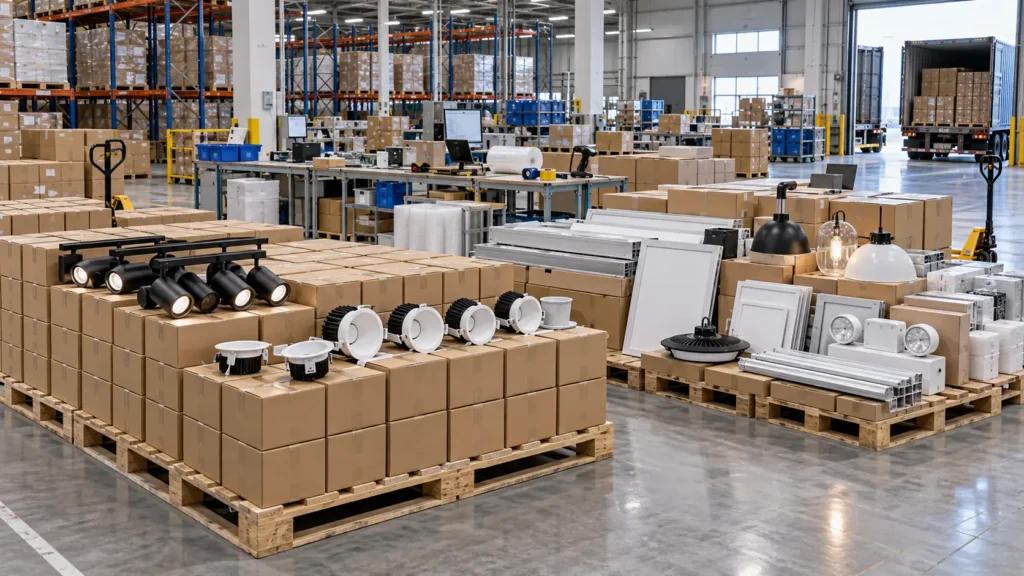
🏭 What Actually Changes When You Buy Factory Direct?
Buying factory direct mainly changes the structure of your sourcing: fewer layers sit between your specification and the production line.
Price is not the main point here.
1. Technical communication gets shorter
Suppose you need to change any of these:
- beam angle or reflector
- CRI or CCT
- Treiber
- DALI or Casambi control
- housing or thermal design
Factory direct usually runs Buyer → Manufacturer. A trading company may run Buyer → Trading company → Manufacturer.
One extra layer is not automatically a problem. But the more technical the product, the more the communication chain matters.
2. Engineering changes sit closer to the source
If the change is “put our logo on it”, the two models may work much the same.
If the change is “new optic, different driver and a new control system”, talking directly to the people who own the engineering is worth far more.
3. Manufacturing responsibility is easier to map
With factory direct, it is easier to see:
- who designs the product
- who buys the key components
- who builds it
- who tests it
- who approves BOM changes
- who handles quality corrective action
🎯 When does a shorter chain matter most?
When optics, drivers or controls change, because each request reaches engineering without being retold.
🤝 What Value Can a Trading Company Add?
A good trading company does real work: it pulls together factories, categories and shipments that the buyer would otherwise manage alone.
Calling it “a middleman taking a margin” misses what it actually does.
1. Multi-category sourcing
One project may need:
- Einbaustrahler
- Schienenstrahler
- Linearleuchten
- emergency lights
- decorative pendants
- outdoor fixtures
Few specialised factories are strong in all of these. A trading company can bring several manufacturers together under one order.
2. Small mixed orders
Take a project with five fixture types, each in modest quantities. Buying direct could mean:
- 5 suppliers
- 5 MOQs
- 5 contacts
- 5 payment arrangements
- 5 production schedules
- 5 sets of shipping arrangements
A trading company can take much of that management off your desk.
3. Supplier and shipment coordination
It may also handle:
- supplier communication and follow-up
- packaging coordination
- QC coordination
- consolidation
- export documents
- shipping arrangements
So the real comparison is not factory price against trader price. It is product cost + coordination cost + sourcing workload + risk.
🎯 Is a trading company just a middleman?
Not when it coordinates factories, QC and shipping that the buyer would otherwise have to manage.
⚖️ Factory Direct vs Trading Company: What Changes for the Buyer?
Side by side, the two models move control, workload and responsibility in different directions.
Der factory direct vs trading company decision changes these ten things for the buyer:
| Factory direct | Trading company | |
|---|---|---|
| Product range | Usually focused on the factory’s own specialised categories | Can combine products from several factories |
| Technical communication | Closer access to engineering and production | Usually one more layer of communication |
| OEM/ODM | Depends directly on the factory’s engineering capability | Depends on partner factories and coordination skill |
| Multi-category sourcing | May mean managing several factories | One contact can bring categories together |
| MOQ | Set by real production requirements | Mixed orders are sometimes more flexible |
| Price structure | Direct manufacturing quote | Includes sourcing and coordination services |
| QC | Closer to the production floor | Depends on the trader’s QC process |
| Technische Dokumente | Usually come straight from the manufacturer | Need coordinating across several suppliers |
| After-sales | Handled with the manufacturer | The trader acts as the interface |
| Repeat orders | Easier to keep on the same production platform | Check that it is still the same factory |
One model gives more direct control; the other can reduce sourcing complexity.
📍 Where Does XHLUX Fit?
XHLUX is a Shenzhen-based commercial LED lighting manufacturer and factory-direct supplier.
We are not a broad trading company whose main business is combining unrelated lighting categories. Our core products are:
- LED-Schienenleuchten
- LED-Einbaustrahler
- LED-Linearbeleuchtung
- Magnetische Schienenbeleuchtung
- related commercial lighting systems
That places XHLUX on the specialised factory-direct supplier side of this comparison, not the broad multi-category trading company side.
What factory direct means in our projects
Customers come to us to discuss:
- optics, reflectors and lenses
- CRI, CCT and beam angle
- Fahrer
- controls such as DALI, Casambi, Zigbee, 0/1–10V and TRIAC
- housing changes
- OEM and ODM development
We develop these requirements around our own product platforms, rather than passing them out as quote requests to unrelated outside factories.
Who our model suits
It usually suits:
- commercial lighting brands
- distributors
- OEM customers
- project buyers
- long-term repeat orders
- projects with demanding technical specifications
- custom products
- dimming and smart controls
- track, downlight and linear lighting for commercial interiors
It is not the easiest route for every buyer. If you need a large mix of completely unrelated lighting categories in one purchase, a general sourcing company may be more convenient than a specialised commercial lighting manufacturer.
🎯 What kind of supplier is XHLUX?
A factory-direct maker of commercial track, downlight and linear lighting, not a multi-category trading company.
🧩 Product Complexity Changes the Answer
The more complex and customised the product, the more the sourcing model matters—and the more direct access to engineering is worth.
Case 1: Standard product, one category
Example: 5,000 standard downlights with a fixed CCT, standard driver, standard housing and standard beam.
Factory direct usually makes more sense here. There is little multi-supplier coordination to pay for.
Case 2: One project, many unrelated categories
Example: commercial downlights, decorative pendants, emergency lights, outdoor lights and LED strip.
Here a trading company or sourcing integrator adds clear value.
Case 3: Technically demanding commercial lighting
Example: CRI 95, SDCM ≤3, custom optics, DALI or Casambi, tunable white, a special housing and a project-specific beam.
The key question becomes: How directly can you communicate with the engineering and manufacturing team? That is where factory direct gains value.
Case 4: Small batches, many SKUs, market testing
Example: a trial order for a new market, several models in small quantities, or a product range that is not settled yet.
A trading company’s consolidation and coordination may matter more here.
Case 5: Deep OEM/ODM
Example: new tooling, optics, PCB, driver, thermal design, mechanical drawings and several sample revisions.
Do not judge by the supplier’s name alone. Ask: Who controls engineering and manufacturing?
🎯 Does order size decide the model?
Order size matters, but product complexity and category mix can be just as important when choosing the sourcing model.
✅ When Does Factory Direct Usually Make More Sense?
Factory direct usually makes more sense when your products are focused, technical and repeated over time.
It fits orders with:
- products in related categories
- long-term repeat orders
- quantities at a stable production level
- frequent technical discussion
- deep OEM/ODM work
- changes to optics, drivers or controls
- tight consistency between repeat orders
- a need to see production and QC directly
- plans for a long-term supply relationship
For commercial track lights, downlights, linear lighting and smart-control commercial fixtures, buying direct from a specialised manufacturer usually makes the most sense.
📦 When Can a Trading Company Be the Better Fit?
A trading company can be the better fit when breadth and coordination matter more than engineering depth.
It fits orders with:
- many completely unrelated fixture categories
- low quantities per category
- small trial orders
- market testing
- a buyer who does not want to manage many factories
- a need for consolidated shipments
- highly standardised products
- few technical changes
A trader is not simply “more expensive”. A sourcing margin can be reasonable if the service removes more coordination cost than the buyer would otherwise handle internally.
🔍 For Hybrid Suppliers, Ask Who Actually Makes the Product
With a hybrid supplier, the useful answer comes product by product, not as one label for the whole company.
Do not stop at “Are you a factory or a trading company?” Continue with:
- Is this model manufactured in your own factory?
- Which processes are in-house?
- Is the product sourced from a partner manufacturer?
- Who controls the BOM?
- Who approves component substitutions?
- Who performs final QC?
- Who handles warranty claims?
- Who is responsible for corrective action?
Good LED supplier due diligence works at this level.
Supplier identity should be understood at product level, not only company level.
🎯 Is a hybrid supplier a warning sign?
No, as long as it tells you clearly which models it builds and which come from its partner factories.
💰 Do Not Compare Only Unit Price
Compare the total sourcing cost, not just the unit price on the quote.
Where these costs sit also shapes the main China LED sourcing risk factors in each model.
| Kosten | What to ask |
|---|---|
| Product cost | Is the quoted unit price compared like for like? |
| Engineering cost | Who handles drawings, samples, technical revisions and engineering communication? |
| QC cost | Who handles inspection, corrective action and any third-party QC coordination? |
| Supplier-management cost | If six factories are involved, who manages them? |
| Logistics cost | Will there be multiple shipments, consolidation work or separate document sets? |
| Problem-resolution cost | How many layers sit between you and the people who actually make the product? |
Lowest unit price does not always mean lowest sourcing cost.
🎯 Where do hidden sourcing costs usually sit?
In engineering, QC, supplier management, logistics and problem fixing, rather than in the quoted unit price.
📝 Make Responsibilities Clear Before You Place the Order
Before you order, write down who carries each responsibility—not just who sends the quote.
| Responsibility | Who is responsible? |
|---|---|
| Product design | |
| Manufacturing | |
| Component sourcing | |
| BOM control | |
| Sample approval | |
| Quality inspection | |
| Compliance documents | |
| Packaging | |
| Export documents | |
| Shipment coordination | |
| Garantie | |
| Corrective action |
This matters most with trading and hybrid suppliers.
Knowing who quotes you is not enough. You also need to know who is finally responsible.
🎯 Why fill in this table before ordering?
Because once a problem appears, the company that quoted you may not be the one able to fix it.
🗂️ Factory Direct or Trading Company? Decide by Order Profile
Match the model to the order profile, not to a general belief about which one is better.
| Order profile | Worth considering first |
|---|---|
| One specialised product | Factory direct |
| Long-term repeat orders | Factory direct |
| Deep OEM/ODM | Factory direct |
| Complex optics or smart controls | Factory direct |
| Many unrelated fixture categories | Trading company / sourcing integrator |
| Small multi-category trial orders | Trading company may help |
| Consolidated shipments from several factories | Trading company may help |
| Standard, technically simple products | Either model can work |
| Own-made core products plus sourced add-ons | Hybrid model can work |
This is not a quality ranking. It is a sourcing-fit decision.
📌 Summary
- Factory direct and trading companies provide different kinds of value.
- The more complex the product and the deeper the OEM/ODM work, the more direct contact with manufacturing and engineering matters.
- The more mixed the categories, the smaller the quantities and the more suppliers involved, the more a trading company’s coordination is worth.
- A hybrid supplier is not a problem in itself, but you need to know who makes each specific product.
- Do not compare unit price alone; compare overall sourcing responsibility, coordination cost and risk.
Häufig gestellte Fragen
🏁 Conclusion: Factory Direct or Trading Company for Your LED Order?
Choosing an LED light supplier in China is also choosing a sourcing model.
Factory direct shortens the distance between the buyer and production and engineering; a trading company can reduce the coordination work of sourcing many categories from many suppliers. The right choice depends on product complexity, order structure, how much technical control you need, and how much sourcing responsibility you want the supplier to carry.
XHLUX belongs to the factory-direct side of this comparison. We are a Shenzhen commercial LED lighting manufacturer focused on track lights, downlights and linear lighting, with OEM/ODM and control options including DALI, Casambi, Zigbee, 0/1–10V and TRIAC.
Entdecken Sie unsere verwandten Blogbeiträge:
- Worauf Projektkäufer bei Lieferanten von Gewerbebeleuchtung achten
- Wie man einen Hersteller von gewerblicher LED-Beleuchtung auswählt
- Wie der Hersteller von LED-Magnetschienen die Produktqualität sicherstellt
Anmerkungen & Quellen
- XHLUX — About Us: Shenzhen Xinghuo LED Tech Limited, founded 2011, commercial LED lighting manufacturer integrating R&D, manufacturing, sales and service; Shiyan, Bao’an District, Shenzhen; track, magnetic low-voltage track, downlight and linear ranges; TRIAC, DALI, 0/1-10V, RF, WiFi and ZigBee control options (xhlux.com/about-us).
- XHLUX — Customization: OEM and private label; customisation based on current products or completely new products, covering optics, appearance and light source (xhlux.com/customization).
- XHLUX — Casambi Tunable White Track Light for 2700K–6500K Projects (xhlux.com/news).
- Quality Sourcing From China — Factory-Direct vs Trading Company vs Sourcing Agent in China: roles of a buyer-side sourcing agent and a trading company that sells to the buyer (qualitysourcingfromchina.com).
- UNCITRAL — United Nations Convention on Contracts for the International Sale of Goods (CISG): seller obligations, conformity of goods and buyer remedies under international sales contracts (uncitral.un.org).
- JQA / IECEE CB Scheme — CB application documentation lists the manufacturing factory separately, showing that applicant, manufacturer and manufacturing site may be recorded as different roles (jqa.jp).
Need a Factory-Direct Commercial Lighting Manufacturer?
If you need a specialised commercial lighting manufacturer rather than an all-category sourcing integrator, send XHLUX your project specification, control requirements and target market.