 XHLUX
XHLUX

Table of contents
- Why Bright on Paper, Uncomfortable in Reality
- What Is Glare in Commercial Lighting?
- Why Glare Control Is Critical in Commercial Projects
- Common Causes of Glare in Commercial Lighting
- How Glare Affects Different Commercial Spaces
- Key Glare Control Methods in Commercial Lighting Design
- Glare Control in LED Track Lights vs LED Downlights
- Charts and Tables: Practical Glare Control Decision Tools
- Common Glare Control Mistakes in Commercial Lighting Projects
- How to Choose Commercial Lighting with Proper Glare Control
- Why Glare Control Often Saves Projects After Installation
- Comparison Table: Track Lighting vs Downlights for Glare Control
- FAQ About commercial lighting glare control
- 1) What causes glare in commercial lighting?
- 2) How do you control glare in LED lighting?
- 3) What is UGR in lighting?
- 4) Are LED lights more prone to glare?
- 5) How does glare affect customer experience?
- 6) Is glare control only important in offices?
- 7) Can track lighting be comfortable and glare-controlled?
- 8) What specifications should I look for to avoid glare complaints?
- Business inquiries are welcome
Why Bright on Paper, Uncomfortable in Reality
Many commercial lighting projects look perfect in drawings and specifications. The lumens are high, the fixtures are modern, and the space appears “bright and premium” in renderings. Yet once installed, the real experience can be disappointing: people squint, customers shorten their dwell time, staff complain about eye fatigue, and the space feels harsh rather than high-end.
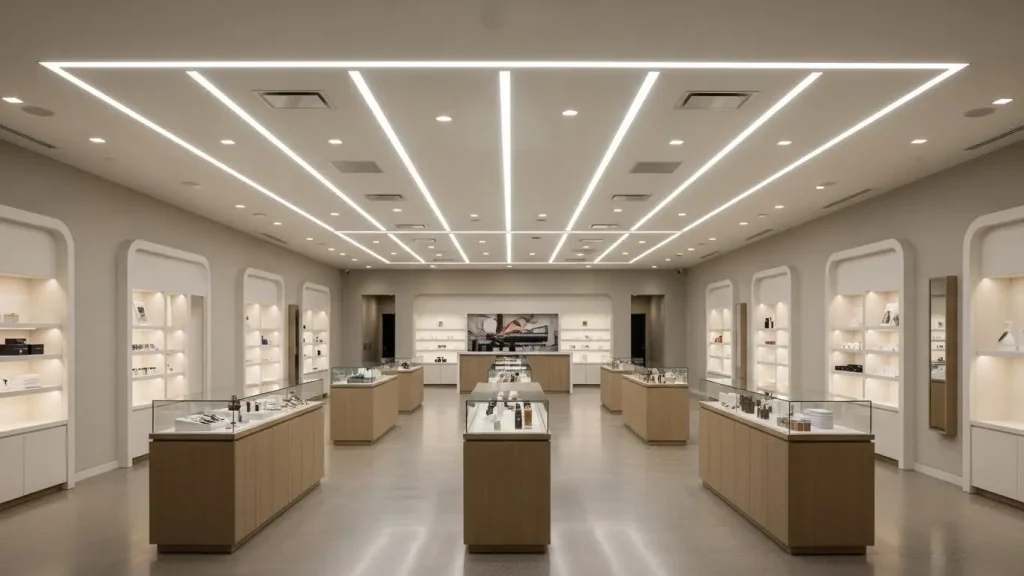
That discomfort is usually not caused by “brightness” itself. It is caused by glare—excessive luminance in the wrong place, at the wrong angle, with the wrong optics.
What makes glare especially dangerous in commercial projects is the risk profile:
- Retail & hospitality: glare directly impacts customer experience and brand perception.
- Offices & public areas: glare reduces productivity and can create safety concerns.
- Project delivery: glare complaints often trigger re-aiming, re-spacing, re-specifying, and sometimes full retrofit—time-consuming and expensive.
The solution is not simply “use lower wattage” or “dim it down.” Real glare control is a design discipline that combines optical engineering, beam selection, and fixture placement.
This guide explains glare in a way that professional users can apply immediately—helping lighting designers, architects, consultants, and B2B buyers create commercial spaces that look premium and feel comfortable.
What Is Glare in Commercial Lighting?
In commercial interiors, glare is the condition where a bright source (or reflection) creates discomfort or reduces visibility. It’s important to separate two common types:
1) Discomfort Glare
This is the most frequent complaint in retail, hospitality, and offices. People can still “see,” but they feel:
- irritation and eye strain
- visual fatigue over time
- a subtle urge to look away
Discomfort glare is why some spaces feel “cheap” or “aggressive” even when design finishes are expensive.
2) Disability Glare
This is more severe: glare reduces the ability to see clearly due to scattered light inside the eye (especially for older occupants). It can create:
- reduced contrast sensitivity
- veiling luminance
- safety risks on stairs, corridors, and circulation routes
Key point: glare is not simply “too bright.” It is “brightness in the wrong geometry.” A space can be bright and comfortable if luminance is controlled properly.
What is glare in commercial lighting?
Glare is excessive brightness that causes visual discomfort or reduces the ability to see clearly in a commercial space.
For terminology and measurement context, professional discussions often reference UGR (Unified Glare Rating). You can use a neutral definition as a shared baseline here: UGR (Unified Glare Rating) definition.
Why Glare Control Is Critical in Commercial Projects
Glare control is not a “nice-to-have.” In commercial environments, it is a baseline requirement that determines whether the space feels premium, comfortable, and professionally executed.
1) Commercial spaces involve prolonged exposure
Unlike short residential use, commercial users often stay in the same environment for hours. Even mild glare becomes a real issue over time.
- retail staff stand under the lighting all day
- restaurant diners remain seated and face the luminaires longer
- office users look upward frequently when moving or collaborating
2) Glare directly influences behavior and perception
In retail, glare doesn’t just annoy customers—it changes how they shop:
- people move faster through uncomfortable zones
- they avoid looking at reflective packaging or glossy shelves
- product visibility can actually decrease due to reflections and contrast loss
In hospitality, glare breaks the emotional goal: relaxation. A “bright but glaring” restaurant can feel sterile rather than inviting.
3) Glare creates project risk
Glare is one of the fastest ways a “successful installation” turns into a problem:
- customer complaints → on-site adjustments
- repeated aiming → inconsistent visual results
- rework → labor and downtime
- reputational damage → future project loss
Professional standards emphasize comfort as an engineering target, not an aesthetic preference. For example, many indoor lighting discussions reference EN 12464-1 for comfort considerations and glare awareness: EN 12464-1 overview.
Why is glare control important in commercial lighting?
Glare control improves visual comfort, safety, and overall user experience in commercial environments.
Common Causes of Glare in Commercial Lighting
Glare is rarely caused by one single mistake. Most glare problems come from a combination of optics, beam behavior, luminance, and placement.
Cause 1: Direct view of a high-luminance LED source
Modern LEDs are efficient, but they can be extremely high in luminance (cd/m²). If the light source is visible at typical viewing angles, discomfort glare increases quickly.
This often happens when:
- track heads are aimed too close to eye level
- downlights have shallow recess depth
- fixtures lack proper shielding angles
Cause 2: Beam is too narrow for the application
Narrow beams (e.g., 15°–24°) are excellent for accent lighting, but only when used correctly. If narrow beams are used as “general lighting,” the result is:
- hotspots
- strong contrast edges
- “patchy” brightness distribution
Cause 3: Optical design quality is insufficient
Two fixtures can share the same beam angle yet produce different glare outcomes because of differences in:
- lens material (clarity, diffusion, micro-structure)
- reflector geometry
- cut-off design
- internal anti-glare baffles
This is also why “spec sheet shopping” can fail. Glare control is strongly dependent on optical design.
Cause 4: Fixture output is too high for mounting height
High lumen packages installed at low ceiling heights can push luminance beyond comfort thresholds, especially when the source is visible.
Cause 5: Reflective surfaces amplify perceived glare
Retail and hospitality spaces often include:
- glossy tiles
- glass shelves
- polished stone
- reflective packaging
In these environments, glare can come from reflections even when the fixture itself is well-designed.
How Glare Affects Different Commercial Spaces
Glare is experienced differently depending on viewing direction, task type, and dwell time. That’s why glare control must be application-based, not generic.
Retail Spaces: Glare Reduces Dwell Time and Product Clarity
Retail is a visibility game. Glare can:
- make products harder to read due to reflections
- create harsh “sparkle” on glossy packaging
- push customers to move away from bright zones
This is especially true for cosmetics, jewelry, electronics, and premium fashion where surface finish matters.
A practical retail goal is to combine:
- strong accent lighting for hero products
- controlled glare for customer comfort
- high color fidelity so products look true-to-life
That’s why professional retail specs often include CRI >90 (or Ra97 for premium) and SDCM <3 for color consistency. A product can be “bright” and still look wrong if color rendering or color consistency fails.
If your retail projects rely on flexible accent lighting, a modular system like LED track lighting makes it easier to aim light onto merchandise without shining into the customer’s eyes.
Hospitality (Hotels & Restaurants): Glare Breaks Atmosphere
Hospitality spaces require comfort-first lighting. Glare is often more noticeable because:
- luminance contrasts stand out in darker ambient scenes
- customers are seated and look around more slowly
- reflections appear on tables, glassware, and polished surfaces
Here, glare control is not just “visual comfort.” It’s part of brand identity.
A common strategy is layered lighting:
- soft ambient illumination (often linear or indirect)
- controlled accent lighting for focal points
- warm-toned scenes with stable color consistency
For ambient layers that support comfort, many designers use continuous lines of light with controlled glare, such as linear lighting solutions, combined with accent points where needed.
Offices & Public Areas: Glare Drives Fatigue and Performance Loss
In offices, glare affects screens, reading comfort, and concentration. People may not complain immediately, but glare causes:
- eye fatigue
- headaches
- reduced productivity
- increased perceived “stressfulness” of the environment
That’s why office lighting commonly targets UGR <19 as a comfort benchmark. (UGR targets depend on standards and project requirements, but UGR <19 is frequently used for office visual comfort specifications.)
In corridors, lobbies, and public areas, glare can also become a safety concern—especially where older users are present.
Key Glare Control Methods in Commercial Lighting Design
This is the core section where glare control becomes actionable. Real-world commercial success typically depends on three levers:
- optical design and lens quality
- beam angle and beam spread selection
- fixture positioning and aiming
1) Optical Design and Lens Quality
Optical design is the “hardware foundation” of glare control. Even perfect placement cannot fully fix poor optics.
Deep anti-glare structure
A deeper optical cavity increases the shielding angle, reducing direct view of the LED source. This is why “deep recessed” designs are widely used in comfort-focused projects.
Lens material and micro-structure
A high-quality PMMA lens can create smoother beam transitions and controlled diffusion. Poor lens quality may cause:
- sparkle artifacts
- uneven beam edges
- uncontrolled spill light
Reflector and cut-off design
Well-designed reflectors guide light precisely and reduce high-angle luminance that contributes to discomfort glare.
Engineering note: glare control is often about controlling high-angle light (light emitted at angles close to the horizontal), which is more likely to enter the viewer’s eyes.
If you are specifying downlights for commercial comfort zones, consider fixtures designed around glare control fundamentals such as deeper recess, controlled cut-off, and stable optics—typical of professional spot downlights used in retail and hospitality.
2) Beam Angle and Beam Spread Selection
Beam angle is not the whole story. Beam spread—how smoothly light transitions and overlaps—often determines comfort.
For a neutral baseline definition of beam angle, you can reference: Beam angle definition.
Avoid over-concentrated beams in comfort zones
- 15°–24° beams: excellent for feature products and artworks
- 24°–36° beams: balanced accent for most commercial applications
- 36°–60° beams: broader support lighting
But the key is not the number alone—it’s how the beam behaves at the edge. A “soft” beam spread reduces harsh transitions and glare perception, especially in hospitality and premium retail.
3) Fixture Positioning and Aiming
Placement is where glare control becomes a “field skill.” Even with excellent optics, poor aiming can create direct glare.
Use safe aiming geometry (30°–45° rule)
A common best practice is to avoid aiming straight down. Angled lighting helps:
- reveal texture
- create depth
- reduce self-shadowing
- avoid direct sightline glare
Keep luminaires out of direct sightlines
In retail, track heads aimed too far outward can shine into customers’ eyes—especially along main aisles. In hospitality, luminaires aligned with seated sightlines can become a constant annoyance.
Match placement to viewing angle, not ceiling symmetry
Commercial lighting often fails when it follows ceiling grids instead of how people look at products and spaces.
How can glare be reduced in commercial lighting?
Glare can be reduced through proper optical design, correct beam angles/beam spread, and thoughtful fixture placement.
Glare Control in LED Track Lights vs LED Downlights
Both track lights and downlights can be used successfully in commercial projects—but their glare risks and control methods differ.
LED Track Lights: Flexible but Higher Glare Risk if Misused
Track lights are powerful for accent lighting and flexible layouts, but glare risk increases when:
- the source is visible from common angles
- narrow beams are misapplied
- aiming is inconsistent across the project
To succeed with track lighting in commercial environments, prioritize:
- anti-glare optics (deep shielding, honeycomb, baffle options)
- stable beam quality and smooth transitions
- controlled output matched to mounting height
- flexibility for future display changes
For projects that need adaptability (retail refresh, seasonal change, mixed displays), a professional LED track lighting system can reduce long-term rework by allowing repositioning and re-aiming without changing ceiling construction.
For even higher flexibility in changing focal needs, consider zoomable track lighting, where adjustable optics help fine-tune focus while maintaining control.
LED Downlights: More Inherently Comfortable When Designed Correctly
Downlights often have better inherent glare control because:
- the source can be recessed
- cut-off angles can be engineered for comfort
- distribution is more stable over time
However, downlights can still produce glare if:
- they are shallow or poorly shielded
- lumen output is too high for low ceilings
- spacing creates bright “dots” rather than uniform comfort
In many commercial designs, the best result comes from combining:
- downlights for ambient comfort foundation
- track lights for controlled accent layers
- linear or indirect lighting to reduce contrast extremes
Charts and Tables: Practical Glare Control Decision Tools
Below are decision-support tables you can use in real projects. These are designed to reduce “interpretation time” for specifiers and buyers.
Table 1: Glare Types and What They Look Like On Site
| Glare Type | What People Feel | Typical Symptoms | Common Locations |
|---|---|---|---|
| Discomfort Glare | “It feels harsh” | squinting, fatigue, irritation | retail aisles, restaurants, lobbies |
| Disability Glare | “I can’t see clearly” | reduced contrast, veiling effect | corridors, stairs, entrances |
Table 2: Common Causes of Glare and Fix Strategy
| Root Cause | Typical On-Site Result | Best Fix Lever |
|---|---|---|
| Visible LED source | discomfort in sightlines | deeper shielding / anti-glare optics |
| Beam too narrow for area | hotspots, patchy light | change beam spread / widen beam |
| Poor lens quality | harsh transitions, artifacts | improved optics (PMMA lens, better design) |
| Output too high for height | “bright but painful” | correct lumen package / dimming + optics |
| Reflective surfaces | glare reflections | adjust aiming + reduce high-angle light |
Table 3: Application-Based Glare Control Targets (Practical)
| Application | Priority | Typical Comfort Target | Recommended Approach |
|---|---|---|---|
| Offices | long visual tasks | UGR <19 (commonly used) | stable ambient + glare-controlled optics |
| Retail | visibility + comfort | controlled contrast | accent beams + anti-glare + high CRI |
| Hospitality | comfort-first | low perceived glare | soft beam spread + layered lighting |
| Public areas | navigation + safety | minimize disability glare | even distribution + careful placement |
For broader industry context on recommended practices, many specifiers use organizations like: IES (Illuminating Engineering Society).
Common Glare Control Mistakes in Commercial Lighting Projects
This section addresses the “risk avoidance” mindset—exactly what professional buyers care about.
Mistake 1: Choosing fixtures by lumens only
High lumens can make a space look “bright,” but can also increase glare complaints if optics and placement are wrong. In commercial work, lumen selection must be balanced with comfort.
A better way is to spec for:
- targeted illuminance on working planes and merchandise
- controlled high-angle luminance
- glare rating targets where relevant (e.g., UGR goals)
Mistake 2: Ignoring mounting height and aiming geometry
A track light with a narrow beam may be perfect at 4.5 m ceiling height, but painful at 2.8 m if aimed incorrectly. Mounting height changes the perceived beam intensity, hotspot size, and glare risk.
Mistake 3: Using narrow beams to “cover” large areas
This creates a pattern of bright spots and dark gaps, leading to uneven uniformity and strong brightness contrasts—classic glare triggers.
Mistake 4: Trying to fix glare only by dimming
Dimming reduces output, but does not change:
- optical cut-off
- high-angle luminance distribution
- beam edge harshness
If optics are wrong, dimming may simply make the space dull without solving discomfort.
What are common glare control mistakes in commercial lighting?
Over-bright fixtures, poor aiming, ignoring mounting height, and underestimating optical design quality are the most common causes.
How to Choose Commercial Lighting with Proper Glare Control
This is the conversion-driven but still professional section: a checklist that helps buyers decide safely.
Glare Control Selection Checklist (Fast, Practical)
Use this checklist when comparing fixtures or approving a lighting package:
1) Does the fixture have real anti-glare design?
Look for:
- deeper recess / shielding angle
- honeycomb / louver / baffle options
- controlled cut-off optics
2) Is the beam appropriate for the application?
Ask:
- Is this an accent zone or comfort zone?
- Do we need a smooth transition (soft spread) or sharp focus?
- Will customers/staff look toward the luminaires?
3) Is the color performance commercial-grade?
In premium retail and hospitality, glare complaints often come together with “it looks wrong.” Ensure:
- CRI >90 (Ra97 for premium)
- SDCM <3 for consistent color across fixtures
- stable CCT options matched to application
4) Are efficiency and lifetime appropriate for commercial operation?
Commercial projects typically require:
- Efficiency ~100–130 lm/W (depending on optics and output class)
- reliable thermal management (e.g., die-cast aluminum heatsink)
- long-term maintenance target such as L70/B50 50,000 hours
These are not marketing points—they define total cost of ownership.
5) Can the system adapt after installation?
Commercial spaces change:
- retail merchandising updates
- hospitality scene changes
- tenant requirements evolve
A flexible system reduces future rework. This is where adjustable track heads—and in some cases zoomable optics—deliver practical value.
If you need to evaluate options across multiple categories (track lights, downlights, linear systems), a structured reference like a commercial product catalog helps speed up specification.
Why Glare Control Often Saves Projects After Installation
In real commercial retrofits, a common pattern appears:
- The space meets brightness expectations
- But staff and customers complain it feels “too harsh”
- The project team initially tries dimming
- Complaints remain—because optics and angles are the real issue
In multiple commercial applications we’ve supported, the most effective fixes were not “more lights” or “less lights,” but:
- switching to glare-controlled optics
- correcting aiming to avoid direct sightlines
- replacing overly tight beams with smoother transitions
- rebalancing ambient-to-accent layers
This approach often resolved complaints while preserving the premium look—because the goal is not reducing visibility, but improving visual comfort and perceived quality.
If your project requires guidance on fixture selection, optical options, and placement strategy, it is usually more cost-effective to validate decisions early through commercial lighting solution support rather than correcting the system after installation.
Comparison Table: Track Lighting vs Downlights for Glare Control
| Factor | LED Track Lights | LED Downlights |
|---|---|---|
| Flexibility | Very high (aiming, repositioning) | Low–medium (fixed location) |
| Glare risk | Higher if optics/aiming are poor | Lower if recessed and shielded |
| Best use | accent lighting, focal highlights | ambient comfort foundation |
| Control strategy | anti-glare optics + aiming discipline | deep recess + controlled cut-off |
| Common mistake | aiming into sightlines | too bright at low ceilings |
For projects that need both comfort and highlight, many designers blend track accents with glare-controlled ambient layers, sometimes adding linear lighting for softer background brightness.
If your application requires decorative and functional comfort layers—especially in hospitality—pendant luminaires can also be part of the hierarchy: commercial pendant lighting.
FAQ About commercial lighting glare control
1) What causes glare in commercial lighting?
Glare is usually caused by visible high-luminance LED sources, narrow beams used incorrectly, poor optical design, incorrect aiming, excessive output for mounting height, and reflections from glossy surfaces.
2) How do you control glare in LED lighting?
Control glare by combining anti-glare optics (shielding, baffles), correct beam angle/beam spread selection, appropriate lumen output, and careful positioning/aiming that avoids direct sightlines.
3) What is UGR in lighting?
UGR (Unified Glare Rating) is a method used to evaluate discomfort glare in interior lighting, commonly referenced in commercial specifications and comfort-focused designs. UGR definition.
4) Are LED lights more prone to glare?
LEDs can be more prone to glare because they can produce very high luminance from small emitting areas. Proper optics, shielding, and placement are essential to ensure comfort.
5) How does glare affect customer experience?
Glare reduces dwell time, makes products harder to evaluate, causes discomfort, and can make a space feel lower quality—even if the design and finishes are premium.
6) Is glare control only important in offices?
No. Glare control is essential in retail and hospitality too, because people spend time looking around, and discomfort reduces engagement and brand perception.
7) Can track lighting be comfortable and glare-controlled?
Yes—if the track lights use glare-controlled optics, appropriate beam spread, and correct aiming. Adjustable systems can be comfortable when engineered and installed properly.
8) What specifications should I look for to avoid glare complaints?
Beyond optics and placement, commercial buyers often verify: UGR targets where relevant, CRI >90 (Ra97 for premium), SDCM <3, appropriate beam options, and robust thermal design (die-cast aluminum heatsink) for stable performance.
Business inquiries are welcome
Many commercial projects fail not because they lack brightness, but because they lack visual comfort. The difference between a space that feels premium and one that feels harsh is often glare control—optics, beam behavior, and placement working together.
When glare control is designed correctly, you get:
- smoother, more professional lighting performance
- better customer comfort and longer dwell time
- fewer complaints and less rework
- higher perceived quality of the entire space
Next Step
If you are currently:
- troubleshooting a space that feels “too harsh” after installation, or
- specifying fixtures for a retail, hospitality, or office project and want to reduce complaint risk,
it can be helpful to validate both optical selection and placement strategy before the project is locked in.
You may explore:
- Commercial-grade LED track lighting options for controllable accent layers: LED track lighting systems
- Glare-controlled downlight options for comfort foundations: professional spot downlights
- Real-world application context and outcomes: project references
If you want project-based guidance (beam choice, optics, aiming strategy, comfort targets, and fixture recommendations), you can also reach out here: contact our lighting team.
For buyers who prefer a full technical overview before making decisions, you can review specifications in the product catalog or learn more about the company approach on About XHLUX.
Outbound links used