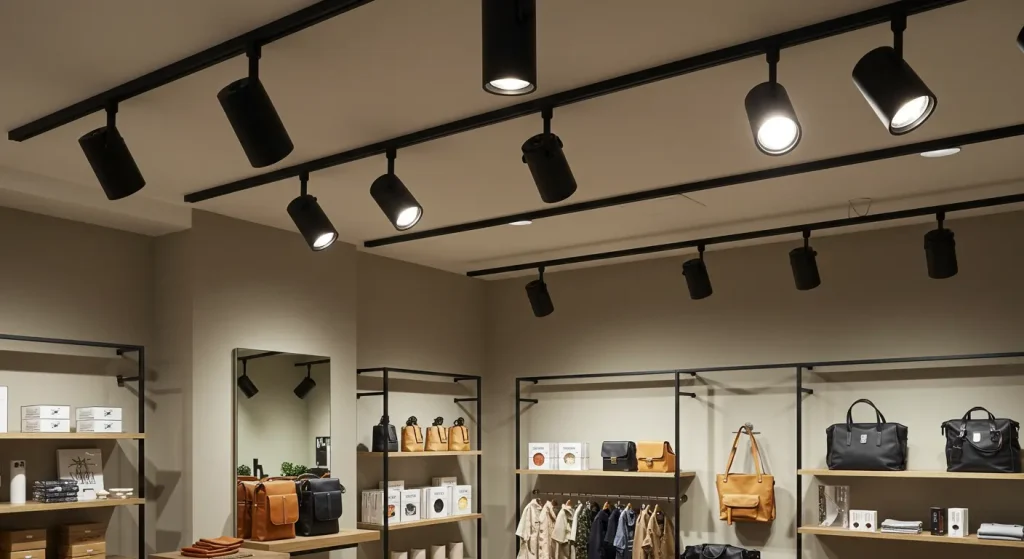
Commercial track lighting fixtures are adjustable LED spotlights or linear lights that clip onto a powered “track” (a metal rail with conductors). You can slide, add, remove, or aim lights any time—perfect for stores, galleries, showrooms, hotels, and offices. They’re flexible, energy-efficient, and scale well from small shops to big chains.
High-end Commercial Track Lighting Fixtures
Buying Checklist
Track type & voltage:
US: H/J/L line-voltage types (match your existing rails).
EU/rest of world: single-circuit (1-phase) or 3-circuit (4-wire, 3-phase) commercial tracks; or 48V magnetic low-voltage systems.
Control & dimming:DALI-2 for large projects; 0-10V for simple zones; Bluetooth Mesh for wireless retrofits; Casambi/Zigbee where wiring is hard.
Light quality:CRI 90+ (with strong R9) for retail, galleries, food; consider TM-30 metrics (Rf/Rg) for advanced color work.
Optics & glare: Pick beam angles (12°/24°/36°/60°), add honeycomb louver or snoot to cut glare. Aim 200–1000 lux depending on task/exhibit.
Safety & compliance:
IEC 60570 (EU) or UL 1574 (US) for track systems; IEC 60529 IP ratings for dust/water.
Load planning: Typical EU 3-circuit tracks are 16A per circuit; spread drivers across phases, mind inrush.
Scalability: Use 3-circuit or DALI when you’ll frequently change layouts, run promos, or rotate exhibits.
What is a commercial track lighting fixture?
A track fixture (also called a track head) is a light that locks into a track rail. The rail carries power (and sometimes data). You can slide the head, rotate it, change beam angle, and swap accessories (lenses, louvers, barn doors). Commercial heads are usually integrated LED with a driver inside.
Two big families:
Line-voltage track (120–277V): common in stores and offices.
Low-voltage track (often 48V magnetic): sleek, safe extra-low voltage (SELV), great for premium interiors and dense accent layouts. (SELV is a defined safety concept—≤60 Vdc—for reduced shock risk.)
Track systems, decoded
A) North America: H, J, and L types (line-voltage)
Heads and rails must match the same family; adapters exist but verify per product.
B) Europe & many global projects: circuits/phases
Single-circuit (all heads on one switch).
3-circuit (4-wire, 3-phase): up to three separately switched/dimmed groups on the same rail—ideal for retail zones and seasonal displays. Regulated by IEC 60570/EN 60570.
C) 48V magnetic track (low-voltage, modular)
Slim rails; snap-in spots, wall-washers, linear grazers. Safer wiring, great for high-touch spaces and quick re-layouts. Many systems are SELV (≤60 Vdc). Check compliance and driver location.
The parts you’ll use (and what they do)
Part
What it is
What to check
Track rail
The powered rail (1-circuit, 2-circuit, 3-circuit, or 48V magnetic).
Rating (A/phase), finish, suspension options, IP rating (indoor vs damp).
Open offices & lobbies: aim at brand walls, meeting zones, and displays.
Light quality that sells: CRI, R9, and TM-30
CRI 90+ is a safe default for retail, hospitality, and galleries. R9 (saturated red) matters for skin tones, meat, produce, and fashion. The U.S. Department of Energy notes CRI 80+ is acceptable for many interiors, but 90+ is “excellent”—choose it when color fidelity drives sales.
TM-30 adds more detail than CRI:
Rf (fidelity, like CRI but smarter) and Rg (gamut/saturation).
For rich yet natural color in stores, many specifiers aim around Rf ≥ 85 and Rg ~ 100–105 (mildly vivid). See DOE’s TM-30 resources for the method and graphics.
Pro tip: Ask your vendor for LM-79 photometric reports (measured lumens, distribution, CCT) and LM-80/TM-21 data for LED lifetime projections. These are standard ways to verify claims.
How bright should it be? Practical lux targets
Use these starting points (tune for your brand/style and finishes):
Space / Task
Recommended maintained illuminance*
General retail sales floor
~300–500 lux
Feature tables / new arrivals
500–750 lux (higher contrast)
Fitting rooms
200–300 lux, flattering CCT & high CRI
Galleries (general)
200–300 lux (art-safe finishes)
Sensitive museum objects (paper, textiles)
≤50 lux
Less sensitive museum objects (stone, metal)
~200 lux
*Based on EN 12464-1 guidance for indoor workplaces and widely used museum recommendations; always confirm with local standards and curator policies. (performanceinlighting.com, ENERGY STAR)
Simple sizing math
Set a target lux (say, 500 lux for a feature table).
Estimate total lumens you need on that area:
Lumens ≈ Lux × Area (m²).
Example: 500 lux × 6 m² table = 3000 lumens on target.
Account for light losses (spill, reflectance). Use a coefficient of utilization (CU) guess of ~0.6–0.7 for spot accent.
Pick heads: If one 25W head delivers 2500 lumens, you’d use two heads with 24–36° beams, aimed to overlap slightly.
Beam angle cheat-sheet
Beam
Typical use
10–15° (spot)
Jewelry, mannequins, small art—high punch
20–30° (narrow flood)
Feature tables, displays
36–60° (flood)
General wash, wide racks
Wall-washer / asymmetric
Even vertical light for walls/graphics
Add honeycomb or snoot to cut glare without killing the punch.
Controls you’ll actually use
DALI-2 (IEC 62386): Wired, addressable. Great for zoning, scenes, schedules, energy reports—ideal in medium/large stores and museums. Works with 1- or 3-circuit track (power + data).
0-10V: Simple, cheap analog dimming of whole runs/zones.
Bluetooth Mesh: Wireless scenes and groups from phones/gateways; fast retrofit where pulling control wire is hard. (Bluetooth SIG documents mesh lighting control profiles.)
Phase-cut (TRIAC): Use when the track heads support it; check minimum load and flicker.
Pro tip: For chains, standardized scenes (e.g., Open / Promo / Clean / Night) save time and keep brand look consistent across locations.
Energy, lifetime, and comfort
Efficacy: Look for 90–120 lm/W at the fixture level for modern track heads (real-world numbers vary by optics and CRI).
Lifetime: Ask for LM-80/TM-21 projections (e.g., L80 @ 50,000 h). This aligns maintenance plans and warranty.
Flicker & glare: Ensure drivers meet flicker guidance (IEEE 1789 or vendor specs) and use louvers/snoots for comfort—especially in fitting rooms and low ceilings.
Color temperature (CCT):
2700–3000K: warm, hospitality, luxury fashion.
3000–3500K: balanced retail.
4000K+: cool/clean, tech and supermarkets. DOE’s LED basics explain CRI and CCT in consumer-friendly terms.
Safety & compliance (so you pass inspection)
Tracks (EU):IEC 60570 / EN 60570 covers electrical track systems for luminaires, including current ratings, thermal and dielectric tests. (webstore.iec.ch)
Tracks (US):UL 1574 is the safety standard for track lighting systems (recently updated to include low-voltage track scope). (UL Standards Online, cdn.intertek.com)
Ingress Protection (IP): Use IEC 60529 IP codes—IP20 typical indoors; consider IP44 in damp zones. (iec.ch)
Tip: If you’re mixing systems (e.g., adding 48V magnetic along with 3-circuit track), label feeds clearly, separate circuits, and keep accessories matched to their system voltage and standard.
Load planning, connectors, and wiring basics
EU 3-circuit rails are often rated 16A per circuit. At 230V that’s plenty of headroom, but don’t cluster too many high-watt heads on one feed; stagger across circuits/phases, and consider driver inrush when many heads switch together.
Common connectors: I (straight), L (90°), T, X, flex. Check that conductors align (and that the joiner preserves all circuits/data if you use DALI).
Suspension kits and power feeds (end or center) must match the brand/system series.
Commercial vs residential track lighting
Factor
Commercial track
Residential track
Circuits
3-circuit often, separate zones; DALI/0-10V
Usually single-circuit
Оптика
Interchangeable lenses, wall-washers
Basic spot/flood
Light quality
CRI 90+, TM-30 optional, tight binning
CRI 80–90
Controls
DALI-2, Bluetooth Mesh, schedules
Simple dimmers, smart home
Compliance
IEC 60570 / UL 1574, IP ratings
UL/ETL for home, fewer circuits
Retail & gallery use cases
Fashion boutique
3000K, CRI 90+ / high R9, 24–36° beams on mannequins and racks.
Add a 12–15° spot for the hero mannequin.
Dimming scene for window displays after sunset.
Supermarket produce
3500–4000K, CRI 90+ with strong R9 to pop reds and greens; wide floods on bins, narrow floods on feature stacks.
Jewelry
4000K crisp white, very narrow spots (10–15°) with high center beam candlepower (CBCP). Add louvers to manage sparkles without glare.
Gallery / museum
Limit sensitive works to ≤50 lux; use precise beams, add shutters/barn doors; choose DALI for time-based reduction. Follow curatorial guidance (NPS and CIE recommendations are common references).
Installation tips
Map your circuits early. On 3-circuit tracks, decide which runs feed “General”, “Accent A”, “Accent B.”
Mount spacing: For uniform wall-washing, set rail ~0.6–1.0 m from the wall and use dedicated wall-washer heads.
Ceiling height: Narrower beams for tall ceilings; wider beams for low ceilings.
Aiming: Start 30°–35° from vertical for product walls (reduces glare and shadows).
Controls commissioning: Name groups and scenes in plain language anyone can use (“Window,” “Promo Tables,” “Wall Art”).
Common mistakes (and how to avoid them)
Mixing track standards (H/J/L, or different EU families) without adapters—leads to loose contacts or no fit. Always match the system.
Under-spec’d color—CRI 80 in fashion/food makes items look flat. Go CRI 90+ with good R9, or use TM-30 to tune fidelity and saturation.
Wrong beams—too wide on tall ceilings (looks dim), too narrow on low ceilings (hot spots).
No glare control—add louvers/snoots, and aim carefully.
Ignoring load/inrush—spread drivers across circuits and use appropriate breakers (C/D curves when required).
No maintenance plan—schedule lens cleaning and annual re-aims (dust and re-layouts reduce performance over time).
Lux targets & museum limits: EN 12464-1 summarised references for indoor lighting levels; museum limits (50/200 lux) reflected in museum guidelines and conservation practice. (performanceinlighting.com, ENERGY STAR)
DALI controls: Official DALI Alliance overview of IEC 62386 (DALI-2). (dali-alliance.org)
Bluetooth Mesh: Bluetooth SIG explainer for lighting control. (维基百科)
Q: Can I mix brands on the same track? A: Often yes if they share the same system (e.g., H-type). But always verify adapters and safety listings.
Q: Do I need DALI? A: If you want per-fixture addressing, scenes, and scalable control across stores, yes. For small shops, 0-10V or Bluetooth Mesh may be enough.
Q: How many heads per 2-meter rail? A: It depends on wattage, load, and beam spacing. Staying under 16A per circuit on EU 3-circuit rails is typical; in the US, follow the branch circuit and UL 1574 ratings.
Q: What IP rating do I need? A: IP20 is fine for dry interiors. Use IP44 or better near humidity. Check IEC 60529 for definitions.
Final recommendations
Decide your backbone: 3-circuit (EU) or the correct (H/J/L) family (US). If you’ll re-layout often, add DALI-2 or Bluetooth Mesh.
Lock in light quality:CRI 90+ (strong R9), CCT that matches your brand (3000–3500K for most retail). Use TM-30 when color is critical.
Pick optics for the job: 24–36° for racks/tables; 10–15° for hero pieces; wall-washers for graphics.
Hit the right lux: Start at 300–500 lux general, 500–750 lux accents; ≤50 lux for sensitive art.
Plan loads safely: Respect rail ratings, drivers’ inrush, and local codes; use qualified installers.
 XHLUX
XHLUX