 XHLUX
XHLUX

Table of contents
- Why Retail Track Lighting Often Fails to Deliver Results
- Why Lighting Layout Matters in Retail Track Lighting
- Basic Principles of LED Track Lighting Layout for Retail
- Recommended Track Lighting Layouts for Common Retail Displays
- How to Determine Track Light Spacing in Retail Stores
- Common Retail Track Lighting Layout Mistakes
- How Adjustable Track Lights Improve Retail Lighting Layout
- FAQ About retail track lighting layout
- Business inquiries are welcome
Why Retail Track Lighting Often Fails to Deliver Results
Many retail stores invest in retail track lighting expecting brighter spaces, stronger product focus, and a more premium shopping experience. However, after installation, store owners and designers are often disappointed: displays look flat, hero products fail to stand out, and the overall atmosphere feels uninspiring.
In most cases, the issue is not the LED track lighting fixtures themselves.
The real problem lies in lighting layout—how track lights are positioned, aimed, spaced, and coordinated with retail store displays and visual merchandising strategies. Track lighting is inherently flexible, but without a clear layout logic, that flexibility is wasted.
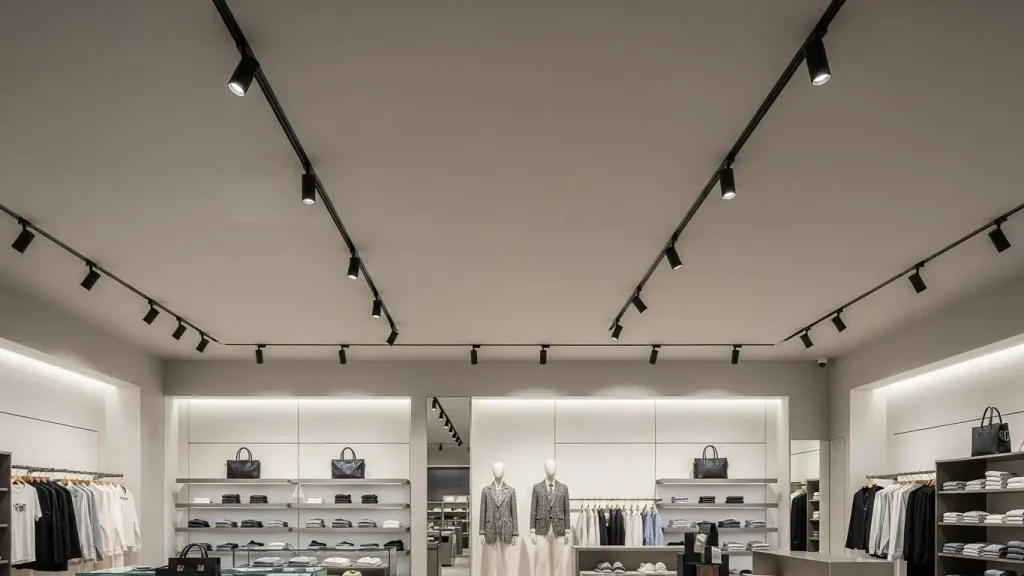
This guide provides practical, execution-level guidance on how to design LED track lighting layouts that genuinely support product highlighting, improve visual merchandising, and shorten decision-making for retail customers.
Many of the principles discussed here are already applied in real commercial projects using professional LED track lighting systems designed specifically for retail environments.
Why Lighting Layout Matters in Retail Track Lighting
Retail lighting is not about creating uniform brightness across a space. Instead, it is about directing attention, creating visual hierarchy, and supporting buying decisions.
A well-designed lighting layout determines:
- Which products customers notice first
- How visual rhythm is created across shelves and displays
- Whether merchandise feels premium or ordinary
- How effectively customer movement is guided through the store
From a visual merchandising perspective, lighting functions as a silent salesperson. Bright, well-aimed accent lighting attracts attention, while softer background lighting allows key products to stand out.
According to recommendations from the Illuminating Engineering Society (IES), effective retail lighting should balance visibility, visual comfort, and emphasis to enhance both perception and engagement
(Illuminating Engineering Society).
In practice, successful retail projects treat lighting layout and fixture selection as one integrated process, often delivered as a complete retail lighting solution rather than an isolated product purchase.
Why is lighting layout important in retail track lighting?
Lighting layout determines how effectively track lights highlight products, guide customer attention, and reinforce retail displays.
Basic Principles of LED Track Lighting Layout for Retail
Align Track Lights with Product Displays (Not the Ceiling)
One of the most common retail lighting mistakes is aligning track rails with ceiling grids or architectural symmetry instead of merchandise.
Professional retail lighting follows a simple rule:
Lights follow products, not the ceiling.
Track placement should align with:
- Wall shelves
- Clothing racks
- Mannequins
- Feature tables
- Promotional and seasonal displays
This ensures light lands on products rather than walkways or floors. As displays change, lighting must adapt. This is why flexible systems with rotatable and tiltable heads—such as adjustable LED track lights—are essential in modern retail stores.
Use Accent Lighting, Not Uniform Lighting
Retail stores should never be lit like offices or warehouses.
Uniform lighting reduces contrast and flattens merchandise. Retail environments rely on accent lighting to create focus and depth.
Effective retail track lighting uses:
- Higher illuminance on key products
- Lower background brightness in circulation zones
- Directional beams to reveal texture, color, and form
Selecting the correct beam angle is essential for effective accent lighting. The technical concept of beam angle determines how light spreads across a surface(beam angle definition).
For professional applications, luminaires with controlled optics, high color fidelity (CRI >90 / Ra97), and stable glare control are typically specified in a detailed product catalog used by lighting designers and contractors.
Should retail track lighting be uniform?
No. Retail track lighting should focus on accent lighting to create contrast and highlight key products.
Recommended Track Lighting Layouts for Common Retail Displays
Retail Track Lighting Layout Reference Table
| Retail Display Type | Track Position | Recommended Beam Angle | Typical Application |
|---|---|---|---|
| Wall Shelves | 30–60 cm from wall | 24°–36° | Apparel, cosmetics, electronics |
| Mannequins / Feature Products | In front, angled | 15°–24° | Fashion, luxury retail |
| Island Displays | Surrounding perimeter | 24°–36° | Seasonal promotions |
| Checkout / Cash Desk | Linear alignment | 36°–60° | POS & impulse items |
This reference table allows designers and buyers to quickly match display type with lighting strategy, reducing uncertainty during planning and procurement.
Track Lighting for Wall Displays & Shelving
Wall displays are critical because they often carry branded or high-margin products.
Recommended layout guidelines:
- Distance from wall: 30–60 cm
- Beam angle: 24°–36°, depending on shelf depth
- Aim angle: 30°–45° toward product face
This geometry minimizes shelf shadows and reduces glare for customers standing close to displays. Track lights with precise optics and stable beam control are especially important for professional retail wall display lighting, which is why many stores rely on high-quality LED track light fixtures rather than generic spotlights.
Track Lighting for Mannequins and Feature Products
Mannequins and hero products require stronger visual emphasis than general merchandise.
Best practices include:
- Narrow beam angles: 15°–24°
- Two or more track heads per mannequin
- Angled illumination at 30°–45°
Multiple light sources prevent harsh shadows and enhance depth, helping fabrics, textures, and finishes appear more tactile and premium.
Track Lighting for Island Displays
Island displays must attract attention from multiple directions.
Effective strategies include:
- Cross-lighting from several track heads
- Slight beam overlap to eliminate dark zones
- Avoiding single overhead “top-down” lighting
Modular track systems allow fixtures to be repositioned as island layouts evolve, supporting frequent merchandising changes without ceiling modifications.
How to Determine Track Light Spacing in Retail Stores
There is no universal spacing rule for retail track lighting.
Correct spacing depends on:
- Ceiling height
- Угол луча
- Product size and display width
- Desired contrast ratio
Track Light Spacing Reference Table
| Ceiling Height | Beam Angle | Suggested Spacing |
|---|---|---|
| ≤3 m | 24° | 0.8–1.2 m |
| ≤3 m | 36° | 1.2–1.5 m |
| 3–4 m | 24° | 1.0–1.4 m |
| 3–4 m | 36° | 1.4–1.8 m |
These values are reference ranges, not fixed rules. Final spacing should always be adjusted based on product size, display depth, and visual merchandising intent.
How far apart should retail track lights be spaced?
Spacing depends on ceiling height, beam angle, and display size, but should ensure consistent product highlighting without dark spots.
Common Retail Track Lighting Layout Mistakes
Even high-quality LED track lighting can fail due to poor layout decisions.
Retail Track Lighting: Mistakes vs Best Practice
| Common Mistake | Result | Correct Approach |
|---|---|---|
| Lights centered over aisles | Products look dark | Align lights with displays |
| Beam angle too wide | Flat visual effect | Use accent beams |
| Lights aimed vertically | Glare & harsh shadows | Aim at 30°–45° |
| Fixed-angle fixtures | Costly rework | Use adjustable track lights |
Ignoring glare control can significantly reduce visual comfort. Professional projects often reference indoor lighting comfort standards such as EN 12464-1 to ensure acceptable glare and brightness levels.
Many of these issues can be avoided early through proper planning and lighting layout consultation before installation.
What are common retail track lighting layout mistakes?
Poor alignment with displays, incorrect beam angles, excessive spacing, and glare issues.
How Adjustable Track Lights Improve Retail Lighting Layout
Retail environments are dynamic. Displays change seasonally, promotions rotate, and product assortments evolve.
Adjustable track lights provide:
- Post-installation aiming without tools
- Reduced need for rewiring
- Faster store refresh cycles
In many retail projects, adjustable fixtures allow store owners to fine-tune lighting angles without altering ceiling layouts. This flexibility is especially valuable when combined with modern lighting control systems compatible with protocols such as DALI.
Real-world applications of adjustable retail track lighting solutions can be seen in completed retail lighting projects, where layout adaptability significantly improved long-term performance.
FAQ About retail track lighting layout
How do you layout track lighting in a retail store?
Align tracks with product displays and use accent lighting to create contrast and guide attention.
How many track lights do I need for retail?
The number depends on ceiling height, beam angle, and display density rather than store size alone.
Where should track lights be placed in a shop?
They should be positioned to illuminate merchandise zones, not just walkways.
What beam angle is best for retail track lighting?
Narrow to medium beams (15°–36°) are most effective for product highlighting.
Can track lighting be adjusted after installation?
Yes. Adjustable LED track lights are designed for post-installation aiming and layout changes.
Business inquiries are welcome
Effective retail track lighting is not about installing more fixtures—it is about using them intelligently.
By focusing on layout logic, beam control, spacing, and adjustability, LED track lighting becomes a powerful visual merchandising tool that enhances product value and customer experience.
Planning a Retail Track Lighting Layout?
Designing an effective retail track lighting layout involves more than selecting fixtures. As discussed throughout this guide, beam angle selection, spacing, glare control, and alignment with retail displays all directly influence how products are perceived.
If you are:
- Planning a new retail store
- Upgrading existing track lighting
- Adjusting layouts for seasonal or promotional displays
it can be helpful to validate both lighting layout and fixture selection before installation or rework.
You may want to explore:
Or, if you are working on a specific project:
For project-based questions, layout suggestions, or fixture recommendations tailored to your store design, you can also contact our lighting team directly