 XHLUX
XHLUX

Table of Contents
- 1. Why Choosing a Commercial Lighting Supplier Is Much Harder Than Residential
- 2. The 8 Critical Criteria to Evaluate a Wholesale Commercial Lighting Supplier
- 2.1 Optical Performance: The Heart of Professional Lighting
- 2.2 Manufacturing Capability: Real Factory vs Trading Company
- 2.3 Driver Reliability: The Invisible Risk
- 2.4 Compliance & Certifications
- 2.5 Supply Chain & Delivery Capability
- 2.6 After-Sales Service
- 2.7 Product Portfolio Coverage
- 2.8 Project Experience & References
- 3. How to Identify Reliable vs Low-Quality Suppliers in Practice
- 4. Matching Suppliers to Application Segments
- 5. How to Verify Commercial Capability Beyond Marketing Claims
- 6. Real-World Scenarios: The Cost of Wrong vs Right Supplier Choices
- 7. Why XHLUX Is a Strong Candidate for Your Commercial Lighting Supply Partner
- 8. FAQ About Wholesale Commercial Lighting
- Q1: How do I know which commercial lighting factory is “the best”?
- Q2: What parameters should I focus on when buying commercial lighting in bulk?
- Q3: What is the main difference between commercial and residential lighting?
- Q4: What are the most important metrics for track and linear lighting?
- Q5: How can I make sure my supplier is suitable for long-term cooperation?
- 9. Conclusion
Choosing a wholesale commercial lighting supplier is no longer a simple game of comparing price lists.
For serious buyers—lighting brands, project contractors, distributors, system integrators, and OEM partners—the right supplier determines:
- Whether your project is delivered on time
- Whether your brand looks professional in front of end clients
- Whether your warranty claims stay under control
- Whether you can scale consistently over the next 3–5 years
Commercial lighting is fundamentally different from residential lighting. It requires stable performance, precise optics, long lifetimes, and project-grade service. A weak supplier can destroy a project; a strong one can quietly become your long-term competitive edge.
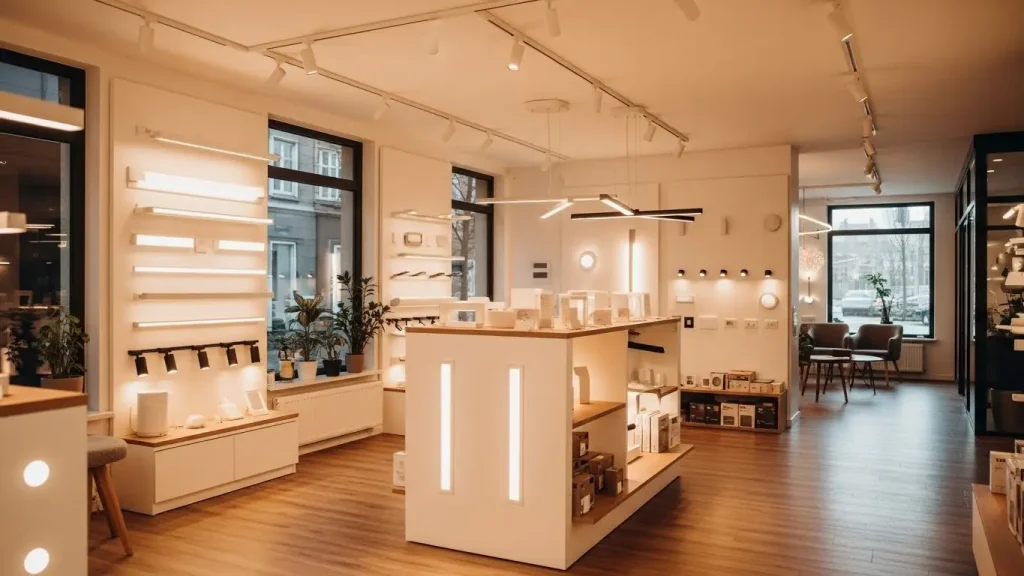
This in-depth guide will show you how to choose the right wholesale commercial lighting supplier in a structured, professional way—beyond shallow advice like “check the price and quality.” We’ll walk through optical performance, factory capability, drivers, certifications, supply chain, after-sales, portfolio fit, and project experience, and show you how to verify whether a supplier is a real factory or just a trading facade.
If you’re already evaluating suppliers and want tailored feedback on your shortlist, you can reach our engineering and sales team directly via Chat on WhatsApp or send your project details through the Contact Our Team page.
1. Why Choosing a Commercial Lighting Supplier Is Much Harder Than Residential
Many buyers underestimate the complexity of commercial lighting. They assume that if a supplier can make downlights or track lights for homes, they can also handle retail chains, offices, hotels, or galleries.
That’s a dangerous assumption.
1.1 Higher Technical Barriers in Commercial Lighting
Commercial lighting involves more demanding technical parameters, such as:
- UGR (Unified Glare Rating) for offices, schools, and public spaces
- CRI and R9 for retail, hospitality, and gallery environments
- Consistency of CCT and color (SDCM) across hundreds or thousands of fixtures
- Professional optical distributions (beam angles, wall-wash, asymmetric beams)
- Driver quality for 50,000–100,000 hours of worry-free operation
In residential, a small color difference or mild flicker might be tolerated. In a commercial office or a flagship retail store, it becomes unacceptable and may trigger complaints or even claims.
1.2 Higher Risk on Project Delivery and Reputation
A single large commercial project may involve:
- Strict milestone deadlines
- Coordinated installation with other trades
- Commissioning schedules
- Penalties for delay
If your supplier cannot hold delivery dates—or ships inconsistent batches—you risk:
- Extra on-site labor
- Rework and re-installation
- Lost confidence from your client
- Damage to your brand reputation
1.3 Complex Application Scenarios
Commercial lighting covers a wide variety of applications:
- Offices
- Retail and supermarkets
- Hotels and hospitality spaces
- Museums and art galleries
- Mixed-use commercial complexes
Each segment has different expectations for lux levels, glare control, CRI, optics, and ambience. A supplier who only understands “basic downlights and panels” will struggle when you need gallery-grade track lights, low-UGR linear systems, or layered lighting for hospitality projects.
1.4 The Cost of Choosing the Wrong Supplier
Choosing a weak supplier doesn’t just cost you money on one order. It can cause:
- Project delays and penalties
- Emergency re-sourcing costs
- End client dissatisfaction
- Negative word-of-mouth in your local market
- Long-term loss of trust from your channel partners
That’s why you must approach supplier selection with a clear evaluation framework, not just instinct or price-driven decisions.
💡 Pro Tip: If you regularly handle commercial projects, consider building a standardized supplier evaluation template. You can adapt internal criteria from your past projects or request a starting point from our team via Lighting Solutions.
2. The 8 Critical Criteria to Evaluate a Wholesale Commercial Lighting Supplier
To choose the right supplier, you need to evaluate them through eight major dimensions. These go far beyond the usual “quality, price, and delivery” and help reveal the real capability behind the website or catalog.
2.1 Optical Performance: The Heart of Professional Lighting
If a supplier does not understand optics, they are not truly a commercial lighting manufacturer—no matter what their website claims.
Key optical factors to assess:
CRI (Color Rendering Index)
- For serious commercial projects, CRI ≥ 90 is the minimum; CRI ≥ 95 is preferred for retail, galleries, and premium hospitality.
R9 value
- High R9 improves reds, skin tones, and warm materials.
UGR (Unified Glare Rating)
- For offices and educational spaces, UGR < 19 is often required.
- Low UGR linear and panel solutions are essential for open-plan offices.
Luminous efficacy (lm/W)
- Affects total system energy consumption and project value.
Beam angle options and consistency
- 10°, 24°, 36°, 60° etc. for track lights and downlights.
Color consistency (SDCM)
- SDCM ≤ 3 across batches ensures visual consistency—no patchy whites.
Availability of IES/LDT files
- For Dialux/Relux simulations and professional lighting design.
A supplier who can explain these terms clearly—and provide test reports and IES files—is usually a true professional partner.
2.2 Manufacturing Capability: Real Factory vs Trading Company
A strong commercial supplier should be able to show evidence of in-house manufacturing capability, such as:
- CNC machining or die-casting facilities
- Injection molding for housings and optics
- SMT lines for LED module production
- Automatic aging lines
- In-house labs (integrating sphere, goniophotometer, EMC testing)
This matters for several reasons:
- Better control of quality and tolerances
- Faster engineering turnaround for custom projects
- Greater flexibility in ODM/OEM collaborations
You can learn more about XHLUX background, production setup, and philosophy on the About XHLUX page to see how a genuine commercial factory presents its capabilities.
2.3 Driver Reliability: The Invisible Risk
The LED driver is often the weakest link in a lighting system. For commercial projects, driver quality directly impacts:
- Flicker performance
- Power factor (PF) and total harmonic distortion (THD)
- Lifetime and failure rates
- Compatibility with dimming systems
When evaluating suppliers, ask:
- What is the PF and THD of the driver?
- Is the driver flicker-free (critical for offices and schools)?
- What is the expected lifetime (e.g., 50,000–100,000 hours)?
- Does it support DALI-2, 0–10V, push dimming, Casambi, etc.?
- Has the driver passed relevant safety and performance standards?
A serious manufacturer will specify driver brands, configurations, and test results. Weak suppliers will give vague answers like “good driver, no problem.”
2.4 Compliance & Certifications
Commercial projects often require compliance with local standards and codes. Your supplier should at least be familiar with:
- CE, CB, ENEC, SAA, UL (depending on your market)
- RoHS, ERP/Ecodesign requirements
- LM80/TM21 lifetime verification
A supplier with structured documents and up-to-date certificates is far easier to integrate into your project documentation.
2.5 Supply Chain & Delivery Capability
Even the best product is useless if it arrives too late.
Assess:
- Standard lead times for samples and mass orders
- Flexibility in MOQs for project-based orders
- Ability to handle multi-SKU, mixed-batch project shipments
- Packaging systems that protect products and simplify installation on site
If you frequently manage roll-out projects, you need a partner who can maintain stable lead times and support phased delivery schedules.
2.6 After-Sales Service
A reliable commercial lighting partner should offer:
- 3–5 year warranty as standard
- Clear RMA policies
- 48-hour technical response time
- Replacement strategies for critical failures
- Support for installers: wiring diagrams, installation manuals, and remote assistance
Good after-sales service is not just about solving problems; it builds long-term trust and protects your brand reputation.
2.7 Product Portfolio Coverage
For wholesalers, distributors, and system integrators, it’s much more efficient to work with suppliers offering complete portfolios rather than single product types.
Ideally, your supplier should cover:
- Track lights (retail, gallery, accent)
- Downlights (fixed, adjustable, anti-glare)
- Linear systems (recessed, suspended, surface-mounted)
- Panels and backlit luminaires for offices
- Architectural profile lights
- Smart lighting-compatible versions
A strong commercial portfolio allows you to build complete solutions—not just sell isolated luminaires.
You can see how a comprehensive portfolio is structured by exploring the XHLUX Каталог продукции, which includes track, downlight, linear, and smart options designed for commercial environments.
2.8 Project Experience & References
Finally, you should check:
- Has the supplier completed projects similar to yours (office, retail chain, gallery, hotel, etc.)?
- Can they share photos, Dialux reports, or case studies?
- Are there repeat customers or long-term partnerships?
Real project references prove that the supplier can deliver under real-world constraints—not just ship “boxes of lights.”
To see how this looks in practice, browse the XHLUX Project Gallery for examples across retail, office, and hospitality environments.
💡 Pro Tip: Compile all eight criteria into a scoring matrix (e.g., 1–5 points per dimension) and compare your shortlisted suppliers. This converts “gut feeling” into a rational decision process.
3. How to Identify Reliable vs Low-Quality Suppliers in Practice
Beyond formal criteria, there are several practical indicators that help you tell a professional manufacturer from a superficial supplier.
3.1 Brand and Product Presentation
Professional manufacturers typically:
- Use consistent product naming and branding
- Present clear specs, photometric data, and technical downloads
- Show clean, well-lit product and application photos
Low-end trading companies often:
- Mix many unrelated styles with inconsistent branding
- Use generic or stock images
- Offer vague product descriptions without concrete data
3.2 Availability of Real Optical Data
Ask for:
- IES/LDT files
- Laboratory reports
- Spectrum, CRI, and UGR information
If a supplier claims to be a lighting manufacturer but cannot provide basic photometric files, it’s a clear warning sign.
3.3 Ability to Explain Optical Principles
Try asking technical questions such as:
- “How do you control glare in this linear system?”
- “What is the difference between 10° and 24° beams in this track light?”
- “How do you guarantee color consistency across large batches?”
A real engineering-based manufacturer will give specific, structured answers. A trading company will usually say, “Don’t worry, quality is good,” without real explanation.
3.4 Own Tooling vs Generic Housings
Ask whether the supplier:
- Uses self-developed toolings and modules
- Or purely resells generic open-mold housings
Factories with their own toolings can:
- Offer better thermal design
- Provide more robust mechanical structures
- Support long-term product continuity
3.5 Sample Consistency Test
Before you trust a supplier, order:
- Several samples from the same batch
- The same model from different batches
Check:
- CCT consistency
- Brightness consistency
- Finish quality
- Mechanical tolerances
Inconsistent samples today usually mean bigger inconsistencies when you place a 500–5,000 pcs order.
💡 Pro Tip: If you need help building a practical inspection routine for sample evaluation, you can request guidance through Lighting Solutions.
4. Matching Suppliers to Application Segments
Not every supplier is good at every type of project. It’s often better to work with partners who specialize in your main segment.
4.1 Office Lighting Suppliers
Key capabilities:
- Low-UGR linear and panel systems
- Optimized for 300–500 lux environments
- Balanced visual comfort and efficiency
- Smart controls (presence detection, daylight harvesting)
4.2 Retail Lighting Suppliers
Key capabilities:
- CRI95+ for products and displays
- Flexible optics for track lights (narrow to wide beams)
- Accent lighting layered with ambient lighting
- Wall-wash and window display solutions
4.3 Hospitality Lighting Suppliers
Key capabilities:
- Warm CCT (2700–3000K)
- High-end finishing and industrial design
- Layered ambient and accent lighting
- Integration with decorative fixtures and cove lighting
4.4 Gallery & Museum Lighting Suppliers
Key capabilities:
- High CRI/R9 and controlled spectrum
- Beam shaping accessories
- No UV/IR
- Precise lux level control (for sensitive materials)
4.5 Large Commercial Complexes
Key capabilities:
- Strong production capacity
- Stable delivery schedules
- Good logistics and packing solutions
- Multi-application support (mall + offices + parking + common areas)
💡 Pro Tip: When briefing a potential supplier, clearly state your main segment: Office, Retail, Hospitality, Gallery, or Mixed-Use. This immediately reveals how aligned they are with your real needs. To discuss your segment in detail, you can Email Us with project specs and photos.
5. How to Verify Commercial Capability Beyond Marketing Claims
Once you have pre-selected some suppliers, you need to verify their capabilities in a practical way.
5.1 Request Samples + IES + Lab Reports
For each major product (e.g., track light, linear, downlight), request:
- Physical samples
- IES files
- LM80/TM21 or internal test reports
This allows your lighting designer or engineer to:
- Run simulations
- Check photometric quality
- Confirm technical compliance
5.2 Ask for Factory Video Walkthroughs
Request recent video footage of:
- SMT lines
- Assembly lines
- Aging racks
- Optical test labs
Video evidence is not perfect, but it tells you more than a polished PDF brochure.
5.3 Run a Small Pilot Order
Before awarding a large project, run:
- A pilot order with limited quantities
- Under realistic packaging and shipping conditions
Check:
- Product consistency
- Delivery accuracy
- Communication responsiveness
- Installation feedback from the site
5.4 Inspect Packaging, Labeling, and Manuals
Professional commercial suppliers:
- Provide clear product labels
- Include installation instructions
- Use barcodes or QR codes
- Have packaging that protects products but remains installation-friendly
Weak suppliers often treat packaging as an afterthought—which becomes a big problem on project sites.
5.5 Test Thermal Management & Driver Stability
Even simple tests such as:
- Running luminaires for several hours in a warm room
- Measuring temperature rise
- Observing for flicker or failure
can reveal whether the thermal design and driver quality are acceptable.
💡 Pro Tip: If you’d like a structured testing SOP for new lighting suppliers, you can request a guideline via Contact Our Team.
6. Real-World Scenarios: The Cost of Wrong vs Right Supplier Choices
To make this more concrete, imagine the following scenarios.
6.1 Scenario 1: Retail Track Lights With Color Shift
A distributor sources cheap track lights from a low-cost supplier. The first batch looks okay, but the second batch arrives with a slightly cooler CCT.
In the final installation:
- One side of the shop appears warm
- The other side looks colder
- The brand’s visual identity suffers
- The client complains and requests replacement
Result: The distributor loses margin, time, and trust.
6.2 Scenario 2: Project Delayed by Unreliable Lead Times
A contractor wins an office lighting project with a tight schedule. The supplier promises a 25-day lead time but ships late by 20 days due to poor planning.
Consequences:
- The ceiling contractor has to come back twice
- The project owner charges penalty fees
- The contractor is unlikely to win future work from this client
6.3 Scenario 3: Long-Term Cooperation with a Reliable Partner
A systems integrator invests time to properly vet a professional commercial supplier:
- Evaluates optics and drivers
- Reviews projects and capabilities
- Runs a pilot batch successfully
They then build a 3–5 year partnership with:
- Shared roadmaps
- Co-developed product lines
- Joint marketing support
Result: Higher project win rates, smoother operations, and stronger market reputation.
If you’d like to see how such long-term cooperation looks in practice, you can explore related references inside our Project Gallery.
7. Why XHLUX Is a Strong Candidate for Your Commercial Lighting Supply Partner
While this guide is meant to be educational and supplier-agnostic, it’s also fair to explain why many international buyers choose XHLUX as their partner for track lights, downlights, linear systems, and smart commercial lighting.
7.1 Focused on Commercial Lighting Core Categories
XHLUX specializes in:
- LED track lights for retail, gallery, and accent lighting
- Anti-glare and deep reflector downlights for hospitality and offices
- UGR-compliant linear systems for corporate spaces
- Smart-ready fixtures compatible with DALI and Casambi
You can see the full product spectrum in the Каталог продукции.
7.2 High-End Optical Design
- CRI 90–95+ options across key product lines
- UGR<19 for office and educational applications
- Carefully engineered beam angles and optical modules
- Tight SDCM color consistency for batch reliability
7.3 ODM & Customization Capability
For brands and project integrators, XHLUX offers:
- Optical customization (beams, lenses, reflectors)
- Structural customization (housings, finishes, mounting interfaces)
- Driver and control customization (CCT, DALI, 0–10V, Casambi)
- Private label and branding support
You can discuss your custom requirements directly through Email Us or submit specifications on the Contact Our Team page.
7.4 Full Engineering Support
XHLUX supports your project lifecycle with:
- IES files and 3D models
- Dialux simulations
- Wiring diagrams and installation manuals
- On-demand technical Q&A for complex project scenarios
The Lighting Solutions section provides a good overview of how solution-based support works in practice.
7.5 Certifications, Warranty, and Global Projects
- Globally relevant safety and performance standards
- Structured quality control and testing
- 5-year warranty options for key commercial ranges
- Proven project experience across offices, retail, hospitality, and galleries
To understand the depth of these references, visit the Project Gallery or learn more background on the About XHLUX page.
💡 If you’re in the process of rationalizing your supplier base, you can book a call, send a BOM, or share your current pain points via Chat on WhatsApp or the Contact Our Team form.
8. FAQ About Wholesale Commercial Lighting
Q1: How do I know which commercial lighting factory is “the best”?
There is no single “best” factory globally. The right partner is the one whose strengths match your segment (office, retail, hospitality, etc.), and who performs consistently across:
- Optical quality
- Reliability
- Certifications
- Delivery
- Support
Use the 8-criteria framework in this guide to rank suppliers objectively.
Q2: What parameters should I focus on when buying commercial lighting in bulk?
Key parameters include:
- CRI and R9
- UGR (for visual comfort)
- lm/W (energy efficiency)
- SDCM (color consistency)
- Driver compatibility with your control systems
- Certifications for your target market
Q3: What is the main difference between commercial and residential lighting?
Commercial lighting emphasizes:
- Higher operational hours
- Stricter visual comfort requirements
- Stronger emphasis on energy efficiency
- Long-term reliability
- Project-grade documentation and support
Residential lighting is generally more forgiving and style-driven, whereas commercial lighting is performance-driven.
Q4: What are the most important metrics for track and linear lighting?
For track lights:
- CRI, R9
- Beam angle options
- Peak candela and distribution shape
- Accessory compatibility (honeycomb, snoots, etc.)
For linear lighting:
- UGR
- Uniformity
- lm/W
- Integration with ceiling systems
Q5: How can I make sure my supplier is suitable for long-term cooperation?
Look for:
- Stable communication and transparency
- Predictable quality and delivery
- Willingness to co-develop solutions and support your market strategy
- Clear and fair warranty terms
Running multiple projects together over time is the best test.
9. Conclusion
Choosing the right wholesale commercial lighting supplier is not a one-time purchase—it is a strategic decision that shapes:
- The reliability of your projects
- The trust of your customers
- Your brand image in the market
- Your ability to scale profitably
Rather than focusing solely on price, analyze suppliers based on:
- Optical performance
- Manufacturing capability
- Driver and system reliability
- Certifications and compliance
- Supply chain and delivery
- After-sales support
- Portfolio completeness
- Real project experience
When you combine technical depth, operational reliability, and partnership mindset, you build a supply chain that supports your growth for many years.
If you’re currently evaluating suppliers or planning new commercial projects, you can:
- Explore products in the Каталог продукции
- Review application ideas through the Project Gallery
- Discuss solutions via Lighting Solutions
- Or talk directly to our team on Chat on WhatsApp or through the Contact Our Team страница
With the right partner, your commercial lighting business doesn’t just grow—it becomes smarter, more stable, and more profitable over time.