 XHLUX
XHLUX

Table of contents
- Why Many Retail Stores Still Fail with LED Track Lighting
- What Is LED Track Lighting and Why It’s Ideal for Retail Stores
- Key Factors to Consider When Choosing LED Track Lighting
- Beam Angle – Spotlight vs Floodlight
- Color Temperature (CCT): Matching Brand, Category, and Customer Psychology
- CRI (Color Rendering Index): Why High CRI Matters in Retail
- Glare Control: Comfort Drives Dwell Time
- Energy Efficiency and Lifetime: Cost of Ownership (Not Only Fixture Price)
- Materials and Thermal Design: Why It Matters More Than You Think
- How Choosing LED Track Lighting Based on Retail Store Type
- Why Dimming, Control & Track Compatibility
- Common Mistakes to Avoid When Buying Retail Track Lighting
- How to Design an Effective Retail Track Lighting Layout
- A Spec-First Checklist for Contractors, Designers, Wholesalers
- Comparison Table: Track Lighting Choices for Retail Applications
- FAQ About led track lighting for retail stores
- 1) Is LED track lighting good for retail stores?
- 2) What beam angle is best for retail track lighting?
- 3) What color temperature (CCT) is best for retail lighting?
- 4) Why is CRI important in retail display lighting?
- 5) Are dimmable track lights worth it?
- 6) How long do LED track lights last in commercial use?
- 7) What should I check before buying a track rail system internationally?
- 8) How can I reduce glare in retail track lighting?
- Welcome to discuss business cooperation
Why Many Retail Stores Still Fail with LED Track Lighting
Many retail stores invest in LED track lighting expecting an instant upgrade, but the result still feels underwhelming: displays look dull, hero products don’t “pop,” and lighting appears uneven across the sales floor. In the end, the store may be brighter, yet sales performance doesn’t improve.
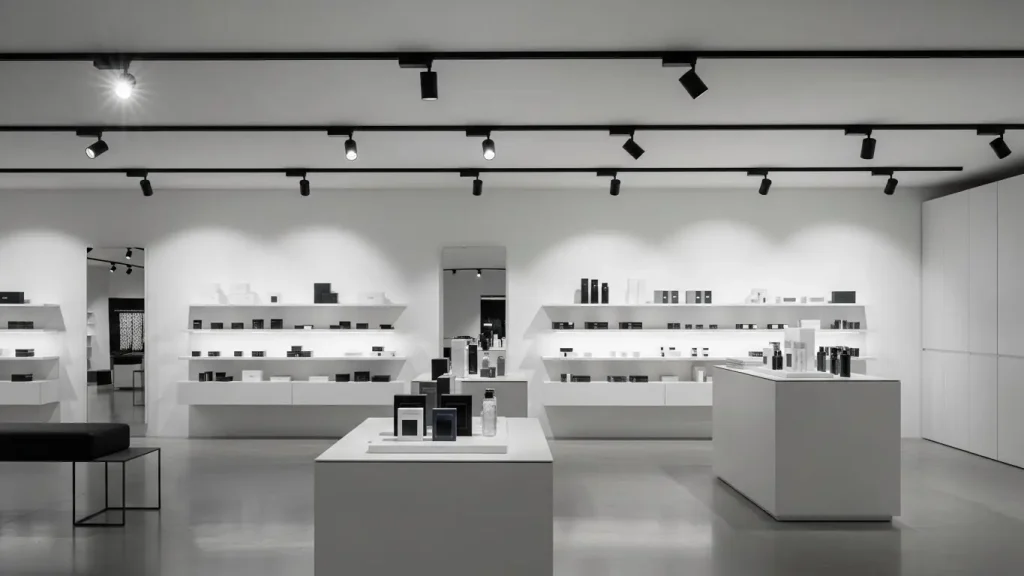
In retail, lighting is not decoration—it is a measurable merchandising lever. When lighting decisions are made without a clear retail lighting design logic, common issues show up fast:
- The wrong beam angle creates harsh hotspots or flat washouts
- Incorrect color temperature (CCT) changes the perceived “freshness,” “luxury,” or “tech” vibe
- Low CRI (color rendering index) distorts brand colors and product materials
- Weak glare control causes discomfort, reducing customer dwell time
- Poor track compatibility leads to installation delays and high rework cost
These mistakes don’t only affect aesthetics—they directly impact conversion rates, return rates, and brand trust.
This guide explains how to choose the right LED track lighting for retail stores based on store type, product category, and professional lighting design principles. You’ll learn how to build a flexible lighting system using adjustable track heads, layered accent lighting, and performance-based specifications—so your store lighting reliably supports visual merchandising and faster purchasing decisions.
If you’re sourcing fixtures for a project, you can quickly browse a complete range of retail-ready track products via the LED Track Light Category, or explore a broader lineup using the Каталог продукции.
What Is LED Track Lighting and Why It’s Ideal for Retail Stores
The Structure: Track Rail System + Adjustable Heads
What is LED track lighting for retail stores?
LED track lighting is a flexible lighting system where adjustable light heads are mounted on a track rail system, allowing retailers to direct light precisely onto products, displays, and focal areas for enhanced visual merchandising.
A typical retail setup includes:
- A powered track rail (surface, recessed, or suspended)
- Multiple adjustable track heads (rotatable + tiltable)
- Optional optics (reflectors/lenses) to change beam distribution
- Optional dimming/control drivers for scenes and schedules
Because the head position and angle can be changed at any time, track lighting is designed for retail’s reality: product layouts evolve weekly, promotions change monthly, and seasonality is constant.
Why Retail Needs Track Lighting More Than Residential Spaces
Residential lighting often aims for comfort and general illumination. Retail is different: it must shape attention. Track lighting enables:
- Spotlighting products without ceiling demolition
- Fast re-aiming for new mannequins, endcaps, or feature tables
- Visual hierarchy (hero → secondary → background)
- Localized highlights with controlled spill light
This is why track systems remain a core tool for commercial LED lighting projects in fashion, supermarkets, specialty stores, and luxury retail.
Track Lighting vs Downlights vs Panel Lights (Retail Reality)
In many retail projects, designers compare track lighting with downlights or panels. Each has a role, but they serve different priorities:
- Panel lights: efficient ambient illumination, but weak merchandising control
- Downlights: clean ceiling look, but limited aiming flexibility
- LED track lighting: adaptable aiming, ideal for accent and display layers
If your store requires frequent layout updates, track lighting is the system that protects you from redesign costs.
For layered lighting strategies, designers often combine track with linear ambient systems. If you need a clean ambient backbone, consider Linear Lighting Series as the “base layer,” then use track heads for merchandising accents.
XHLUX Real Project Pattern (Retail Renovation)
In multiple clothing store remodels, a common pattern appears: fixed downlights may meet brightness targets on paper, but they fail to create strong product focus in reality. Switching to adjustable track heads typically improves:
- Outfit texture visibility (fabric weave, stitching, material gloss)
- Color fidelity under real customer viewing angles
- Flexibility for seasonal re-merchandising without re-cutting ceilings
Key Factors to Consider When Choosing LED Track Lighting
Retail track lighting should be chosen like a toolset, not a single product. Below is a practical, structured checklist used by contractors, lighting designers, and distributors to evaluate systems.
Beam Angle – Spotlight vs Floodlight
What beam angle is best for retail track lighting?
Narrow beam angles highlight featured products, while wider beams provide general illumination. Most retail stores combine both for layered lighting effects.
Think of beam angle as your “visual emphasis knob”:
- 15°–24° (Narrow / Spotlight)
Best for hero displays, mannequins, premium items, window zones
Creates higher contrast → stronger attention pull - 36°–60° (Medium/Wide / Floodlight)
Best for shelves, aisles, wall zones, and broader product bays
Helps avoid harsh hotspots when ceiling heights are lower
Pro Design Insight: Mix Beam Angles
Retail lighting that looks “professional” almost never relies on one beam angle. Instead, it uses a deliberate combination:
- Narrow beams for focal points
- Wider beams to support browsing visibility
- Strategic overlap to avoid dark gaps
If your merchandising changes frequently, zoomable optics can reduce SKU complexity while increasing adaptability.
For projects needing flexible optics, explore Zoomable LED Tracklight Options—useful for retailers who want to shift from spotlighting products to wider display lighting without changing fixtures.
Color Temperature (CCT): Matching Brand, Category, and Customer Psychology
Color temperature (CCT) affects how customers interpret freshness, warmth, luxury, and cleanliness. Common retail CCT choices:
- 3000K: warm, premium, inviting
Best for luxury, boutique fashion, leather goods, hospitality-style retail - 4000K: neutral, balanced, mainstream
Great for clothing chains, supermarkets, pharmacy retail, general merchandise - 5000K: cool, crisp, high-tech
Suitable for electronics, sports performance zones, modern tech brands
Don’t select CCT in isolation. Consider:
- Wall and floor finishes (warm materials vs cold metals)
- Brand identity (heritage vs modern minimalism)
- Product category (food vs jewelry vs apparel)
In practice, many stores choose a base CCT and adjust accents slightly (e.g., neutral ambient with warmer accents) to guide attention.
CRI (Color Rendering Index): Why High CRI Matters in Retail
CRI is not a marketing label—it’s revenue protection. Low CRI lighting makes products look different than they truly are, causing:
- Color mismatch complaints (especially fashion and cosmetics)
- Reduced perceived quality (luxury items look “flat”)
- Lower trust in brand presentation
For modern retail projects, CRI ≥ 90 is the minimum serious baseline. For high-end applications, Ra97 is a common target.
Where CRI is most critical:
- Fashion: accurate fabric colors and prints
- Cosmetics: skin tone rendering and shade comparison
- Jewelry: metal tone clarity and gemstone brilliance
- Food: freshness perception (greens, reds, baked goods)
Technical recommendation:
Choose track heads that can deliver:
- CRI > 90 (Ra90+), and for premium use cases Ra97
- SDCM < 3 (tight color consistency across fixtures)
- Stable CCT across dimming (if dimmable track lights are used)
Glare Control: Comfort Drives Dwell Time
Retail is a human experience. If customers squint or feel visual discomfort, they browse less and leave sooner. Glare control should be treated as a measurable design requirement.
Key factors affecting glare:
- Optical design (deep reflectors, lens structure)
- Mounting height and aiming angle
- Beam angle choice (narrow beams can cause bright hotspots if mis-aimed)
For comfort-focused commercial spaces, many designers align with glare control principles similar to EN 12464-1 (indoor workplace lighting guidance), even if retail is not identical to office standards. In mixed-use retail (cashier zones, service counters), targeting UGR < 19 can significantly improve comfort.
Energy Efficiency and Lifetime: Cost of Ownership (Not Only Fixture Price)
Retail often runs 10–14 hours daily. That makes operating cost and maintenance frequency extremely important.
A strong commercial choice typically targets:
- Efficiency: 100–130 lm/W
- Power Factor suitable for commercial power quality requirements
- Lifetime: L70/B50 50,000 hours (real-world planning metric)
For distributors and contractors, these metrics reduce call-backs and increase customer satisfaction after handover.
Materials and Thermal Design: Why It Matters More Than You Think
Track lights are compact fixtures. Thermal management directly impacts lumen maintenance and color stability.
Professional-grade retail track heads often use:
- COB chip for smooth beams and strong center intensity control
- Die-cast aluminum heatsink for efficient heat dissipation
- PMMA lens or advanced optics to shape beam angle and reduce glare
If heat is not controlled, lumen depreciation accelerates, CCT shifts, and CRI stability can degrade over time.
If you want to compare different fixture families and specs quickly, the Каталог продукции helps shortlist models based on wattage, beam angle, and application focus.
How Choosing LED Track Lighting Based on Retail Store Type
Different retail categories demand different lighting logic. Below are practical buying and design recommendations that align with how professionals specify systems.
LED Track Lighting for Clothing Stores
Clothing stores depend heavily on color accuracy, texture visibility, and glare control.
Recommended priorities:
- CRI ≥ 90 (prefer Ra97 for premium brands)
- SDCM < 3 to keep walls and garments consistent under multiple heads
- Adjustable aiming for mannequins, racks, feature walls
- Strong glare control (avoid harsh reflections on mirrors and glossy surfaces)
Beam angle approach:
- Narrow beams (15°–24°) for mannequins and new arrivals
- Wider beams (36°–60°) for aisle/rack browsing visibility
Why it works:
Clothing stores sell “identity.” Lighting must communicate color accuracy and quality instantly.
LED Track Lighting for Supermarkets and Grocery Retail
Supermarkets prioritize uniformity, efficiency, and long operating stability.
Recommended priorities:
- Wider beams for aisles and shelves
- High energy efficiency (100–130 lm/W)
- Stable drivers for long daily hours
- Easy maintenance and quick replacement
Design tip:
Use track heads strategically for promotional endcaps and feature islands. For general aisles, combine track accents with efficient ambient systems.
For large-format stores, pairing track accents with continuous ambient lighting improves energy performance and reduces “spotty” ceilings. Consider integrating Linear Lighting Solutions for the ambient layer.
LED Track Lighting for Jewelry & Luxury Retail
Luxury retail is where track lighting becomes a precision instrument.
Recommended priorities:
- Narrow beams for dramatic contrast
- High CRI and tight SDCM for premium color appearance
- Excellent optics to avoid glare while maximizing sparkle
Beam angle approach:
- 15°–20° for jewelry displays and hero items
- Carefully aimed highlights to avoid direct eye glare
Why it works:
Luxury products are purchased emotionally. High contrast and controlled highlights increase perceived value.
Why Dimming, Control & Track Compatibility
Dimming Options: TRIAC vs DALI (and Why It Matters)
TRIAC dimming
- Common and cost-effective
- Works in smaller stores or simple renovation projects
- Dimming behavior depends more on driver quality and compatibility
DALI dimming (DALI-2)
- Scene control, zoning, schedules, consistent dimming behavior
- Better for chain stores and standardized rollouts
- Works well with smart building integration
For technical reference, DALI control systems are defined by the DALI Alliance, which helps unify protocol expectations in professional lighting projects.
Practical retail benefit:
Dimming is not only for mood—it supports merchandising cycles:
- Brighter scenes during peak traffic
- Lower scenes near closing time
- Spotlight emphasis for promotions
This is why many buyers consider dimmable track lights a long-term value investment.
Track Compatibility and Global Standards: Avoid the “Adapter Trap”
Retail projects often involve international sourcing, and track standards vary by region.
Common setups include:
- 3-phase track (common in EU commercial projects)
- Different adapter formats for US markets
Typical compatibility risks:
- Head adapter doesn’t match installed track
- Incorrect grounding/phase configuration
- Mixed brands leading to loose mechanical fit
real-world lesson:
A buyer once ordered fixtures assuming “standard track” compatibility. After arrival, the adapters didn’t match the installed rails, causing rework and delays. The final cost exceeded what the buyer would have paid for correct compatibility planning upfront.
Recommendation:
Before purchase, confirm:
- Track type (single phase vs 3-phase)
- Adapter standard (EU/US)
- Driver/dimming method
- Mechanical locking safety for long-term use
If you want expert guidance on track compatibility, layout planning, and project specification, you can reach out directly through Contact & Quote or review available support under Lighting Solutions & Services.
Common Mistakes to Avoid When Buying Retail Track Lighting
What are common mistakes in retail track lighting?
Common mistakes include choosing the wrong beam angle, ignoring CRI, and failing to match lighting design with the store’s product category and layout.
Below are the biggest mistakes seen in real purchasing cycles:
1) Choosing by Price Only (Ignoring Total Cost of Ownership)
Low upfront price can hide:
- Shorter lifetime and more replacements
- Driver failures and flicker issues
- Color inconsistency across batches
2) Using One Beam Angle Everywhere
This is the fastest way to make a store feel flat. Retail needs layered lighting, not uniform spotlight repetition.
3) Ignoring Glare Control
Customers don’t describe glare scientifically—they say “this store feels uncomfortable.” That discomfort reduces dwell time.
4) Using Low CRI Lights for Premium Products
High-end merchandise under low CRI looks less valuable. That directly damages margin.
5) Not Planning for Track Compatibility
Incorrect adapters can cause:
- Installation delays
- Return logistics complexity
- Rework labor costs
How to Design an Effective Retail Track Lighting Layout
Choosing fixtures is only half the job. Layout determines whether the lighting strategy actually works.
Use Layered Lighting: Ambient + Accent + Feature
A professional retail lighting design usually includes:
- Ambient layer
Provides overall brightness and orientation. Often achieved with linear systems, panels, or wide-beam solutions. - Accent lighting
Directs attention to products and displays. This is where track lighting excels. - Feature layer
Highlights brand zones: window displays, promo tables, wall features, and seasonal campaigns.
This layered approach aligns with professional guidance often discussed in lighting society references such as IES.
Avoid the “Starry Ceiling” Trap
When too many track heads are placed evenly without a merchandising plan, ceilings become crowded and visual focus disappears. Instead:
- Place fewer heads with purposeful aiming
- Create contrast between hero and background zones
- Use wider beams where browsing is required
Correct Angle Relationship: Light vs Product vs Customer View
A simple but powerful rule:
- Aim accents so light hits the product at roughly 30°–45° from customer viewing direction
- Reduce reflection glare on glossy packaging by adjusting tilt and position
- Ensure hotspot is on the product surface, not the floor
This is why adjustable track heads are so valuable: they allow micro-adjustments during store setup.
Practical Planning Metrics
While every store differs, these are useful starting heuristics:
- Ceiling 3m–4m: mix 24° and 36° beams
- Ceiling 4m–6m: narrower beams become more important (15°–24°)
- High shelves: avoid narrow beams that create stripy illumination
- Feature tables: narrow beam accents plus softer ambient fill
Then refine on-site using aiming and dimming.
For project inspiration and real retail implementation references, browse Project Cases to see how different store types apply beam angles, CCT choices, and track layouts.
A Spec-First Checklist for Contractors, Designers, Wholesalers
When you’re specifying commercial LED lighting for retail, a spec-first approach speeds decision-making and reduces risk.
Recommended retail-track baseline (typical professional targets):
- CRI > 90 (Ra90+); premium zones Ra97
- SDCM < 3 (tight color consistency)
- UGR < 19 in comfort-critical zones (counters / service areas / mixed-use)
- Efficiency 100–130 lm/W
- Lifetime L70/B50 50,000 hrs
- Optics designed for glare control (deep reflector/lens)
- Robust thermal design: die-cast aluminum heatsink
- Stable beam optics: PMMA lens options
- Light source: COB chip for smooth, controlled beams
- Dimming option matched to project: TRIAC or DALI-2
- Track adapter compatibility verified (EU/US, 3-phase, etc.)
- Support for ODM customization if rollouts require branding or unique optics
If the supplier can’t answer these clearly, the risk of project inconsistency increases.
If you’re evaluating a supplier’s production stability, certifications, and customization capability, the О нас page gives a quick background on manufacturing and service scope.
Comparison Table: Track Lighting Choices for Retail Applications
| Retail Need | Best Track Approach | Beam Angle Range | Key Specs to Prioritize |
|---|---|---|---|
| Window display / hero products | Strong accent lighting | 15°–24° | CRI>90/Ra97, glare control, stable optics |
| Shelves / aisles | Balanced flood lighting | 36°–60° | energy efficiency 100–130lm/W, uniformity |
| Fashion / apparel | High fidelity + comfort | Mixed | CRI>90, SDCM<3, UGR control |
| Jewelry / luxury | High contrast + precision | 15°–20° | high CRI, tight SDCM, optics quality |
| Chain store rollouts | Standardized + controllable | Mixed | DALI-2, consistency, reliability |
| Frequent re-merchandising | Maximum flexibility | Zoomable | adjustable optics, easy aiming |
FAQ About led track lighting for retail stores
1) Is LED track lighting good for retail stores?
Yes. LED track lighting is one of the best solutions for retail because it enables flexible aiming, strong accent lighting, and efficient spotlighting products as layouts change.
2) What beam angle is best for retail track lighting?
Most stores use a mix: 15°–24° for featured items and 36°–60° for shelves and browsing zones. This layered approach improves contrast and reduces flat lighting.
3) What color temperature (CCT) is best for retail lighting?
- 3000K for premium/luxury warmth
- 4000K for mainstream retail balance
- 5000K for electronics/tech crispness
Your CCT choice should match brand identity and merchandise category.
4) Why is CRI important in retail display lighting?
Low CRI distorts colors, making products look different from reality. In fashion, cosmetics, jewelry, and food retail, CRI ≥ 90 is essential for accurate product presentation.
5) Are dimmable track lights worth it?
Often yes—especially for stores using promotional scenes, day/night adjustments, or chain-wide standardization. Dimming supports customer comfort and merchandising flexibility.
6) How long do LED track lights last in commercial use?
High-quality commercial fixtures commonly target L70/B50 50,000 hours, assuming proper thermal design and stable drivers.
7) What should I check before buying a track rail system internationally?
Confirm:
- Track type (3-phase or other)
- Adapter standard (EU/US)
- Dimming protocol (TRIAC / DALI-2)
- Mechanical fit and safety locking
8) How can I reduce glare in retail track lighting?
Use optics designed for glare control (deep reflectors/lenses), aim lights to avoid direct view angles, and consider comfort targets like UGR < 19 in service and cashier zones.
Welcome to discuss business cooperation
Retail lighting wins when it turns attention into action. The right LED track lighting system combines:
- Correct beam angle strategy (spot + flood layering)
- Proper color temperature (CCT) aligned with brand and category
- High CRI (color rendering index) for accurate product presentation
- Effective glare control for customer comfort
- Verified track compatibility and smart dimming options for scalable rollouts
If you want a faster sourcing path with clearer decision-making:
- Start by exploring the main LED Track Lighting Collection
- For maximum flexibility, check Zoomable Track Lights
- For layered ambient + accent solutions, review Linear Lighting
- For full project support and specification help, visit Lighting Solutions & Services
- To discuss your project details (store type, ceiling height, beam angles, track standard, dimming), reach out via Contact & Quote
When you align specs with store type and merchandising intent, track lighting stops being a cost—and becomes a conversion tool.