XHLUX
XHLUX

In a retail floor, gallery or showroom, the eye should reach merchandise, artwork, a display wall or a feature object first.
A black track spotlight system can break that order. When a black rail and black heads sit on a light ceiling, the fixture line may become one of the strongest marks in the room before the lit object does.
If the track becomes one of the strongest visual lines in the room, is it still supporting the display—or competing with it?
Вкратце: Black track can distract when contrast and density push the fixture forward. It can also recede on a darker ceiling or work as a deliberate architectural line. Judge by what the viewer notices first—not by whether black “looks contemporary.”
Оглавление
- ⚡ Quick answer: do black track spotlights distract from displays?
- 👁️ 1. What makes black track spotlights visually distracting?
- 🌑 2. When does black track lighting stay in the background?
- 🌫️ 3. Does matte black make the track less noticeable?
- 🧩 4. Should the track rail and spotlight heads match?
- 🏗️ 5. When should black track become part of the design?
- 📏 6. How much black track is too much?
- 👀 7. Check the display before you sign off the ceiling look
- ❌ Common mistakes
- 📋 Final checklist — will black track compete with the display?
- 📝 What to specify before ordering
Quick Answer: Do Black Track Spotlights Distract From Displays?
They can, especially when the black rail and heads create strong contrast with a light ceiling or become too visually dense. A coordinated black track system can also recede into a darker ceiling or work as an intentional architectural line.
| Ситуация | Likely visual effect |
|---|---|
| Black track on white/light ceiling | Strong contrast; fixture becomes more visible |
| Black track on dark ceiling | Rail and heads can visually recede |
| Compact heads + disciplined layout | Cleaner ceiling |
| Large heads + many adapters/accessories | More visual weight |
| Rail/head finishes coordinated | Reads as one system |
| Mixed or inconsistent finish | System looks busier |
The real question is not whether black looks good. It is whether the fixture becomes more noticeable than the object it is lighting.
For how retail often uses rail heads when displays keep changing, see Why Do Retail Stores Use Rail Spot Lights Instead of Downlights?.
🎯 Do black track spots always steal attention?
No. Contrast, density and ceiling context decide whether the system leads the eye—or the display still does.
1. What Makes Black Track Spotlights Visually Distracting?
Four factors usually raise fixture visibility.
Ceiling contrast
A black rail on a white, pale grey or light timber ceiling draws a clear line.
That contrast is not automatically wrong. It does raise how quickly the fixture is seen.
Fixture size
Large heads, thick rails and obvious adapters add visual weight.
Dark colour alone is not the whole story. Dark colour, physical size and contrast work together.
Number of heads
One black head can read as a small point.
Many black heads on one rail can read as ceiling clutter.
Layout
Uneven spacing, crooked runs and random aiming often look messy before “black” is blamed.
Black amplifies what is already visible. It does not create good or bad composition by itself.
🎯 What usually makes black track compete?
Strong ceiling contrast, larger hardware, high head density and messy layout—amplified by the dark finish.
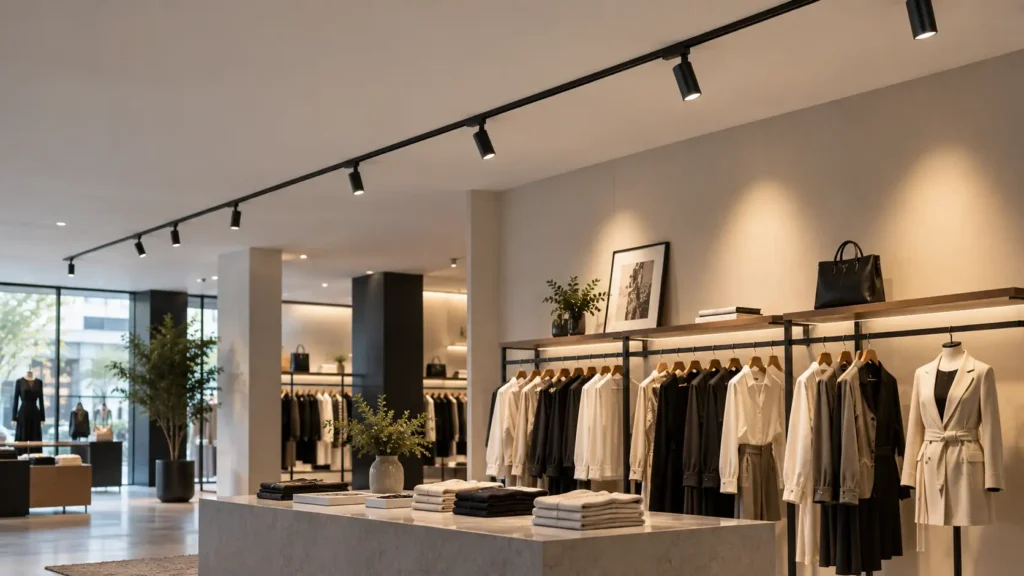
2. When Does Black Track Lighting Stay in the Background?
A black track lighting system can sit quietly when background and architecture agree with it.
Typical conditions include:
- a dark or black ceiling
- exposed ceiling architecture
- existing black structural elements on the soffit
- compact track heads
- consistent spacing
- rail lines that follow the building geometry
- display illumination that clearly outranks fixture presence
Black track “disappears” not because black is naturally discreet, but because it matches the background and architectural language.
A dark ceiling does not automatically require a black rail. It simply makes it easier for black track to recede visually.
🎯 When can black track stay quiet?
When the finish, ceiling and structure read as one language—and the lit display still carries more visual weight.
3. Does Matte Black Make the Track Less Noticeable?
A matte black track head finish is often assumed to be quieter and more “premium.”
Matte finish can:
- reduce obvious specular highlights on the housing
- make rail and heads look more stable under ambient light
- avoid bright hotspots that high-gloss black can throw
Matte black does not remove colour contrast.
On a pure white ceiling with a continuous black rail, the track remains a clear graphic line.
Matte ≠ invisible.
🎯 Does matte finish remove ceiling contrast?
No. It can calm surface shine, but black-on-light ceiling contrast still remains.
4. Should the Track Rail and Spotlight Heads Match?
Для black track rail and head options, this section is about visual composition—not electrical fit of mixed heads.
Black rail + black heads
Usually reads as one continuous black system.
White rail + black heads
The rail can blend into a white ceiling. The heads remain separate black nodes.
Black rail + contrasting heads
Can be intentional. Without a clear purpose, mixed finishes often add noise.
The more visible the track is, the more important rail, head, adapter and accessory finishes become as one composition.
Rail and head do not have to match in every project. Matching is a composition choice, not a universal rule.
When you review a published commercial track head sheet, a MINI D55 Series 4 Wire 3 Phase LED Track Light shows how head, adapter and wattage sit on one specified run—then match finish language across the rail family you quote.
🎯 Must rail and heads be the same black?
No. Same-finish systems read cleaner; contrasting parts need a clear design reason.
5. When Should Black Track Become Part of the Design?
Contemporary track spotlight design sometimes wants the rail to be seen.
Примеры включают:
- industrial retail
- exposed ceilings
- black structural framing
- dark ceiling grids
- deliberately graphic interiors
Then black track can work as an architectural line.
If the design asks for the black track to be seen, it must be a conscious architectural element—not an accidental rival to the display.
Two coherent states:
- Make the system recede.
- Make the system a designed part of the room.
The weak middle case is wanting invisibility while specifying a finish and density that shout.
🎯 When should black track be visible on purpose?
When it is designed as architecture—not when black was picked only to look contemporary while the brief still wants a quiet ceiling.
6. How Much Black Track Is Too Much?
There is no useful universal “metres of rail per square metre” rule here.
Judge visual density from:
- rail count
- rail length
- head density
- adapter visibility
- junctions and connectors
- высота потолка
- ceiling contrast
- existing architectural lines
Visual density matters more than simply counting black fixtures.
Two clear, aligned black rails can look cleaner than four short runs with many connectors and packed heads.
This is ceiling composition—not a lighting-layout calculator.
🎯 What makes “too much” black track?
Rising density of rails, heads, adapters and junctions against a contrasting ceiling—not a fixed count of fixtures.
7. Check the Display Before You Sign Off the Ceiling Look
On a sample or mock-up, check two views.
Look at the ceiling
On entry, do people notice rails, adapters, heads or junctions first?
Look at the display
Does the eye move to illuminated merchandise, artwork, a product feature or the display wall?
If you notice the track before the display, ask whether that hierarchy is intentional.
🎯 What is the simple site check?
See which wins on first look: the track composition or the lit display.
Common Mistakes
Choosing black only because it looks contemporary
“Black feels modern” is not a hierarchy decision.
Ignoring the ceiling colour
The same black track weighs differently on a black ceiling and a white ceiling.
Looking at the spotlight head without the rail
Product shots often show the head alone. Installed view is rail + adapter + head + connectors.
Using too many heads
Pretty heads still create noise when density climbs.
Treating matte black as invisible
Matte reduces shine. It does not erase contrast.
Mixing finishes unintentionally
Different black tones or gloss levels can make one “black” system look fragmented.
🎯 Which mistake breaks display-first hierarchy fastest?
Picking black for trend while ignoring ceiling contrast, density and the full rail–adapter–head composition.
Final Checklist — Will Black Track Compete With the Display?
- [ ] What colour is the ceiling?
- [ ] Is the track supposed to disappear or be visible?
- [ ] How strong is the track-to-ceiling contrast?
- [ ] Are rail and head finishes visually coordinated?
- [ ] Are the heads compact enough for the ceiling scale?
- [ ] Is the head density controlled?
- [ ] Are track lines aligned with the architecture?
- [ ] Are connectors and adapters visually clean?
- [ ] Does the illuminated display still attract attention first?
- [ ] Is the black track intentional—not selected only because black looks modern?
What to specify before ordering
Do not stop at “black track spotlight” on the quote.
Проверять:
- rail finish
- head finish
- matte / gloss level
- adapter colour
- connector / end-cap finish
- housing size
- rail profile
- head dimensions
- ceiling colour / project rendering
- complete system appearance
Specify the whole visible system, not only the colour of the spotlight head.
Что делать дальше?
- Note ceiling colour, intended hierarchy (recede vs visible), and head density on the drawing.
- List rail, head, adapter and connector finishes as one composition set.
- Need a project review or quotation? Contact the XHLUX team with ceiling photos or renders, finish options and the display objects that must lead the eye.
🏁 Conclusion: Do black track spotlights distract from displays?
Black track spotlights do not automatically distract from a display. The risk comes from visual contrast, fixture scale, density and how the rail relates to the ceiling. If the display should lead the eye, the track system needs to support that hierarchy rather than compete with it.
Ознакомьтесь с другими статьями в нашем блоге:
- В каких случаях гибкость использования магнитного трекового прожектора оправдана?
- Когда следует использовать трековые светильники с узким лучом в коммерческих помещениях
- Подойдет ли этот трековый светильник к вашим рельсам? Что нужно проверить перед покупкой.