 XHLUX
XHLUX

Inhoudsopgave
- Why Lighting Is Critical in Hotel Public Areas
- Key Functional Requirements of Hotel Public Area Lighting
- Visual Comfort and Glare Control in Public Spaces
- Lighting Layers for Hotel Public Areas
- Choosing the Right Color Temperature for Public Areas
- Recommended Lighting Fixtures for Hotel Public Areas
- Lighting Design Considerations for Different Hotel Public Zones
- 📊 Chart 1 — Zone-by-Zone Technical Targets for Hotel Public Areas
- Energy Efficiency and Long-Term Maintenance Considerations
- 📊 Chart 2 — Fixture Strategy by Lighting Layer
- Common Mistakes in Hotel Public Area Lighting Design
- How to Design Successful Lighting for Hotel Public Areas
- External References
- FAQ About hotel public area lighting
- Conclusion
- Business negotiations are welcome
Hotel public areas are not “background space.” They are the hotel’s first impression, a brand experience stage, and a high-use operational environment that must perform day after day.
That is why hotel public area lighting is one of the most decision-heavy topics in hospitality projects. Public areas must support moving guests, waiting guests, social interaction, staff operations, and visual storytelling—often in the same footprint.
When public-area lighting is planned incorrectly, the symptoms show up quickly:
- The lobby looks “expensive” in photos but feels uncomfortable in person
- Corridors feel either dim and unsafe or bright and stressful
- Lounge areas look stylish but guests don’t stay
- Maintenance becomes frequent and disruptive
- Energy costs climb because lights are oversized and never properly dimmed
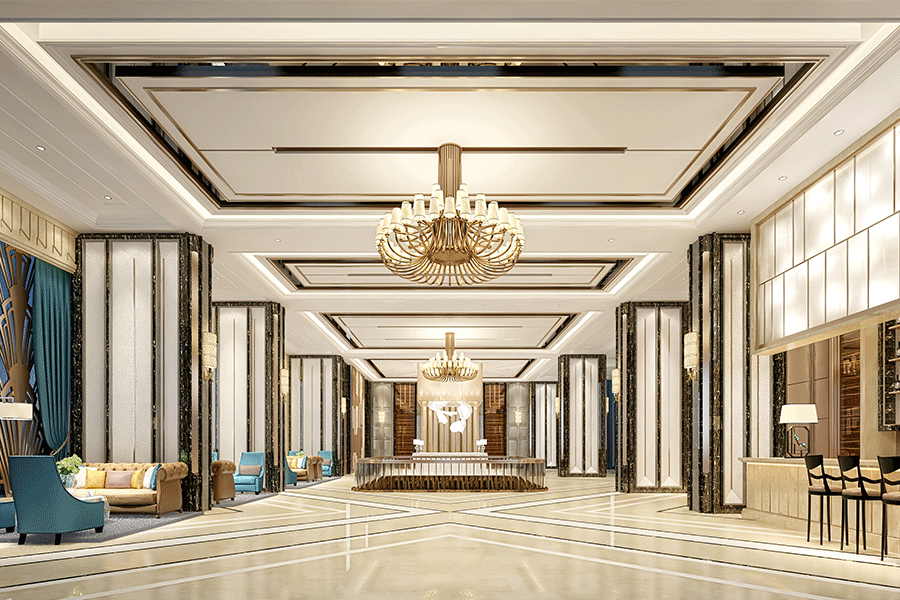
A successful hotel public area lighting scheme is not about chasing brightness or decorative statements. It is a layered design system that balances:
- Brand identity (visual hierarchy + focal points)
- Guest comfort (glare control + consistency)
- Operations (reliability + maintainability + energy strategy)
This article provides a project-ready method to design hotel public area lighting with measurable rules—so the result looks premium and remains stable, comfortable, and maintainable over time.
Why Lighting Is Critical in Hotel Public Areas
Hotel public areas are the brand handshake. Before a guest evaluates the room, they already form an opinion in the lobby, transition zones, and lounge areas.
Lighting determines whether that opinion is:
- Calm vs stressful
- Premium vs ordinary
- Welcoming vs intimidating
- Organized vs chaotic
Public areas are “behavior mixed zones”

Unlike a single-purpose workspace, hotel public areas have mixed behaviors:
- Flow behavior: guests passing through (entrances, corridors, elevator lobbies)
- Dwell behavior: guests staying (reception queues, lounge seating, waiting areas)
This matters because flow zones require clarity and safety, while dwell zones require comfort and atmosphere. Great hotel public lighting designs do not choose one—they structure both through layered lighting.
🎯 Why is lighting important in hotel public areas?
Lighting shapes first impressions, supports guest comfort, and reinforces hotel brand identity in public areas.
Key Functional Requirements of Hotel Public Area Lighting
Hotel public lighting must meet non-negotiable functional requirements before it can “look premium.” These requirements are also where many competitor articles stay too shallow—because they focus on visuals without operational reality.
Clear Visibility and Safety
Public zones are high-traffic. Lighting must:
- Prevent dark pockets and sudden luminance drops
- Reduce trip hazards and improve wayfinding
- Avoid glare that causes discomfort or disorientation
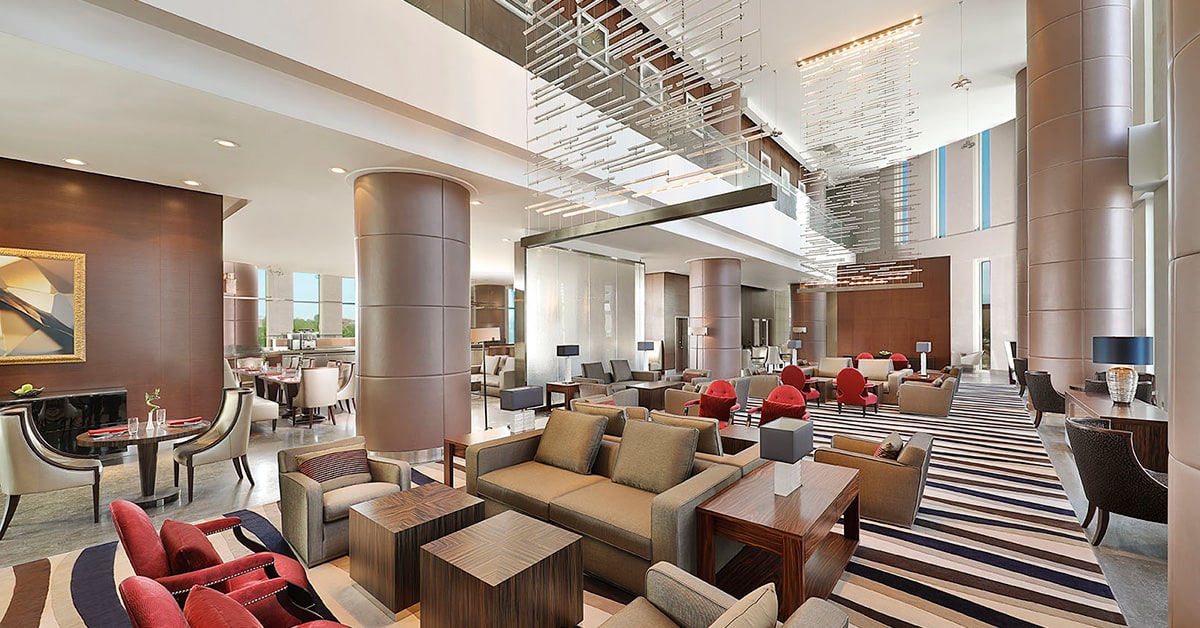
In practical engineering terms:
- Uniformity matters more than “peak lux” in circulation zones
- Visual comfort targets such as UGR <19 are widely used in comfort-driven areas (especially where guests face luminaires frequently, such as corridors and service counters)
- Stable color consistency (SDCM <3) prevents patchy ceilings and inconsistent atmosphere across long corridors and large lobby grids
Comfort for Long and Short Stays
A lobby must support:
- A guest walking from door → reception
- A guest waiting 10–20 minutes
- A guest socializing in a lounge corner
- Staff working behind a counter for hours
This is why layered lighting is essential: one uniform lighting approach cannot satisfy all of these at once.
🎯 What are the main functions of lighting in hotel public areas?
Hotel public area lighting must ensure visibility, safety, and visual comfort for diverse guest activities.
Visual Comfort and Glare Control in Public Spaces
If you want a simple rule for hotel public areas, it is this:
A premium space fails faster due to discomfort than due to insufficient brightness.
Where glare problems come from in hotels

Glare in public areas is commonly caused by:
- Direct view of high-luminance sources (especially at eye level)
- Incorrect aiming angles for accent lighting
- Too many narrow beam accents without a comfortable base layer
- Reflective surfaces (polished stone floors, glossy wall panels, mirrors) amplifying luminance
Practical glare-control strategy
A project-ready glare strategy typically includes:
- Deep anti-glare downlights for base lighting
- Controlled cut-off and shielding for accent fixtures
- Correct aiming angles (often 30°–45° approach rather than “straight down” for highlights)
- A layered system so accent contrast does not become harsh
When designers reference professional glare and comfort practices, organizations like IES (Illuminating Engineering Society) are commonly used as technical background for lighting metrics and application guidance.
🎯 Why is glare control important in hotel public areas?
Glare control prevents visual discomfort and ensures a relaxed, premium guest experience.
Lighting Layers for Hotel Public Areas
Hotel public lighting should be designed as layers, not as a single lighting type. This is the central structural concept that turns “looks good” into “works long-term.”
General Lighting – The Base Layer
General lighting provides:
- Orientation and safe movement
- Comfortable brightness for the whole space
- The background that makes accent lighting feel intentional
For public areas, base lighting must prioritize:
- Comfort (often aiming for UGR <19 where guests frequently face luminaires)
- Consistency across large surfaces (SDCM <3 preferred in premium projects)
- Efficiency and stability (public areas run long hours)
Base lighting is commonly delivered by glare-controlled downlights and/or architectural linear systems such as LED Linear Lighting when designers want continuous lines and structured ambient fill.
Accent Lighting – Creating Focus and Identity
Accent lighting is where brand identity becomes visible:
- Reception counter emphasis
- Art installations and feature walls
- Signature materials and textures
- Boutique-like highlights in lounge corners
Flexible systems are important because hotels adjust décor and furniture over time. This is why LED-railverlichting is widely used in public-area accent strategies—aiming can be updated without construction.
Where beam flexibility is required (changing artwork, rotating displays, adjustable focal distance), Zoomable LED Track Lights reduce risk because the beam can be tuned without swapping optics.
Decorative and Architectural Lighting
Decorative lighting is often the visual “hero,” but it should not carry the entire functional load. Decorative elements:
- Reinforce the design language
- Provide visual rhythm and hospitality warmth
- Create brand signature moments (chandeliers, pendants, feature luminaires)

To keep decorative layers coherent with the project’s product strategy, many hotels standardize decorative families such as LED Pendant Lights while keeping general + accent layers technically consistent.
🎯 What lighting layers are used in hotel public areas?
Hotel public areas use layered lighting, combining general, accent, and decorative lighting for balance and depth.
Choosing the Right Color Temperature for Public Areas
Color temperature (CCT) is one of the most visible “brand signals” in hospitality. The wrong CCT can instantly make a luxury lobby feel like an office.
Recommended CCT ranges (project-friendly rules)
- Lobby & lounge: 3000K–3500K (warm to neutral-warm)
- Corridors & circulation: often around 3000K for comfort, with controlled levels at night
- Avoid overly cool white in public zones unless the brand positioning is intentionally modern-minimal or “business hotel” oriented
Color consistency matters as much as the target CCT. This is where SDCM <3 becomes a practical requirement—especially in long corridors or open lobby ceilings where different luminaires are visible at the same time.
🎯 What color temperature is best for hotel public areas?
Warm to neutral color temperatures (3000K–3500K) provide comfort while maintaining clarity in hotel public spaces.
Recommended Lighting Fixtures for Hotel Public Areas
Instead of choosing fixtures by appearance alone, professional hospitality projects choose fixtures by layer role En risk control.
General lighting fixtures (base layer)
- Glare-controlled LED downlights
- Architectural linear lighting for structured ambient
- Corridor-friendly luminaires with comfort optics
For base lighting that must remain stable and clean, hotels typically prioritize:
- Driver reliability
- Low glare performance
- Maintenance-friendly access
- Target efficacy often in the 100–130 lm/W range for commercial LED systems to reduce operational load without sacrificing performance
A strong base-layer option category is LED-spotdownlights (including adjustable variants for mixed needs), especially when you need precise control without exposing track lines.
Accent lighting fixtures (focus layer)
- Track lights for lobby focal points and feature areas
- Adjustable spot downlights for recessed ceilings
- Beam options (narrow / medium) depending on viewing distance and mounting height
Track systems remain the most flexible choice for evolving public spaces. For hotel lobbies that incorporate art, branding walls, or seasonal décor updates, LED-railverlichting provides fast re-aiming and easy adjustments.
Decorative lighting fixtures (identity layer)
- Pendants, chandeliers, custom architectural luminaires
- Mostly for lounge, reception, and brand signature points
Decorative fixtures should be supported by stable general lighting—so you don’t need to overdrive decorative luminaires for brightness.
Lighting Design Considerations for Different Hotel Public Zones
“Hotel public area lighting” is not a single space. A successful project treats each public zone as a different lighting problem.
Lobby and Reception Areas
Goal: premium first impression + functional clarity
Design rules that work in real projects:
- Keep the base layer comfortable and consistent (avoid hot spots)
- Use accent lighting to define the reception counter as the “anchor”
- Support vertical illumination (walls, branding, artwork) because guests perceive vertical surfaces first
- Maintain high color quality for finishes: CRI ≥90 / Ra97 is often preferred in premium lobbies
Practical fixture strategy:
- Base: glare-controlled downlights + architectural linear accents
- Focus: track lights or adjustable downlights on reception, art, and branding wall
- Decorative: pendants/chandeliers supported by stable base lighting
Where aiming flexibility is needed for lobby features, track-based accent systems such as LED-railverlichting are commonly used.
Public Corridors and Walkways
Goal: safe navigation + calm comfort + operational efficiency
Corridors are among the highest operating-hour areas. They are also where guests complain fastest if glare exists because:
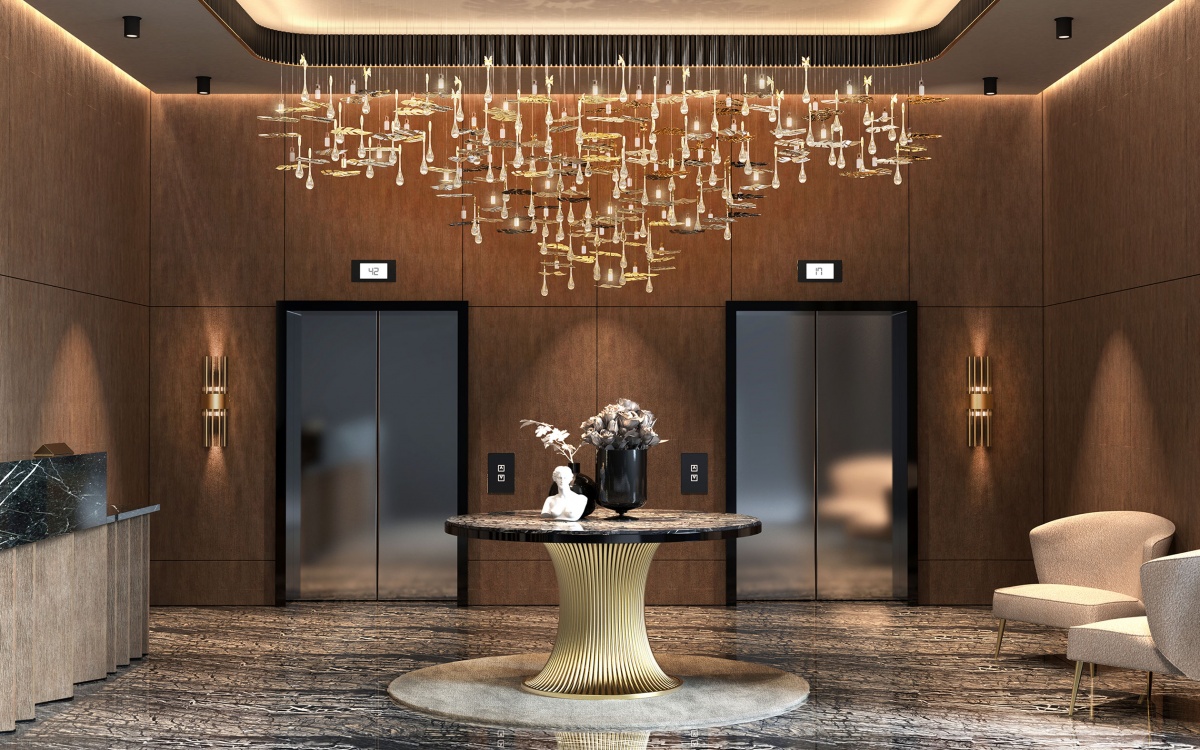
- Guests walk directly under luminaires
- Sightlines are long
- Ceiling repetition makes inconsistencies obvious
Key rules:
- Uniformity and low glare come first
- Avoid overuse of narrow beam accents in corridors
- Night mode is essential: reduce output without losing safety
Engineering targets often used:
- Comfort-driven optics: UGR <19 as a practical goal
- Color consistency: SDCM <3 to avoid visible patchiness
- Reliability: high-quality drivers and thermal management to keep performance stable over years
This zone benefits greatly from structured systems such as LED Linear Lighting for guidance lines, paired with downlights where needed.
Lounge and Waiting Areas
Goal: dwell-friendly atmosphere + flattering light
In lounge areas, guests sit, talk, and stay. Lighting must be:
- Softer and less contrast-heavy than retail
- Glare-free from seated eye lines
- Balanced on faces (avoid heavy shadows)
Key rules:
- Keep base lighting warm-neutral (often 3000K–3500K)
- Use accent lighting to highlight texture and décor, not to “spotlight guests”
- Avoid overly bright downlights directly above seating
A common approach is combining:
- Soft base downlighting
- Decorative pendants to define seating clusters
- Subtle accent lighting for artwork and feature materials
📊 Chart 1 — Zone-by-Zone Technical Targets for Hotel Public Areas
| Public Zone | Primary Behavior | Base Layer Target | Accent Strategy | Key Specs to Demand | Common Risk |
|---|---|---|---|---|---|
| Lobby / Reception | Flow + Dwell | Comfortable, uniform base | Reception, brand wall, art | CRI≥90/Ra97, SDCM<3, glare control | Hot spots, reflective glare |
| Corridor / Walkway | Flow | Uniform navigation lighting | Minimal accents | UGR<19, SDCM<3, stable drivers | Glare in long sightlines |
| Lounge / Waiting | Dwell | Softer ambient | Décor, feature corners | High CRI, low glare optics | Harsh downlight over seating |
| Elevator Lobby | Flow + Pause | Clear but calm base | Signage / wayfinding | Controlled beams, glare management | Over-bright “office feel” |
| Bar / Social Zone | Dwell | Lower ambient, warm | Back bar, feature wall | High CRI, beam control | Excess contrast, eye fatigue |
This chart turns “hotel public area lighting” into a measurable zone strategy instead of generic advice.
Energy Efficiency and Long-Term Maintenance Considerations
Hotel public lighting runs long hours. This makes operational design just as important as the visual concept.
Why “stable performance” beats “initial brightness”
Hotels often face a real operational issue: lighting looks great at opening, then degrades unevenly. The result is:
- Patchy brightness and color
- Maintenance interruptions in public spaces
- Guest perception of “aging property”
This is why professional buyers often evaluate:
- Lifetime targets like L70/B50 50.000 uur as a baseline expectation for commercial public areas
- Thermal design: a koelblok van gegoten aluminium supports heat dissipation and stability
- Optics stability: PMMA-lens performance consistency matters in high-use environments
- LED package choice: many project-grade accent systems use COB chip designs for clean beam control and stable focal performance
- Driver quality and dimming stability for daily use
Control systems and real operational wins
If the hotel uses scene control (day/evening/night), energy savings and experience consistency improve significantly. Standards and ecosystems like DALI-2 via the DALI Alliance are often referenced when interoperability and dimming consistency are required in multi-zone hospitality spaces.
🎯 Why is energy efficiency important in hotel public area lighting?
Energy-efficient lighting reduces operational costs while maintaining consistent performance in high-use areas.
📊 Chart 2 — Fixture Strategy by Lighting Layer
| Lighting Layer | What It Must Achieve | Typical Fixture Types | Spec Priorities | XHLUX Matching Path |
|---|---|---|---|---|
| General / Ambient | Comfort, uniformity, safety | Downlights, linear | UGR<19, SDCM<3, stable drivers, 100–130 lm/W | LED Linear Lighting + Spot Downlights |
| Accent / Focus | Brand hierarchy, highlights | Track lights, adjustable downlights | CRI≥90/Ra97, beam control, glare shielding | LED-railverlichting + Adjustable Downlights |
| Flexible Accent | Adapt to changing décor | Zoomable track | Adjustable beam, stable optics | Zoombare railverlichting |
| Decorative / Identity | Premium perception | Pendants | Integration, aesthetic consistency | LED Pendant Lights |
If you want to standardize fixture families across multiple properties, it is often easier to shortlist from a unified range like the Productcatalogus to reduce procurement and maintenance complexity.
Common Mistakes in Hotel Public Area Lighting Design
Most hotel public lighting mistakes fall into predictable categories. Avoiding them is “risk avoidance” at the project decision stage.
Mistake 1: Chasing brightness instead of comfort
Over-bright public spaces look harsh, especially with reflective finishes. Guests interpret harsh lighting as cheap or stressful.
Mistake 2: Ignoring glare as a design constraint
Glare is not a minor issue—it directly impacts guest satisfaction. Without deep optics and correct aiming, even expensive fixtures feel wrong.
Mistake 3: Treating all public zones the same
Lobby, corridor, lounge, and reception behave differently. When one lighting logic is applied everywhere, operational and experience problems appear immediately.
Mistake 4: No maintenance strategy
Hotels need:
- Easy access for replacement
- Stable drivers
- Standardized SKUs to reduce spare-part complexity
- Long-life performance, not just “high lumen output”
🎯 What are common mistakes in hotel public area lighting?
Excessive brightness, poor glare control, and lack of coordinated lighting layers.
How to Design Successful Lighting for Hotel Public Areas
Below is a project-ready checklist that aligns brand experience with operational reality.
Project Checklist (Decision-Making Level)
- Define public zones by behavior: flow vs dwell vs mixed
- Set base lighting comfort targets: glare control first, uniformity second
- Plan vertical illumination: walls, brand elements, and artwork
- Build lighting layers: general + accent + decorative (each with a job)
- Lock color strategy: 3000K–3500K where appropriate + SDCM <3 consistency
Specify critical performance:
- CRI ≥90 / Ra97 for premium public finishes
- UGR <19 in comfort-sensitive zones
- Efficiency 100–130 lm/W where applicable
- Lifetime L70/B50 50,000 hrs baseline
- Choose maintainable families: reduce SKUs, keep optics and drivers consistent
- Integrate control strategy: scenes and dimming for day/night operation (DALI if required)
Project Reality
In hospitality projects, we often see the biggest improvement when teams stop treating public lighting as “decoration” and instead structure it as a layered system:
- a stable, glare-controlled base (fewer complaints),
- targeted high-CRI accents (better brand perception),
- and a scene strategy for long operating hours (better operations).
This is exactly the difference between lighting that looks good on day one and lighting that stays premium over years.
If your project needs a system-level approach rather than a single fixture purchase, start from Lighting Solutions, then match product families based on ceiling conditions and zone behavior.
External References
When discussing professional lighting metrics like illuminance targets, visual comfort, and glare control, designers commonly reference organizations and standards such as:
- IES (Illuminating Engineering Society) for lighting practice and metrics guidance
- EN 12464-1 for illuminance and glare-related considerations in work/commercial environments
- DALI-alliantie for interoperable lighting control and dimming ecosystems used in multi-zone projects
These references are not “decorative citations”—they are the technical backbone behind comfort-driven project decisions.
FAQ About hotel public area lighting
What lighting is best for hotel public areas?
Layered lighting: glare-controlled general lighting + targeted accent lighting + decorative elements.
How bright should hotel lobby lighting be?
Bright enough for clarity, but controlled—use ratios and layering rather than uniform high brightness.
What color temperature is used in hotel public spaces?
Typically 3000K–3500K for comfort and premium atmosphere.
How do hotels reduce glare in public areas?
Use deep anti-glare optics, correct aiming angles, and avoid excessive narrow-beam accents.
Is LED lighting suitable for hotel public areas?
Yes—especially with stable drivers, good thermal design, and long-life targets (e.g., L70/B50 50,000 hrs).
Conclusion
Hotel public area lighting is a combined challenge of brand experience + behavior guidance + long-term operations.
- Public spaces must serve both movement and staying
- Comfort and glare control are non-negotiable for premium perception
- Layered lighting creates hierarchy without sacrificing usability
- Operational stability (drivers, thermal design, maintenance strategy) protects long-term ROI
If you are planning a new hotel, renovating public areas, or replicating a brand across multiple properties, the next step is to align these principles with your floor plan, ceiling conditions, and operating schedule.
You can review our system-level approach here: Hospitality & Commercial Lighting Solutions.
Business negotiations are welcome
1) From Reading → Project Alignment
If you already have any of the following:
- Public-area floor plan (lobby / corridor / lounge)
- Ceiling heights and ceiling type
- Target atmosphere (luxury / lifestyle / business)
- Key focal points (reception, artwork, brand wall)
Then we can convert “public area lighting ideas” into a zone-by-zone layered plan with correct glare control, ratios, and fixture families.
To understand our manufacturing and project support capability, see About XHLUX.
2) Submit Your Project / Let Us Configure a Solution
👉 Please submit your project details, drawings, or requirements via our Contact & Project Submission Page.
We will help you match:
- Base layer comfort (UGR<19 where needed)
- High-CRI focal accents (CRI≥90/Ra97)
- Consistent color appearance (SDCM<3)
- Efficient performance targets (100–130 lm/W)
- Stable lifetime expectations (L70/B50 50,000 hrs)
- A coordinated fixture mix from LED-railverlichting, LED-spotdownlights, LED Linear Lighting, and LED Pendant Lights
So your hotel public areas look premium, feel comfortable, and remain operationally efficient for the long run.