 XHLUX
XHLUX

Inhoudsopgave
- When Clean Design Conflicts With Real-World Project Changes
- What Are Magnetic Track Lighting Systems?
- Why Magnetic Track Lighting Systems Are Popular in Modern Projects
- Key Benefits of Magnetic Track Lighting Systems
- Magnetic Track Lighting vs Traditional Track Lighting
- Applications of Magnetic Track Lighting Systems in Real Projects
- Common Misunderstandings About Magnetic Track Lighting
- How to Choose the Right Magnetic Track Lighting System for Your Project
- Step 1: Confirm the Project “Flexibility Requirement”
- Step 2: Evaluate Module Ecosystem (Not Just One Spotlight)
- Step 3: Glare Control and Optics (Comfort Is Not Optional)
- Step 4: Color Quality and Consistency (Premium Spaces Demand It)
- Step 5: Dimming and Control Compatibility
- Step 6: Reliability for Long Operating Hours
- Charts and Tables: Magnetic Track Decision Tools
- Why Magnetic Track Often Prevents “Second Renovation” Costs
- Comparison Table: Magnetic Track vs Traditional Track
- FAQ About magnetic track lighting systems
- 1) What are magnetic track lighting systems used for?
- 2) Are magnetic track lights suitable for commercial projects?
- 3) Is magnetic track lighting safe?
- 4) Can magnetic track lights be dimmed?
- 5) Are magnetic track lighting systems expensive?
- 6) What should I check before choosing a system?
- 7) Can magnetic track replace downlights entirely?
- Conclusion
- Business inquiries are welcome
When Clean Design Conflicts With Real-World Project Changes
Many modern lighting projects face a frustrating trade-off: the design concept demands a clean, minimalist ceiling, but the space itself is dynamic. Retail layouts change with seasons, restaurants refresh seating and décor, showrooms rotate displays, and hospitality spaces evolve to match new branding.
Many projects struggle to balance clean architectural aesthetics, functional lighting performance, and long-term flexibility when space layouts change.
Traditional lighting systems often force compromise. If you want to change lighting focus later, you may face rewiring, reinstallation, patching ceilings, or living with lighting that no longer fits the space. This creates project friction: higher labor, longer downtime, and more risk of inconsistent results.
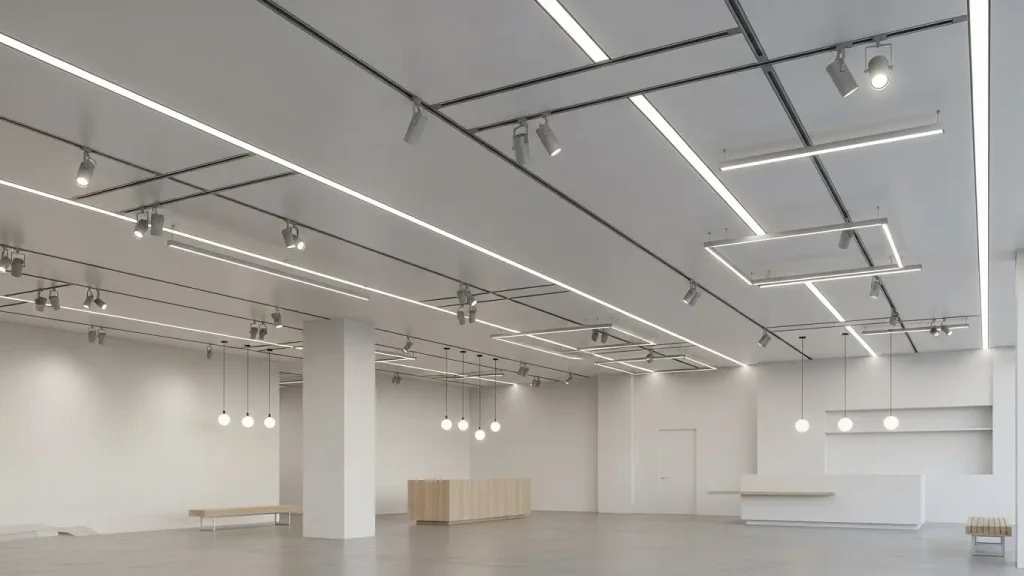
Magnetic track lighting systems solve this by combining architectural minimalism with a modular, plug-in lighting platform. Instead of treating lighting as fixed hardware, magnetic tracks treat lighting as a reconfigurable system—closer to how modern commercial spaces actually operate.
This guide explains what magnetic track lighting is, why it’s popular, and—most importantly—what practical benefits it delivers in real projects beyond “looking modern.” We’ll also compare it with traditional track lighting, show common misconceptions, and provide a decision checklist for professional buyers.
If you’re evaluating modular track solutions alongside conventional systems, you may also want to compare standard LED-railverlichting with complementary ambient layers such as LED linear lighting, and comfort-focused base lighting like LED spot downlights.
What Are Magnetic Track Lighting Systems?
Magnetic track lighting systems are modular lighting platforms where fixtures (modules) attach to a track via magnetic + mechanical alignment, typically using low-voltage power rails inside the track. Instead of hardwiring each luminaire to the ceiling, you install the track once and then add or reposition lighting modules as needed.
System Components (Practical View)
A typical magnetic track system includes:
- Magnetic track
- surface-mounted, recessed, or suspended (depending on design)
- contains internal conductors for low-voltage power distribution
- acts as the physical and electrical “backbone”
- Plug-in lighting modules
- spot modules (accent lighting)
- linear modules (ambient or fill)
- wall washer modules (vertical emphasis)
- grille / anti-glare modules (comfort upgrade)
- pendant adapters (decorative + functional hybrid)
- Driver / power supply
- converts mains (AC) to low-voltage (DC)
- may support dimming protocols depending on configuration
- Connectors & accessories
- L-shape, T-shape, X-shape connectors
- end caps, mounting clips, suspension kits
- optional smart control interface
Why “Low Voltage” Matters (Beyond Safety Buzzwords)
Most magnetic systems run on extra-low voltage DC. This supports:
- easier modular connections
- safer handling during module changes (when designed correctly)
- cleaner aesthetics (less bulky fixture housings)
- more integrated architectural lighting forms
For a neutral baseline on extra-low voltage terminology, you can reference: Extra-low voltage definition.
What are magnetic track lighting systems?
Modular lighting solutions where fixtures attach magnetically to tracks, allowing easy repositioning and flexible lighting design.
Why Magnetic Track Lighting Systems Are Popular in Modern Projects
Magnetic track is not popular only because it looks minimalist. It’s popular because it matches how modern spaces are designed and operated.
1) Architectural minimalism is now the “default language”
In commercial interiors, ceilings are expected to look:
- clean and continuous
- less cluttered
- visually “architectural,” not “fixture-heavy”
Magnetic tracks fit that language, especially in recessed or trimless styles.
2) Projects need flexibility and speed
Retail and hospitality increasingly prioritize:
- faster construction cycles
- adaptable layouts
- minimized future renovation impact
A modular track system supports changes without tearing apart ceilings.
3) Lighting is expected to do multiple jobs in one space
Modern spaces rarely rely on one lighting type. A single area might require:
- ambient lighting for comfort
- accent lighting for product or table focus
- vertical lighting for walls/branding
- decorative moments for identity
Magnetic track systems are designed to combine these functions on one platform.
Why are magnetic track lighting systems popular?
They combine clean architectural aesthetics with flexibility and modularity—ideal for modern commercial and high-end residential projects.
Key Benefits of Magnetic Track Lighting Systems
This is the section where magnetic track stops being “a style choice” and becomes “a project decision.”
High Flexibility for Changing Layouts (The #1 Practical Advantage)
The biggest value is simple: you can move light where the project needs it—without rewiring.
This matters in real-world projects like:
- retail stores changing merchandising and displays
- restaurants adjusting seating plans
- showrooms rotating featured products
- hotels refreshing corridors, art walls, and branding zones
Traditional systems often force you to accept lighting that no longer aligns with the space. Magnetic track keeps the system relevant longer.
What is the biggest benefit of magnetic track lighting?
Flexibility—fixtures can be repositioned easily as layouts or lighting needs change.
If your project also uses conventional accent lighting, it can be useful to compare the modular approach with a classic LED track lighting system (often used when standard mains track is preferred).
Modular Design for Different Lighting Functions
Magnetic track is best understood as a modular lighting system, not a “track spotlight system.”
A single track can host:
- spot modules for accent lighting
- linear modules for ambient fill
- wall washers for vertical illumination
- grille modules for glare control
- pendant modules for decorative + functional blends
This reduces the need to mix many different ceiling fixture types and creates a cleaner, more consistent design language.
Practical project advantage: fewer ceiling cutouts, fewer fixture families, simpler site coordination.
For projects that require a strong ambient layer (especially offices, public areas, or hospitality corridors), pairing modular track with continuous ambient can improve comfort. Consider integrating LED linear lighting where the design calls for a softer background brightness.
Clean and Minimalist Aesthetics
Yes, magnetic track looks modern—but the aesthetic advantage also carries practical value:
- a cleaner ceiling improves perceived quality
- recessed solutions reduce visual clutter in luxury projects
- slim profiles work better with modern ceiling details
- modular forms support “architectural lighting” expectations
In high-end residential and hospitality projects, this can be the difference between “decorative lighting” and “architectural lighting.”
Improved Glare Control and Visual Comfort
A major misconception is that magnetic track is just for decoration. In reality, many systems offer glare-control modules and optics designed for professional comfort.
Glare control becomes critical in:
- retail aisles (customer sightlines)
- restaurants (nighttime comfort)
- hotel corridors (late-night use)
- office collaboration areas (long dwell time)
In professional interior lighting discussions, comfort frameworks such as EN 12464-1 are often referenced for glare awareness and visual comfort thinking: EN 12464-1 overview.
Commercial comfort target reminder:
- Offices often specify UGR <19 as a common comfort benchmark.
- Hospitality and retail may not always specify UGR formally, but the comfort expectation is just as real.
Spec-first notes (for professional buyers):
- aim for UGR<19 in office-type use zones
- choose SDCM<3 for consistent color appearance along long tracks
- prefer CRI>90 / Ra97 where premium color rendering matters (retail, hospitality, art)
Efficient Installation and Maintenance (Time Is Money)
Magnetic track systems can reduce project friction because:
- the track is installed once
- modules plug in without rewiring each luminaire
- adjustments and replacements are faster
- fewer ceiling repairs during reconfiguration
This often translates into:
- shorter installation timelines
- reduced labor complexity
- lower long-term disruption during refresh cycles
If you manage multi-site rollouts (chains, franchises, or repeated hotel room/corridor typologies), this repeatability can be a real cost advantage.
Magnetic Track Lighting vs Traditional Track Lighting
This comparison is essential for decision-making. Traditional track lighting is proven and widely used. Magnetic track isn’t “always better”—but it is often better for projects where flexibility and architectural integration matter.
Comparison Table (Project Perspective)
| Project Factor | Magnetic Track Lighting Systems | Traditional Track Lighting |
|---|---|---|
| Installation flexibility | ⭐⭐⭐⭐⭐ (modules reposition easily) | ⭐⭐ (re-aiming easy, relocating harder) |
| Aesthetic integration | ⭐⭐⭐⭐⭐ (slim, recessed-friendly) | ⭐⭐⭐ (more visible hardware) |
| Modularity (multiple functions) | High (spots + linear + washer on one rail) | Medium (mostly spot-focused) |
| Reconfiguration after handover | Very easy | Moderate to difficult |
| Project fit | Modern, high-end, design-driven | Standard commercial, broad use |
| Upgrade path | Strong (add modules, change functions) | Limited (often fixture-family dependent) |
Is magnetic track lighting better than traditional track lighting?
It offers greater flexibility, cleaner aesthetics, and easier reconfiguration—especially valuable when layouts and lighting goals change over time.
Internal decision shortcut:
- If your priority is simple, proven, standard commercial: explore LED-railverlichting.
- If your priority is architectural minimalism + modular change: magnetic track is often worth the upgrade.
Applications of Magnetic Track Lighting Systems in Real Projects
Magnetic track systems perform best in projects where lighting needs change or where architectural integration is a priority.
Retail Stores & Showrooms
Retail is the most natural use case because:
- displays change constantly
- focus lighting needs shift
- seasonal collections require new highlight patterns
- brands want clean ceilings
A modular system supports accent lighting for hero products while allowing quick layout changes. For higher flexibility in accent control, some retail projects also use zoomable track lighting in focal zones (especially when beam tuning is needed without replacing modules).
Restaurants & Cafés
Restaurants need layered brightness:
- comfortable ambient lighting
- clear tabletop visibility
- feature lighting for walls/bar/back displays
- glare control for night comfort
A modular magnetic system supports these layers on one platform—especially useful when seating layouts evolve. For the ambient foundation, many projects combine track-based accents with glare-controlled recessed fixtures like LED spot downlights.
Hotels & Serviced Apartments
In hospitality, long-term value matters:
- corridor upgrades
- lobby refresh cycles
- branded feature walls
- guest experience sensitivity (glare and comfort)
Magnetic track can add adaptable accent and wall emphasis without constant rewiring. For corridors and comfort-sensitive zones, downlights remain a strong base layer, so it’s common to pair with low-glare downlights plus modular accents.
Offices & Creative Spaces
Modern offices prioritize:
- clean ceilings
- flexible layouts (desks move, zones change)
- visual comfort (glare control, uniformity)
Magnetic track supports a reconfigurable lighting grid. For comfort targets, it’s common to use a layered approach that includes linear ambient layers like LED linear lighting and carefully specified optics.
High-End Residential Projects
In premium residential:
- design details are scrutinized
- users want clean ceilings
- flexibility helps with furniture changes and art rotation
Magnetic systems provide architectural style while keeping functional lighting adaptable.
Common Misunderstandings About Magnetic Track Lighting
Misunderstanding 1: “Magnetic track is just decorative”
Reality: Many systems support real functional lighting with:
- professional optics
- multiple beam options
- anti-glare modules
- linear ambient modules
- wall washers for vertical illumination
The system is architectural, but the output can be fully commercial-grade if specified correctly.
Misunderstanding 2: “Magnetic track isn’t bright enough”
Reality: Brightness is not the true question. The real question is:
- does the system deliver the required illuminance and uniformity for the task?
- can it do so with visual comfort and controlled glare?
If a project needs strong ambient lighting, it often uses layered design: ambient foundation (linear/downlights) + modular accents. This is why pairing with LED linear lighting or LED-downlights can be the professional approach.
Misunderstanding 3: “Maintenance will be complicated”
Reality: Maintenance is often easier, because modules can be replaced without rewiring. The key is selecting:
- reliable drivers
- consistent module availability
- robust thermal design
From an engineering viewpoint, commercial-grade modules should prioritize:
- koelblok van gegoten aluminium for thermal stability
- stable drivers (especially for dimming)
- optical materials like PMMA-lens for consistent distribution
- LED engines like COB chip where beam quality and color consistency matter
- lifetime expectations such as L70/B50 50.000 uur
- efficiency targets often in the 100–130 lm/W range (depending on optics and output class)
How to Choose the Right Magnetic Track Lighting System for Your Project
This is where professional buyers reduce risk. Instead of choosing magnetic track because it “looks good,” choose it because it fits the project’s change profile and performance requirements.
Step 1: Confirm the Project “Flexibility Requirement”
Ask:
- Will the layout change at least once per year?
- Will display or seating positions move?
- Do we need to highlight different focal points over time?
- Is ceiling rework expensive or disruptive?
If the answer is “yes,” magnetic track’s flexibility often pays back quickly.
Step 2: Evaluate Module Ecosystem (Not Just One Spotlight)
A strong system should offer:
- spot modules with multiple beam angles
- linear modules for ambient fill
- wall washer modules
- glare-control options (grille/baffle)
- accessory connectors (L/T/X) and reliable joints
If a supplier only offers a spotlight and a line module, the system may be too limited for long-term value.
Step 3: Glare Control and Optics (Comfort Is Not Optional)
For commercial and hospitality projects, glare control is a pass/fail requirement.
Checklist:
- Is the light source shielded at normal viewing angles?
- Are there anti-glare module options?
- Is beam distribution smooth (no harsh edge fall-off)?
- Can the system meet comfort expectations in night-sensitive spaces?
For professional comfort framing, EN 12464-1 is a widely referenced baseline: EN 12464-1 overview.
Step 4: Color Quality and Consistency (Premium Spaces Demand It)
If the project is retail, hospitality, or high-end residential:
- CRI >90 / Ra97 helps materials and products look premium
- SDCM <3 avoids visible color mismatch along the track
- stable CCT options support the intended atmosphere
Step 5: Dimming and Control Compatibility
Many modern projects require scene control:
- retail: day/night + promotions
- restaurant: lunch/dinner/late-night
- hotel: day/night + corridor comfort
- office: task + presentation + energy savings
If the project needs protocol-based control, DALI is commonly used in commercial applications: DALI-alliantie.
Step 6: Reliability for Long Operating Hours
For hospitality and commercial continuous-use zones, confirm:
- driver stability and thermal performance
- commercial lifetime expectations (L70/B50 50.000 uur)
- consistent optics and module interchangeability
- service strategy for multi-site operations
If you’re aligning procurement and specs across multiple projects, it can be easier to start from a complete reference like the product catalog.
Charts and Tables: Magnetic Track Decision Tools
Chart 1: “When Magnetic Track Makes Economic Sense”
| Project Scenario | Change Frequency | Ceiling Rework Cost | Best System Choice |
|---|---|---|---|
| Retail store / showroom | Hoog | Hoog | Magnetic track often pays back |
| Restaurant with evolving layout | Medium | Medium–High | Magnetic track + dimming scenes |
| Hotel corridors with occasional refresh | Medium | Medium | Hybrid (downlights + modular accents) |
| Office with flexible zoning | Medium | Medium | Magnetic track + linear ambient |
| Fixed-layout commercial space | Laag | Laag | Traditional track or fixed fixtures |
Chart 2: Value Comparison (Lifecycle View)
| Value Dimension | Magnetic Track | Traditional Track |
|---|---|---|
| Initial material cost | Often higher | Often lower |
| Installation labor | Often lower (modular) | moderate |
| Reconfiguration cost | very low | higher |
| Downtime during changes | minimal | moderate to high |
| Long-term adaptability | strong | limited |
Interpretation: magnetic track is rarely “cheaper on day one,” but it can be cheaper across the project lifecycle when changes are expected.
Chart 3: Spec-First Checklist (Commercial-Grade Magnetic Track)
| Spec Item | Practical Target | Why It Matters |
|---|---|---|
| Glare control | low glare optics, anti-glare modules | comfort and premium feel |
| Office comfort reference | UGR<19 (where relevant) | reduces complaints/fatigue |
| Color rendering | CRI>90 / Ra97 | premium materials/products |
| Kleurconsistentie | SDCM<3 | avoids mismatch along track |
| Efficiëntie | 100–130 lm/W (application-dependent) | operating cost + thermal load |
| Lifetime | L70/B50 50,000 hrs | reduces maintenance downtime |
| Thermal design | koelblok van gegoten aluminium | stability under long hours |
| Optiek | PMMA lens, controlled distribution | beam quality and consistency |
Why Magnetic Track Often Prevents “Second Renovation” Costs
In many commercial projects, the first lighting installation is only the beginning. The space evolves:
- retail refresh cycles
- restaurant rebranding
- new product categories
- updated seating and customer flow
- new art and feature walls
With traditional fixed systems, these changes often trigger a second wave of costs:
- re-aiming that still doesn’t solve the mismatch
- adding fixtures (more ceiling work)
- relocating power points
- patching ceilings and repainting
- inconsistent visual results due to “afterthought” modifications
Magnetic track systems reduce this friction by turning change into a controlled operation:
- move modules, swap modules, add modules
- change lighting function without tearing ceilings
- keep a clean architectural ceiling even after updates
For projects where flexibility is a long-term operational requirement, that “future-proofing” is usually the real ROI—not just the minimalist look.
If your project team wants help matching module types to real application needs (retail, restaurant, hotel, office), you can start from a structured lighting solution approach and review proven applications in project cases.
Comparison Table: Magnetic Track vs Traditional Track
| Category | Magnetic Track Lighting Systems | Traditional Track Lighting |
|---|---|---|
| Typical power architecture | low-voltage modular rails | mains track power |
| Visual integration | very clean, architectural | more visible hardware |
| Functions supported | spots + linear + washer + accessories | mainly spots, some linear |
| Het beste voor | modern, flexible, design-driven projects | standard commercial projects |
| Change management | plug-and-play module changes | re-aiming easy, relocation harder |
| Comfort potential | high with correct optics | high with correct optics |
| Risk if poorly specified | module limits, driver mismatch | glare, limited adaptability |
FAQ About magnetic track lighting systems
1) What are magnetic track lighting systems used for?
They’re used for projects that require clean architectural aesthetics and flexible lighting—such as retail, restaurants, hotels, offices, and high-end residential spaces where layouts or focal points may change.
2) Are magnetic track lights suitable for commercial projects?
Yes—if the system is commercial-grade and specified correctly (optics, glare control, drivers, and module ecosystem). Many modern commercial projects use them to reduce rework risk and improve flexibility.
3) Is magnetic track lighting safe?
Magnetic track systems are typically designed around low-voltage power distribution, which supports safer modular handling when properly installed and used. For a neutral definition reference: Extra-low voltage definition.
4) Can magnetic track lights be dimmed?
Yes, many systems support dimming depending on driver/control configuration. Larger commercial projects often use protocol-based control such as: DALI-alliantie.
5) Are magnetic track lighting systems expensive?
They often cost more upfront than traditional track systems, but can reduce lifecycle costs when reconfiguration, layout changes, and reduced downtime are considered.
6) What should I check before choosing a system?
Confirm module availability (spots/linear/washers), glare control options, CRI and SDCM, driver stability, dimming compatibility, and support for your project type.
7) Can magnetic track replace downlights entirely?
Sometimes, but not always. Many hospitality and comfort-focused designs still use recessed LED-downlights as the ambient foundation, then use magnetic track for adaptable accents and vertical emphasis.
Conclusion
Magnetic track lighting systems are popular because they match modern project realities:
- clean architectural ceilings
- multiple lighting functions in one platform
- flexible layouts and evolving spaces
- faster adjustments with less disruption
- strong potential for glare control and premium visual comfort
If your project is static and budget-driven, traditional track may still be the best fit. But if your project is design-led, change-prone, or brand-sensitive, magnetic track is often a smarter system decision—because it protects the project from future rework and keeps lighting aligned with the space over time.
Business inquiries are welcome
If you’re currently evaluating whether magnetic track is “worth it,” the fastest way to decide is to map your project’s change risk and lighting functions:
- Do you need accent + linear + wall emphasis in one ceiling language?
- Will the space layout change within 12–24 months?
- Is ceiling rework expensive or disruptive?
- Do you need low glare and premium comfort (retail/hospitality/office)?
If yes, a modular system is usually the safer long-term choice.
To shorten decision time, you can explore related lighting building blocks here:
- Accent systems: LED-railverlichting
- Flexible focus options: zoomable track lighting
- Ambient comfort foundation: LED spot downlights
- Softer architectural ambient layers: LED linear lighting
- Proven applications: project cases
- Full technical overview: product catalog
- Project consultation: Contact/Quote
- Company background for qualification: Over ons
- Full-service approach: Lighting Solutions