 XHLUX
XHLUX

In the vocabulary of commercial interior design, commercial recessed lighting fixtures are the quintessential workhorses. They are the silent partners responsible for creating clean, uncluttered ceilings, for shaping mood and focus, and for delivering functional light precisely where it is needed. From the ambient glow of a corporate lobby to the dramatic accent on a piece of retail merchandise, their versatility is unmatched.
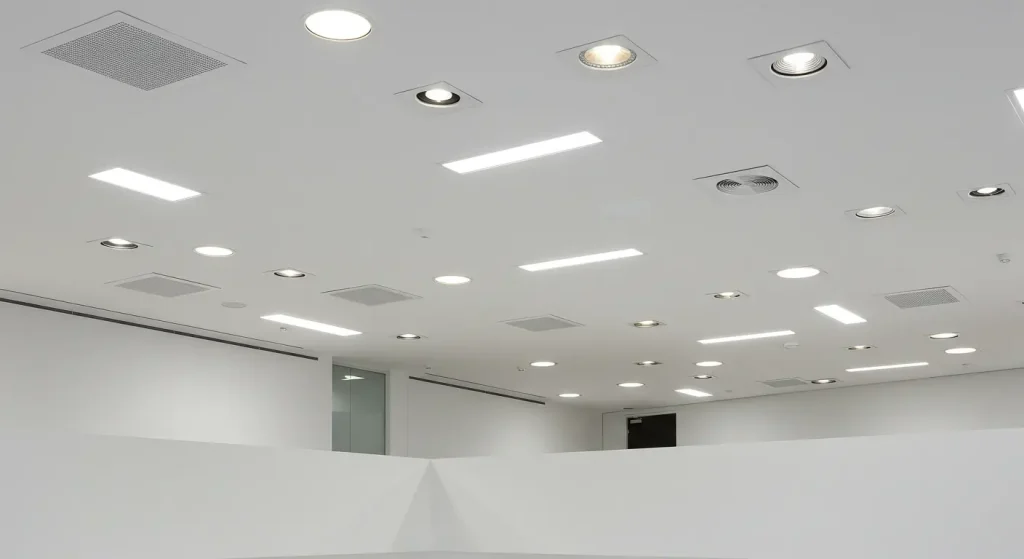
Yet, this versatility presents a formidable challenge. The term “recessed lighting” encompasses a vast and complex universe of housings, functions, trims, and technologies. To the uninitiated, it’s a sea of confusing options. For the professional architect, interior designer, or electrical contractor, making the right choice is a high-stakes decision that directly impacts a project’s aesthetic success, energy performance, and the visual comfort of its occupants. A poor choice can litter a ceiling with sources of glare or render colors lifelessly.
This guide is designed to be your systematic protocol for navigating this complexity. We will move beyond the basics to provide a professional framework for how to choose commercial downlights, breaking down the decision-making process into a logical sequence—from the foundational structural choices to the final aesthetic touches. This is your masterclass in specifying recessed lighting with precision, confidence, and a clear understanding of the technology that drives modern illumination.
Part 1: The Frame of The House Cannot be Changed
Before you consider aesthetics or light quality, your first decision is dictated by the ceiling itself. The housing is the fixture’s chassis, and it is the first component to be installed.
New Construction vs. Remodel Housing
- New Construction Housing: This is a robust frame that is installed before the drywall goes up. It is mounted directly to the ceiling joists, providing a secure and stable foundation for the fixture. For any new build or major gut renovation, this is the superior choice, offering greater stability and a wider range of compatible fixtures.
- Remodel Housing: Designed for retrofit projects, this housing is installed after the drywall is in place. It is pushed up through a hole cut in the ceiling and is held in place by clips that clamp onto the drywall. While convenient for upgrades, it is generally less secure than new construction housing.
The Critical Safety Rating: IC vs. Non-IC
This is a non-negotiable safety consideration dictated by building codes.
| Rating | Stands For | Description & Use Case | Key Consideration |
|---|---|---|---|
| IC-Rated | Insulation Contact | The housing is engineered to be in direct contact with ceiling insulation without posing a fire hazard. It is a sealed unit that prevents heat from escaping into the insulation. | The required choice for most modern, insulated ceilings. Using a Non-IC fixture where an IC-rated one is needed is a serious code violation. |
| Non-IC Rated | Non-Insulation Contact | The housing must have at least 3 inches of clearance from all sides of any ceiling insulation. It relies on air circulation to dissipate heat. | Typically used only in ceilings with no insulation (e.g., between two conditioned floors) or in older construction. Much less common in new builds. |
| Airtight (AT) Housing | Airtight | Often combined with an IC rating (IC-AT), this housing is sealed to prevent airflow between the conditioned room and the unconditioned ceiling plenum. | Crucial for energy efficiency. It prevents heating and cooling loss, helping to meet stringent energy codes like the IECC (International Energy Conservation Code). |
Part 2: Choosing the Right Fixture Function
Once the housing is determined, you must choose the fixture’s primary job. Recessed lights are specialized tools, and using the wrong one is like using a screwdriver to hammer a nail. There are three primary functions.
- The Downlight (For General & Ambient Lighting): This is the most common type. A standard downlight casts a cone of light directly downwards, providing the main layer of ambient illumination for a space. It’s used to create a comfortable, functional level of light throughout offices, corridors, and general circulation areas.
- The Adjustable / Gimbal (For Accent & Task Lighting): This fixture adds flexibility. The internal lamp assembly can be tilted and sometimes rotated within the housing, allowing you to direct a focused beam of light onto a specific object. This is essential for:
- Accent Lighting: Highlighting artwork, architectural details, or retail displays.
- Task Lighting: Aiming light onto a specific work surface or reception desk from a distance.
- Sloped Ceilings: Compensating for the ceiling angle to cast light straight down.
- The Wall Washer (For Vertical Illumination): This is a highly specialized fixture. A true wall washer features a unique reflector, a half-scoop, or an asymmetric lens designed to throw light sideways and create a smooth, even wash of illumination on a vertical surface. This technique is used to make spaces feel larger and brighter, eliminate the “cave effect,” and create a feature wall. Do not confuse this with simply aiming an adjustable fixture at a wall, which creates a “hot spot” rather than an even wash.
Part 3: You Need to Understand These Professional Terms
This is where professional-grade fixtures separate themselves from consumer-grade products. Mastering these metrics is key to specifying architectural downlights that perform flawlessly.
- Aperture Size: This is the diameter of the opening. The trend in modern design is towards smaller, less conspicuous apertures (e.g., 2, 3, or 4 inches) that provide a “quiet ceiling” look, yet still deliver powerful illumination thanks to advanced LED technology.
- Beam Angle (or Beam Spread): Measured in degrees, this determines the width of the light cone.
- Narrow Spot (10°- 25°): Creates a tight, dramatic beam. Perfect for accenting small objects or for use in very high ceilings.
- Medium Flood (30°- 45°): A versatile, all-purpose beam for general lighting and washing medium-sized areas.
- Wide Flood (50°+): Creates a broad, soft pool of light. Best for general ambient lighting in spaces with lower ceilings.
- Light Quality Metrics: The Holy Trinity
- Color Rendering Index (CRI): The industry standard for color accuracy. For commercial spaces, CRI 80+ is the baseline. For any color-critical application—retail, healthcare, hospitality, art galleries—CRI 90+ is the mandatory professional standard.
- Color Temperature (CCT): The color appearance of the light. Common choices for commercial interiors are 3000K (warm neutral), 3500K (neutral), and 4000K (cool neutral).
- Glare Control (UGR): A visually comfortable space is a low-glare space. Glare is controlled by the fixture’s design. Look for features like deeply regressed light sources, “snoot” accessories, or high-quality optics. For offices, the target is a UGR (Unified Glare Rating) of less than 19.
Part 4: A Professional’s Guide to Trim Selection
The trim is the only part of the fixture you see. It shapes the light and defines the final aesthetic.
| Trim Type | Beschrijving | Primary Function & Application |
|---|---|---|
| Baffle Trim | Features a ribbed, grooved interior (typically black or white). | Glare Control. The grooves absorb stray light, reducing glare and creating a softer, more comfortable light source. The go-to choice for many office and residential applications. |
| Reflector Trim | Has a smooth, mirror-like interior surface. | Maximum Light Output. It reflects the maximum number of lumens out of the fixture. Best for spaces where high light levels are the priority, like utility areas or high-ceiling atriums. |
| Wall Washer Trim | Includes a half-shield or “scoop” on one side. | Vertical Illumination. The scoop shields the light from the viewer’s eye and directs it sideways onto the wall for an even wash effect. |
| Adjustable / Gimbal Trim | The lamp is mounted in a movable “eyeball” housing. | Accent & Task Lighting. Allows for flexible aiming of the light beam. This is the trim used for adjustable fixtures. |
| Lensed / Shower Trim | Covered by a flat piece of glass or plastic (often frosted). | Wet Location Protection. Required for showers, bathrooms, and outdoor soffits. The lens protects the internal components from moisture. |
The Architectural Choice: Flanged vs. Trimless
This is the final aesthetic decision.
- Flanged Trim: The trim has a visible lip that overlaps the drywall. This is the standard, most common, and easiest-to-install option.
- Trimless (or Flangeless) Trim: This trim is designed to be installed flush with the ceiling and then “plastered in” with drywall compound. The result is a seamless, minimalist opening with no visible flange. This is the hallmark of high-end architectural lighting but requires a highly skilled installer to achieve a perfect finish.
Part 5: Choosing Your Manufacturing Partner
- High Ceiling Applications: For atriums, lobbies, or convention centers with ceilings over 20 feet, you must specify fixtures with a high lumen package (e.g., 3000+ lumens) and a narrow beam spread (e.g., 15-25 degrees) to ensure a strong punch of light reaches the floor.
- The Manufacturer Matters: A recessed fixture is a complete system of housing, driver, LED module, optic, and trim. Choosing a reputable manufacturer is crucial for ensuring all these parts work together harmoniously. Specialist manufacturers like XHLUX offer comprehensive portfolios where you can get a wide variety of fixture types and trims that all share the same quality of light and color consistency, which is vital for large projects. Always verify that a manufacturer’s products are UL or ETL listed for safety and, for maximum ROI, DLC listed for performance and rebate eligibility.
Conclusion
The process of how to choose commercial recessed lighting fixtures is not a single decision but a logical cascade of choices. By working through this professional protocol—from the foundational housing and function to the nuanced details of performance metrics and trim aesthetics—you transform a potentially overwhelming task into a methodical process.
This structured approach ensures that you are not just selecting a light fixture, but are consciously designing an environment. You are specifying a tool that will deliver the right amount of light, with the right quality, in the right place, all while disappearing into the architecture to create the clean, comfortable, and sophisticated spaces that define modern commercial design.