 XHLUX
XHLUX
![How to Calculate Downlight Spacing in 3 Easy Steps [2025]](https://xhlux.com/wp-content/uploads/2024/05/news.webp)
Inhoudsopgave
- 🔍 Why Downlight Spacing Matters
- 🧠 Quick Answer: Downlight Spacing Formula
- 📏 LED Downlight Spacing Calculator (Chart)
- 🛋 Downlight Spacing by Room Type
- 🔄 How Beam Angle Affects Spacing
- 🧮 Example: 4m x 4m Room Layout
- 📌 Bonus Tips: Advanced Considerations
- 📈 Industry Insight: Why It Pays to Plan Properly
- 🚫 Common Mistakes in Downlight Spacing
- 🧾 Final Checklist: How to Space Downlights Correctly
- 💬 Final Thoughts
- 📎 Suggested Internal Links
- 🔖 Suggested External Sources
Whether you’re lighting a cozy living room or a high-traffic commercial space, getting your downlight spacing right is crucial. Poorly spaced downlights can lead to dark patches, overlit areas, or uneven lighting that throws off your entire interior design.
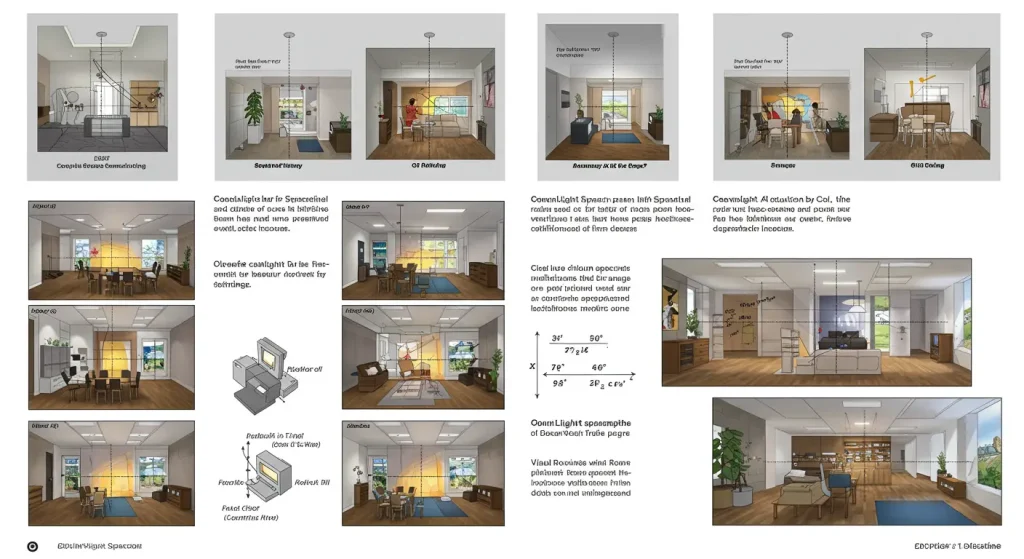
So how far apart should downlights be? And how do room size, ceiling height, and beam angle affect your layout?Let’s break it down.
🔍 Why Downlight Spacing Matters
Before we get into the math, let’s answer a fundamental question: Why is downlight spacing important?
- Too far apart → Uneven illumination with shadows.
- Too close together → Wasted energy, over-bright spaces, glare.
- Poor placement → Ineffective lighting for tasks or ambiance.
An effective layout considers lumens, beam spread, ceiling height, and application purpose. That’s why following a rule of thumb—or better, a calculated approach—is essential.
🧠 Quick Answer: Downlight Spacing Formula
Here’s a widely accepted downlight spacing rule of thumb:
Spacing (in meters) = Ceiling Height (in meters) ÷ 2
So, if you have a 2.4m ceiling:
Spacing = 2.4 ÷ 2 = 1.2 metersThis gives you even coverage without overlapping beams.
🛠 Pro Tip: Always position your first row of downlights about 0.5 to 0.8m from the wall to avoid harsh wall shadows or inefficient wall wash.
📏 LED Downlight Spacing Calculator (Chart)
| Ceiling Height | Recommended Spacing | Beam Angle |
|---|---|---|
| 2.4 meters | 1.2 meters | 60° – 90° |
| 2.7 meters | 1.35 meters | 60° – 90° |
| 3.0 meters | 1.5 meters | 36° – 60° |
| 3.3+ meters | 1.65+ meters | 24° – 36° (narrow) |
🔍 Note: Use narrow beam angles for higher ceilings or task lighting. Wider beams work better for ambient lighting in residential spaces.
🛋 Downlight Spacing by Room Type
✔️ Living Room Downlight Layout
- Goal: Ambient lighting with no glare on screens
Recommended:
- Use dimmable downlights
- Keep 1.2–1.5m spacing with a 60°–90° beam angle
- Avoid direct lighting above TV screens
✔️ Kitchen Downlight Spacing
- Goal: Functional task lighting over worktops
Recommended:
- Place lights directly above counters, especially prep zones
- Gebruik 60° beam angles for concentrated light
- Spacing: 1.0m–1.2m between fixtures
🔧 Add under-cabinet LED strips for layered task lighting.
✔️ Bathroom Downlight Spacing Guide
- Goal: Bright, clear lighting with safe IP-rated fittings
Recommended:
- Use IP65 or higher for shower zones
- 1.0–1.2m spacing for even wash
- Use warmer 3000K color temperature for comfort
✔️ Hallways or Narrow Spaces
- Gebruik narrow beam angles (30°–36°)
- Downlights spaced every 1.2m
- Consider motion sensors for energy efficiency
🔄 How Beam Angle Affects Spacing
Beam angle plays a key role in light spread.
| Beam Angle | Spread Width (on 2.4m ceiling) | Best Use Case |
|---|---|---|
| 24° | ~0.9m | Accent lighting, artwork |
| 36° | ~1.2m | Task lighting, kitchen zones |
| 60° | ~1.8m | General ambient lighting |
| 90° | ~2.4m | Wide room coverage, hallways |
💡 Pro Insight: Wider beam = fewer lights, but may cause glare. Narrow beam = focused, but needs more fixtures.
🧮 Example: 4m x 4m Room Layout
Let’s say your living room is 4m x 4m with a 2.4m ceiling.
- Spacing = 2.4 ÷ 2 = 1.2m
- Leave 0.6m from walls
- Arrange in 3×3 grid = 9 downlights
🗺 Layout Plan:
[ O ]——1.2m——[ O ]——1.2m——[ O ]
 |                         |
1.2m                     1.2m
 |                         |
[ O ]——1.2m——[ O ]——1.2m——[ O ]
 |                         |
[ O ]——1.2m——[ O ]——1.2m——[ O ]
📌 Bonus Tips: Advanced Considerations
✅ 1. Use a Lighting Design Software
If you’re working on commercial projects, try tools like:
- Dialux
- Relux
- AGi32
These tools allow accurate lux level calculations and 3D modeling.
✅ 2. Downlight Spacing for Sloped Ceilings
Sloped ceilings distort beam angles. Use adjustable gimbal downlights to correct direction. Place closer together—reduce spacing by 15–20% to prevent dark patches.
✅ 3. Combine with Other Lighting
Downlights are best when layered with:
- Pendant lighting
- Wall sconces
- Cove LED strips
This gives flexibility and minimizes harsh shadows.
📈 Industry Insight: Why It Pays to Plan Properly
According to a 2025 study by Research and Markets, the global LED downlight market is projected to grow at 9.4% CAGR from 2024–2029. This rise is driven by energy efficiency demands and smart lighting integration in both residential and commercial builds.
That means more lighting designers and homeowners are becoming aware of proper lighting layout. A well-lit space isn’t just about visibility—it influences mood, productivity, and property value.
🚫 Common Mistakes in Downlight Spacing
| Mistake | Fix |
|---|---|
| Lights too close to walls | Leave 0.5–0.8m gap |
| Random, unplanned layout | Use a calculated grid or plan |
| Ignoring furniture layout | Avoid placing downlights above reflective areas |
| Mixing too many beam angles | Use consistent beam angle per zone |
🧾 Final Checklist: How to Space Downlights Correctly
✅ Know your ceiling height
✅ Choose your straalhoek
✅ Apply the height ÷ 2 rule
✅ Leave 0.5–0.8m from walls
✅ Adjust for room purpose and layout
✅ Use IP-rated lights in wet areas
✅ Cross-check with spacing calculators or design tools
💬 Final Thoughts
Understanding how to calculate downlight spacing isn’t just a design preference—it’s essential for effective, efficient, and visually appealing lighting. By applying the right formulas, avoiding common pitfalls, and considering real-world factors like furniture and room function, you’ll avoid expensive rewiring and enjoy optimal illumination from day one.
Whether you’re a DIY renovator or a professional lighting designer, let this guide be your go-to blueprint.